
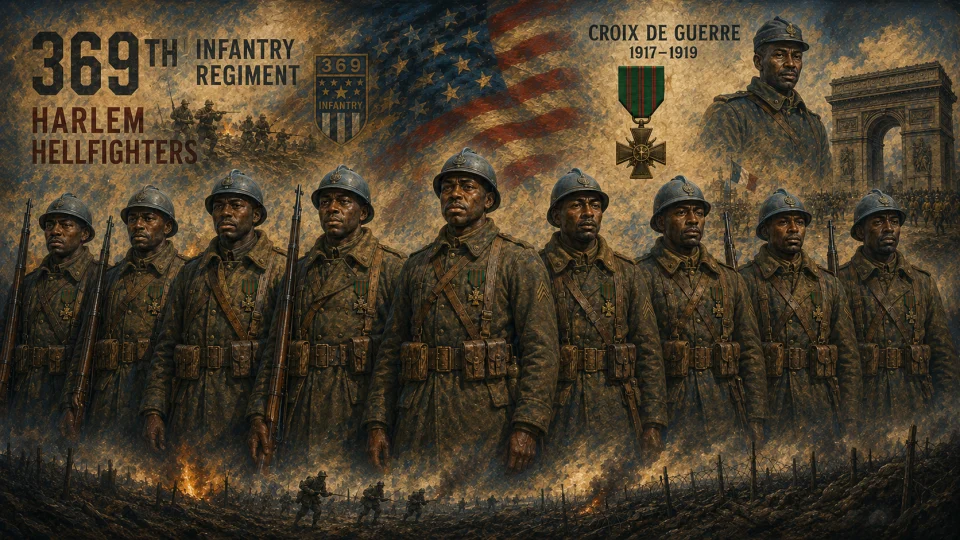
The story of the 369th Infantry Regiment stands as one of the most remarkable chapters in First World War history—and as a powerful lens on the contradictions within American democracy itself. Composed primarily of men from Harlem who were denied basic rights at home, the regiment journeyed across the Atlantic to fight for a nation that would not fight beside them. Serving under French command, armed with French weapons, and clad in French helmets, they endured more continuous combat than any other American regiment, never yielded an inch of ground, never lost a single man to capture, and returned as some of the most highly decorated soldiers of the war. Their enemies feared them. Their allies celebrated them. Yet their own country delayed its highest honor for nearly a century.
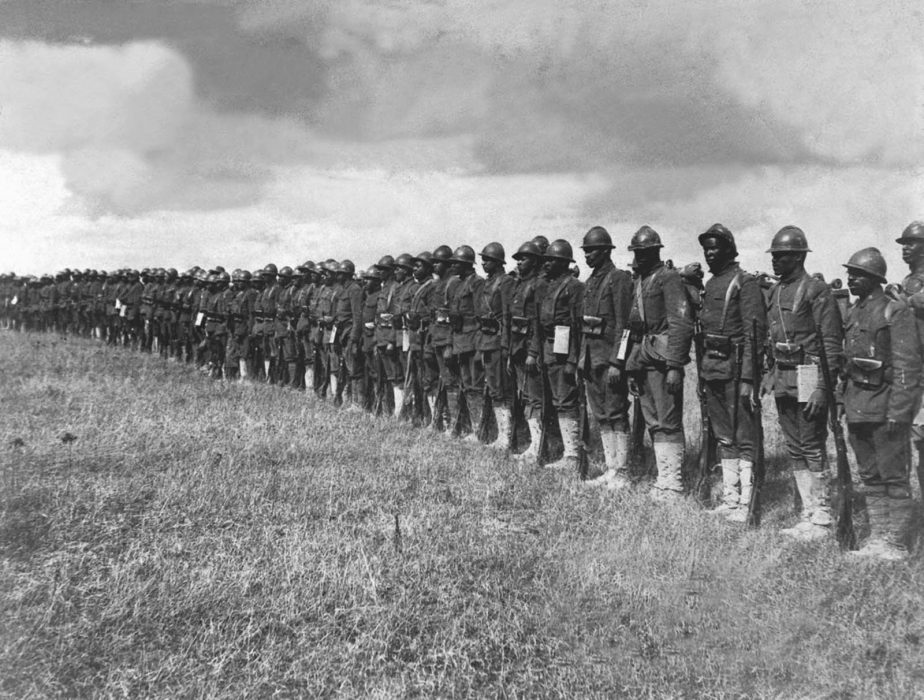
The Birth of the 369th Infantry
The origins of the 369th Infantry Regiment lie in the determined efforts of African Americans in New York to gain inclusion in the state’s National Guard. After persistent lobbying by civic leaders, Governor Charles Whitman authorized the creation of an all-Black National Guard unit in New York on June 2, 1913. The regiment was officially organized as the 15th New York Infantry Regiment of the New York Army National Guard on June 29, 1916—the first African American unit of its kind in the state’s history.
Most of the regiment’s first enlistees hailed from Harlem, which at the time counted about 50,000 of Manhattan’s 60,000 African American residents, though recruits were drawn from across New York State. Lacking an armory of their own, the men trained at Lafayette Hall on Seventh Avenue and 132nd Street. Colonel William Hayward, a Euro-American lawyer and political figure, was appointed to lead the regiment. Remarkably for his time, Hayward not only supported the recruitment of African-American officers at the company level but also leveraged his political influence to advance the unit’s interests. Among the notable recruits was James Reese Europe, the renowned African American bandleader and conductor, who was commissioned as a lieutenant and tasked with assembling what Hayward ambitiously called “the best damned band in the U.S. Army.”
When the United States entered the war against Germany in April 1917, the regiment was called into federal service. Men joined for varied reasons—civic duty, economic need, and the democratic promises articulated by President Wilson—but for many, enlisting was a bold and purposeful affirmation of Black citizenship. With the regiment’s ranks filled mostly by volunteers, there emerged a strong, shared resolve to demonstrate that African American soldiers matched any others in courage and ability.
Training under the Shadow of Jim Crow
From the outset, the regiment’s journey was hindered by the entrenched racism woven into American society. When the unit was dispatched to Camp Wadsworth in Spartanburg, South Carolina, in October 1917 for training, the local mayor made it clear that African American soldiers were unwelcome in uniform. Tensions escalated when Noble Sissle, the regiment’s drum major and acclaimed musician, was assaulted by a hotel owner for not removing his cap. The incident nearly sparked a major confrontation, prompting the commander to withdraw the unit to New York to safeguard his men. The events in Spartanburg were not an anomaly, but rather a stark illustration of the Jim Crow system the soldiers would face throughout their service.
Even before departing for France, the regiment faced exclusion: it was barred from the farewell parade of New York’s National Guard—dubbed the “Rainbow Division” to symbolize national unity. Colonel Hayward was told plainly, “Black is not a color in the rainbow.” As a result, the regiment shipped out in silence, without ceremony, its soldiers denied the public recognition granted to every other New York unit heading to war.
Arrival in France: Labour Before Combat
The regiment landed in Brest, France, on December 27, 1917, making them one of the first American units to set foot in Europe. On March 1, 1918, the U.S. Army officially redesignated the regiment as the 369th Infantry, assigning it to the segregated 93rd Infantry Division. Yet this new designation changed nothing about their status. Like nearly all African American units, the 369th was relegated to non-combat duties—unloading ships, constructing roads and docks, and digging latrines—while Euro-American troops readied themselves for battle at the front.
Roughly 350,000 African Americans served in the U.S. military during the First World War, yet 89 percent found themselves confined to labor and support roles. General John J. “Black Jack” Pershing, commander of the American Expeditionary Forces, openly opposed deploying African-American troops in combat, echoing the widespread prejudice within the military hierarchy that deemed them unfit for the battlefield.
In stark contrast, the French Army, depleted by three years of devastating losses on the Western Front, urgently needed combat troops. Having long integrated soldiers from their African colonies into their ranks, the French command adopted a more pragmatic—and, in practice, more egalitarian—approach. On April 8, 1918, General Pershing officially attached the 369th Infantry to the French 16th Division, and later the 161st Division—not out of respect, but because Euro-American commanders categorically refused to serve beside them.
Outfitted with French helmets and Lebel rifles, the regiment received just enough French instruction to understand orders on the battlefield. They were assigned a sector in the Champagne region near the Argonne Forest. In a striking twist of irony, the men of the 369th found more acceptance, respect, and opportunity in the French Army than they ever did in their own.
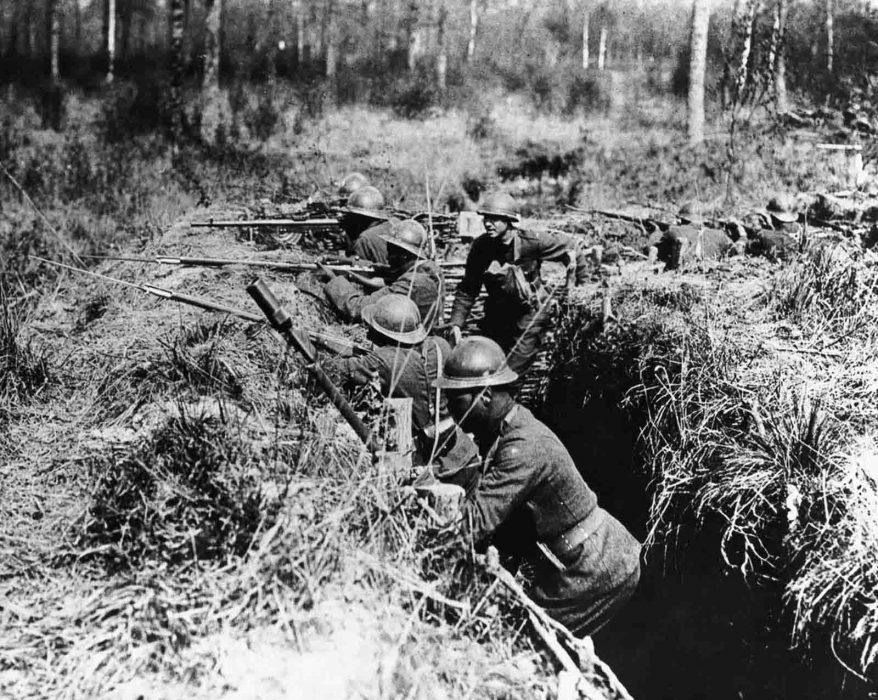
Baptism of Fire: May 1918
In the spring of 1918, the regiment entered the frontline trenches, beginning their service in a comparatively quiet sector east of Butte Mesnil and south of Séchault in the Champagne region. Their baptism of fire arrived swiftly. The men launched bold patrols and raids against German positions, and their determination in these initial clashes quickly earned them the respect of French commanders—and the wary attention of the Germans.
Serving under French General Henri Gouraud’s Fourth Army, the 369th fought in sectors scarred by some of the war’s fiercest and most devastating battles. The men endured relentless machine-gun fire, brutal artillery barrages, and the unending misery of the trenches—flooded, crawling with rats, teeming with lice—and the constant threat of poison gas. Corporal Horace Pippin, who would later rise to prominence as a self-taught American painter, kept a journal during his time with the regiment, offering a rare firsthand African American perspective on the ordeal.
The Night Henry Johnson Became “Black Death”
In the predawn hours of May 15, 1918—though some sources cite the night of May 14—two sentries from the 369th stood guard at a lonely outpost on the edge of the Argonne Forest: Private William Henry Johnson and Private Needham Roberts. Their post, overlooking a bridge on the Aisne River, was manned from midnight to 4am.
Around 2am, Johnson heard the distinct snip of wire cutters at the perimeter. He hurled a grenade toward the source and ordered Roberts to run for help from the French troops behind them. Roberts began to retreat but turned back when the Germans opened fire, lobbing grenades of their own. Shrapnel from a German grenade struck and seriously wounded Roberts. The German raiding party—estimated at between twelve and thirty-six men, with most accounts agreeing on about twenty-four—advanced from several directions. Johnson threw grenades until he had none left, then fired his rifle until it was empty. When his ammunition was gone, he used the rifle as a club until the stock shattered. As the Germans began dragging Roberts away, Johnson grabbed the only weapon left to him: a bolo knife.
What unfolded next was among the most extraordinary feats of individual combat in the entire war. Johnson surged into the German ranks, slashing and stabbing even as he was repeatedly shot. He drove his knife through one soldier’s head, cut down others, and forced the raiding party to retreat in a whirlwind of close-quarters violence. By dawn, the battlefield revealed that Johnson had killed at least four Germans and wounded between ten and twenty more—despite sustaining twenty-one wounds himself.
Roberts, meanwhile, had thrown grenades and fought on from where he lay wounded, until the attack left him incapacitated. His determined actions and steadfastness under fire were acts of courage in their own right, and both men were recognized for their heroism.
The French high command acted swiftly. In their citation for Johnson, dated May 16, they praised him for providing “a magnificent example of courage and energy.” Johnson and Roberts were awarded the Croix de Guerre, France’s highest military honor—becoming the first Americans of any background to receive it during the war. Johnson’s decoration included the Gold Palm, an additional distinction reserved for extraordinary valor.
From that night forward, Henry Johnson earned the legendary moniker “Black Death.”
When asked about his actions, Johnson replied simply, “There wasn’t anything so fine about it. Just fought for my life. A rabbit would have done that.”
Repelling the German Spring Offensive
The months after Johnson’s heroic stand marked one of the war’s most pivotal periods. In March 1918, Germany unleashed its massive Spring Offensive (Operation Michael), hoping to shatter the Allied lines before American reinforcements could shift the balance. Assigned to the French 4th Army, the 369th found itself at the heart of the struggle as the French fought desperately to halt and then reverse German gains in the Champagne-Marne sector.
The regiment held the forward trenches against relentless German assaults, refusing to give ground. When the Allies seized the initiative, the 369th joined the counteroffensive that, throughout the summer and autumn of 1918, steadily drove the Germans back toward their own borders.
The Meuse-Argonne and the Capture of Séchault
The defining engagement of the 369th’s war came in September 1918, amid the sweeping Allied autumn offensive that would bring the conflict to its close. On September 25, the French 4th Army launched an assault in concert with the American push in the Meuse-Argonne. Attached to the French 161st Division, the 369th faced some of the fiercest fighting of the campaign.
Their crowning achievement during this phase was the capture of Séchault—a fortified village whose rail junction made it a strategic prize. The regiment seized Séchault despite fierce German resistance, though the victory came at a heavy price: the Meuse-Argonne campaign alone cost the 369th nearly one-third of its strength. Corporal Horace Pippin was among the wounded, struck in the right arm by a sniper—a wound that would permanently impair his use of that arm.
For capturing Séchault and their distinguished conduct throughout the Meuse-Argonne Offensive, the 369th received the French Croix de Guerre with Silver Star—a unit citation awarded to the entire regiment. Over the course of the war, they were cited for bravery eleven times.
First to the Rhine
When the Armistice took effect on November 11, 1918, the 369th stood with the French 161st Division in the Vosges Mountains, having weathered sporadic fighting until the very end. In the weeks that followed, as Allied forces occupied the German Rhineland, the 369th was reportedly the first Allied unit to reach the Rhine River—the coveted objective of generals like Pershing, the young Patton, and Douglas MacArthur. That this distinction belonged to an African American regiment the U.S. command had once refused to send into combat was not lost on those who witnessed it.
By war’s end, the regiment’s record spoke for itself. The 369th spent 191 continuous days in the front-line trenches—longer than any other American regiment. They suffered 1,500 casualties, more than any other American unit. They never retreated. They never lost an inch of ground. Not a single man was taken prisoner. Over 170 members received the Croix de Guerre for personal valor; the entire regiment earned a unit citation.
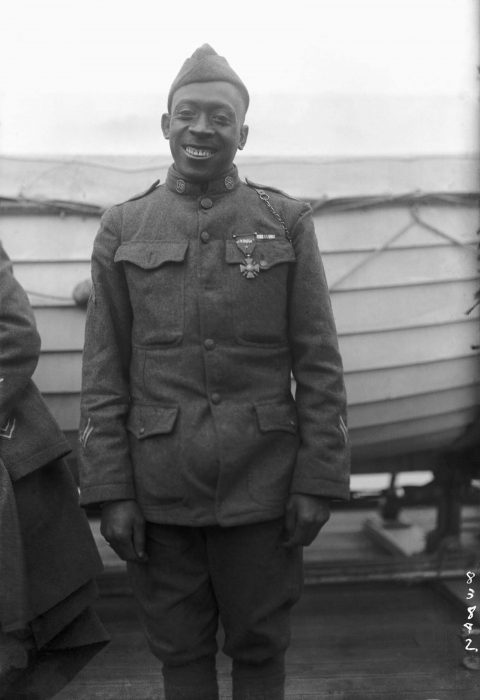
William Henry Johnson
William Henry Johnson was born around July 15, 1892, in Winston-Salem, North Carolina. As a teenager, he moved to Albany, New York, working several jobs before becoming a Red Cap porter at the city’s Union Station—one of the few steady roles open to African-American men at the time. Standing five feet four and weighing 130 pounds, Johnson was twenty-five when he enlisted on June 5, 1917. Like many African Americans, he volunteered for a country that denied him basic rights.
After training and difficult assignments, Johnson reached the front in spring 1918. His legendary stand on May 15 made him a national figure almost overnight. Journalist Irvin S. Cobb’s account spread Johnson’s fame, and his heroism appeared on Army posters and war bonds. Theodore Roosevelt called him “one of the five bravest Americans to serve in World War I.” he ended the war as a sergeant and, in February 1919, led the 369th’s triumphant parade up Fifth Avenue and through Harlem—the recognition they were denied before shipping out.
But homecoming brought hardship. Johnson was briefly celebrated, but after speaking honestly about the racism he faced in the military, he was dropped from public speaking engagements and left without support. His discharge papers omitted his wounds, leaving him ineligible for disability benefits. Unable to work due to his injuries, he struggled financially and personally, dying penniless and alone at thirty-two in 1929. For years, it was believed Johnson was buried in an unmarked grave. In 2001, historians discovered he had, in fact, been interred with full military honors at Arlington National Cemetery.
Recognition came late. Johnson received the Purple Heart in 1996, the Distinguished Service Cross in 2002, and, finally, the Medal of Honor in 2015—nearly a century after his heroism.In June 2023, Louisiana’s Fort Polk was renamed Fort Johnson in his honor, replacing the Confederate namesake.
Needham Roberts: Johnson’s Companion in Arms
No account of Johnson’s heroism is complete without Private Needham Roberts. Born in Trenton, New Jersey, in 1901, Roberts was just seventeen when he enlisted—one of the regiment’s youngest soldiers.
On May 15, 1918, Roberts fought bravely with grenades until wounded. Even then, he passed grenades to Johnson and was nearly taken prisoner before Johnson rescued him. Roberts and Johnson were the first Americans, and first two privates of any nation, to receive the Croix de Guerre. Roberts died in 1949, and received the Purple Heart posthumously in 1996—nearly fifty years after his death.
Other Notable Members of the 369th
The 369th produced several remarkable figures whose legacies stand alongside Henry Johnson’s.
James Reese Europe (1880–1919) was a pioneering African American musician and conductor before the war. As a lieutenant in the 369th, he commanded the machine gun company and led the celebrated “Hellfighters Band.” Touring over two thousand miles across France, the band performed for troops and civilians, helping introduce jazz to Europe and thrilling audiences with their innovative sound. Europe survived a gas attack and continued to lead the band until his tragic death in 1919, when he was fatally stabbed backstage in Boston just weeks after returning home.
Horace Pippin (1888–1946), a corporal in the 369th, kept a detailed journal of his wartime experience. Wounded by a sniper in September 1918, he lost the use of his right arm. Undeterred, Pippin taught himself to paint by guiding his right hand with his left, creating powerful works drawn from his experience in the trenches. He became one of the first Black American painters to receive major critical acclaim, and his war paintings are enduring testaments to the African American experience in World War I.
Noble Sissle (1889–1975) was the regiment’s drum major and sergeant, working closely with James Reese Europe to organize the Hellfighters Band. He was the musician assaulted in Spartanburg—a moment that nearly sparked a conflict and led to the regiment’s redeployment. After the war, Sissle became a renowned bandleader and co-wrote the groundbreaking Broadway musical Shuffle Along (1921) with Eubie Blake.
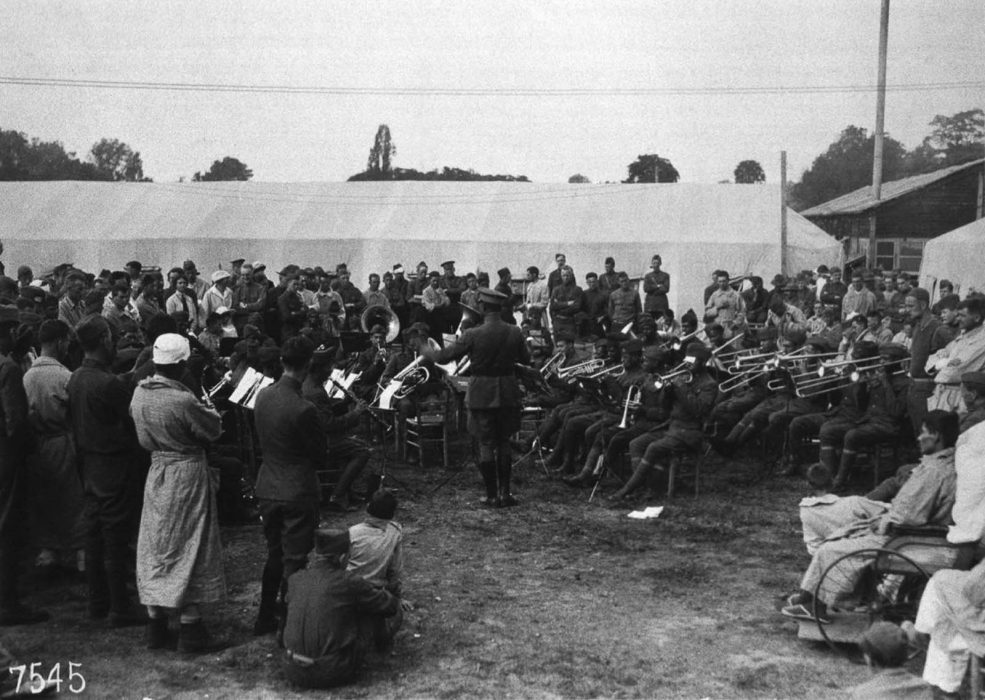
The Hellfighters Band and the Gift of Jazz
Among the 369th’s most culturally significant contributions in France was their role in introducing jazz to European audiences. Under James Reese Europe’s leadership, the Hellfighters Band delivered performances unlike anything Europe had experienced—syncopated, improvisational, and deeply rooted in African American musical traditions absent from European concert halls or military bands.
The band performed for an astonishing range of audiences: wounded soldiers in hospitals, dignitaries at formal dinners, and massive civilian crowds in public squares and grand opera houses. Reports suggest they played for as many as fifty thousand people at a time. When the Hellfighters unveiled their jazz-infused arrangement of “La Marseillaise,” French listeners were at first bemused, then utterly enthralled. Their recordings for the Pathé brothers marked some of the earliest jazz ever captured outside the United States.
James Reese Europe captured the meaning of their achievement: “I have come from France more firmly convinced than ever that Negroes should write Negro music. We have our own racial feeling… We won France by playing music which was ours and not a pale imitation of others, and if we are to develop in America we must develop along our own lines.”
The Names They Were Called
The regiment carried several names during and after the war, each reflecting a different relationship and a different kind of recognition.
Among themselves, the men of the 369th called their regiment the “Black Rattlers” or “Harlem’s Rattlers,” after the coiled rattlesnake that appeared on their unit crest—a symbol drawn from the revolutionary-era Gadsden flag, signifying vigilance and resolve.
French soldiers who fought beside them, recognizing their courage and endurance, called them “Hommes de Bronze”—the Men of Bronze.
Their German adversaries, facing the 369th in relentless night raids, patrols, and open combat, dubbed them “Höllenkämpfer”—Hellfighters. One captured Prussian officer described them as “devils” who “smile while they kill and won’t be taken alive.” In 2020, the U.S. Army officially adopted “Hellfighters” as the regiment’s formal designation.
It was this final name—bestowed by their enemies, out of fear and respect—that entered history: the Harlem Hellfighters.
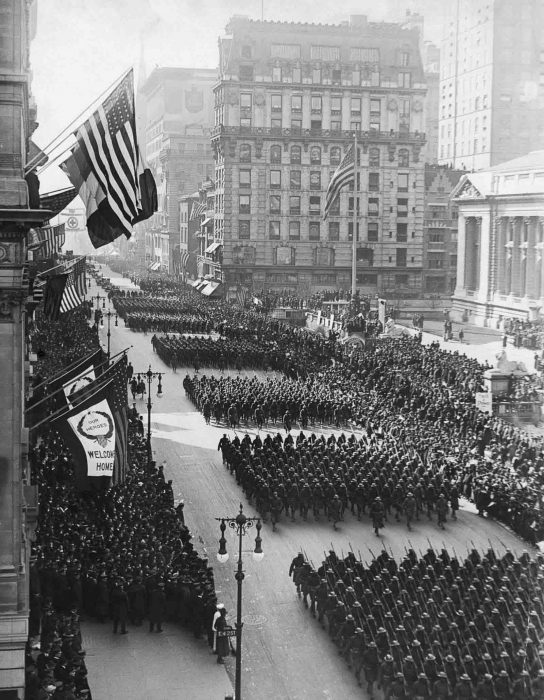
The Parade: February 1919
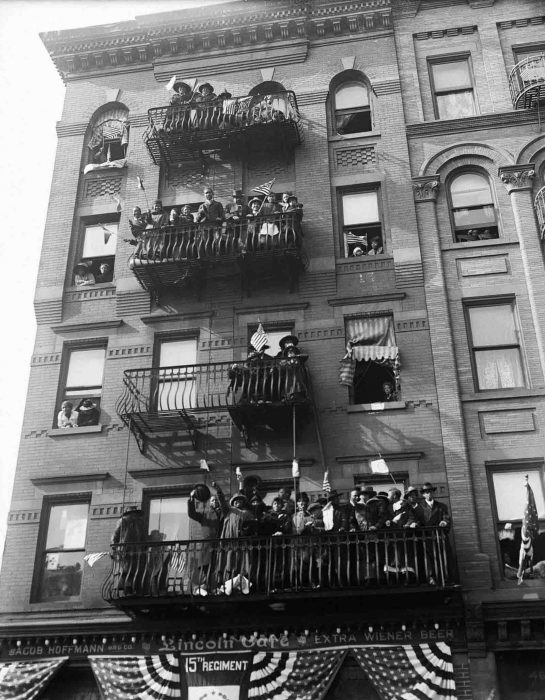
On February 17, 1919, the 369th Infantry Regiment returned home. The regiment that had been denied a farewell parade—told that Black was not a color in the rainbow—now marched triumphantly up Fifth Avenue from Washington Square Park to their Harlem armory. An estimated million spectators lined the streets. Sergeant Henry Johnson led the procession, the Hellfighters Band played, and Black schoolchildren throughout Harlem were let out of school to witness the historic moment.
Colonel Hayward worked tirelessly to secure this day, calling in favors and using every political connection to guarantee the regiment received the recognition they were owed. Their inclusion on the city’s permanent list of veteran units was both a gesture of restitution for past wrongs and a modest acknowledgment of their rightful place in history.
Yet the America that welcomed them home remained fundamentally unchanged. Within months, the Red Summer of 1919 erupted—a season of anti-Black riots and violence across the nation. Honors, medals, and parades could not dismantle the architecture of Jim Crow. Henry Johnson himself would be silenced, impoverished, and gone within a decade.
Conclusion: The Weight of What They Proved
The 369th Infantry Regiment did not go to war to make a statement—they went to fight. But in doing so, with a ferocity and endurance their own country had claimed they lacked, they shattered every notion of American racial hierarchy.
The 369th spent 191 days in continuous combat—more than any other American regiment—and suffered 1,500 casualties, also the most of any unit. They never lost a man to capture, nor a single inch of ground. Their valor was recognized with more than 170 individual French decorations, a regimental Croix de Guerre with Silver Star, eleven unit citations for bravery, and—almost a century later—two Medals of Honor. In 2021, Congress awarded the regiment the Congressional Gold Medal, a final tribute to their legacy.
Henry Johnson—William Henry Johnson—the man who fought off two dozen Germans with his bare hands and a bolo knife in the Argonne Forest at two in the morning, earning the title “Black Death,” was awarded the Medal of Honor, eighty-seven years after his death. It was a long-overdue acknowledgment of what America owed him.
References:
https://rarehistoricalphotos.com/harlem-hellfighters-photographs/
https://en.wikipedia.org/wiki/369th_Infantry_Regiment_(United_States)
https://nmaahc.si.edu/explore/stories/remembering-harlem-hellfighters
https://www.warhistoryonline.com/world-war-i/harlem-hellfighters-369th-infantry-regiment.html
https://empirestateplaza.ny.gov/legacy-harlem-hellfighters
https://museum.dmna.ny.gov/unit-history/conflict/world-war-1-1914-1918/369th-infantry-regiment
https://armyhistory.org/369th-sustainment-brigade/
https://www.coffeeordie.com/harlem-hellfighters
https://www.historynewsnetwork.org/article/the-harlem-hellfighters-struggle-for-freedom-in-ww
https://history.army.mil/Research/Reference-Topics/African-Americans-in-the-US-Army/93d-Division-WWI
https://www.military.com/history/african-american-service-national-guard.html
https://en.wikipedia.org/wiki/Henry_Johnson_(World_War_I_soldier)
http://www.army.mil/medalofhonor/johnson/army
https://en.wikipedia.org/wiki/Needham_Roberts
https://www.archives.gov/research/military/ww1/meuse-argonne
https://en.wikipedia.org/wiki/James_Reese_Europewikipedia
https://nhd.org/wp-content/files/JazzHarlemHellfighters-2019.pdfnhd
https://www.searchablemuseum.com/horace-pippins-military-journal
https://emuseum.delart.org/objects/25453/the-harlem-hellfighters-capture-sechault-25-september-1918
“https://blogs.loc.gov/maps/2025/09/the-harlem-hellfighters-win-gold-the-369th-infantry-regiment-in-world-war-i/