
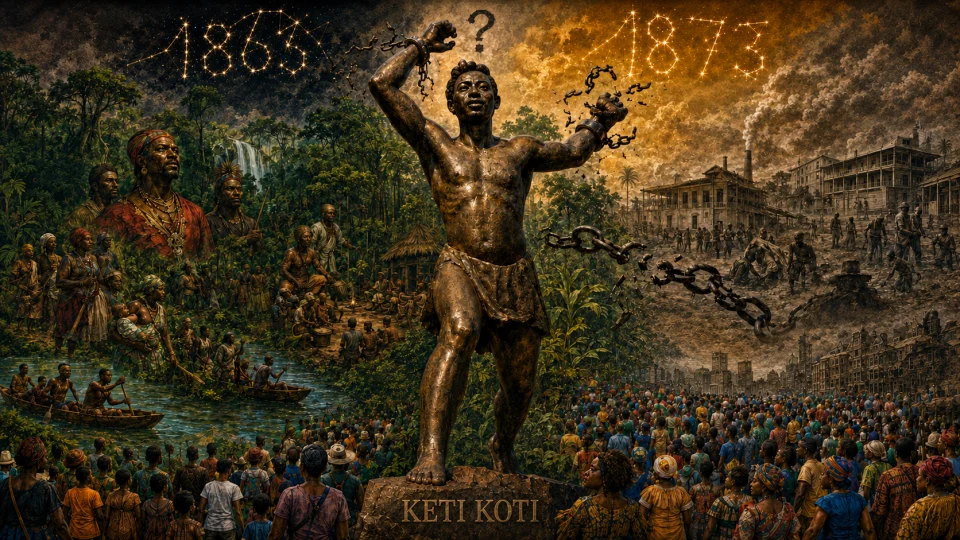
Keti Koti is an Afro-Surinamese commemoration that brings together remembrance, spiritual tradition, and cultural celebration to mark the formal end of the Maafa in Suriname and the Dutch Caribbean on 1 July 1863. It has become a key ritual in the Black Atlantic world, linking Suriname, the Caribbean territories under Dutch rule, and the Netherlands itself through a shared history of captivity, resistance, and ongoing struggle for justice.
Naming the Day and the Language of Memory
The name Keti Koti comes from Sranantongo (Sranan Tongo), the Afro-Surinamese creole language, and is commonly translated as “the chain is cut” or “the chains are broken.” Sranantongo developed among Africans brought to Suriname from Central and West Africa, in contact with Dutch, English, and Portuguese, becoming a syncretic tongue and a principal vehicle of Afro-Surinamese cultural identity. The Sranantongo term stands alongside names such as Dag der Vrijheden (Day of the Freedoms), Dia di Abolishon (Day of Abolition) and Manspasi Dei (Emancipation Day), but it is the Sranan expression that carries the weight of communal memory and resistance.
The alternate renderings of Keti Koti—“break the chains,” “the chain is cut,” “the chains are broken”—signal both a historical event and an ongoing imperative. They evoke the July 1863 emancipation decree while insisting that the work of breaking chains—of confronting inequality and anti‑Black racism—remains unfinished.
The Maafa and the Dutch Atlantic Economy
Keti Koti cannot be understood apart from the Maafa and the wider Dutch Atlantic project. Between 1596 and 1829, the Dutch transported around 600,000 African people across the Atlantic, primarily to Suriname and to Caribbean islands under Dutch control. The Dutch West India Company (WIC), founded in 1621, rapidly became a central engine of this trafficking; after the mid‑seventeenth century its second phase operated largely as a commercial structure organised around the movement and sale of African labour.
Suriname, known as Dutch Guiana, became the “crown jewel” of this system. After intense competition among European nations, the Dutch secured lasting control of Suriname’s fertile coastal lands in 1667 through the Treaty of Breda, exchanging New Amsterdam (present‑day New York) for Suriname. They established an extensive plantation complex producing sugar, coffee, cacao, and cotton, all sustained by compelled African labour under notoriously brutal conditions. By 1770, activities tied to the Maafa accounted for 5.2% of the Dutch Republic’s total GDP and over 10% of Holland’s GDP; more than 19% of goods passing through Dutch ports had been produced by African labour on Atlantic plantations. The so‑called Dutch Golden Age was thus structurally underwritten by African captivity, not at its margins but at its core.
Suriname itself developed a reputation as one of the harshest plantation societies in the Americas, with systems of punishment and exploitation that demanded constant importation of new African laborers well into the nineteenth century. People brought from Akan, Fon, Yoruba, Kongo, and many other cultural backgrounds carried their languages, spiritual traditions, and social practices into this forced environment, reshaping them in the crucible of plantation life.
Emancipation, Staatstoezicht and the Debate over Dates
The Dutch Emancipation Act (Emancipatiewet) of 1 July 1863 is conventionally marked as the turning‑point commemorated by Keti Koti, but for Afro‑Surinamese communities this date is contested. The law formally outlawed the captivity of people in Suriname and the Dutch Caribbean, yet it imposed a ten‑year transition regime known as staatstoezicht (“state supervision”). Under this system, those emerging from bondage were legally required to remain on plantations, working for minimal wages under strict oversight; anyone found outside plantation districts without official permission could be detained.
Plantation owners in Suriname were compensated at a rate of ƒ300 per liberated person (ƒ200 in the Antilles), a sum that totalled almost 9.9 million florins—roughly €250 million in contemporary values. Those who had endured captivity received no land, no capital and no formal reparative support. Full legal freedom came only on 1 July 1873, after the staatstoezicht ended, which is why many Surinamese scholars and activists—including the National Reparation Commission of Suriname—argue that 1873 should be recognized as the true date of emancipation. After this point, many Afro‑Surinamese people left plantations for Paramaribo, but remained constrained by the wider colonial legal and social order.
Maroon Resistance and Negotiated Freedom
Keti Koti also stands on the shoulders of three centuries of African resistance in Suriname, most famously embodied by Maroon communities. In the eighteenth century, nearly one in ten people held in captivity in Suriname liberated themselves by leaving plantations and forming independent communities in the interior rainforest. The Surinamese Maroons—Saamaka (Saramaka), Ndyuka (Aucan), Matawai, Aluku (Boni), Kwinti, and Paamaka—are descendants of these Africans who carved out autonomous territories, negotiated with Dutch authorities, and defended their freedom through armed struggle.
Drawing on Akan, Fon, Kongo and other African traditions, Maroon communities combined ancestral spiritual systems with deep environmental knowledge of the Surinamese forest, often acquired through interaction with Indigenous peoples. They constructed villages, developed their own governance, sustained agriculture, and maintained elaborate ceremonial lives that affirmed their status as free societies
Unable to defeat the Maroons militarily, the Dutch authorities were eventually compelled to recognize them. The Ndyuka signed a peace treaty with Dutch representatives on 10 October 1760, and the Saamaka followed with their own treaty on 19 September 1762; a later agreement was secured with the Matawai. These treaties acknowledged the political and cultural independence of Maroon communities, albeit with restrictions on settlement locations relative to plantation zones. The Saamaka treaty exists in Sranantongo as well as Dutch, one of the earliest formal documents in that language. Ndyuka people continue to mark 10 October as the Day of the Maroons, a parallel commemoration that honours an earlier, negotiated freedom.
Within this tradition, figures such as Bokilifu Boni, Alabi of the Saramaka, Baron, Joli Coeur, Kromantikodjo, Aricon, Kwami, Joosje, Wierai, Aloekoe and Broos are remembered as leaders whose armed and diplomatic efforts predate and make possible any discussion of the 1863 emancipation decree.
Spiritual Dimensions: Winti and Kabraneti
The Keti Koti observance is deeply rooted in the Afro‑Surinamese sacred system known as Winti. Winti emerged in Suriname through the syncretisation of diverse African cosmologies brought by people from West and Central Africa, and is organised around belief in a supreme creator, Anana Kedyaman Kedyanpon; a pantheon of spirits called Winti; and a strong emphasis on ancestor veneration. Practitioners safeguarded Winti through concealment, adaptation and continuity, especially within Maroon territories where Dutch surveillance was weaker.
On the evening of 30 June, communities gather for Kabraneti (“ancestor night”), a Winti ceremony dedicated to remembrance and communication with those who have passed on. Participants pray, sing, play traditional games, recount stories and dance in ceremonial attire, creating a relational bridge between present generations and those who endured the plantation era. In Suriname this pattern—Kabraneti on 30 June followed by emancipation celebration on 1 July—echoes the Dutch sequence of Remembrance Day and Liberation Day, keeping mourning and celebration in deliberate tension.
Keti Koti in Suriname: Kwakoe and Bigi Spikri
Keti Koti has been an official public holiday in Suriname since 1 July 1955, with events centered on Paramaribo and characterized by a distinctly joyous affirmation of Afro‑Surinamese culture. A key symbol is the Kwakoe statue, unveiled in June 1963 for the centenary of emancipation. Sculpted by Jozef Klas and unveiled by Prime Minister J.A. Pengel, the figure depicts a man breaking metal restraints, visually embodying the meaning of Keti Koti. The name Kwakoe, drawn from Kromanti language, means “Wednesday,” referencing the day of the week on which 1 July 1863 fell. Located at a busy intersection, the statue serves as a focal gathering point during commemorations.
Another important tradition is Bigi Spikri (“Big Mirror”), a parade celebrated in both Paramaribo and Amsterdam. Its narrative origin lies in the moment when newly liberated communities walked through city streets, seeing themselves reflected in shop windows, dressed in their finest clothing—an act of self‑regard and dignity that had been long denied. The modern parade re‑enacts this scene with participants in vibrant traditional clothing, accompanied by music and dance, reclaiming public space through beauty and collective presence.
Diaspora, Dialogue and Ritual Innovation in the Netherlands
Suriname’s independence in 1975 and later migration flows created a substantial Surinamese and Antillean presence in the Netherlands, which has been central to establishing Keti Koti as a recognized observance there. In Amsterdam, Oosterpark’s National Monument to the History of Slavery and related institutions provide a formal setting for annual remembrance, yet community initiatives have significantly reshaped the practice.
One of the most notable developments is the Keti Koti Dialogue Table (Keti Koti Dialoogtafel), a ritual meal devised by educators and activists drawing inspiration from practices such as the Jewish Seder. The Table brings together participants from different backgrounds to share food, stories, and reflections on how the history of the Maafa touches their lives. Its protocol includes a libation honoring ancestors; tasting kwasi bita (a bitter wood) to embody historical hardship; anointing wrists with coconut oil to symbolize healing; structured storytelling guided by the youngest participant; and the puncturing of 21 balloons in reference to the 21 cannon shots fired during the 1863 emancipation ceremony. By combining narrative, sensory ritual, and shared vulnerability, the Dialogue Table serves as a grassroots restorative practice, counterbalancing the potentially depoliticizing tendencies of large, festival‑style events.
Contestations: Dates, Reparations and the Festival Form
Despite increased public recognition, Keti Koti remains a site of contestation. The debate over whether 1863 or 1873 should be foregrounded illustrates how legal markers can obscure lived experience; many argue that centering 1863 legitimizes a date imposed by Dutch legislators rather than the moment when African communities actually gained freedom of movement.
There is also a pronounced reparations gap. The Dutch state has offered apologies, erected monuments and invested in educational projects, yet the long‑term economic inequalities produced by plantation economies remain largely unaddressed in material terms. Descendants of those held in bondage highlight the stark asymmetry between the generous compensation paid to plantation owners in 1863 and the absence of comparable redress for their ancestors or for present‑day communities. Additionally, some commentators question whether the transformation of Keti Koti into a national festival—with stages, markets and official speeches—risks turning a radical history into spectacle, diluting its potential to challenge structural injustice.
Conclusion
Keti Koti is more than a single date on the calendar. It is a layered remembrance in which language, ritual, resistance, and public memory converge to confront the Maafa and its legacies. The commemoration brings together the economic history of Dutch Atlantic exploitation, the courage of Maroon communities who negotiated and fought for freedom, the resilience of Winti and ancestor veneration, and the creative power of Sranantongo as a language of self‑definition. It also encompasses contemporary efforts—from Dialogue Tables to reparations campaigns—to ensure that remembrance does not end at symbolism but contributes to substantive change.
References:
https://en.wikipedia.org/wiki/KetikotiKetikoti
https://www.iamsterdam.com/en/whats-on/festivals-and-events/about-keti-koti
https://introdans.nl/en/programma/keti-koti/
https://www.government.nl/themes/migration-and-travel/discrimination/history-of-slavery/the-history-of-slavery-in-the-kingdom-of-the-netherlands
https://slaveryandremembrance.org/articles/article/?id=A0145
https://www.historicalmaterialism.org/dutch-capitalism-and-slavery/
https://www.the-low-countries.com/article/slavery-was-of-major-importance-to-the-dutch-economy
https://slaveryandremembrance.org/articles/article/?id=A0060s
https://en.wikipedia.org/wiki/Surinamese_Maroons
https://www.creolica.net/Saramaka/saramakaPC.htm
https://globalamericans.org/maroons-and-indigenous-people-in-suriname-the-struggle-for-land-rights
https://en.wikipedia.org/wiki/Boni_(guerrilla_leader)
https://orb.binghamton.edu/cgi/viewcontent.cgi?article=1056&context=comparative_literature_facorb.binghamton
https://wrasse.plymouth.ac.uk/ac-news/winti-suriname-a-deep-dive-into-afro-surinamese-religion-1764804596wrasse.plymouth
http://www.immaterieelerfgoed.nl/en/keti-koti
https://linguistics.byu.edu/classes/Ling450ch/reports/Sranan1.htmllinguistics.byu
https://amsterdamian.com/see/photos/keti-koti-amsterdam-stories-events-and-meaning/
http://www.immaterieelerfgoed.nl/en/keti-koti
https://www.thuas.com/about-thuas/events-activities/celebrating-remembering-keti-koti
https://www.houseofperegrine.com/events/calendar/keti-koti-festival-2025-20250701
https://casco.art/keti-koti/
https://sprekendegeschiedenis.nl/en/keti-koti-2023-2/
https://www.smcm.edu/events/wp-content/uploads/sites/57/2016/08/Explaining-the-Keti-Koti-Table_MZ_MK_2016.pdf
https://dialogicsofjustice.org/2022/07/01/keti-koti-dialoogtafel-is-actief-burgerschap/
https://asf.be/historical-redress-through-dialogue-grassroots-can-change-the-national-conversation-about-dutch-slavery/
https://www.government.nl/themes/migration-and-travel/discrimination/history-of-slavery/slavery-memorial-year
https://www.hrw.org/news/2022/12/15/dutch-apology-slavery-only-first-step
https://www.dw.com/en/dutch-king-apologizes-for-colonial-era-slavery/a-66088881
https://www.iamexpat.nl/expat-info/dutch-news/the-netherlands-debates-making-july-1-public-holiday
https://ibw21.org/reparations/july-1-1863-the-day-of-great-deception-in-suriname/
https://globalvoices.org/2023/07/10/surinames-significant-holiday-of-keti-koti-is-finally-gaining-dutch-importance/
https://www.kunstinstituutmelly.nl/en/programs/7953-free-heri-heri-for-all
https://www.amare.nl/en/celebrate-keti-koti-in-amare-mbyk