
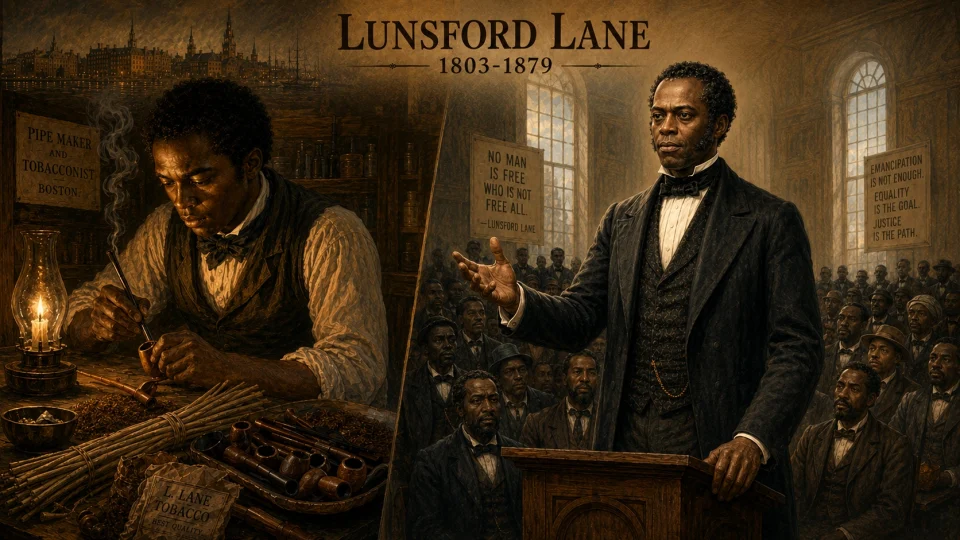
Lunsford Lane (1803–1879) was a remarkable nineteenth-century entrepreneur, abolitionist, and author who rose from captivity as a house servant in Raleigh, North Carolina, to become a prominent advocate for freedom in the American North. Demonstrating extraordinary business acumen as a tobacconist and inventor, Lane diligently saved enough money to secure his own freedom, followed by that of his entire family. Despite suffering banishment, arrest, and violent attacks, he emerged as a nationally recognized orator on the abolitionist circuit and published a widely read narrative. His narrative remains a crucial historical record, illuminating both the brutality of the Maafa and the resourcefulness required to overcome it.
Early Life and Awakening to Slavery
Lane was born on May 30, 1803, in Raleigh, North Carolina, and was held as a house servant to the Sherwood Haywood family. His father, Edward Lane, was also held in bondage in Raleigh, though by a “near neighbor” rather than the Haywoods themselves. In his early childhood, Lane played in the yard with both Black and European children, initially perceiving “no difference” between himself and his captors’ children. This innocent sense of equality was shattered as he grew older, witnessing his European playmates receive an education while he himself was forbidden even to hold a book.
At age ten or eleven (1813–1814), Lane was assigned regular tasks such as cutting wood in winter and gardening in summer. By 1818, at age fifteen, he became his captor’s carriage driver—a role that demanded long hours but provided opportunities to travel between the city and surrounding plantations. During these formative years, Lane embarked on his first entrepreneurial venture, earning his first 30 cents by selling a basket of peaches his father had gifted him. This early success was the first of many contributions Edward made to Lunsford’s eventual achievements.
Building a Business Empire in Bondage
Lane’s foray into the tobacco business began with knowledge inherited from his father, who taught him a distinct method of preparing smoking tobacco. Edward’s unique technique became the foundation of Lunsford’s burgeoning enterprise. Lane refined his father’s process to create tobacco with a “peculiarly pleasant” and “sweet” flavor, enabling even mediocre leaf to be transformed into a desirable product. To avoid interfering with his servant duties, he performed all tobacco manufacturing late at night.
To complement his tobacco, Lane engineered a specialized pipe designed to cool the smoke for those who found the heat of standard pipes unpleasant. Using reeds that grew plentifully in the Raleigh region, along with clay and wire, he bored a passage through the center of the reed with a hot wire, polished the stem, and attached a clay pipe bowl to the end. Lane compared the function of his pipe stem to the “worm of the still” used in distilling whiskey, which cools the vapor as it passes through. His business grew so significantly that many members of the North Carolina Legislature became his regular customers.
After Sherwood Haywood’s death in the early 1830s, Lane negotiated with Haywood’s widow to “hire his own time” for an annual fee of $100 to $120. This arrangement granted him the autonomy to pursue his business interests full-time. He soon established agencies in towns across North Carolina—Fayetteville, Salisbury, and Chapel Hill—placing his products in local stores on commission.
The Long Road to Freedom
By 1835, Lane had saved $1,000 from his various enterprises—including selling firewood, offering hauling services, and working as a messenger for the Governor—enough to purchase his freedom. However, North Carolina law required “meritorious service” for manumission, forcing him to travel to New York to be legally recognized as a free man. Between 1837 and 1839, he continued working as a messenger and handyman for the Governor’s office in Raleigh, earning respect from state officials and negotiating the purchase of his wife and six children for $2,500.
In 1840, Lane was served a legal notice to leave North Carolina within 20 days because he was a free Black man from another state residing there illegally. Despite a petition to the Legislature supported by prominent white citizens, he was forced to relocate to New York and Boston in 1841. There, he began lecturing to raise the remaining $1,380 required to finalize the purchase of his family’s freedom.
Persecution and the Raleigh Riot
During a return visit to Raleigh in 1842 to complete the purchase of his family, Lane was arrested for “abolitionist lectures” he had delivered in Massachusetts. Although he was legally discharged after explaining that his lectures were primarily a means of raising funds for his family, he was subsequently seized by a mob and tarred and feathered in a local woods. Lane was eventually rescued by friends, including prominent American citizens such as William Boylan, whom Lane described as “more than a father” and “unflinching in his friendship,” and Benjamin B. Smith, who called upon the Governor for official interference and provided a safe house.
Lane and his friends spent the night using lard and warm water to remove the tar and feathers from his body. By the next morning, with the help of his allies, he had arranged his business affairs and successfully escaped to the North on a 10:00 a.m. train with his wife Martha (whom he had married in May 1828), their children, and his mother Clarissa.
Abolitionist Career and Literary Achievement
Settling in Massachusetts, Lane became an active member of the American Anti-Slavery Society, led by William Lloyd Garrison, which regarded slavery as illegal under both natural law and the U.S. Constitution. Between 1842 and 1856, Lane traveled extensively on the abolitionist circuit, delivering “soul-trying” accounts of his enslavement and frequently sharing the stage with renowned activists, including Frederick Douglass.
In July 1842, Lane published The Narrative of Lunsford Lane in Boston, aiming to shed light on the “policy of a [captive] holding community” and to foster sympathy for those still in bondage. As he completed his memoir, Lane expressed joy that his father would soon join him in freedom. The narrative achieved significant success, selling rapidly in both America and England. The first edition sold out so quickly that a second edition was printed by August 1842, and the book was reprinted three times within its first six years.
Reunion and Later Years
In 1844—two years after Lunsford’s escape from Raleigh—Edward Lane was manumitted and joined his son’s family in New England, completing their reunion in freedom. The family first settled in Philadelphia, then moved to Cambridge, Massachusetts, in 1845, where their seventh child was born. To support his large household, Lane took on various careers; census records and city directories list him as a physician, book agent, and manufacturer of patent medicines. On March 22, 1855, he was a guest at the Brattle Street mansion of poet Henry Wadsworth Longfellow, where the two reportedly shared such a lengthy conversation that it drove away other visitors.
During the Civil War in 1863, Lane served as a steward at Wellington’s Hospital in Worcester, Massachusetts. Following the war, he collaborated with Horace James to establish a school for freedmen near New Bern, North Carolina, demonstrating his lifelong dedication to education and the advancement of the African American community.
After the death of his youngest daughter, Clara, in April 1872, Lane moved from Massachusetts to Greenwich Village in New York City, where he spent his final years in a multi-family tenement. He remained industrious, selling patent medicines and working as a fundraiser for various charities. Lunsford Lane died on June 27, 1879, at the age of 76, reportedly from a heart attack or dropsy, and is buried in Jersey City, New Jersey.
Lane’s extraordinary journey from captivity to nationally known orator and entrepreneur was officially recognized by his home state in 2019, when a historical marker was erected in his honor on Edenton Street in Raleigh, North Carolina. He is celebrated for his industriousness, resilience, and unwavering commitment to his family, ultimately securing the freedom of his wife, Martha (also known as Patsy), and all seven of his children: Laura, Edward, William, Lunsford, Maria, Ellick, and Lucy.
Source:
https://www.nps.gov/people/lunsford-lane.htm
https://en.wikipedia.org/wiki/Lunsford_Lane
https://www.dncr.nc.gov/blog/2023/12/28/lunsford-lane-1803-1879-h-125
https://docsouth.unc.edu/neh/lanelunsford/lane.htmlhttps://daily.jstor.org/tarring-and-feathering-american-style/