
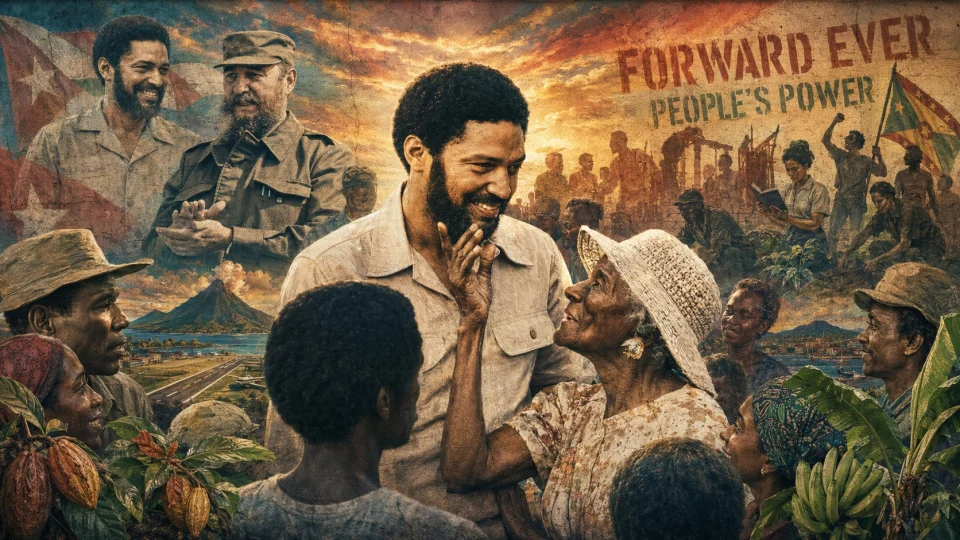
Maurice Rupert Bishop (1944–1983) was a charismatic revolutionary who served as Prime Minister of Grenada from 1979 until his assassination in 1983. After overthrowing the oppressive Eric Gairy regime, Bishop launched one of the most ambitious socialist transformations in the English‑speaking Caribbean. His leadership ushered in sweeping social reforms, notably in healthcare, literacy, and gender equality, turning the small “Spice Island” into a symbol of Black pride, participatory democracy, and anti‑imperialist sovereignty.
Early life and education
Maurice Bishop was born on 29 May 1944 on the island of Aruba, where his Grenadian parents, Rupert and Alimenta Bishop, had migrated in search of better economic opportunities. He spent his early childhood in Aruba with his two older sisters, Ann and Maureen, until the family returned to Grenada when he was six. Settling in St George’s, the capital, his father opened a small retail shop. As the only son, Maurice’s upbringing was marked by high expectations and discipline: his father demanded academic excellence and “perfect grades,” while his mother, even after the family acquired a car, insisted he walk to school like other children.
Bishop’s formal education began at a Wesleyan elementary school in Grenada before he transferred to Roman Catholic institutions, such as St George’s primary and high school. Although he was notably tall for his age and sometimes teased for it, his intellectual abilities soon became apparent. His outstanding academic record earned him one of just four government scholarships to Presentation Brothers’ College, a prestigious Roman Catholic boys’ secondary school. There, he excelled both academically and as a leader. Upon graduating in 1962, he received the Principal’s Gold Medal for “outstanding academic and general all‑round ability.” He also served as president of the Student Council, the Discussion Club, the History Study Group, and the school’s Historical Society, while editing the student newspaper, Student Voice.
During these formative years, Bishop’s political consciousness began to take shape. He developed a deep interest in history, politics, and sociology, championed Caribbean nationalism and the West Indies Federation, and immersed himself in the works of anti‑colonial thinkers like Frantz Fanon and Julius Nyerere. Alongside his classmate Bernard Coard, he co‑founded the Grenada Assembly of Youth Fighting for Truth in 1962, an organization devoted to fostering political awareness among young Grenadians through public debate.
London: legal training and political maturation
After a brief stint in Grenada’s civil service, Bishop moved to Britain in December 1963 to pursue legal studies. He attended the University of London—studying at both the London School of Economics and King’s College—and completed his professional training at Gray’s Inn. Although he received his Bachelor of Laws and was called to the bar in 1969, Bishop’s years in London proved to be as transformative politically as they were academically.
In 1966, while still in Britain, Bishop married nurse Angela Redhead, with whom he had two children, Nadia and John. Angela and the children later emigrated to Toronto, Canada, in 1981, during his time in office, a move shaped in part by mounting political tensions and uncertainty in Grenada. Bishop subsequently entered a long‑term relationship with Jacqueline Creft, a founding member of the New Jewel Movement who would serve as Minister of Education in the People’s Revolutionary Government.
To support himself, Bishop took on modest jobs such as postman and vegetable packer, experiences that kept him grounded in working-class realities even as he trained for a professional career. He also assumed numerous leadership roles in student organizations, serving as president of the Students Association at Holborn College and later of the West Indian Students Society at the Royal College. In these capacities, he organized Caribbean and African students, led debates on decolonisation, and honed his public speaking skills.
London played a crucial role in shaping Bishop’s ideological outlook. He immersed himself in the writings of Marx, Lenin, Stalin, and Mao Zedong, wrestling with the complexities of imperialism, vanguard organization, and revolutionary strategy. Simultaneously, he became involved in the civil rights and anti-racist movements sweeping Britain in the 1960s. Bishop co-founded a legal aid clinic for West Indian migrants in Notting Hill and participated in the Campaign Against Racial Discrimination. By the time he returned to Grenada in December 1970, he and his close comrades had developed a two-year plan to build an organization capable of seizing political power.
Return to Grenada: lawyer and activist
Upon returning to Grenada, Bishop established a legal practice in St George’s, dedicating his work to defending the “common man” against the growing repression of Sir Eric Gairy’s regime. He quickly threw himself into activism, organizing demonstrations in solidarity with Black Power insurgents in Trinidad and defending striking nurses at St George’s General Hospital in November 1970. During this struggle, Bishop was arrested alongside about thirty others, but his determined legal advocacy ultimately led to the nurses’ acquittal after a seven-month trial, solidifying his reputation as a courageous movement lawyer.
Throughout the early 1970s, Bishop became a prominent figure at protests and community meetings, often taking cases that highlighted the violence and corruption of Gairy’s government. His unique combination of legal expertise and grassroots activism earned him credibility both as a barrister and as a mass leader willing to stand alongside ordinary Grenadians in times of confrontation.
Building a revolutionary movement
Bishop’s political activism soon transitioned from spontaneous protest to more structured organization. In 1972, alongside Kenrick Radix and Jacqueline Creft, he co-founded the Movement for Assemblies of the People (MAP), inspired by Julius Nyerere’s vision of Tanzanian socialism. MAP aimed to establish village-level institutions that enabled direct participation in decision-making, paving the way for a more radical and participatory democracy than the traditional Westminster model.
In 1973, MAP merged with the rural-based Joint Endeavour for Welfare, Education and Liberation (JEWEL), founded by Unison Whiteman, to form the New Jewel Movement (NJM). Bishop and Whiteman became joint coordinating secretaries, and the NJM quickly emerged as the leading force opposing the Gairy regime. The movement’s 1973 Manifesto condemned decades of “cheap politics” and outlined an ambitious program of socio-economic transformation, including improvements in housing, health, and education, as well as the creation of a new, truly democratic grassroots system of governance.
From its inception, the NJM blended Black Power nationalism with an increasingly pronounced Marxist-Leninist perspective. Bishop and his comrades were profoundly influenced by the Black Power movements in the United States, the 1970 Trinidad uprising, and a broader surge of Third World liberation struggles. They aspired to achieve not only national independence but also the “decolonization of the mind” and the shaping of a “New Caribbean Man.” Over time, this Black nationalist impetus evolved into a more systematic commitment to anti-imperialism, class struggle, and democratic centralism.
Violence, personal loss, and the road to revolution
Opposition to Gairy was met with harsh and often violent retaliation. The Prime Minister established what many observers described as a “constitutional dictatorship,” propped up by electoral fraud, political patronage, and a private paramilitary force—the notorious
Mongoose Gang. Modeled after Haiti’s Tonton Macoutes, the Mongoose Gang was drawn largely from criminal circles and operated with virtual impunity, terrorizing political opponents and dissenters. A later Commission of Enquiry found that at least sixty-four of Gairy’s “Police Aides,” including many Mongoose members, had extensive criminal records.
Bishop himself endured two harrowing attacks that left deep scars on both his personal life and the movement. On “Bloody Sunday,” 18 November 1973, he and five other NJM leaders were ambushed by police and the Mongoose Gang, viciously beaten “almost to the point of death,” and jailed without medical treatment—Bishop’s jaw was broken in the assault. On “Bloody Monday,” 21 January 1974, during a mass demonstration against Gairy, his father Rupert was shot and killed by security forces while shielding women and children from gunfire.
These ordeals only strengthened Bishop’s resolve. In their aftermath, the NJM shifted from public demonstrations to a more clandestine, cell-based structure. On the eve of Grenada’s independence in February 1974, Bishop was again arrested on trumped-up charges of plotting an assassination and was briefly exiled to North America. He soon returned, undeterred, to continue the struggle. Despite widespread allegations of fraud in the 1976 elections, Bishop won the St George’s South-East seat and became Leader of the Opposition, using Parliament to expose Gairy’s abuses and forge new international alliances, most notably with Cuba in 1977.
The Grenada Revolution
By 1979, Gairy’s regime was collapsing under the weight of corruption, bizarre conduct—including his notorious UN plea for UFO research—and the ongoing threat of paramilitary violence against NJM leaders. When word spread that the Mongoose Gang might assassinate NJM figures during Gairy’s absence abroad, the party resolved to act. In the predawn hours of 13 March 1979, NJM cadres swiftly seized key installations, including the radio station and army barracks, in an almost bloodless insurrection. With Gairy overseas, the government fell with minimal resistance, and Bishop announced the creation of the People’s Revolutionary Government (PRG).
As Prime Minister, Bishop was immensely popular, known for his warmth, his talent for explaining complex ideas in accessible language, and his steadfast respect for the dignity and agency of ordinary people. Under his leadership, the PRG suspended the 1974 constitution and set about constructing new institutions of “popular democracy.” The government replaced the Westminster model with village, zonal, and parish councils, and launched mass organizations such as the National Women’s Organisation and National Youth Organisation. These structures allowed citizens to question officials directly, deliberate on national budgets and policies, and take part in decision-making far beyond periodic elections.
Social transformation and “astronomical feats”
During its four years in power, the PRG achieved remarkable social progress, often described by supporters as “astronomical feats.” A nationwide literacy campaign by the Centre for Popular Education slashed adult illiteracy from an estimated 35 percent to around 5 percent, while overall literacy soared to about 96 percent. For the first time, secondary education became free and widely accessible, and hundreds of scholarships were offered for study in Cuba, Eastern Europe, Africa, and beyond.
Healthcare was transformed from a privilege to a right. The government established free public healthcare, expanded the network of clinics, and invested in new facilities. Economically, the PRG followed a mixed approach, sustaining private enterprise while strengthening state control over critical sectors. Tools like the Marketing and National Importing Board helped stabilize prices and ensure food security. Unemployment, previously near 50 percent under Gairy, dropped sharply to 12-14 percent, and GDP grew steadily despite a challenging regional context.
Among the PRG’s most ambitious projects was the construction of a new international airport at Point Salines—later renamed Maurice Bishop International Airport—with significant Cuban support in funding, expertise, and labor. For Bishop, the airport symbolized economic self-reliance and a decisive break from dependency, allowing Grenada to manage its own tourism and trade routes instead of relying on foreign hubs.
Ideologically, Bishop advanced the vision of a “New Caribbean Man”: a decolonized individual connected to indigenous culture and Black pride, dedicated to collective labor, self-reliance, and international solidarity with the oppressed. Through education, political engagement, and cultural initiatives, the PRG worked to dismantle “colonial mimicry,” reject the “visa mentality” of migration as escape, and inspire Grenadians to view themselves as active builders of their own future.
Internationalism and defiance of “backyardism”
Bishop’s foreign policy firmly positioned Grenada within the global movement for Third World solidarity. He drew inspiration from anti-colonial leaders like Nkrumah, Nyerere, Fanon, Castro, and Che Guevara, forging close personal and political bonds with Fidel Castro in Cuba and Daniel Ortega’s Sandinistas in Nicaragua. Bishop also built relationships with African leaders such as Samora Machel and Kenneth Kaunda, actively supported liberation movements like the ANC and SWAPO, and expressed solidarity with struggles in Palestine, Western Sahara, East Timor, El Salvador, Chile, and Puerto Rico.
Grenada became a prominent voice in the Non-Aligned Movement, serving as a vice-president on its Bureau and championing a “New International Economic Order” to address systemic inequalities in global trade. Bishop was a leading advocate for the Caribbean as a “Zone of Peace,” firmly rejecting great-power military interventions and denouncing U.S. policies that treated the region as a strategic backyard.
Bishop’s declaration that Grenada was “not in anybody’s backyard” captured this defiant outlook. Although he maintained a non-aligned policy and embraced diverse economic models, his strong ties with Cuba and the socialist bloc—alongside his outspoken advocacy for Black liberation and self-determination—provoked alarm in the Reagan administration. U.S. officials, fearing that a successful, English-speaking Black socialist nation could inspire African Americans, allegedly devised a “pyramid plan” of destabilization involving economic pressure, diplomatic isolation, propaganda, and contingency plans for military intervention.
Leadership style and internal tensions
Despite his widespread popularity and international standing, Bishop’s leadership style came under fierce criticism within the NJM. Hardline cadres criticized him for being too “consensual” and “petty-bourgeois,” arguing that his approach did not align with their vision of strict Leninist discipline. Bishop’s reliance on broad consultation, personal rapport, and moral authority, while effective at mobilizing the masses, unsettled those who favored centralized party control and rigid hierarchy.
By late 1982 and into 1983, tensions within the Central Committee intensified, especially around Deputy Prime Minister Bernard Coard, who pushed for a “joint leadership” structure to formally share power with Bishop. Party documents and later testimonies reveal that some comrades accused Bishop of lacking organizational rigor and ideological firmness, while Bishop and his supporters suspected a bureaucratic power grab that risked alienating the public. The leadership dispute became entangled with deeper debates over party rule, democratic centralism, and the relationship between the vanguard and the people.
Collapse, execution, and invasion
The crisis reached its peak in October 1983. On 13 October, the Central Committee majority placed Bishop under house arrest for refusing to accept the joint leadership arrangement. Detaining such a beloved leader proved unsustainable. On 19 October, an estimated 30,000 people—nearly a third of Grenada’s population—marched to his home, freed him, and accompanied him in triumph to military headquarters at Fort Rupert (now Fort George), where Bishop hoped to regain control.
What followed was catastrophic. Troops loyal to the hardline faction, led by General Hudson Austin, advanced on the fort in armored vehicles and opened fire on the crowd. Witnesses recalled Bishop’s anguished cry—“My God, my God. They have turned the guns against the people”—as civilians were gunned down. Bishop surrendered with his hands raised but was seized, and shortly afterward, a firing squad from the People’s Revolutionary Army executed him in the courtyard along with several close comrades: Education Minister Jacqueline Creft (his partner, reportedly pregnant), Foreign Minister Unison Whiteman, Norris and Fitzroy Bain, and other aides and supporters. Some accounts report that after Bishop fell, a soldier slit his throat and severed his finger to steal his ring.
The bodies were taken to a military camp on the Calivigny peninsula, placed in a pit, and partially burned. Despite decades of investigations and advocacy, the remains of Bishop and his comrades have never been found or definitively identified, leaving their families and the nation without a physical site for mourning. In the immediate aftermath, a 16-member Revolutionary Military Council seized power, imposed a 24-hour “shoot-on-sight” curfew, and banned demonstrations, plunging Grenada into fear and confusion.
Six days later, on 25 October 1983, the United States launched Operation Urgent Fury—a large-scale invasion, officially justified as a mission to rescue American medical students and restore order. U.S. forces, numbering around 7,000–8,000 troops, faced resistance from the People’s Revolutionary Army and Cuban workers but quickly overwhelmed them. The invasion dismantled the PRG, reinstated the 1974 constitution, and abolished the revolution’s participatory structures. Seventeen NJM and PRA leaders, including Coard and Austin, were arrested, tried, and initially sentenced to death for their role in the Fort Rupert killings—sentences later reduced to life imprisonment.
Memory, martyrdom and legacy
Bishop’s death and the destruction of the revolution are remembered across Grenada and the Caribbean as a profound tragedy—marked by a double betrayal: first by imperialism, and more immediately by comrades who turned their guns on the people. His political life was bookended by state violence against his family: his father was killed during the struggle against Gairy in 1974, and his partner Jacqueline Creft was executed alongside him in 1983; the tragedy continued into the next generation with the stabbing of their son Vladimir in Toronto in 1994.
Yet Bishop’s legacy is not solely one of loss. Many Grenadians recall the revolution’s four years as a period of unprecedented hope, dignity, and collective effort—symbolized by dramatic reductions in illiteracy, the introduction of free education and healthcare, falling unemployment, and a renewed sense of national pride rooted in Black liberation and self-reliance. Across the region and the wider Black Atlantic, Bishop is often compared to a “Caribbean Che Guevara”—a martyr whose image and words continue to inspire movements for social justice, even though the institutions he built were dismantled.
The contradictions of Bishop’s life—his emergence as a “New Caribbean Man” influenced by both Black Power and Marxism-Leninism, his charismatic authority within a vanguard party committed to democratic centralism, and the revolution’s collapse into fratricidal violence—have made Grenada a crucial case study for those reflecting on revolution in small postcolonial states. Today, Grenada observes the date of the US landing, 25 October, as Thanksgiving Day, while the international airport—once at the center of Washington’s ire—now bears Bishop’s name, serving as a lasting reminder of a project that envisioned an English-speaking Black socialist future. The unresolved absence of his remains continues to haunt the island’s political memory, but his vision of a decolonized, sovereign Caribbean still inspires those who invoke his name.
Source:
https://en.wikipedia.org/wiki/Maurice_Bishop
http://news.bbc.co.uk/onthisday/hi/dates/stories/october/20/newsid_3720000/3720608.stm
https://morningstaronline.co.uk/article/c/we-want-our-leaders-campaign-reveal-whereabouts-grenada-revolutions-dead
https://newleftreview.org/issues/i142/articles/fitzroy-ambursley-winston-james-maurice-bishop-and-the-new-jewel-revolution-in-grenada.pdf
https://globalsocialtheory.org/thinkers/bishop-maurice/
https://timescaribbeanonline.com/maurice-bishop-the-revolutionary-who-dared-to-dream-and-died-for-it/
https://www.peoplesworld.org/article/remembering-maurice-bishop-and-the-revolution-in-grenada/
https://themilitant.com/2022/05/21/fidel-castro-maurice-bishop-was-a-true-revolutionary-2/
https://spartacus-educational.com/COLDbishop.htm
https://www.encyclopedia.com/people/history/historians-miscellaneous-biographies/maurice-bishop
https://anticonquista.com/2018/03/13/in-honor-of-maurice-bishop-and-the-revolutionary-caribbean/