
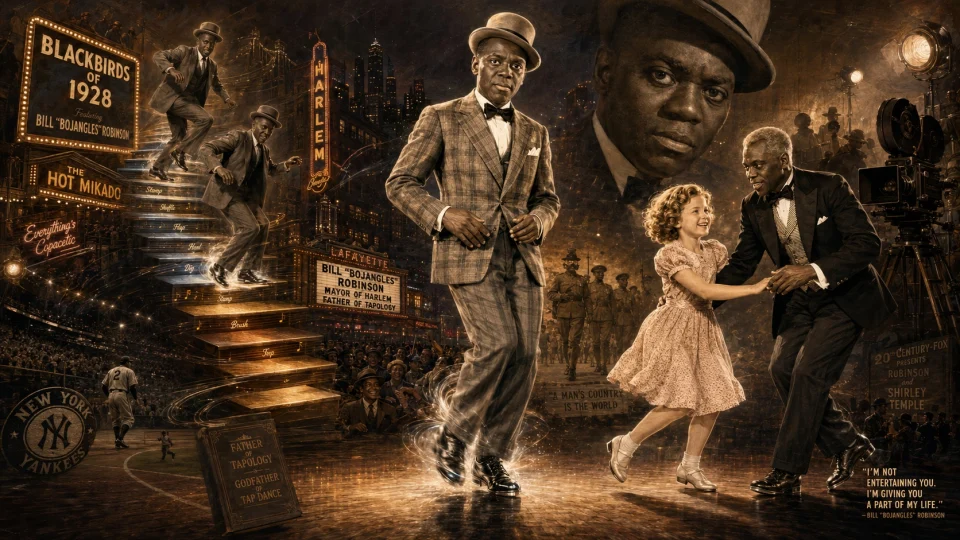
Bill “Bojangles” Robinson (1878–1949) was a pioneering African American tap dancer, actor, and singer who rose to become the most renowned and highest-paid Black entertainer in the United States during the early 20th century. Robinson’s signature stair dance showcased his innovative rhythms and unmatched skill, catapulting him to legendary status in the world of tap. His illustrious career encompassed vaudeville, Broadway successes like Blackbirds of 1928, and appearances in 14 Hollywood films. He leveraged his fame to challenge systemic racial barriers, becoming one of the first Black performers to appear without blackface and to headline solo, defying vaudeville’s “two-coloured rule.” In 1935, he made history alongside Shirley Temple as part of Hollywood’s first interracial dance team in The Little Colonel. Offstage, Robinson was known as the honorary “Mayor of Harlem” and a generous philanthropist, performing in an estimated 400 benefits in a single year. Despite dying penniless due to his charitable nature, his enduring legacy is honored every May 25—his birthday—which Congress designated as National Tap Dance Day.
Early life and the making of “Bojangles”
Bill “Bojangles” Robinson, born Luther Robinson on May 25, 1878, in Richmond, Virginia, was the son of Maxwell Robinson, a machinist, and Maria Robinson, a choir singer. Tragically orphaned by the age of seven, Robinson and his brother were raised by their grandmother, Bedelia Robinson.
From an early age, Robinson displayed a strong sense of self and a remarkable talent for performing. Disliking the name Luther, he insisted that his younger brother William swap names with him, so Luther became Bill and William would later be known as Percy. Around this period, he gained the nickname “Bojangles,” a Black community term for a “squabbler” or “jangler,” reflecting his spirited and sometimes argumentative demeanor—though European audiences later interpreted it as meaning “happy-go-lucky.”
Robinson’s love for dance began at the age of five, when he busked for coins in beer gardens and saloons. During this time, he also worked as a stable boy at a racetrack, harboring hopes of one day becoming a jockey. By age nine, he joined Mayme Remington’s touring troupe and quickly became a “pick” in minstrel and traveling shows—a role for Black children who danced and joked at the stage’s edge to support European performers. He toured in shows such as The South Before the War, and in his youth, briefly partnered with a young Al Jolson, with Jolson singing while Robinson danced or sold newspapers.
In 1898, Robinson served as a rifleman in the Spanish-American War, where he suffered a permanent injury from an accidental gunshot by a lieutenant cleaning a weapon. His path to stardom quickened on March 30, 1900, when he won a gold medal in a buck-and-wing dance contest in Brooklyn, defeating the acclaimed Harry Swinton. This victory provided Robinson with vital publicity, cementing his reputation as an emerging headliner.
Revolutionising tap “up on the toes”
Robinson is widely credited with revolutionizing tap dance by transforming it from a heavy, flat-footed “iron-hoof” style into a light, swinging art performed on the balls of the feet. Prior to his influence, tap was dominated by an earthbound, percussive style, exemplified by dancers like King Rastus Brown. Robinson introduced what critics and contemporaries called a “hitherto-unknown lightness and presence,” merging nimble footwork with an upright, refined posture that elevated the art form.
Robinson’s innovative technique emphasized a forward shift of weight, requiring exceptional control to generate movement primarily from the waist down while keeping the upper body composed and graceful. He preferred handcrafted, split-soled wooden shoes, which enabled him to create distinct tones and execute complex rhythms and syncopated breaks. He also popularized key technical elements such as slide steps and the shuffle ball change, both of which became foundational to modern tap vocabulary.
To Robinson, tap dance was an expression of musicianship rather than slapstick comedy. He openly criticized dancers who “pounded their feet like iron,” insisting instead on treating his feet as precision instruments that produced clear, musical rhythms. This philosophy reached its peak in his legendary stair dance, where he tapped up and down a staircase, coaxing distinct pitches and rhythms from each step so that the stairs themselves became a melodic instrument. While he did not originate the dance on stairs, Robinson perfected and popularized the routine to the point that it became synonymous with his name.
Across a remarkable sixty-year career that spanned street performances, vaudeville circuits, Broadway, and Hollywood, Robinson earned recognition as the “Father of Tapology.” He mentored and inspired generations of dancers, leaving an indelible mark on legends such as Fred Astaire, the Nicholas Brothers, Lena Horne, Sammy Davis Jr., Ann Miller, and Gregory Hines.
Breaking barriers on stage and screen
Robinson’s rise from street performer to star took place within a deeply segregated entertainment industry, yet he consistently challenged its restrictions. In vaudeville, he broke the “two-colored rule,” which forced Black acts to perform in pairs, by achieving success as a solo headliner—making him one of the first African Americans to do so. He was also among the earliest Black performers to appear before mainstream audiences without donning blackface, rejecting a demeaning convention imposed on both Black and white artists.
Robinson’s Broadway breakthrough arrived with Blackbirds of 1928, where his iconic stair dance captivated white audiences and established him as a marquee attraction. Later, in The Hot Mikado (1939), his electrifying performance reportedly “stopped the show,” earning up to eight encores in one night. In 1940, he broke new ground as the first African American to headline an otherwise all-white Broadway production with All in Fun, expanding opportunities for Black performers even as racial barriers persisted.
Hollywood catapulted Robinson to national fame. Appearing in 14 films, he brought tap dance to the silver screen, most memorably in a celebrated series of collaborations with Shirley Temple. In The Little Colonel (1935), they became Hollywood’s first interracial dance team, with Robinson as “Uncle Billy” and Temple as the precocious child—a partnership that symbolized a new, if limited, visibility for Black performers in mainstream cinema. Their onscreen chemistry delighted audiences across four films and helped globalize Robinson’s fame.
At the height of his career, Robinson was the most recognized and highest-paid Black entertainer in the United States, earning up to $6,600 a week in Hollywood and amassing an estimated $2 million over his lifetime. By 1937, he was widely celebrated as the highest-paid Black entertainer in the world.
Controversy, respectability and limited choices
Robinson’s film roles—especially those alongside Shirley Temple—also attracted criticism from Black contemporaries and later scholars. He was often cast as the genial, accommodating Black servant or butler: a cheerful, loyal caretaker whose presence reassured Europeans and reinforced nostalgic images of the Old South. Film historian Donald Bogle, for example, called his role as Uncle Billy in The Littlest Rebel (1935) a classic “Uncle Tom” portrayal, though he noted that Robinson’s performance was “a cut above” the more crude caricatures of the era.
Robinson himself vehemently rejected the “Uncle Tom” label. On at least one occasion, after a Harlem newspaper used the term, he reportedly arrived at the office armed and prepared to confront the editor. Defenders and biographers argue that critics often overlooked the severe constraints Black performers faced under Jim Crow laws and the tightly controlled Hollywood studio system. In an industry that relegated African Americans to servant roles, buffoonery, or invisibility, Robinson’s presence as a dignified, technically masterful artist—sometimes cast as the protector of a European child—embodied both a compromise with stereotype and a strategic step forward.
By accepting what some called “Cool-Eyed Tom” roles, Robinson maintained the income and public profile that allowed him to break other barriers: performing solo, rejecting blackface, and using his fame in civic causes. Yet he was also the subject of romanticized—and sometimes fabricated—stories about his life and career, many circulated by himself, his wife Fannie, or his manager Marty Forkins for publicity. These included the staged soup-spilling anecdote about meeting Forkins, embellished accounts of World War I front-line service, and the oft-repeated but unverified tale of a legendary dance contest against Fred Astaire and others that Robinson was said to have won.
Even Robinson’s nickname became entangled with myth. Jerry Jeff Walker’s 1968 song “Mr. Bojangles” is often mistakenly assumed to be about Robinson, but it was actually inspired by a European street performer Walker met in a New Orleans jail. The real Robinson—who neither smoked nor drank and reportedly never owned a dog—had little in common with the song’s melancholic, hard-drinking character.
The “Mayor of Harlem” and a life of giving
Offstage, Robinson crafted a memorable public persona as the dapper, ever-smiling, plaid-suited “Mayor of Harlem”—a nickname given to him in 1933 by both political leaders and the white establishment. This title represented far more than fame: within Harlem, Robinson was synonymous with generosity, civic involvement, and relentless charitable work. Throughout his life, he is believed to have performed at approximately 3,000 benefits—sometimes as many as 400 in a single year—donating millions to Black charities, schools, and countless individuals in need.
Robinson’s civic impact extended well beyond philanthropy. In 1936, he co-founded the New York Black Yankees baseball team, creating new professional opportunities for Black athletes. He played a key role in establishing the Negro Actors Guild of America, an organization focused on improving working conditions and representation for Black performers. He also became an integral part of local life by providing prizes for graduating classes at Harlem’s Public School 119 and supporting neighborhood institutions.
Robinson also leveraged his influence to confront racial inequality. He lobbied President Franklin D. Roosevelt for fair treatment of Black soldiers during wartime and successfully pressured the Dallas Police Department to hire its first Black officer. His national profile made him a symbolic representative for Harlem and Black America at large—a position that brought both empowerment and scrutiny. While some Black commentators criticized the “Mayor of Harlem” moniker and his role as mascot for the New York Giants baseball team as patronizing, many others admired how he wielded his influence for progress.
Robinson led a vibrant parallel life in sports and showmanship. A talented athlete, he famously ran 100 yards backward in 13.5 seconds—a feat widely publicized as a world record, though likely orchestrated for publicity. His passion for baseball was evident: he co-founded the Black Yankees and regularly attended New York Yankees games, occasionally entertaining fans by tap-dancing atop the dugout roof.
Robinson’s personal habits and contradictions intrigued those around him. He was widely believed to abstain from smoking and drinking, though some reports contradicted this. He was famous for his extravagant love of ice cream, which he was said to eat at every meal. At the same time, he was a compulsive gambler and possessed a famously quick temper.
Robinson often carried a gold-plated, pearl-handled .32-caliber pistol—a gift from the New York Police Department—and meticulously registered it in every city he visited. This ritual traced back to a traumatic 1908 arrest for armed robbery following a dispute with a tailor. Although he was initially sentenced to Sing Sing prison, Robinson was later exonerated when the accusation was proven false.
Private life, honours and enduring legacy
In his private life, Robinson was married three times and, according to most sources, had no children. He married Lena Chase in 1907; they separated in 1916 and divorced in 1922. That same year, he wed Fannie S. Clay, who became not only his wife but also his business partner and manager. Fannie played a pivotal role in founding the Negro Actors Guild and managed both his finances and career until their divorce in 1943. In 1944, Robinson married dancer Elaine Plaines (also known as Dash), remaining with her until his death in 1949.
Despite earning an estimated $2 million over his lifetime, Robinson died penniless due to his unflagging generosity. He passed away from heart failure at age 71 in 1949, with his funeral expenses covered by his friend, television host Ed Sullivan. The outpouring of public mourning reflected his profound impact: nearly half a million people lined the streets of Harlem for his funeral procession, and neighborhood schools reportedly closed for a half-day so children could attend or listen in.
Throughout his life, Robinson received numerous honors: the gold medal he won in 1900 as a national dance champion; a 1918 War Department commendation for boosting troop morale during World War I; and a variety of civic distinctions. In 1939, the New York World’s Fair celebrated “Bill Robinson Day” in his honor. He became a lifetime member of several police associations and fraternal organizations and performed command shows for President Franklin D. Roosevelt and Queen Elizabeth II. In the world of sports, he also served as the official mascot of the New York Giants.
Robinson’s legacy has only grown since his death. He was inducted into the American Theater Hall of Fame in 1979 and the National Museum of Dance Hall of Fame in 1987. His film Stormy Weather—a landmark in Black musical cinema—was preserved in the National Film Registry for its cultural significance, and a pair of his tap shoes is housed at the Smithsonian Institution. In 1989, the U.S. Congress designated May 25, his birthday, as National Tap Dance Day—an annual celebration of the man widely recognized as the “Godfather of Tap Dance.”
Robinson’s influence even found its way into language: he popularized the term “copacetic,” meaning “everything is fine,” through decades of stage and radio work—even if he didn’t invent the word himself. Above all, his legacy endures in the art form he transformed and the barriers he broke. As Rev. Adam Clayton Powell Sr. once described, Robinson was a “credit to the human race”—a sentiment echoed by generations of dancers, actors, and audiences who draw inspiration from the small, poised man who tapped “up on the toes,” turning staircases into music and every stage into a site of joy and perseverance.
Source: