
“Whatever path we seem to take, it always has one end: a racist bullet. A racist bullet murdered Malcolm X, murdered Martin Luther King, murdered Bobby Hutton. Attempted to murder Huey Newton; attempted to murder Eldridge Cleaver. From the streets, from the flying of this bullet in the air into the flesh of a black man, a whole structure proceeds: walls of courthouses, bars of jails, locked keys, billy-clubs, police.”
Kathleen Neal Cleaver
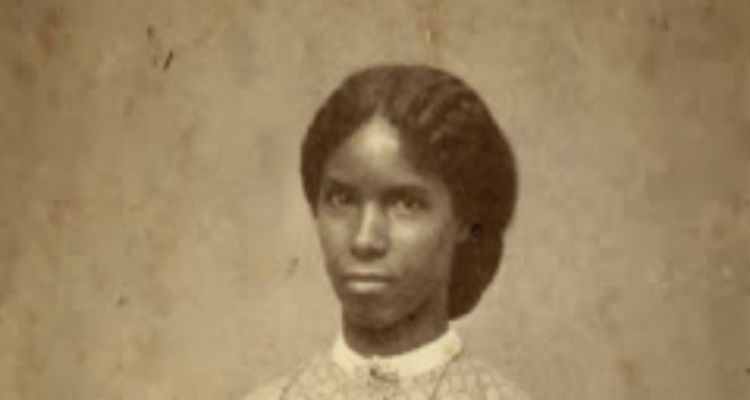
Kathleen Neal Cleaver is a distinguished American law professor, scholar, and activist whose extraordinary journey spans from Black Power revolutionary to renowned legal intellectual. Born in Dallas, Texas, on May 13, 1945, Cleaver was raised by Ernest Neal, a sociology professor, and Juette Johnson, a mathematician with an advanced degree, placing her in a college-educated, middle-class Black environment from an early age. When her father joined the U.S. Foreign Service, the family left the Jim Crow South, and Cleaver spent her formative years in India, Liberia, Sierra Leone, and the Philippines. These international experiences exposed her to socialism, communism, nationalism, and anti-colonial movements, profoundly shaping her perspectives on race, power, and human rights. Witnessing newly independent countries led by “dark-skinned people” rendered Eurocentric ideology “incoherent,” and instilled in her a powerful awareness of the capacity of people of color to govern themselves.
Upon returning to the United States as a teenager, Cleaver enrolled at the George School, a Quaker boarding institution in Pennsylvania, where she graduated with honors in 1963. She continued her education at Oberlin College and later at Barnard College. However, the intensifying violence against civil rights activists—including the tragic murder of her childhood friend Sammy Younge Jr.—galvanized her commitment to the movement. In 1966, Cleaver left Barnard before completing her degree to join the Student Nonviolent Coordinating Committee (SNCC) in New York. She began as a secretary in the organization’s Fifth Avenue office under project director Ivanhoe Donaldson, where she managed communications, welcomed weary organizers returning from the South, and witnessed SNCC’s ideological evolution from “Freedom Now” to “Black Power.”
In January 1967, Cleaver relocated to SNCC’s Atlanta office, where she became secretary for the Campus Program and worked closely with her mentor, George Ware. She played a key role in guiding SNCC through internal challenges involving finance and strategy, and she organized the pivotal “Liberation Will Come from a Black Thing” student conference at Fisk University during Easter 1967. When campus authorities revoked room reservations, she swiftly adapted, moving the event to a local Episcopal church. It was at this influential Nashville conference that she met Eldridge Cleaver, then the Black Panther Party’s Minister of Information. His invitation to San Francisco would prove transformative for her life and activism.
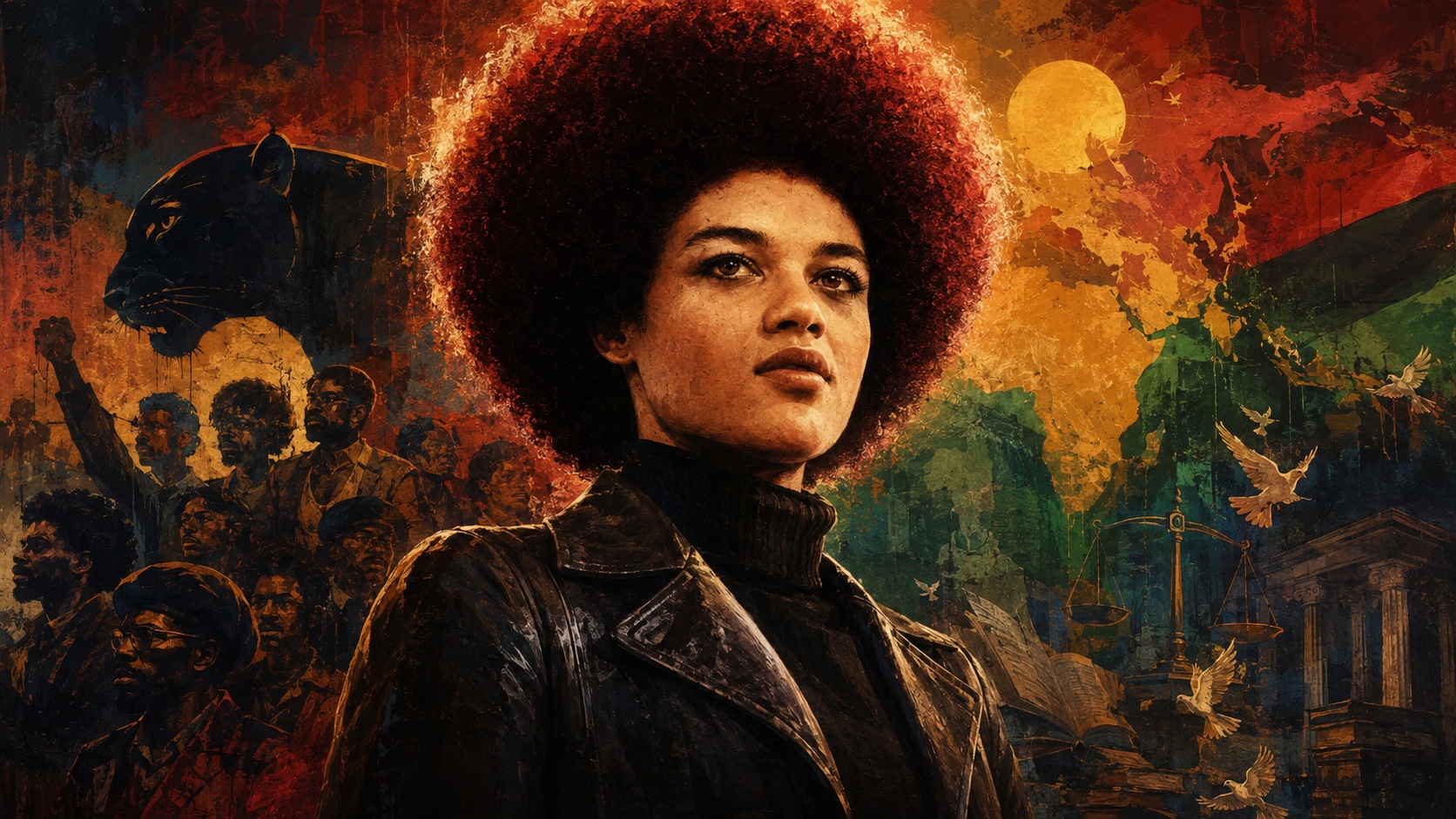
Arriving in San Francisco in November 1967, just weeks after Panther co-founder Huey P. Newton was jailed, Kathleen Cleaver entered the epicenter of the Black Power movement. Drawing on her experience with SNCC and inspired by communications strategist Julian Bond, she established the position of Communications Secretary within the Black Panther Party—becoming its press secretary and chief media spokesperson. In this pivotal role, Cleaver organized rallies and press conferences, crafted persuasive leaflets and posters, and appeared frequently on television and radio, quickly emerging as the public face of the party’s program, especially through the influential “Free Huey” campaign. Her dynamic leadership led to her historic appointment as the first woman on the Panthers’ Central Committee, the organization’s highest decision-making body, breaking significant gender barriers.
Cleaver’s contributions to the party extended far beyond media work. She played an active role in the Panthers’ “survival programs,” providing meals to communities, supporting families with medical needs, and organizing visits for relatives of political prisoners. In 1968, she ran for the California State Assembly on the Peace and Freedom Party ticket, using electoral politics to further amplify the Panthers’ challenge to racial capitalism and state violence. Throughout her activism, Cleaver consistently emphasized that women in the Panthers were revolutionaries first—not auxiliaries—highlighting that the party’s membership was majority female and that women’s leadership was both central and indispensable.
State repression intensified dramatically in 1968. Following a shootout between Eldridge Cleaver and Oakland police that resulted in the death of 17-year-old Panther Bobby Hutton and Eldridge facing attempted murder charges, the Cleavers became targets of heightened surveillance and legal persecution. When Eldridge—already on parole—was ordered back to prison, he jumped bail and fled the United States, first to Cuba and then to Algeria. Pregnant with their first child, Kathleen briefly remained in the U.S. before joining him in Algiers in mid-1969, where their son Maceo was born. In Algeria, they established the International Section of the Black Panther Party, turning Algiers into a vibrant hub for revolutionaries from Africa, Asia, and the Arab world. There, Cleaver became the primary media spokesperson and international face of the movement.
Exile led the Cleaver family far beyond Algeria. They spent time in North Korea, where their daughter Jojuyounghi (Joju) was born in 1970, and later relocated to France after tensions with the Algerian government and internal divisions within the Panther leadership made their stay in Algiers untenable. The ideological split between Eldridge Cleaver and Huey Newton—centered on armed struggle versus community programs—resulted in the expulsion of the international section from the Black Panther Party in 1971 and the creation of the Revolutionary People’s Communication Network, with Kathleen as a prominent public advocate. During these years, she deepened her global connections, meeting African and Arab liberation leaders and expanding the internationalist vision of Black Power.
In late 1975, after years of clandestine movement and negotiation, the Cleavers returned to the United States, where Eldridge accepted a plea agreement on his outstanding charges. For Kathleen, this homecoming marked the start of a remarkable transformation—from fugitive revolutionary to esteemed legal scholar. Awarded a full scholarship, she enrolled at Yale University in 1981, graduating summa cum laude and Phi Beta Kappa with a B.A. in History in 1984. Inspired in part by her fascination with the Watergate hearings and the law’s power to shape society, she continued her studies at Yale Law School, earning her Juris Doctor in 1989. Kathleen divorced Eldridge Cleaver in 1987, closing one chapter of her life and beginning another defined by intellectual achievement and public service.
Cleaver launched her legal career at the prestigious New York firm Cravath, Swaine & Moore, serving as an associate from 1989 to 1991 before clerking for Judge A. Leon Higginbotham on the U.S. Court of Appeals for the Third Circuit. Transitioning to academia, she joined the faculty at Emory University School of Law in 1992, where she has been a senior lecturer and held visiting and fellowship appointments at institutions including the Benjamin N. Cardozo School of Law, the University of Texas School of Law, Sarah Lawrence College, Yale Law School, Rutgers University, and the New York Public Library. Cleaver’s public service also extended to the Georgia Supreme Court Commission on Racial and Ethnic Bias in the Courts, deepening her lifelong commitment to advancing racial justice within judicial institutions.
As a scholar and writer, Cleaver has emerged as a leading voice in reinterpreting the history and legacy of the Black Panther Party and the broader Black Power movement. She co-edited Liberation, Imagination, and the Black Panther Party: A New Look at the Panthers and Their Legacy, and edited Target Zero: A Life in Writing, a collection of Eldridge Cleaver’s works. Her essays appear in influential volumes such as Critical Race Feminism, Critical White Studies, The Promise of Multiculturalism, and The Black Panther Party Reconsidered. Cleaver’s writing has also reached wider audiences through publications like The Village Voice, The Boston Globe, and Transition. For many years, she has worked on a memoir, Memories of Love and War. Beyond her written contributions, Cleaver has participated in documentaries and media projects exploring Black Power’s enduring significance, further solidifying her place as both a subject and interpreter of this pivotal history.
Across these multifaceted roles—as the daughter of diplomats and scholars, a SNCC organizer, a prominent figure in the Black Panther Party, an exile in revolutionary Algiers, and a Yale-trained lawyer and professor—Kathleen Cleaver has consistently embodied a profound commitment to Black liberation and human rights on a global scale. Her life’s journey reveals the deep connections between the anti-colonial struggles of the mid-twentieth century, the insurgent energy of Black Power, and today’s movements against racialized state violence and mass incarceration. In this way, Cleaver serves as a living archive of the Black radical tradition: a bridge between grassroots revolution and institutional transformation, and a testament to the ongoing resistance against systemic racism and the carceral state.
Source:
https://en.wikipedia.org/wiki/Kathleen_Cleaver
https://www.pbs.org/wgbh/pages/frontline/shows/race/interviews/kcleaver.html
https://americanradioworks.publicradio.org/features/blackspeech/kcleaver.html
https://www.archives.gov/research/african-americans/individuals/kathleen-cleaver
https://www.younghistoriansproject.org/single-post/2018/04/26/power-to-the-people-a-conversation-with-kathleen-cleaver
https://www.encyclopedia.com/education/news-wires-white-papers-and-books/cleaver-kathleen-neal-1945
https://www.crmvet.org/nars/cleaver_k.pdf
https://www.freedomarchives.org/Documents/Finder/DOC513_scans/BPP_Women/513.BPP.women.women.power.revolution.cleaver.pdf