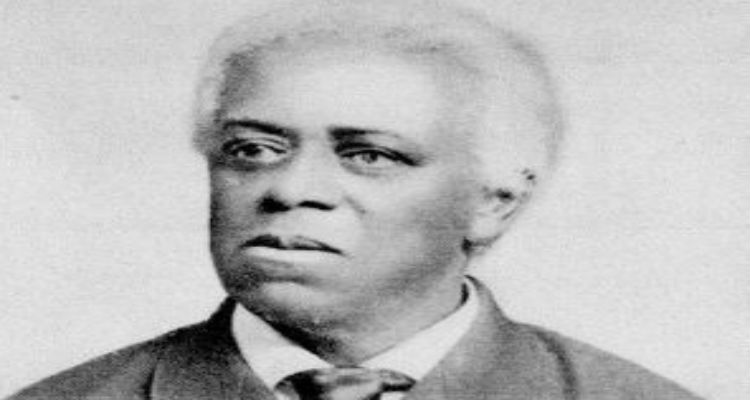

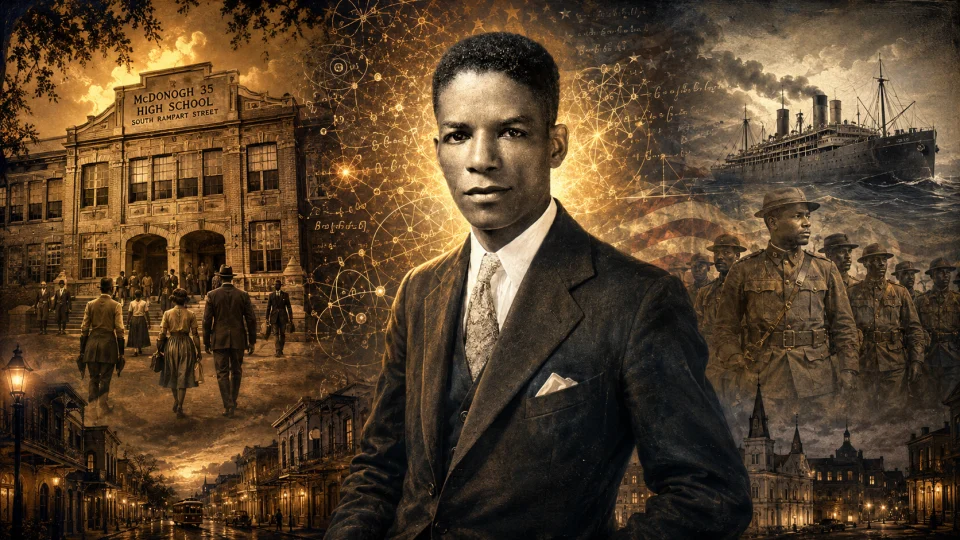
Lucien Victor Alexis Sr. was a New Orleans-born educator, scientist, military officer, entrepreneur, and civic leader whose life embodied disciplined achievement, intellectual ambition, and community service. Born on July 8, 1887, he rose to prominence during the Jim Crow era as one of the most consequential figures in Black educational history in Louisiana. Best known for his long tenure as principal of McDonogh 35, the only public high school for Black students in New Orleans during much of his career, Alexis helped shape generations of students who would go on to leave a lasting mark on the civic and professional life of the city. Beyond education, he distinguished himself as a self-directed scholar of science, a World War I veteran, a business leader, and an institutional builder within Black New Orleans.
Alexis was born in New Orleans to Louis Victor Alexis and Alice Saucier Alexis, members of the city’s Creole community. He came of age in a society structured by rigid racial inequality, where educational and professional opportunities for Black citizens were sharply limited. Although relatively little is recorded about his childhood, he was known to have shown strong academic promise in the local schools. He also came from a family network rooted in New Orleans, including at least one brother, Benoit Victor Alexis. His early years unfolded in a city where no public high school existed for African Americans before 1917, making advanced education difficult to attain and often dependent on private or religious institutions.
Determined to pursue higher education at the highest level, Alexis set his sights on Harvard University. Lacking the financial means to attend immediately, he began working in 1907 as a railway mail clerk and spent seven years saving enough money for college. After he was accepted to Harvard, he was first required to attend Phillips Exeter Academy in New Hampshire for one year. Even there, the period’s racial codes shaped his experience, and he lived in a private home rather than in the student dormitories. Yet the Exeter year proved decisive. It deepened his interest in languages and science, sparking a lifelong intellectual pursuit that would become a defining feature of his career.
The year at Exeter consumed money he had intended for Harvard, leaving him with funds for only three years of university study instead of four. Alexis met that challenge through exceptional scholarship, graduating cum laude from Harvard in 1917, a full year ahead of schedule. His academic success reflected both brilliance and discipline, qualities that would define every phase of his life. He also cultivated an impressive command of languages, becoming fluent in German, French, Spanish, Latin, and Italian. This broad intellectual range distinguished him not simply as an educator but as a scholar whose interests reached well beyond the classroom.
In 1917, the same year he graduated from Harvard, Alexis entered Officers’ Training School in Des Moines, Iowa. He was commissioned as a First Lieutenant and assigned to the 367th Infantry on October 15, 1917. Before leaving for military service, he married Rita Holt in Gulfport, Mississippi. He sailed for France in June 1918, serving during the closing phase of the First World War in a segregated United States Army. Like many Black officers and soldiers of his generation, Alexis served a country that denied him full equality at home, yet he returned to New Orleans with the prestige of military leadership and an even sharper sense of discipline and purpose.
After the war, Alexis entered the field of education, where he would make his most enduring contribution. He began as a teacher at McCarthy Elementary School in 1921 and was appointed assistant principal at Willow Elementary School in 1923. In 1926, following the death of John Wesley Hoffman, the founding principal of McDonogh 35, Alexis was appointed to lead the school. McDonogh 35 had opened in 1917 after sustained demands from Black New Orleanians for a public secondary school for their children. Under Alexis’s leadership, the school developed into one of the most respected Black educational institutions in Louisiana.
His style as principal combined military order with high academic expectations. Students remembered him as strict, exacting, and deeply committed to discipline, but also as fair and invested in their futures. Those who violated dress or conduct codes could be assigned to march in his “army” along the corridors, a disciplinary method that reflected his military background. At the same time, he modeled intellectual seriousness in his own person. Former students recalled seeing him walking the halls with scientific texts in German and teaching advanced Latin when needed. His very presence conveyed that scholarship, self-mastery, and public dignity were inseparable.
Alexis’s authority extended beyond the school building. McDonogh 35 stood in a neighborhood where students, especially girls, could face harassment on their way to and from school. Former students remembered that once it was known that a girl was one of “Alexis’s girls,” neighborhood men generally left her alone. This reputation speaks to the force of his moral standing in the wider community. He was not only a school principal but also a guardian figure whose influence shaped the social world around the institution. During his years at McDonogh 35, the school educated students who later became major public figures. Among them were Ernest Nathan Morial, the first African American mayor of New Orleans; Rev. Abraham Lincoln Davis, a major civil rights leader and public official; Joan Bernard Armstrong, a judicial pioneer; and Israel Meyer Augustine Jr., another groundbreaking jurist. Although their achievements belonged to their own talents and efforts, Alexis helped build the disciplined educational culture in which such leadership could take root. His tenure left a durable institutional legacy, one later reflected in the school’s continuing prestige.
Yet Alexis’s ambitions were never confined to school administration. While serving as principal, he pursued sustained independent study in science and developed what he called his “ethonic theory.” Over the course of several years, he published a series of scientific writings, including Fundamentals in Physics & in Chemistry, The Thermo-Electric Formula, The Riddle of the Magnetic Field, An Empirical Disclosure of the Fallacies of Relativity, A Counter-Deduction from Bent Alpha Tracks, Radiations—Their Loci of Travel and Their Loci of Origin, The Co-Origin of Gravity & Cosmic Rays, and Simple Formulae for Measuring Atoms, Their Speed, and the Speed of Light. These writings reveal a mind deeply engaged with the scientific debates of the early twentieth century and committed to original inquiry, despite his location outside the formal structures of university research.
After retiring from McDonogh 35, Alexis remained active as an educator and entrepreneur. He co-founded the Straight Business School on North Claiborne Avenue in New Orleans, an institution that provided Black students with practical business education in a segregated society. The school was closely associated with his wife Rita Holt Alexis, who played a central role in its operation and day-to-day management. He also founded the School of Post-Modern Science, extending his lifelong commitment to scientific thought, and served as president of the Supreme Industrial Life Insurance Company, one of the important Black-owned insurance enterprises in New Orleans. In these roles, Alexis contributed to the broader Black tradition of institution-building through education, business, and mutual uplift.
His civic commitments were equally significant. Alexis was among the charter members of the Sigma Lambda Chapter of Alpha Phi Alpha Fraternity, installed in New Orleans in 1925 as the first Black Greek-letter organization in the greater New Orleans area. His participation in the fraternity aligned with the broader pattern of his life: leadership, scholarship, discipline, and service to the race. In every sphere he entered, he helped create and sustain institutions that expanded opportunity for Black people in a segregated city.
Family formed an essential part of Alexis’s legacy. His marriage to Rita Holt was also a working partnership grounded in shared educational purpose. Together, they had one son, Lucien Victor Alexis Jr., born on July 23, 1921. Like his father, Lucien Jr. attended Phillips Exeter Academy and Harvard University. While at Harvard, he became part of a significant episode in the history of American race relations when, as the only Black player on the lacrosse team, he was barred from participating in a 1941 game against the U.S. Naval Academy because the Academy refused to face an integrated team. The decision provoked protest at Harvard and became an important moment in the struggle against racial discrimination in collegiate athletics.
Lucien Jr. later attended Harvard Business School and returned to New Orleans, where he became associated with the Straight Business School founded by his parents. The family’s tradition of distinction continued into another generation through Alexis’s granddaughter, Lurita Alexis Doan, who rose to national prominence in business and government. She founded New Technology Management Inc. and in 2006 became the 18th Administrator of the U.S. General Services Administration, the first woman and only the second African American to hold that office. Her achievements extended the Alexis family legacy from New Orleans into the highest levels of federal administration.
Lucien Victor Alexis Sr. passed away on December 18, 1981, at the age of ninety-four, and was buried in St. Louis Cemetery No. 3 in New Orleans. His life joined scholarship, military service, educational leadership, scientific inquiry, entrepreneurship, and family legacy into a single, remarkable career. He belonged to a generation of Black men and women who built institutions under the weight of segregation and who turned discipline and learning into instruments of collective advancement. In New Orleans, his imprint remained visible not only in the history of McDonogh 35 and the institutions he helped found, but also in the generations of students and descendants who carried forward his example.
References:
https://www.creolegen.org/2014/05/05/the-negro-einstein
https://veritenews.org/2026/02/20/bitd-lucien-alexis-mcdonogh-35
https://blackamericaweb.com/2020/04/08/little-known-black-history-fact-lucien-alexis-sr/
https://sybilwilkes.com/2025/01/little-known-black-history-fact-lucien-alexis-sr-the-negro-einstein/
https://www.petervintonjr.com/blm/lesson143.html
https://www.creolegen.org/2015/07/19/lucien-alexis-jr-1921-1975
https://www.sportsmuseum.org/curators-corner/game-changer-lucien-alexis-jr/
https://www.creolegen.org/2013/01/25/alpha-phi-alpha-fraternity-new-orleans-chapter-1948/
https://www.sigmalambda.org/about.php
https://en.wikipedia.org/wiki/McDonogh_35_College_Preparatory_Charter_High_School
https://africanamericanhighschoolsinlouisianabefore1970.com/wp-content/uploads/2018/03/history-of-the-normal-school-at-mcdonogh-35-and-valena-c-jones.pdf