
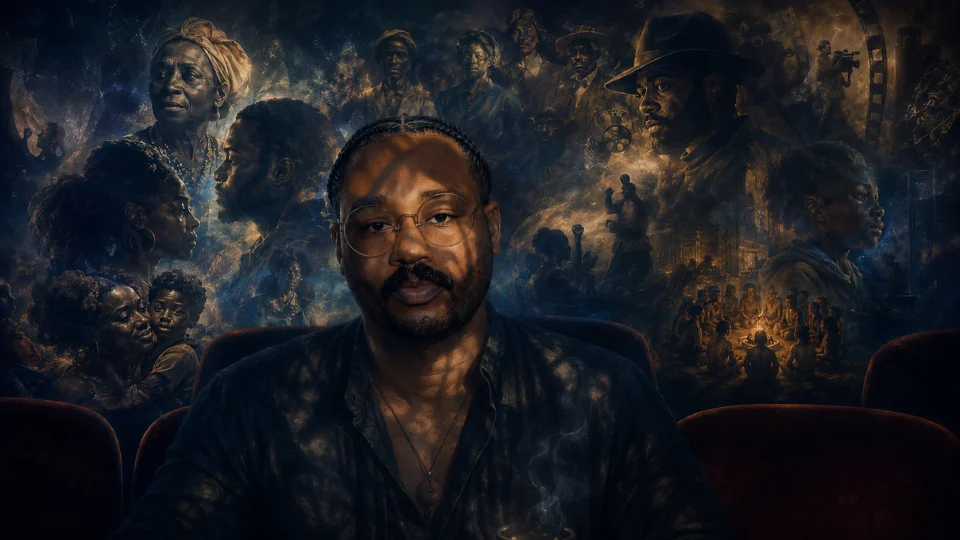
Ryan Coogler’s birth chart features a Yod, a rare astrological configuration often called the “finger of fate” or “finger of God.” In astrology, a Yod signals a powerful sense of destiny and a singular life path. I had already written a meditation on Coogler as a cinematic medium to celebrate his 40th birthday, before feeling drawn to see whether his chart was available online. What I found aligned uncannily with what I had sensed. Before incarnating on earth, Coogler’s Ori—his spiritual essence—made deliberate and intriguing astrological choices. He arrives in this life with a distinct mission, destined to face intense karmic lessons that demand resilience, persistent effort, and adaptability.
After watching Black Panther: Wakanda Forever, I called my best friend, as I always do after experiencing something profound. I told him it was one of the cleverest films I had ever seen—especially by a Black director. I remarked on Coogler’s depth, insisting that we had only begun to glimpse the full extent of his creative mind. When Sinners was released, brimming with symbolism, the depth I had sensed became unmistakably clear.
I have always had a knack for perceiving what lies beneath the surface, perhaps because my Moon is in Scorpio. Let me share a story. I once aspired to become Jamaica’s greatest novelist. From childhood, I felt destined to be a writer, so this dream felt natural. Then I read The Book of Night Women. I told my mentor, half‑laughing and half‑bereft, that Marlon James had shattered my dream because he was on his way to becoming Jamaica’s greatest writer. If he had been anywhere near me after I finished the book, I might have jokingly strangled him. Ultimately, I laid that dream down—rightly so, as I now recognize fiction writing as my anti‑talent. As I foresaw, James went on to become the first Jamaican writer to win the Booker Prize.
Maybe writers can recognize each other, intuitively sensing who stands out in their creative circles. Ryan Coogler stands out. He not only possesses a remarkable intellect but also the skill to articulate his thoughts through both words and film. At the apex of his Yod, Mercury sits in Gemini, in conversation with Pluto in Scorpio (Scorpio is his Ascendant) and Neptune in Capricorn. This astrological configuration gives Coogler a mind (Mercury) influenced by Plutonian depth (trauma, death, transformation), Neptunian permeability (empathy, psychic openness, filmic and imaginal space), and the Scorpio Ascendant’s intense, x‑ray gaze into underworld realities.
This is why Coogler’s films function as a form of on-screen mediumship. His cinematic worlds are populated by communions with the dead—ancestors, lost fathers, departed kings, and beloved figures who linger between scenes, across music, and within altered planes of existence. Yet communion with the dead is only the first register of Coogler’s mediumship. With Neptune in his Yod, Coogler possesses what some might call a leaky aura or psychic sponge. He has an inner permeability, a psychic openness that allows others’ grief to seep through. His films reveal an artist who does not simply feel pain from a distance but receives it, experiences it, and channels it into film, music, gesture, and aftermath—thereby embodying quintessential Neptunian qualities.
Coogler’s inner life is porous enough to admit the sorrow, longing, and unfinished business of others. Such permeability is both dangerous and gifted. It creates the psychic space in which the dead may be felt, but also the space in which the living pour their tears. In Coogler’s cinema, this watery register matters. Again and again, his films return to women’s grief, to women’s tears, to the emotional and imaginal world of women when Black life has been ruptured, and they are left among the fragments.
If any planet in the sky embodies the spirit of Esu-Elegba, it is Mercury—and Coogler is undeniably mercurial. In my cine-essay, I wrote: “Coogler emerges as a profound messenger; if Elegba, the Yoruba trickster and guardian of the crossroads, were to manifest as a filmmaker, it would be in Coogler.” I was right to intuit this because Mercury forms seven aspects in his chart, imbuing him with what I would call a “Seventh Son” energy. Across traditions, the seventh son is often seen as marked by destiny: sometimes as an extraordinary healer or seer, other times as a bearer of a dangerous curse, such as a werewolf or vampire. Is it any wonder, then, that Coogler conjured a vampire in Sinners? Yet more often, the “Seventh Son” is a healer and visionary, gifted with the ability to foresee the future or possess “second sight.”
Coogler’s Yod first manifests in Fruitvale Station, his debut feature and his inaugural act of cinematic mediumship. In this work, he speaks to and for Oscar Grant. What lingers most after viewing the film is not Oscar’s murder at the hands of state violence, but the ordinary tenderness of a day unaware of its impending doom and the deep mourning that follows. Coogler humanizes Oscar, rendering the loss all the more unbearable: we witness his mother’s tough love, his daughter’s laughter, and his desire to be a better man for the woman who loves him. The film unfolds as a dialogue between Pluto and Neptune, facilitated by Mercury, revealing that its true subject is what lies beyond death. Oscar is violently taken into an otherworldly space, but the women who formed the center of his world—his daughter, his partner, his mother, and his sister—are left with grief, guilt, memory, tears, protest, and the impossible labor of carrying broken lives forward.
In Creed, rupture takes the form of a broken lineage. Adonis is shaped by the father he never met, guided by a presence carried in his blood rather than in memory. Here, Coogler’s mediumship shifts to ancestral inheritance as an inward, animating force—the parent who lives within, serving as ancestral guide. In African thought, ancestors can return through a family line or exist among a person’s collective selves to continue unfinished work. Like Fruitvale, Creed is structured by aftermath and unresolved karma. Apollo is already gone, yet he remains an inescapable force—one that must be lived with, not overcome.
This is a central Plutonian challenge at the core of Coogler’s Yod: transmutation. In grappling with Pluto’s complexities, Coogler must probe deeply into every subject, shunning surface‑level answers. He is driven to research, to explore what is taboo, to ask the deeper questions: How does one come back from failure, from humiliation, from brokenness? In Creed II, when Adonis sinks to the bottom of the pool to scream, that is a quintessential “Cooglerian” moment: the emotional explosion occurs in a safe, contained Neptunian space. Pluto’s strength in Scorpio grants Coogler a controlled use of this intense energy. Solitude is essential for his well-being and creativity, because it gives him a tremendous capacity to focus; it is this inward focus that lends such heart‑energy to Creed.
In Black Panther, and even more so in Wakanda Forever, Coogler’s films dive deeply into the watery realm of grief. The sequel revolves around the death of T’Challa and, beyond the story itself, the real-life passing of Chadwick Boseman, transforming the film into both a narrative and a communal ritual of mourning. Coogler describes grief as a bomb, its blast radius wounding those closest to the loss most profoundly. Once again, the emotional center of the film belongs to the women—Shuri, Ramonda, Nakia, Okoye—through whose tears and resilience Coogler channels his empathy. His work brims with “relational depth,” as if he is continually exploring the dimensions of love: personal, communal, and collective.
Coogler’s Yod reaches new intensity in Sinners, where he dramatizes themes of Death, Sex, Obsession, Alcoholism, Power, Toxic Authority, Emotional Repression, the Vengeful Victim and Secrecy. The film’s juke-joint sequence serves as a sacred (Neptunian) gathering place, uniting ancestors, the Living, and the yet-to-be-born, with music transformed into a medium for healing. Here, Coogler fully engages with the African cosmological field only hinted at in Black Panther. He takes Black history in his hands and shakes it with Plutonian force, venturing boldly where others hesitate. Coogler’s mediumship is inseparable from the aftermath. He does not present the Maafa as a story concluded. Instead, he insists we recognize its persistent echoes in the present. The end of formal captivity wasn’t true emancipation, but reverberation. The civil rights movement did not end anti-Black violence, because its continuation is seen in the persistent realities of Black male imprisonment, whether in juvenile detention, prison, probation, surveillance, or the anticipatory criminalization shadowing Black boyhood. The tears of Black women continue to flow, as they so often remain the ones left to gather the fragments.
To see Coogler as a cinematic medium is to recognize an artist defined by permeability—someone who opens himself to the grief and complexity of Black life and transforms it into cinematic expression. He channels not only the voices of the dead but also those of the Living, attuned to the cries that follow violence, the silence after a father’s passing, the tears shed for a buried king, and the sacred wound left when covenants with the future are ruptured. Through his films, Coogler poses a persistent, haunting question: how do we piece together what has been broken?
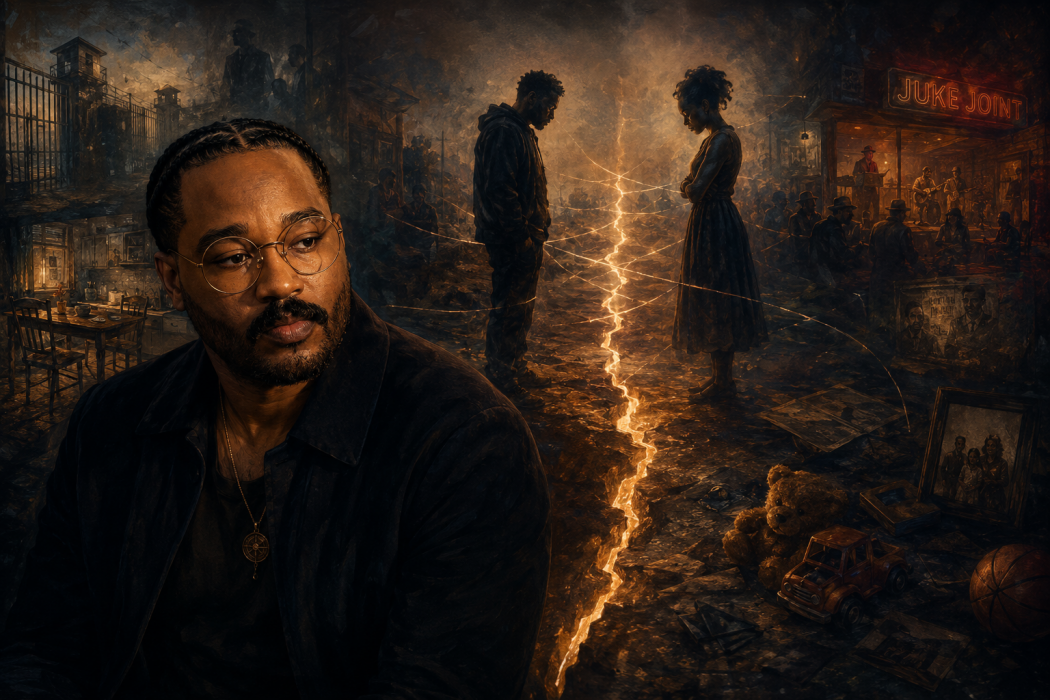
What I like most of all about Coogler’s films is how they point toward a relational ethics of reassembly. In watching his films, I am also reminded of Gwendolyn Brooks’ words: “we are each other’s harvest … business … magnitude and bond.” Coogler’s gift as a cinematic medium lies in his ability to take the intricate field of Black male and female relationships and make it his central “show business.”
Across Fruitvale Station, Creed, Black Panther, Wakanda Forever, and Sinners, Coogler continually returns to the charged space between Black men and Black women—mothers and sons, lovers, sisters and brothers, queens and protectors—examining it with a tenderness that feels like an “eye on the inside.” Here, Brooks’ words are more than poetic, as Coogler films the magnitude and the bond, showing how, even after the devastations of Maafa and Jim Crow, Black life is sustained by these relationships and the work they do in grief, conflict, and care.
Coogler’s Maya Birth Kin is 126—World Bridger. This day sign, known as Cimi, also connects him to the underworld. Death is the root word of Cimi, where it is not an end but a transformative force. Death turns the present into the past and gives birth to the future. Through Cimi, Coogler is blessed by the spirits of the ancestors. His tall and coolest glass of water comes from this world. As he drinks, Coogler is compelled to question prevailing beliefs and to dismantle those that no longer serve the greater good. He listens to the inner call for death and transmutation, recognizing both the consequences and the possibilities that accompany transformation. Every experience becomes material for his evolution. And Coogler is destined to evolve, especially with the powerful addition of Mars in Capricorn to his Yod—one of astrology’s most auspicious aspects. If I could give everyone just one astrological placement, it would be Mars in Capricorn. My eldest son has this placement, and I have witnessed firsthand how this celestial energy manifests: it confers a steady, relentless drive to reach the top of the mountain of any chosen pursuit.
Ryan Coogler was born on May 23, 1986, making him 40 years old today. He stands as a living exemplar of what it means to be young, gifted by astrology, and Black. His astrological gifts will continue to manifest powerfully in his life’s work as a cinematic medium. As he moves into deeper realms, he will continue to shock and inspire, bringing to light the hidden thoughts, feelings, and motivations of the underworld—realms that demand acknowledgment and reckoning.
Author’s note:
I am not a professional astrologer, but my passion for astrology matches my deep love for Black history. Over the years, I have taken short courses and read numerous books on astrology (both Vedic and Western), all in pursuit of self-knowledge.
References / Further reading
Ryan Coogler natal chart, Astro-Charts – “Ryan Coogler: Filmmaker; Black Panther, Creed, Fruitvale Station.”
https://astro-charts.com/persons/chart/ryan-coogler/
Ryan Coogler interview on grief and Black Panther: Wakanda Forever, Screen Rant.
https://screenrant.com/black-panther-wakanda-forever-ryan-coogler-interview/
Margaret Busby (ed.), Daughters of Africa: An International Anthology of Words and Writings by Women of African Descent (Jonathan Cape).
Kambole Campbell, “Ryan Coogler’s Communions with the Dead,” Seen (BlackStar Projects).
https://blackstarprojects.org/seen/read/issue-009/ryan-cooglers-communions-with-the-dead
Donna Cunningham, Healing Pluto Problems (Weiser Books).
Liz Greene, The Astrology of Fate (Weiser Books).
Howard Sasportas, The Twelve Houses: Understanding the Importance of the Houses in Your Astrological Birth Chart (Flare Publications).