
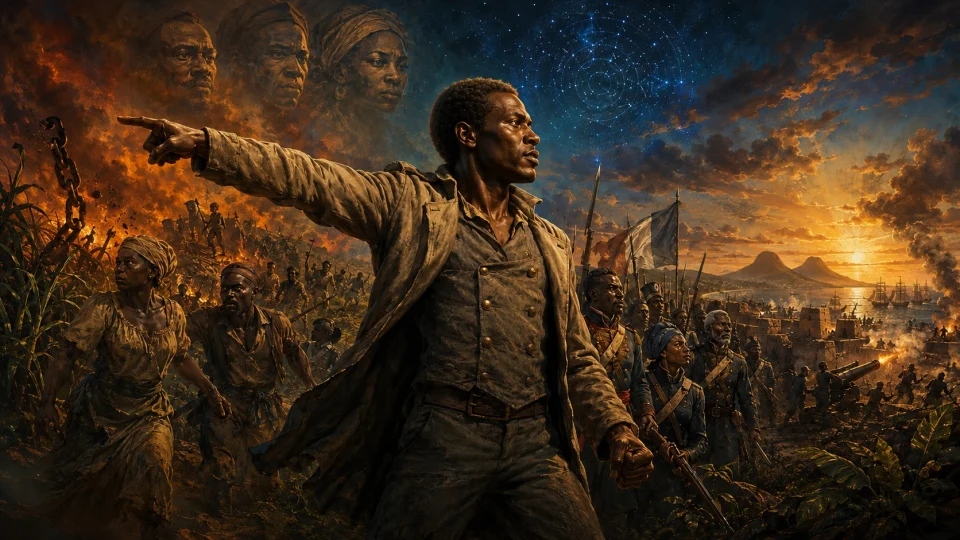
Joseph Ignace of Guadeloupe (c. 1769–1802) was a renowned freedom fighter and French Republican military officer, celebrated as one of the foremost heroes of Guadeloupe’s resistance to the Maafa. On May 25, 1802, he chose to end his own life rather than surrender to Napoleon Bonaparte’s forces, who sought to reimpose bondage on the island.
Born into the furnace of captivity in Pointe-à-Pitre, he became a carpenter, then walked the path of self-liberation, joining communities of Africans who had torn themselves from the plantation order and reconstituted themselves as sovereign beings in stolen land. Ignace first appears in the historical record during the great uprising of Pointe-à-Pitre in 1792, demonstrating a political consciousness that anticipated the formal abolition of the Maafa by two years.
In 1794, when French Revolutionary commissioner Victor Hugues arrived to proclaim the abolition of slavery in Guadeloupe, Ignace enlisted in the Republican army and fought alongside Hugues against the British forces occupying the island. He rose steadily through the ranks, becoming a captain by 1801 and subsequently chef de bataillon (battalion commander) in 1802, taking command of Fort de la Victoire in Pointe-à-Pitre. Ignace also played a pivotal role in the 1801 coup that expelled the pro-Napoleonic governor, Jean-Baptiste Raymond de Lacrosse, from the island.
In early 1802, Napoleon Bonaparte sought to reinstate slavery in the Caribbean territories under French control. On May 6, General Antoine Richepance landed at Pointe-à-Pitre with approximately 3,500 troops and began disarming Black and mixed-race soldiers. Refusing to submit, Ignace escaped with about 150–200 men and led a daring march across the island to Basse-Terre. There, he persuaded Colonel Louis Delgrès, commander of the local Republican forces, to assume leadership of the armed resistance.
Ignace stood out as even more radical than Delgrès in his political vision—not only did he reject the reimposition of slavery, but he also openly demanded complete independence from France, pushing beyond the aspirations of his ally. On May 22, 1802, the two broke out of the besieged Fort Saint-Charles. They divided their forces: Delgrès retreated toward Matouba, while Ignace advanced toward Pointe-à-Pitre.
On May 25, 1802, Ignace and his men took up a defensive position at Fort Baimbridge in Les Abymes. There, they were overwhelmed by the combined might of Richepance’s troops and Magloire Pélage—a Black officer who had defected to the French—supported by formidable artillery. Unwilling to surrender, Ignace honored his oath, “Vivre libre ou mourir” (“Live free or die”), by taking his own life. Around 700 of his comrades perished in the battle, including one of his sons. The approximately 250 survivors were executed in the Place de la Victoire in Pointe-à-Pitre the next day, with a second son of Ignace among those killed.
Six days later, on May 28, Delgrès and his remaining fighters detonated their position at Matouba rather than surrender.
Today, Joseph Ignace is revered as a foundational hero of Guadeloupean identity and a powerful symbol of resistance to the Maafa. Each May 27—Guadeloupe’s official Day of Commemoration of the Abolition of Slavery—he is honored alongside Delgrès, Solitude, and other freedom fighters. In his memory, a prominent statue by Guadeloupean sculptor Jacky Poulier was unveiled on the Boulevard des Héros in Les Abymes on May 22, 1998. Ignace was also portrayed by actor Jean-Michel Martial in Christian Lara’s 2005 film 1802. Scholars note that “Ignace and his comrades deserve recognition” as committed revolutionaries who shaped every stage of Guadeloupe’s thwarted revolution.
Source:
https://fr.wikipedia.org/wiki/Joseph_Ignace
http://une-autre-histoire.org/joseph-ignace-biographie/
https://outremermemory.com/joseph-ignace-1769-1802/
http://www.memoires-de-guadeloupe.com/patrimoine/fiche/47
https://www.mmoe.llc.ed.ac.uk/en/memory/statue-joseph-ignace-les-abymeshttp://www.lameca.org/publications-numeriques/dossiers-et-articles/1802-la-rebellion-en-guadeloupe/histoire-baimbridge-et-fouillole-dans-la-tourmente-revolutionnaire-de-1802/
https://www.agenda21culture.net/sites/default/files/2025-11/brochure_pdp_ignace.pdf https://slaveryandremembrance.org/partners/partner/?id=P0065