

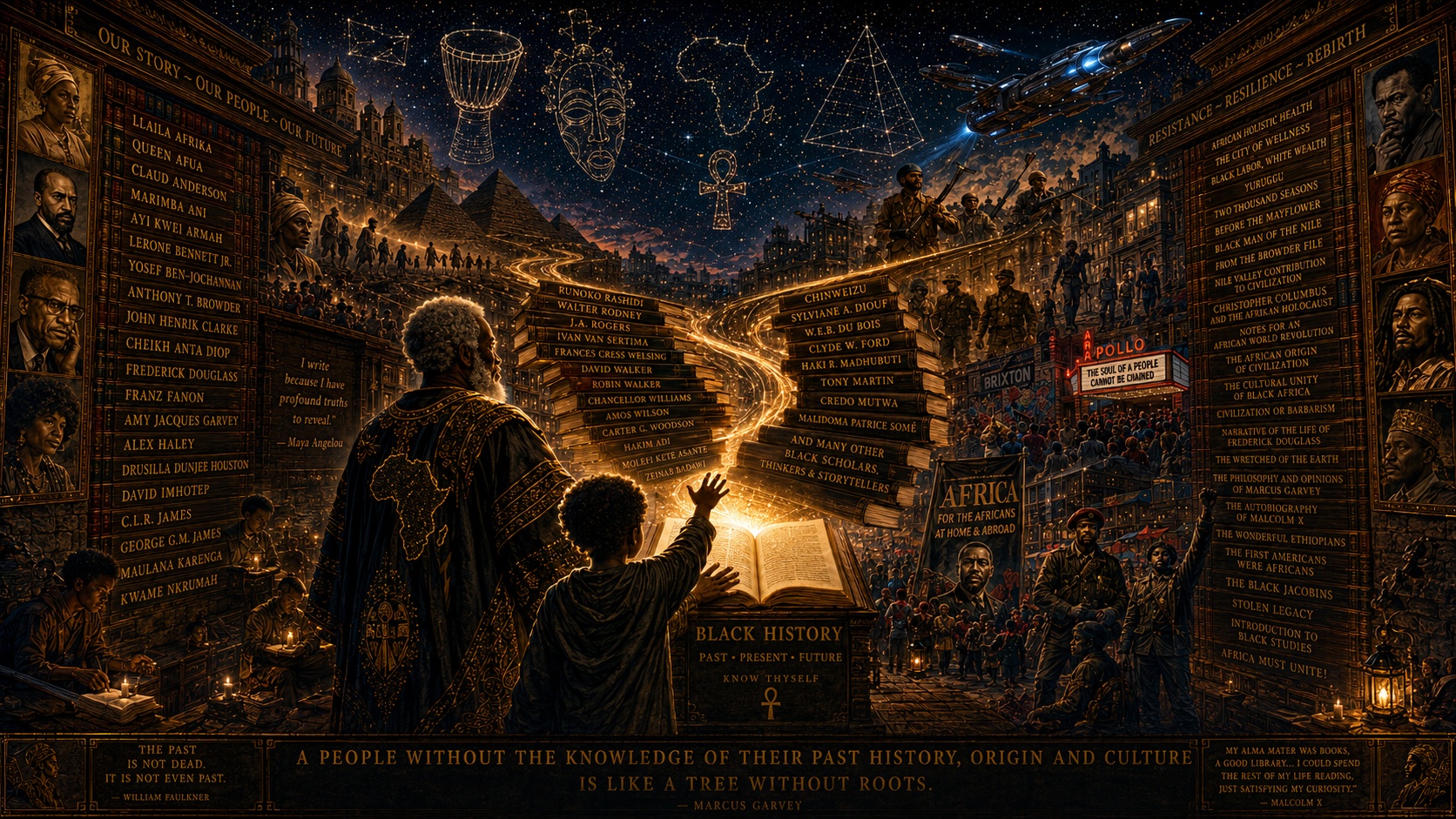
Maya Angelou stated, “I write because I have profound truths to reveal.”
I believe it is our individual responsibility to read and study the works of Black authors with profound truths to reveal. Truths revealed and acted upon can lead to the revolution that must begin within. Such truths can awaken us from social amnesia, stir the dormant genes within our cells that contain the ancient knowledge of who we are, and “unearth what W.E.B. Du Bois called the ‘soul of Black folk.’”
Reading makes us grow and develop so we can move toward determining our own destiny. As Malcolm X puts it:
“My alma mater was books, a good library… I could spend the rest of my life reading, just satisfying my curiosity.”
If you would like to satisfy your curiosity, here is a list of books on Black history compiled by Dr. Runoko Rashidi, to get you started.
African Holistic Health by Llaila Afrika presents an African-centered approach to health, linking diet, lifestyle, spirituality, and environment, and offering herbal and homeopathic remedies tailored to the specific needs of people of African descent.
The City of Wellness by Queen Afua outlines a “dietary greenprint” and Liberation Diet for healing African-descended communities, combining plant-based nutrition, cleansing, and spiritual practices to address malnutrition, obesity, and emotional trauma.
Black Labor, White Wealth by Claud Anderson traces how coerced Black labor built “white” wealth in the Americas, arguing that structured exploitation and discriminatory policy created a racial wealth gap requiring targeted, group-centered economic strategies.
Yurugu by Marimba Ani offers an Afrikan-centered critique of European thought, arguing that European culture’s incomplete, “Yurugu” nature underlies global white supremacy and structures of domination.
Two Thousand Seasons by Ayi Kwei Armah is an epic fiction that compresses roughly a thousand years of African history into a single narrative about a West African community’s drift from, and struggle to return to, a communal “way” of reciprocity. Told in a first-person plural voice, it traces how Arab and European “predators” and local collaborators usher in enslavement, patriarchy, and betrayal, while rebels and seers fight to reclaim an egalitarian, African-centered social order.
Before the Mayflower by Lerone Bennett surveys Black American history from African origins through slavery, Reconstruction, Jim Crow, and the civil rights era, highlighting Black resistance and contribution.
Black Man of the Nile by Yosef A.A. Ben-Jochannan documents African origins of ancient Nile civilizations, asserting that Kemet was fundamentally Black and central to world civilization.
From the Browder File by Anthony T. Browder collects essays that decode African-centered history, symbolism, and politics, challenging Eurocentric narratives and encouraging independent research.
Nile Valley Contribution to Civilization by Anthony T. Browder highlights scientific, spiritual, and cultural innovations of Nile Valley societies and their influence on later “Western” civilization
Christopher Columbus and the Afrikan Holocaust by John Henrik Clarke reframes Columbus’s voyages as the opening of an African holocaust, linking conquest, slavery, and European capitalism.
Notes for an African World Revolution by John Henrik Clarke gathers Clarke’s essays arguing for Pan-African unity, historical consciousness, and revolutionary struggle against global white supremacy.
The African Origin of Civilization by Cheikh Anta Diop asserts that ancient Egypt was a Black African civilization and demonstrates Africa’s foundational role in global culture and science.
The Cultural Unity of Black Africa by Cheikh Anta Diop argues that Black African societies share deep cultural continuities in religion, social organization, and worldview, despite colonial borders.
Civilization or Barbarism by Cheikh Anta Diop synthesizes Diop’s research on African history, anthropology, and linguistics to argue for Africa’s central place in humanity’s development.
Narrative of the Life of Frederick Douglass by Frederick Douglass is an autobiographical account of Douglass’s life from enslavement to escape, exposing the Maafa’s brutality and the making of a freedom fighter.
The Wretched of the Earth by Franz Fanon examines colonization’s psychological and structural violence, arguing that decolonization often requires revolutionary force and profound cultural renewal.
The Philosophy and Opinions of Marcus Garvey by Amy Jacques Garvey collects Garvey’s speeches and writings on race pride, Pan-Africanism, and “Africa for the Africans,” articulating a mass Black nationalist program.
The Autobiography of Malcolm X by Alex Haley traces Malcolm X’s transformation from street hustler to disciplined revolutionary, framing his evolving critique of racism and imperialism.
The Wonderful Ethiopians by Drusilla Dunjee Houston reclaims the history of Cushite/Ethiopian civilizations, portraying them as advanced Black empires that influenced world culture.
The First Americans were Africans by David Imhotep presents arguments and evidence that Africans reached the Americas before Columbus, challenging conventional timelines.
The Black Jacobins by C.L.R. James narrates the Haitian Revolution as a mass Black uprising led by Toussaint Louverture, reshaping slavery, empire, and modern politics.
Stolen Legacy by George G.M. James asserts that Greek philosophy was largely appropriated from Egyptian Mystery teachings, challenging Eurocentric histories of philosophy.
Introduction to Black Studies by Maulana Karenga provides a foundational framework for Black Studies, covering history, politics, culture, economics, psychology, and philosophy from an Afrocentric perspective.
Africa Must Unite! by Kwame Nkrumah rgues that only a politically and economically unified Africa can defeat neocolonialism and secure development.
African Star Over Asia by Runoko Rashidi explores African presences in Asia, highlighting Black communities and individuals across the continent’s history.
Black Star: The African Presence in Early Europe by Runoko Rashidi documents historical Black figures and communities in Europe, challenging assumptions about an exclusively white European past.
How Europe Underdeveloped Africa by Walter Rodney analyzes how slavery, colonialism, and capitalism systematically extracted African resources and stunted development, arguing that Europe’s advancement was directly linked to Africa’s deliberate underdevelopment.
100 Amazing Facts About the Negro by J.A. Rogers presents concise vignettes on notable Black achievements and histories worldwide, aimed at countering racist myths.
Blacks in Science by Ivan Van Sertima collects essays on African and diasporic contributions to science, technology, and invention across history.
They Came Before Columbus by Ivan Van Sertima asserts that Africans made pre-Columbian voyages to the Americas, influencing Indigenous cultures and technology.
The Isis Papers by Frances Welsing interprets racism as a system rooted in white fear of genetic annihilation, analyzing symbols, institutions, and behavior to explain white supremacy’s psychological foundations.
Appeal to the Colored Citizens of the World by David Walker is a fiery pamphlet condemning captivity and racism, urging enslaved Africans and free Blacks to resist oppression by any means necessary.
When We Ruled by Robin Walker synthesizes evidence of ancient and medieval Black civilizations, emphasizing African leadership in science, statecraft, and culture before European domination.
The Destruction of Black Civilization by Chancellor Williams reconstructs African history from antiquity to modernity, arguing that internal weaknesses and external invasions destroyed independent Black civilizations, and proposing paths to restoration.
Blueprint for Black Power by Amos Wilson argues that liberation requires organized Black economic and institutional power, proposing comprehensive strategies for building autonomous structures in education, finance, media, and politics.
The Miseducation of the Negro by Carter Woodson argues that colonial schooling trains Black people to serve others’ interests, calling for education that centers African history, self-reliance, and institution-building.
Although this is a very rich and comprehensive list compiled by Dr. Runoko Rashidi, I would like to add a few more books that further deepen our understanding of African and African diasporic history, thought, and spirituality.
African and Caribbean People in Britain – Hakim Adi
Hakim Adi offers a sweeping history of African and Caribbean people in Britain from the earliest human presence on the islands to the late twentieth century. He shows that African and Caribbean men and women have been “at Britain’s heart” from the beginning, challenging the idea that Black presence is recent or marginal.
Drawing on new archival research, Adi highlights Black participation in major British developments—abolition, the fight for universal suffrage, the world wars, the creation of the NHS, and anti-racist struggles—demonstrating that Britain’s “greatest collective achievements” are inseparable from African and Caribbean activism. The book also traces changing racial terminology and the evolution of Black political organizing, offering a resource for understanding both historical continuities and contemporary debates about race, belonging, and nationalism in Britain.
The History of Africa: The Quest for Eternal Harmony – Molefi Kete Asante
Molefi Kete Asante presents a wide-ranging history of Africa from early prehistory to the contemporary era, written from an Afrocentric perspective that centers African people as historical subjects rather than objects. He frames African history as a “quest for eternal harmony,” emphasizing the philosophical, cultural, and ethical principles that undergird African societies across time.
Asante moves through ancient Nile civilizations, Sahelian empires, forest kingdoms, colonial conquest, and independence struggles, using cultural, social, political, and economic lenses rooted in African worldviews. The book challenges Eurocentric narratives that portray Africa as a place without history, and instead foregrounds African agency, creativity, and complexity, making it both an overview and a theoretical intervention in how history itself is told.
An African History of Africa – Zeinab Badawi
Zeinab Badawi offers a continent-wide history that explicitly seeks to narrate Africa “through an African lens,” from the dawn of humanity to the era of independence struggles. Structured in around seventeen chapters, the book moves chronologically and regionally: from early humans and ancient Nile civilizations to West African empires, internal and external slaveries, European conquest, and the complex routes to decolonization.
Badawi foregrounds African voices, oral traditions, and local perspectives, challenging histories that treat Africa only as a site of European action. She highlights the rise and fall of kingdoms, religious transformations, artistic and architectural achievements, and the enduring impact of extraction and “European predation.” The result is a synthetic narrative that insists African history is global history, and that contemporary Africa cannot be understood without recovering its long, internally driven past.
The West and the Rest of Us – Chinweizu
Chinweizu’s The West and the Rest of Us is a searing, polemical history of five centuries of Western expansion and imperialism, focused especially on Africa. He characterizes “the West” as a single predatory formation that has waged an “unbroken assault” on non-Western peoples through slavery, conquest, colonial rule, and neocolonial economic arrangements.
The book examines not only European and American aggression, but also the complicity of African elites—“black slavers” and postcolonial petite bourgeoisies—who helped sustain systems of exploitation. Chinweizu dissects colonial policy, “strategic decolonization,” international law, foreign aid, debt, and cultural domination as tools of continued control. His analysis calls for a radical rethinking of African–Western relations and for political, economic, and cultural strategies that break with dependency and restore genuine sovereignty.
Who Betrayed the African World Revolution? – John Henrik Clarke
This collection brings together John Henrik Clarke’s speeches and essays on the unfinished project of global African liberation. Clarke examines the “African World Revolution” as a long historical movement—from anti-slavery struggles and early Pan-Africanism to anti-colonial wars and Black Power—and asks how internal and external forces have undermined its progress.
He critiques Western powers, local elites, and ideological divisions that derailed revolutionary momentum, while also celebrating the “true light” of African history and the contributions of key activists and thinkers. The book weaves historical analysis with political instruction, urging contemporary Africans and people of African descent to recover their historical mission, build unity, and develop strategies that avoid past betrayals.
Fighting the Slave Trade: West African Strategies – ed. Sylviane A. Diouf
This edited volume shifts focus from the familiar narrative of transatlantic slavery as a one-sided process to the many ways West Africans resisted, evaded, and fought the slave trade before embarkation. Drawing on oral histories, European records, ship logs, and archaeology, the contributors document defensive, protective, and offensive strategies developed by communities across West Africa.
Essays explore tactics such as fortifying towns, relocating settlements, organizing armed resistance, creating escape routes, and mobilizing religious and social institutions to shield potential captives. By foregrounding African agency, the volume challenges simplistic narratives of African “complicity” and instead portrays a complex, contested landscape in which the slave trade was constantly resisted on African soil.
The Souls of Black Folk – W.E.B. Du Bois
The Souls of Black Folk (1903) is a landmark collection of essays in which W.E.B. Du Bois sets out to show “what it is like to be a problem” in the United States as a Black person after Emancipation. He introduces the now-classic concepts of the “color line,” the “Veil,” and “double-consciousness”—the experience of always seeing oneself through one’s own eyes and through the eyes of a racist society—and argues that the central problem of the twentieth century will be race.
Across fourteen essays, Du Bois ranges from Reconstruction politics and the failures of the Freedmen’s Bureau to debates with Booker T. Washington over education, portrayals of rural Black life, and a pioneering study of Black religion and spirituals. He interweaves sociological analysis, history, autobiography, and lyrical meditation, mourning his own child’s death and narrating fictionalized portraits like “Of the Coming of John” to dramatize how racism crushes aspiration. The book ends by elevating Negro spirituals as “the most beautiful expression of human experience born this side the seas,” insisting that Black culture and struggle are central to American democracy’s fate.
The Hero with an African Face: Mythic Wisdom of Traditional Africa – Clyde W. Ford
Clyde W. Ford “reclaims” African mythology as a missing pillar of world myth, arguing that its stories are as philosophically rich and archetypally powerful as the Greek, Near Eastern, and Asian traditions more familiar to Western readers. Drawing on tales from across the continent—Ashanti, Yoruba, Congo, Uganda, and others—he presents creation myths, underworld journeys, heroic quests, and transformation stories, and then interprets their symbols, metaphors, and structures. Figures like Kwasi Benefo, Kintu, and Mwindo become guides to questions of love, loss, community, destiny, and the relationship between humans, nature, and the divine.
Ford extends a Campbellian “hero’s journey” framework but adapts it to African worldviews, highlighting how African hero archetypes are expected, communal healers rather than isolated, exceptional individuals. He also reads the African diaspora—especially the forced displacement of enslaved Africans—as a vast, collective heroic ordeal, suggesting that many captives may have interpreted their suffering in mythic terms. In doing so, the book offers both a primer on African myth and a meditation on how those myths can help people of African descent (and others) recover meaning, identity, and spiritual depth in the aftermath of enslavement and racism.
Black Men, Obsolete, Single, Dangerous? – Haki R. Madhubuti
Haki R. Madhubuti’s influential work is a collection of essays on the crisis and possibilities of Afrikan American families, with particular attention to Black men. He interrogates stereotypes that cast Black men as “obsolete, single, dangerous,” while also confronting issues of family disintegration, systemic racism, and internalized dysfunction.
Madhubuti emphasizes the transformative power of education, culture, and literature, insisting that healthy Black families require conscious male responsibility, strong women, and community-based institutions. The book combines critique with “essays in discovery, solution, and hope,” offering practical guidance for building stable relationships, raising children, and constructing a self-determined Black future.
Race First – Tony Martin
Race First is a foundational study of Marcus Garvey and the Universal Negro Improvement Association (UNIA), focusing on their ideology and organizational practice. Tony Martin analyzes Garvey’s emphasis on racial pride, self-reliance, economic nationalism, and the creation of global Black institutions—what he termed “Africa for the Africans, at home and abroad.”
The book explores internal debates within the UNIA, conflicts with other Black leaders, and state repression, situating Garvey within the broader history of Pan-Africanism, civil rights, and Black Power. Martin’s meticulous archival work helped solidify Garvey’s centrality to twentieth-century Black political thought and offers insight into the possibilities and challenges of mass-based Black nationalist organizing.
The Jewish Onslaught: Dispatches from the Wellesley Battlefront – Tony Martin
In this controversial work, Tony Martin reflects on the campaign by Jewish organizations and allies to have him removed from his tenured position at Wellesley College after he assigned material on Jewish involvement in the Atlantic slave trade. Through essays and commentaries, he analyzes what he sees as a wider “onslaught” against Black scholars, leaders, and Afrocentric perspectives.
Martin critiques the narrative of an idealized Black–Jewish alliance, discusses debates over anti-Black racism and antisemitism, and defends the right of African-descended scholars to investigate all aspects of slavery’s history. The book thus functions both as a personal defense and as a broader intervention in discussions of academic freedom, historical memory, and the politics of Black–Jewish relations.
Indaba, My Children – Vusamazulu Credo Mutwa
Indaba, My Children is Credo Mutwa’s expansive retelling of African creation stories, epics, and historical memories, particularly those of the Bantu and Zulu peoples. As a self-described Guardian of Tribal History, Mutwa “breaks secrecy” by committing oral traditions to writing—an act both preservative and, within some customary codes, transgressive.
The book moves from cosmogony and deities to heroic sagas and accounts of migrations, wars, and cultural encounters, blending myth, history, and spiritual teaching. Mutwa seeks not only to archive stories threatened by colonialism and modernity, but also to promote mutual respect, honesty, and understanding between Africans and others by revealing the depth and sophistication of African cosmology. It is at once a mythic chronicle and a plea for healing historical wounds.
Of Water and the Spirit: Ritual, Magic, and Initiation in the Life of an African Shaman – Malidoma Patrice Somé
Malidoma Patrice Somé recounts his journey from a Dagara village in what is now Burkina Faso, through forced Jesuit schooling, back to traditional initiation and shamanic vocation. As a child, he is taken to a Catholic seminary, where he spends fifteen years subjected to harsh discipline and indoctrination designed to sever him from his people, language, and spiritual heritage.
Escaping as a young man, Somé returns home only to find himself a stranger, unable to speak his language or function in his own culture. To be reintegrated, he must undergo a grueling month-long initiation in the wilderness, confronting non-ordinary realities and mortal danger. The narrative uses this experience to introduce readers to Dagara cosmology, ritual, and “the crisis of the spirit” in the modern world, casting Somé as a bridge between African spiritual traditions and Western seekers.

3 Responses
Awesome book list!!
I literally asked about a list of books to read on REAL Black/African history about our true heritage and now here it is ….
WE WAZ KEENGZ N QEENZ N SHEIT