
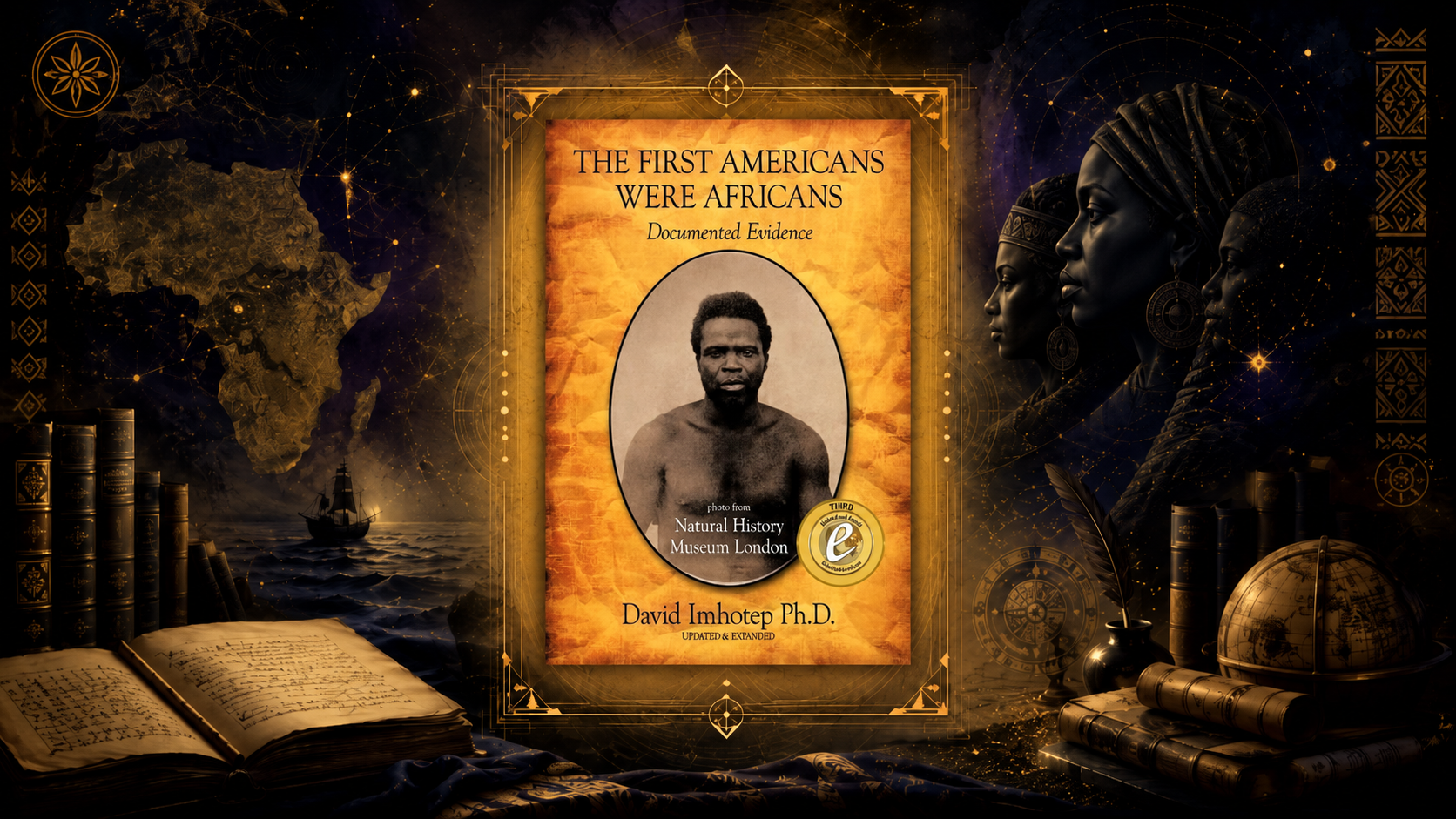
David Imhotep’s The First Americans Were Africans: Documented Evidence begins by challenging the stories through which many readers first encountered American history. In his introduction, he recalls questioning a classroom illustration of Christopher Columbus “discovering” a land whose inhabitants were already watching him arrive. That childhood objection supplies the book’s governing impulse: to interrogate inherited narratives and restore African people to a history that, Imhotep argues, has obscured their presence.
His contention goes far beyond rejecting the Columbus discovery story. He maintains that Africans were the earliest inhabitants of the Americas, arriving before the Clovis culture, at least 60,000 years ago. Drawing on material from several scientific and historical disciplines, he assembles what he interprets as evidence for a chronology fundamentally different from conventional accounts of the continents’ settlement.
Published by AuthorHouse in 2011, the book includes a foreword by Clyde Winters and an afterword by Molefi Kete Asante. Imhotep presents his project as an extension of Ivan Van Sertima’s work on an African presence in the Americas before Columbus. His aim, however, is not simply to establish early contact across the Atlantic, but to place the beginnings of American settlement within an African-centred account of human migration.
Africa and the earliest Americans
The book’s central concern is origins. Rather than beginning the African story in the Americas with the transatlantic trafficking of people, Imhotep presents Africans as early inhabitants whose movements and achievements belong to a much longer history. His account draws together the work of scholars and researchers in an effort to trace that presence across different bodies of evidence.
The cover photograph offers a striking visual introduction to his argument. According to the book’s description, it was taken during the HMS Challenger expedition of 1872–1876 in Tierra del Fuego, at the southern end of South America. Imhotep uses the image to invite readers to reconsider the identities of the people pictured and their place within the history he seeks to recover.
Egyptians in the Americas
Imhotep also explores what he identifies as evidence of an ancient Egyptian presence in North America. He discusses artefacts, inscriptions and architectural remains that he interprets as signs of Egyptian activity long before the voyages of the Vikings or Columbus.
The geographical scope is broad, extending from the eastern to the western coast of North America, through valleys and mountain landscapes, and encompassing structures both on land and beneath the water. By connecting these places and material remains, Imhotep seeks to reconstruct a chapter of African exploration and influence that he believes has been overlooked.
Recovering a concealed past
Running through the book is a concern with the authority to define historical knowledge: what becomes accepted, what is dismissed, and whose interpretations reach the public. Imhotep portrays the history he is recovering as one that has been suppressed or excluded. The book’s description recounts allegations that researchers pursuing findings outside accepted interpretations faced intimidation, withdrawn funding and threats to their careers.
This sense of recovering concealed knowledge gives the work its urgency. Imhotep situates the book within a continuing project of disclosure, described through his proposed “Lifting of the Veil” series. For him, revisiting the ancient Americas means more than adding neglected details to an existing narrative; it requires reconsidering how that narrative was constructed.
A different starting point
The First Americans Were Africans is an ambitious contribution to African-centred interpretations of the American past. Combining an account of ancient migration with a challenge to the boundaries of accepted history, it invites readers to consider Africa not as peripheral to the American story, but as foundational to it.
For readers interested in African exploration and alternative interpretations of the ancient Americas, the book poses a provocative question: what changes when American history is told with Africa at its beginning?
For more information, please visit David Imhotep’s website, Historic Truths.