
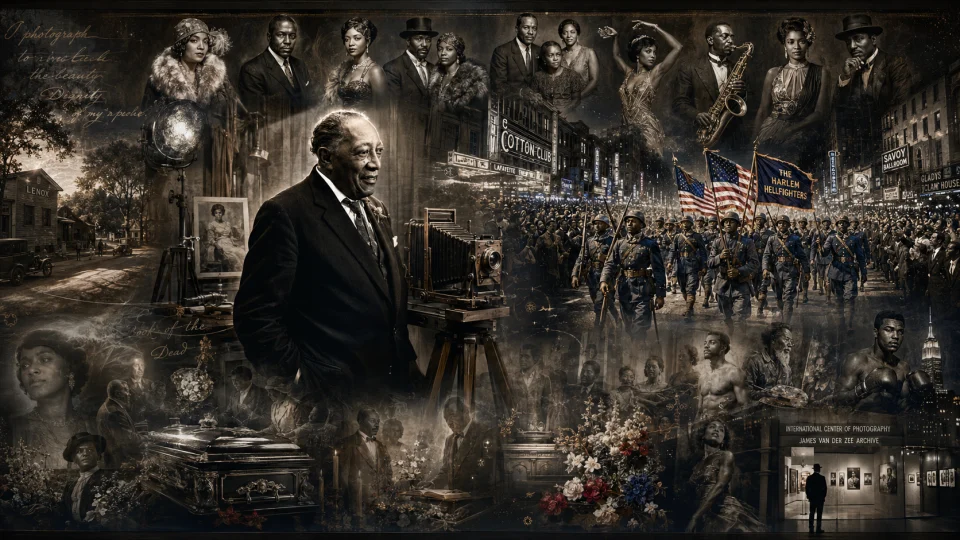
James Van Der Zee was a renowned African American photographer and a central figure of the Harlem Renaissance, celebrated for his evocative portraiture. Over his long career, he combined technical mastery with artistic idealism, producing a rich archive that captured Black dignity, ambition, and daily life. Working primarily from his New York studio, Van Der Zee documented the emerging Black middle class through innovative techniques such as double exposures and careful retouching. His extensive body of work offers a vivid visual chronicle of twentieth-century life, portraying both ordinary residents and notable figures like Marcus Garvey and Bill Robinson. Today, Van Der Zee is celebrated for uniting artistic vision with social documentation, preserving the cultural legacy of Harlem for future generations.
James Augustus Van Der Zee was born on June 29, 1886, in Lenox, Massachusetts, as the second of six children to Elizabeth and John Van Der Zee. His parents reportedly worked as maid and butler to former President Ulysses S. Grant. From a young age, Van Der Zee was recognized as a strong student and demonstrated an early talent for music, becoming a skilled pianist and aspiring violinist. His fascination with photography began around age fourteen, after receiving a toy camera through a magazine promotion. He quickly upgraded his equipment, producing hundreds of photographs of his family and hometown; these images remain some of the earliest visual records of his New England community. As only the second person in Lenox to own a camera, he taught himself to develop photographs, creating a makeshift darkroom in his parents’ home.
In 1906, Van Der Zee moved with his father and brother to Harlem, New York, where he supported himself as a waiter and elevator operator while continuing to pursue music. He co‑founded a five‑person Harlem Orchestra and taught both piano and violin. In 1907, he married Kate L. Brown. The couple briefly returned to Lenox for the birth of their daughter Rachel, then relocated to Phoebus, Virginia, where Van Der Zee worked as a photographer for Hampton Institute. They soon returned to New York in 1908. Following the tragic death of their infant son Emile and mounting marital strain, the marriage ended in 1915. That same year marked a pivotal shift in Van Der Zee’s career: in Newark, New Jersey, he worked as a darkroom technician at Gertz Department Store, impressing customers with his creative posing skills when substituting as a portraitist. Encouraged by this success, he opened his own studio. In 1916, Van Der Zee returned to Harlem, first establishing a studio at the Toussaint Conservatory of Art and Music, founded by his sister Jennie Louise. That same year, he and his second wife, Gaynella Greenlee, opened the Guarantee Photo Studio on West 125th Street, later renamed GGG Studio in her honor.
Van Der Zee rapidly emerged as Harlem’s most celebrated photographer, becoming the principal visual chronicler of the Harlem Renaissance. He was renowned for his meticulously staged studio portraits that drew inspiration from late Victorian and Edwardian aesthetics. Through elaborate tableaux vivants—featuring props, architectural elements, painted backdrops, and carefully directed poses—he conveyed dignity, elegance, and what he termed “Black opulence.” As a master of darkroom artistry, Van Der Zee extensively retouched negatives to eliminate imperfections and enhance glamour, striving to make each image “better-looking than the person” and aiming for photographs that would “transcend the subject.” He pioneered creative techniques such as double exposure and superimposition, sometimes adding “ghostly” children to wedding portraits to allude to a couple’s future or overlaying religious symbols onto funeral images. He even scratched lines into negatives to evoke smoke curling from a cigarette.
Van Der Zee’s work was guided by a distinct artistic philosophy: he believed the photographer’s vision was more important than the camera itself. He famously remarked, “You can see the picture before it’s taken; then it’s up to you to get the camera to see,” and strove “to make the camera take what I thought should be there.” This idealism shaped his refusal to portray Black people as “downtrodden urban or rural poor.” Instead, he presented them as sophisticated, stylish, and educated Americans, with a particular emphasis on the rising Black middle class. During the height of the Harlem Renaissance, from approximately 1918 to 1930, Van Der Zee’s lens captured both the everyday residents and the luminaries of Harlem, resulting in what many consider the most comprehensive visual documentation of the era.
Van Der Zee’s appointment as the official photographer for Marcus Garvey’s Universal Negro Improvement Association (UNIA) in 1924 marked a pivotal moment in his career and in the visual politics of Black representation. Tasked with documenting the association’s members and activities, he created thousands of photographs during the spring and summer of that year. Many of these images were later distributed through a special calendar for Garveyite members in 1925. Van Der Zee’s portraits were thoughtfully composed to convey strength, dignity, and elevated social status, highlighting sophisticated, well-dressed subjects while purposely omitting references to Garvey’s legal controversies or ideological disputes. In doing so, he crafted a powerful visual narrative of Black excellence and collective unity.
Van Der Zee also documented significant historical moments, such as the 1919 victory parade of the 369th Infantry Regiment, known as the “Harlem Hellfighters,” producing an iconic image of Black military pride. Beyond public celebrations, his expansive archive includes school graduations, weddings, and social organizations like the Unity Athletic & Social Club and Les Modernes Bridge Club. He captured countless domestic and community scenes, weaving a rich visual tapestry that chronicles the rhythms and rituals of everyday life in Harlem.
In the years between the world wars, Van Der Zee developed a distinctive specialty in funerary photography, capturing the elaborate mourning rituals and “opulence” with which Harlem families honored their departed. His images often featured superimposed celestial motifs and poetic inscriptions. The loss of his daughter Rachel in 1927 inspired him to create deeply personal funeral portraits, enriched with poetry and spiritual symbolism. This collection was eventually published as The Harlem Book of the Dead in 1978, with a foreword by Toni Morrison, becoming a poignant testament to Black funeral traditions and the role of photography as a medium for remembrance and transcendence.
Over the course of his long career, Van Der Zee photographed an extraordinary array of prominent individuals. In the interwar years, his subjects ranged from Marcus Garvey, Adam Clayton Powell Jr., and Father Divine to Charles “Daddy” Grace, heavyweight champions Joe Louis and Jack Johnson, dancer Bill “Bojangles” Robinson, singer Florence Mills, pianist Hazel Scott, and poet Countee Cullen. Members of the broader community often wished to emulate these celebrities, requesting similar poses and expressions to capture a sense of glamour and aspiration. After his late-career resurgence, Van Der Zee turned his lens to a new generation of luminaries—including Muhammad Ali, Jean‑Michel Basquiat, Cicely Tyson, Bill Cosby, Lou Rawls, Ruby Dee, Ossie Davis, Romare Bearden, and Benny Andrews—thereby extending his visual chronicle of Black cultural life well into the 1970s and early 1980s.
Despite his considerable success during the 1920s and 1930s, Van Der Zee’s business began to decline in the early 1930s. The Great Depression sharply reduced demand for costly studio portraits, while the rising popularity of personal cameras further diminished the need for professional photography. Although his studio managed to survive the Depression relatively unscathed, it suffered greatly in the years following World War II. Van Der Zee increasingly relied on photo restoration, passport photos, and mail-order work to make ends meet. By the mid-1960s, he and his wife, Gaynella Greenlee, faced near-destitution. After being evicted from their Harlem home, they moved to the Bronx, and following Greenlee’s death in 1976, Van Der Zee lived in poverty and poor health.
Van Der Zee’s unexpected “renaissance” began in December 1967, when Reginald McGhee—a researcher for an upcoming Metropolitan Museum of Art exhibition—visited his studio and inquired about photographs from the 1920s and 1930s. Van Der Zee revealed boxes of meticulously preserved negatives, which became the centerpiece of the landmark and controversial 1969 Met exhibition, Harlem on My Mind: Cultural Capital of Black America, 1900–1968. While the show drew criticism for omitting Black painters and sculptors and for presenting Harlem primarily through photography, Van Der Zee’s images were widely regarded as the exhibition’s “biggest revelation.” The show catapulted him to immediate international acclaim.
This rediscovery ignited a remarkable late-career resurgence. With the dedicated support of gallery director Donna Mussenden—who organized his living space, managed his public appearances, and eventually married him in 1978—Van Der Zee revived his portrait practice and began exhibiting his photographs nationwide. He held solo shows at institutions such as the Lenox Library (1970), Studio Museum in Harlem (1971), Lunn Gallery in Washington, D.C. (1974 and 1978), Alternative Center for International Arts and Delaware Art Museum (1979), as well as the Camera Club of New York and Idaho State University (1983). His work also featured in prominent group exhibitions, including Fleeting Gestures: Dance Photographs at the International Center of Photography and a 1993 National Portrait Gallery retrospective. Van Der Zee was honored as a “Fellow for Life” at the Metropolitan Museum of Art, received a Living Legacy Award from President Jimmy Carter in 1979, and was granted several honorary doctorates, including one from Howard University.
In 1981, Van Der Zee filed a lawsuit to reclaim the rights to over 50,000 images held by the Studio Museum in Harlem—photographs he had signed away following his eviction. The case was ultimately settled after his death, resulting in the archive being divided between his estate and the museum. Van Der Zee passed away in 1983 at the age of 96, leaving behind a monumental and unparalleled photographic record of Black urban life in America.
Today, Van Der Zee’s legacy is preserved in the James Van Der Zee Archive, an expansive collection established through a 2021 partnership between the Metropolitan Museum of Art and the Studio Museum in Harlem. The archive comprises over 20,000 prints and 30,000 negatives, along with studio equipment and ephemera, capturing nearly the entire twentieth-century history of Harlem. The holdings are divided between the two institutions—The Met houses approximately 14,000 prints and 23,000 negatives, while the Studio Museum retains about 6,000 prints and 7,000 negatives. The Met also serves as the copyright holder and leads ongoing conservation, digitization, and research. This extraordinary collection places Van Der Zee alongside Walker Evans and Diane Arbus as one of only three American photographers whose complete catalogs are held by the museum, highlighting his stature as “one of the nation’s most important picture makers.”
Reflecting on his own work, Van Der Zee often described photography as a labor of love and a powerful means of expressing his community’s pride. He noted that his photographs sometimes held more meaning for him than for his sitters, since he poured his “heart and soul” into every image. He was especially moved by Harlem’s Sunday rituals—particularly Easter—when “the high class, the middle class, the poorer class all looked good,” and his studio flourished with activity. Today, Van Der Zee is celebrated as the foremost visual historian of the Harlem Renaissance, a visionary creator of Black identity whose portraits of everyday people and cultural icons remain a cornerstone of the history of photography and Black visual culture.
Source:
https://en.wikipedia.org/wiki/James_Van_Der_Zee
https://www.studiomuseum.org/artists/james-van-der-zee
https://www.nga.gov/exhibitions/james-van-der-zees-photographs-portrait-harlem
https://www.moma.org/artists/6074-james-van-der-zee
https://kavigupta.com/blog/108
https://www.kennedy-center.org/education/resources-for-educators/classroom-resources/media-and-interactives/artists/vanderzee-james
https://kavigupta.com/artists/185-james-van-der-zee
https://www.davisart.com/blogs/curators-corner/african-american-history-month-james-van-der-zee-1886-1983-us
https://www.biography.com/artists/james-van-der-zee
https://www.culturetype.com/2021/12/18/archive-of-james-van-der-zee-one-of-the-nations-most-important-picture-makers-headed-to-metropolitan-museum-of-art-in-partnership-with-studio-museum-in-harlem/
https://www.holmesartgallery.com/jamesvanderzee
https://www.lsumoa.org/inside-lsu-moa/2017/8/2/notes-on-photographer-james-van-der-zee