
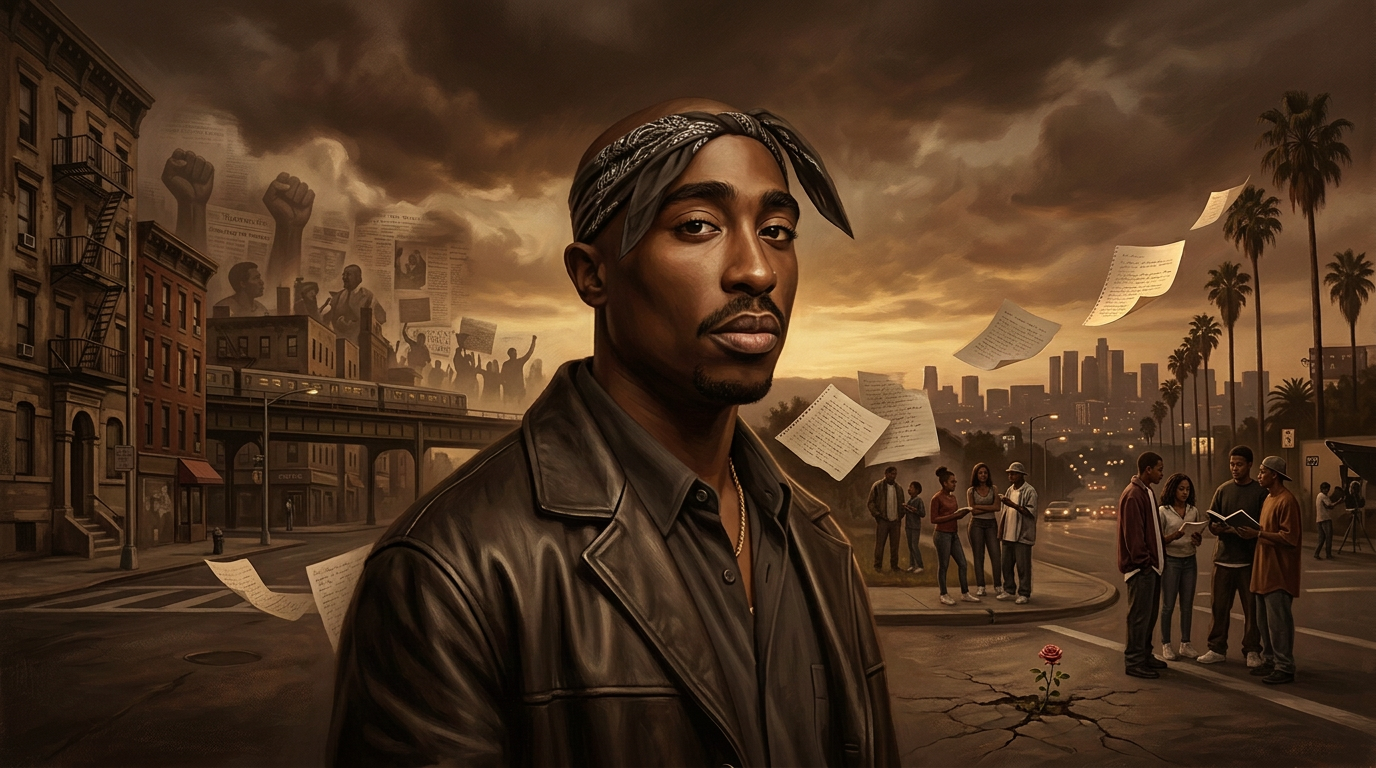
Tupac Amaru Shakur, born Lesane Parish Crooks on June 16, 1971, was an American rapper, actor, poet, and activist whose brief yet impactful life produced one of the most enduring and debated legacies in modern popular culture. Professionally known as 2Pac and later as Makaveli, he sold over 75 million records worldwide, securing his place as one of the most recognizable figures in hip-hop history. Shakur’s work seamlessly blended political witness, personal confession, cinematic performance, and hard-edged bravado, establishing him as both a chronicler of Black urban life and a product of Black radical lineage. Today, his image and influence continue to resonate globally, long after his untimely death.
Born in East Harlem, New York City, Shakur was immersed in politics from birth. His mother, Afeni Shakur, was a prominent member of the Black Panther Party and was pregnant with him while incarcerated and defending herself against conspiracy charges during the famous Panther 21 trial. Initially named Lesane Parish Crooks—partly to shield him from immediate association with the Panthers—he was renamed Tupac Amaru Shakur at about one year old, after the 18th-century Peruvian revolutionary Túpac Amaru II. This renaming was intentional and ideological: Afeni wanted her son to carry the name of a revolutionary, indigenous figure to root his identity in a global culture of struggle and resistance.
Shakur’s family history was a living education in Black radical politics. His stepfather, Mutulu Shakur, was associated with the Black Liberation Army and spent years on the FBI’s Ten Most Wanted list. His godparents included Assata Shakur and Elmer “Geronimo” Pratt, both prominent figures in the Black liberation movement who endured imprisonment or exile. This political inheritance deeply shaped Shakur’s worldview: ideas of self-determination, state repression, collective responsibility, and resistance were not abstract concepts but part of his daily life. The organizational instincts he later demonstrated—such as planning gang truces, youth centers, and national Black uplift initiatives—can be traced directly to the political environment of his upbringing.
However, the world of ideas was inseparable from material hardship. During his first eleven years, Shakur and his family moved repeatedly throughout the Bronx and Harlem, sometimes living in homeless shelters and constantly navigating poverty, surveillance, and instability. Afeni’s political history made stable employment difficult, and her struggle with crack cocaine addiction in the early 1980s further deepened the family’s insecurity. Before leaving New York, they had moved approximately eighteen times. Despite these challenges, Afeni nurtured her son’s artistic side, enrolling him in Harlem’s 127th Street Ensemble, where he made his stage debut as Travis in A Raisin in the Sun. This blend of radical consciousness, economic struggle, and artistic encouragement formed the foundation from which his distinctive voice later emerged.
In 1984 the family moved to Baltimore, Maryland, hoping for a fresh beginning. They settled in a decaying rowhouse at 3955 Greenmount Avenue in the Pen Lucy neighborhood, a place Shakur later remembered as traumatic, with large rats, poor heating, and harsh winter conditions. At Roland Park Middle School, he was initially mocked for his unusual name and thrift-store clothing, but he won respect after defending a girl from a bully, an early sign of the fierce loyalty and public courage that would become central to his image. Baltimore, however difficult materially, was also the city in which his artistry began to take form with unusual clarity.
His artistic growth accelerated at the Baltimore School for the Arts, where he studied acting, poetry, jazz, and ballet. He performed as the Mouse King in The Nutcracker, immersed himself in Shakespeare, and later described his time there as the freest period of his life. The discipline he gained extended well beyond acting ambitions. Behind the apparent spontaneity of his later performances was rigorous training in movement, breath control, vocal projection, and dramatic interpretation—all of which contributed to the chest-driven intensity that made his recorded verses feel like live speech. His engagement with Shakespeare and classical drama also sharpened his understanding of monologue, conflict, betrayal, and shifting persona, qualities that would later animate his lyrics and screen performances.
At the Baltimore School for the Arts, Shakur formed one of the most significant relationships of his life: his friendship with Jada Pinkett (later Jada Pinkett Smith). Their bond, which both described in notably intimate terms, was rooted in shared struggle, creativity, and mutual recognition. He would later call her his “heart,” and she remembered him as a once-in-a-lifetime companion whose presence transcended ordinary friendship. During these years, he also connected with Dana “Mouse” Smith, who became his beatbox partner. Shakur began recording under the name MC New York, performing in local rap contests and writing obsessively in notebooks. Even at fourteen, he filled pages with poems about love, loneliness, mortality, and desire, revealing a literary seriousness that remained central to his artistry, even as he became primarily known as a rapper.
In 1988, before his senior year, Shakur moved with his family to Marin City, California, near San Francisco. This relocation placed him in a vastly different social setting and ultimately connected his future to the West Coast, though his identity remained shaped by his East Coast upbringing, Southern family roots, and global political awareness. He attended Tamalpais High School, continued acting in theater, and increasingly had to fend for himself as his mother’s addiction worsened. Shakur briefly tried to survive through street hustling, including a failed attempt to sell marijuana, but those who knew him noted that he lacked the hardened disposition associated with that lifestyle and remained fundamentally oriented toward performance and writing.
A decisive turning point came when he met Leila Steinberg, who led poetry classes he attended in California. Steinberg recognized his charisma and talent, became his first manager, organized concerts for his rap group Strictly Dope, and eventually introduced him to Atron Gregory, manager of Digital Underground. In 1990, Gregory hired Shakur as a roadie and backup dancer for the group, giving him his first steady entry into the professional music world. He joined their U.S. and Japan tours, quickly gaining a reputation for tireless work. Shakur later recalled that during this period he “never went to bed,” working relentlessly to seize every possible opportunity for recognition.
That drive quickly bore fruit. In January 1991, Shakur made his recorded debut as 2Pac on Digital Underground’s “Same Song,” which also appeared on the soundtrack to the film Nothing but Trouble, where he made a cameo with the group. Later that year, he released his solo debut, 2Pacalypse Now, under Interscope Records, immediately distinguishing himself as a singular voice in hip-hop. Departing from Digital Underground’s comic energy, the album tackled police brutality, poverty, teenage pregnancy, and urban despair with stark honesty and rare empathy. Tracks like “Brenda’s Got a Baby” showcased his ability to tell the stories of marginalized Black girls and women with gravity and compassion, while the album as a whole introduced him as an artist deeply committed to social witness.
The release also thrust him into national controversy. After a young man involved in a police shooting claimed he was influenced by the track “Soulja’s Story,” then–Vice President Dan Quayle publicly called for 2Pacalypse Now to be pulled from stores. This condemnation painted Shakur as a dangerous figure in the eyes of establishment politics, even though the album’s focus was less on glorifying violence and more on exposing the realities that produced it. The backlash fueled his notoriety and, along with the album’s eventual Gold certification, solidified the oppositional public identity that would remain with him throughout his life.
As his career progressed, Shakur developed the concept of “Thug Life,” a phrase often misinterpreted as a celebration of lawlessness. For Shakur, it was a social diagnosis, rooted in the legacy of Panther politics and urban neglect. He famously turned the phrase into an acronym—“The Hate U Give Little Infants Fucks Everybody”—insisting that structural neglect, violence, and contempt toward poor Black children would inevitably harm society as a whole. In this framework, the “thug” was not simply an outlaw to be romanticized, but a figure created by state failure, racism, poverty, and social abandonment. Even when his public persona embraced danger and aggression, the concept retained a sharp critique of the society that produced those conditions.
vHis second album, Strictly 4 My N.I.G.G.A.Z… (1993), marked his commercial breakthrough. Achieving Platinum status, it produced crossover hits like “I Get Around” and “Keep Ya Head Up,” and confirmed his unique talent for moving between exuberant party anthems and socially conscious reflection. This duality became a hallmark of his artistry: he could embody swagger, erotic bravado, and street language, but also give voice to those wounded by misogyny, poverty, and abandonment. This complexity contributed to his mass appeal, while simultaneously making his public identity difficult to confine to a single moral narrative.
This same complexity shaped his gender politics. Shakur’s work frequently expressed deep sympathy for Black women and girls, especially in songs like “Brenda’s Got a Baby” and “Keep Ya Head Up,” which confronted male neglect and affirmed the dignity of women facing structural hardship. These tracks helped build his reputation as an artist unusually attentive to women’s struggles within hip-hop’s masculine culture. Yet, his legacy here remains fraught with contradiction: he was convicted of sexual abuse in 1995—a charge he denied—and continued to produce music that, at times, mirrored the misogynistic and hypersexualized language he elsewhere critiqued. This ongoing tension between advocacy and contradiction remains central to understanding his relationship to women, both in life and art.
Alongside his rise as a recording artist, Shakur also established himself as a compelling actor. In 1992, he starred as Roland Bishop in Juice, landing the role after accompanying rapper Money-B to the audition—and reportedly having only fifteen minutes to prepare. Critics singled out his performance as the film’s most magnetic feature, and it remains one of the earliest truly accomplished dramatic turns by a rapper in American cinema. He followed with Poetic Justice (1993), opposite Janet Jackson, and Above the Rim (1994), further proving his major screen talent apart from his music career. His theater training was evident throughout: he knew how to embody conflict, project menace, and give emotional weight to both silence and speech.
By the mid-1990s, however, Shakur’s growing fame was shadowed by legal troubles, violence, and surveillance. In 1993, he was arrested for shooting two off-duty police officers in Atlanta, though the charges were later dropped. In November 1994, he was shot five times in the lobby of Quad Studios in New York—an event that deeply impacted his views on loyalty, betrayal, and conspiracy. He became convinced that rivals within East Coast hip-hop, including The Notorious B.I.G., Sean “Puffy” Combs, and Haitian Jack Agnant, were somehow linked to the shooting. Whether justified or not, these suspicions intensified the paranoia that increasingly colored his public and private life.
That paranoia cannot be separated from the patterns of violence and state pressure that had shadowed him since childhood. He grew up amid political repression, incarceration, poverty, and constant upheaval—all under the long shadow of Black radical surveillance. As an adult, he faced police brutality, prosecution, imprisonment, and repeated threats, reinforcing his sense of living within overlapping systems of danger. The “paranoid descent” noted by some in his final years was not merely a matter of temperament, but a response to repeated encounters with both state and street violence. His later reading of Machiavelli and Sun Tzu gave him new frameworks for understanding these threats, but did little to relieve the relentless pressure he endured.
Shortly after the Quad Studios shooting, Shakur was convicted of sexual abuse and sentenced to prison. During his incarceration, primarily at Clinton Correctional Facility in Dannemora, New York, he underwent one of the most significant transformations of his life. Unable to use marijuana or alcohol, he later said that the forced sobriety “cleared his head,” and he turned intensely to reading, especially Niccolò Machiavelli’s The Prince and Sun Tzu’s The Art of War. These books shaped his thinking about strategy, power, warfare, and political maneuver, and later informed his adoption of the name Makaveli. At the same time, prison sharpened his reflections on artistic responsibility; he said that if rap was truly an art form, then artists had to take greater responsibility for the effects of their words.
Even while incarcerated, Shakur’s career soared to new heights. In 1995, he released Me Against the World, becoming the first solo artist to debut at number one on the charts while in prison. Widely considered his masterpiece, the album showcased a more vulnerable, introspective, and fatalistic side than his previous work. Its emotional centerpiece, “Dear Mama,” paid tribute to Afeni, acknowledging both her sacrifices and her struggles with addiction, and revealed the unresolved tenderness at the core of their relationship. Prison did not stifle Shakur’s creativity: he continued to write scripts, music, and concepts for community projects, maintaining a lively correspondence with friends, public figures, and supporters.
Among the relationships he maintained, his bond with Jada Pinkett Smith remained especially significant. Their friendship extended into their professional lives—he helped her secure her first film role, she helped him land a guest appearance on A Different World, and she appeared in several of his music videos, including “Keep Ya Head Up” and “Temptations.” Pinkett Smith also contributed financially to his bail when he was incarcerated, and later revealed that he proposed marriage to her during his time at Rikers Island—a proposal she declined. The poems he wrote for her, later published in The Rose That Grew from Concrete, reveal a tenderness often hidden behind his tougher public image. Their relationship provides one of the clearest insights into the emotional and literary depths of his life.
Shakur’s release in October 1995 came through a pivotal—and ultimately constraining—deal with Suge Knight, head of Death Row Records. Knight posted a $1.4 million bond on the condition that Shakur sign a three-album contract with the label. This arrangement freed him from prison but bound him to a volatile corporate and street environment that would define his final year. Immediately after his release, Shakur was flown to Los Angeles, where he launched into an extraordinary period of productivity, often recording in multiple studios simultaneously and inundating collaborators with new material.
The most notable outcome of this period was All Eyez on Me (1996), the first solo double studio album in hip-hop history. Debuting at number one, it produced major hits like “California Love” and “How Do U Want It,” and eventually achieved Diamond certification. The album marked a dramatic tonal shift: while his earlier work centered on social commentary and introspection, All Eyez on Me reveled in excess, sexual bravado, street dominance, and the pleasures of celebrity. Even so, Shakur’s command of performance was undiminished—his voice could move effortlessly between invitation, threat, lament, and triumph, often within a single track.
During this period, Shakur fully embraced his Makaveli persona. Inspired by his prison reading of Machiavelli, the name reflected a more strategic, militant, and war-minded self-image. In the summer of 1996, he recorded The Don Killuminati: The 7 Day Theory in a matter of days, producing one of the darkest and most prophetic albums of his career. Released posthumously, the record delves into themes of mortality, betrayal, revenge, and survival, and its rapid creation added to the mythos surrounding his final months. The Makaveli turn did not erase the poet and political witness of his earlier years, but intensified the sense that he was now performing from within a state of siege.
Shakur’s involvement in the East Coast–West Coast feud intensified dramatically after his release from prison. He became the most prominent spokesperson for the West Coast, particularly in opposition to The Notorious B.I.G. and Bad Boy Records. In June 1996, he released “Hit ’Em Up,” one of the most aggressive diss tracks in hip-hop history—its personal insults and threats further fueling an already volatile rivalry. Friends and observers noted he had changed after prison and the Quad Studios shooting: he was more volatile, more suspicious, and more willing to turn conflict into spectacle. By this point, his art and his life were feeding off one another, making each more combustible.
Even in his final, turbulent year, Shakur’s ambitions reached far beyond music. He completed acting work for films released after his death—including Bullet (1996), Gridlock’d (1997), and Gang Related (1997)—with many critics seeing Gridlock’d as evidence of his potential to become a major film star. He was also developing numerous projects that reflected both entrepreneurial spirit and social vision: a fashion line, restaurant, radio show, publishing company, cartoon series, cookbook, and a video game. Perhaps most notably, he was organizing a production collective for women writers and had scheduled a meeting for the group at his Los Angeles home just days after he was shot. These plans show a figure looking beyond celebrity, envisioning broader cultural institution-building.
His activism remained strongly rooted in his Panther heritage. Shakur aspired to open a center for at-risk youth, support young people through a helpline, and continue funding sports teams in South Central Los Angeles. He envisioned the 50 N.I.G.G.A.Z. initiative—“Never Ignorant, Getting Goals Accomplished”—which aimed to recruit one young Black man from each U.S. state to create a national network of community organizations. He hoped his influence could help broker gang truces and reduce urban violence. These efforts were not mere add-ons to his music career but direct extensions of a political legacy in which community defense and collective organization were essential. In Shakur, the child of Panthers reemerged as a celebrity striving to adapt radical principles to the realities of the crack era and post–civil rights America.
During these years, Shakur’s personal life was marked by a serious relationship with Kidada Jones, daughter of Quincy Jones. This relationship was significant not only for revealing a more private, domestic side of his life, but also because Kidada was by his side in his final days after he was shot. While he was hospitalized, she recalled playing Don McLean’s “Vincent”—a song he had cherished since youth—and seeing him briefly respond. Such moments reveal a vulnerability and tenderness that are often overshadowed by the monumental image of Tupac as icon, martyr, or myth.
On September 7, 1996, after attending the Bruce Seldon–Mike Tyson boxing match at the MGM Grand in Las Vegas with Suge Knight, Shakur became involved in an altercation in the hotel lobby with Orlando Anderson, a member of the South Side Compton Crips. The confrontation, recorded on surveillance cameras, was sparked when Death Row associate Trevon Lane identified Anderson as someone who had previously tried to steal his medallion. Later that night, as Shakur and Knight were driving toward Club 662, their BMW stopped at a red light at East Flamingo Road and Koval Lane. A white Cadillac pulled up alongside, and an occupant fired thirteen shots into the car, hitting Shakur four times and grazing Knight with bullet fragments.
Shakur was rushed to the University Medical Center of Southern Nevada, where he was heavily sedated, placed on life support, and eventually put into a medically induced coma after repeatedly trying to get out of bed. Doctors removed his right lung to control internal bleeding, but his condition remained critical. Afeni Shakur, Kidada Jones, the Outlawz, and other close associates kept a vigil at the hospital, fearing the shooters might return. On September 13, 1996, after six days in the hospital, Shakur died of respiratory failure and cardiac arrest caused by multiple gunshot wounds. He was twenty-five years old.
For decades, Shakur’s murder remained one of the most notorious unsolved cases in popular music. Investigators considered Orlando Anderson a prime suspect, but he was killed in an unrelated shooting in 1998 and was never charged. In September 2023, Las Vegas police arrested Duane “Keefe D” Davis, Anderson’s uncle, following years of public admissions implicating himself in the car used in the shooting and tying himself to the weapon. Davis pleaded not guilty, marking the first significant legal breakthrough in the case after more than twenty-five years. Nevertheless, the mythology surrounding Shakur’s death—fueled by his swift cremation, prophetic lyrics, and the Makaveli persona—continued to inspire conspiracy theories suggesting he had staged his own disappearance.
Shakur’s death did not lessen his cultural influence; in many ways, it magnified it. He left behind a vast archive of unreleased material, particularly from his Death Row years, which became the foundation for numerous posthumous albums and compilations. His achievements continued to grow after his death: he earned six total Grammy nominations, won major music awards, and became the first rapper to have two number-one albums in the same year with All Eyez on Me and the posthumous The Don Killuminati: The 7 Day Theory. His image as both artist and martyr became central to the emotional and visual language of global hip-hop.
Over time, institutions that once viewed Shakur as a threat to public order began to include him in the cultural canon. “Dear Mama” was preserved in the Library of Congress’s National Recording Registry, his work appeared on the Vatican’s online playlist, and his life and lyrics became subjects of university courses, scholarly symposia, museum exhibitions, and sustained academic study. He was inducted into the Rock and Roll Hall of Fame in 2017—his first year of eligibility—becoming its first solo hip-hop artist. In 2023, he received a star on the Hollywood Walk of Fame. These honors represent more than celebrity memorialization; they mark the embrace of a once-controversial Black urban voice into the official narratives of American culture.
Shakur’s legacy also resonates globally in a deeply personal way. The name, Tupac, Afeni gave him connected him from birth to an anti-colonial history beyond the United States. After his death, she had his ashes interred in Soweto, South Africa, further anchoring his memory within a broader geography of Black and liberation struggle. Murals, commemorations, and fan communities around the world now regard him not simply as an American rapper, but as a symbol of resistance, contradiction, pain, and possibility. His life became part of a wider diasporic memory culture, with Black struggle, creativity, and martyrdom narrated across continents.
What remains most striking about Shakur is how impossible it is to reduce him to a single meaning. He was a child of Panthers and a commercial superstar, a trained actor and a street mythmaker, an advocate for vulnerable women and a participant in misogynistic performance cultures, a thinker shaped by poetry and political philosophy, and a celebrity drawn into ever more destructive public conflicts. His voice embodied both the softness of the poet and the force of the agitator. That complexity is precisely what makes him so enduringly compelling.
In just five years as a major recording artist, Tupac Shakur created a body of work and a public persona that continue to resonate because they embody the deep, unresolved tensions of late twentieth-century Black America. He gave urgent voice to grief, anger, longing, desire, and political pain, and vividly dramatized the costs of survival and creation in a world shaped by violence and spectacle. His biography is not merely that of a rapper gone too soon, but the story of a historically rooted artist whose life traced the legacies of Black radicalism, urban struggle, artistic ambition, and global memory.
Source:
https://www.2pac.com-bio/
https://en.wikipedia.org/wiki/Tupac_Shakur
https://www.biography.com/musicians/tupac-shakur
https://www.newyorker.com/magazine/2023/10/30/tupac-shakur-the-authorized-biography-book-review
https://www.rollingstone.com/music/music-features/tupac-biography-only-god-can-judge-me-excerpt-1235444817/
https://www.bbc.co.uk/news/newsbeat-66940018
https://en.wikipedia.org/wiki/Murder_of_Tupac_Shakur
https://www.rollingstone.com/music/music-news/8-ways-tupac-shakur-changed-the-world-128421/
https://www.cbc.ca/news/entertainment/tupac-video-game-stranger-than-heaven-9.7232112
https://www.encyclopedia.com/people/literature-and-arts/music-popular-and-jazz-biographies/tupac-shakur https://www.imdb.com/name/nm0000637/bio/
https://www.youtube.com/watch?v=AQ0WGYfQr
https://www.cbsnews.com/news/tupac-shakur-has-california-street-named-for-him-27-years-after-his-killing/
https://www.nme.com/news/gaming-news/tupac-video-game-snoop-dogg-stranger-than-heaven-3949683