
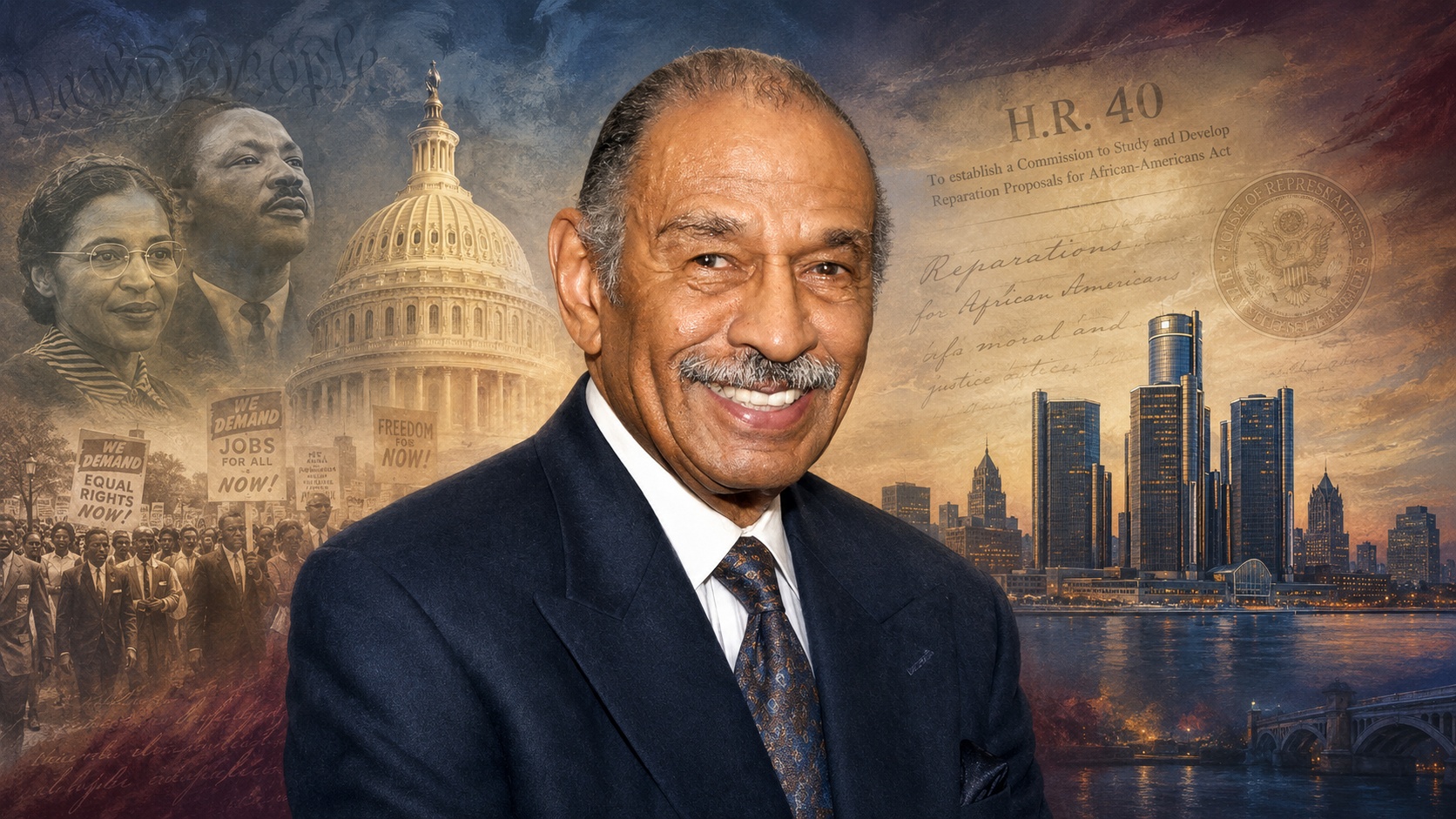
John Conyers Jr. (1929–2019) was the longest-serving African American in congressional history. He was a central architect of Black political power in the late twentieth- and early twenty-first-century United States. Serving as a Detroit congressman for 53 years, Conyers led a determined campaign to transform the unfinished goals of the civil rights movement into law. He brought together the grassroots urgency of Black freedom struggles with the complex, deliberate workings of the U.S. legislative process, persistently urging Congress to address issues of war and peace, police violence, voting rights, and historical redress.
Roots in Detroit’s Black Working Class
Born on May 16, 1929, in Highland Park, Michigan, Conyers grew up in Detroit as the eldest of four sons in a Black, middle-class household. His upbringing was deeply influenced by his father’s work as a labor union organizer in the auto industry. This environment, both precarious and aspirational, exposed him early to the hardships of industrial exploitation and the strength of collective bargaining. After graduating from Detroit’s public schools, he attended Wayne State University, earning a BA in 1957 and a law degree in 1958, while remaining active in Black Detroit’s churches, unions, and neighborhood associations.
Conyers’s journey to public office was interrupted by the Korean War. He served in the U.S. Army, spending a year in Korea with the Army Corps of Engineers, earning combat and merit citations. Upon returning to Detroit, he established a law practice, worked with the National Lawyers Committee for Civil Rights Under Law, and maintained strong connections to local labor—foreshadowing a career built on both legal advocacy and movement politics.
Entering Congress in the Maelstrom of the 1960s
Conyers entered electoral politics at the height of the 1960s’ social upheaval. In 1964, after a tightly contested Democratic primary, he secured a seat in the U.S. House, representing a Detroit-area district that became his enduring political home for over fifty years. When he assumed office in 1965, Conyers was one of only six Black members of Congress, arriving in Washington as the Voting Rights Act was taking shape.
From the outset, Conyers bridged the halls of Congress with the street-level vitality of the movement. He championed the Voting Rights Act of 1965, collaborated with civil rights organizations during its 1982 reauthorization, and consistently supported measures to protect Black voters from disenfranchisement, including restoring voting rights to formerly incarcerated people. In Detroit, he served as a crucial link between local struggles and national policy, making employment, housing, and education for Black communities central to his legislative agenda.
Rosa Parks, Martin Luther King Jr., and Institutional Memory
Conyers’ ties to iconic civil rights figures extended far beyond symbolism. In 1965, he hired Rosa Parks—recently forced out of work in Montgomery—to join his Detroit staff, a role she held for over twenty years. Parks’ presence transformed Conyers’ office into a living archive of the Montgomery Bus Boycott and the Southern freedom struggle. This move demonstrated his resolve to bring the moral weight of the movement into the legislative process.
Just four days after Martin Luther King Jr.’s assassination in April 1968, Conyers introduced the first bill to establish King’s birthday as a federal holiday. Undeterred by repeated setbacks, he reintroduced the legislation annually, forging alliances, mobilizing petitions, and supporting campaigns that engaged labor unions, artists, and grassroots activists. The holiday was finally enacted in 1983, with the first federal observance in 1986—a testament to Conyers’ view of Congress as an arena for persistent, long-term struggle rather than immediate triumphs.
Founding the Congressional Black Caucus
Between 1969 and 1971, as the number of Black representatives gradually grew, Conyers was instrumental in founding the Congressional Black Caucus (CBC), emerging as one of its leading and most consistent voices. The CBC sought to consolidate Black legislative power, coordinate strategy, and ensure both parties remained accountable to Black communities. Conyers used his seniority and committee posts to keep critical issues—police brutality, poverty, and militarism—on the national agenda, even when such topics were sidelined in mainstream politics.
The Architecture of Persistence: H.R. 40 and Reparations
Few initiatives encapsulate Conyers’ political vision as powerfully as H.R. 40, the Commission to Study and Develop Reparation Proposals for African Americans Act. In 1989, moved by Congress’s decision to grant reparations to Japanese Americans incarcerated during World War II, Conyers introduced H.R. 40. He contended that the United States needed a formal investigation into the enduring harms of slavery, Jim Crow, and systemic racism.
H.R. 40 did not call for immediate cash payments. Rather, it proposed creating a federal commission to examine the history and legacy of enslavement and recommend appropriate forms of redress. The number “40” referenced the unfulfilled Reconstruction-era promise of “forty acres and a mule,” connecting the bill to a long history of state failure and Black claims-making. For decades, H.R. 40 was sidelined and ridiculed, but Conyers reintroduced it every session until his retirement in 2017—making persistence a core political strategy.
By the time Congress held a landmark hearing on reparations in 2019, H.R. 40 had become a rallying point for an expanding coalition of scholars, activists, and lawmakers. Conyers’ name was repeatedly cited as the figure who had “kept the question open” in the halls of Congress. Even after his passing, new versions of the bill continued to be introduced, building upon the foundation he established.
Legislative Craft: Civil Rights, Gender Justice, and Criminal Law
Conyers’ legislative reach was broad, but several threads are particularly notable. He introduced and championed bills such as the Civil Rights Protection Act and the Violence Against Women Civil Rights Restoration Act, demonstrating his commitment to connecting racial justice with broader human rights. As a key sponsor of the Violence Against Women Act of 1994, he helped strengthen legal protections for survivors of domestic violence and sexual assault.
He authored the Hate Crime Statistics Act, mandating federal data collection on hate crimes and making racially and bias-motivated violence visible on a national scale. Conyers played a pivotal role in passing key legislation, including the Church Arson Prevention Act (1996), the Emmett Till Unsolved Civil Rights Crime Act (2007), and the Pigford Claims Act (2008), addressing racial harms from church burnings to injustices faced by Black farmers.
As a ranking member and later chair of the House Judiciary Committee, Conyers was at the center of major constitutional debates—opposing expansive surveillance measures, challenging certain military interventions, and playing a pivotal role in the impeachment proceedings against Presidents Nixon and Clinton. He was also an early congressional champion of single-payer health care, introducing the United States National Health Insurance Act (H.R. 676) in 2003 and reintroducing it as a legislative blueprint for “Medicare for All.”
War, Peace, and Dissent
Conyers’ skepticism toward U.S. military interventionism ran as a consistent thread throughout his career. He opposed the Vietnam War and, decades later, became a leading critic of the Iraq War, organizing hearings and public forums to challenge the Bush administration’s justification for invasion. His antiwar stance placed him within a tradition of Black elected officials who connected opposition to imperialism abroad with struggles against racism and inequality at home.
A Cultural Politician: Jazz and Black Public Life
Beyond formal civil rights legislation, Conyers recognized culture as inherently political. A devoted jazz enthusiast, he championed the recognition of jazz as a national treasure, helping to secure federal acknowledgment of the music’s central role in American and African American culture. This cultural advocacy complemented his legislative efforts, placing Black creativity at the heart of the American story and insisting that African American cultural forms merit institutional protection and support.
Scandal and Resignation
Conyers’ career ended amid controversy. In late 2017, during the nationwide #MeToo movement, it was revealed that he had settled a sexual harassment complaint with a former staffer using House funds, followed by further allegations from other women. Though he denied the accusations, Conyers announced his retirement from Congress on December 5, 2017, at age 88, stepping down after more than fifty years of service. The scandal prompted a difficult reckoning: how to hold a pioneering civil rights legislator accountable while also recognizing the harm suffered by women in his office and the broader gendered power dynamics of Congress.
Death and Ongoing Legacy
John Conyers died on October 27, 2019, at his Detroit home, at age 90. Tributes from the NAACP Legal Defense Fund and other civil rights organizations highlighted his “unrelenting” advocacy for voting rights, reparations, and gender justice, and celebrated his foundational role in the Congressional Black Caucus. Many commentators noted that causes Conyers once championed—reparations, police accountability, universal health care—have shifted from the margins to the center of national debate.
In retrospect, Conyers’ life stands as an experiment in practicing movement politics within the slow-moving machinery of state institutions. He did not always prevail, and his fall from grace complicates any attempt at hagiography. Yet, the architecture of persistence he built—bills reintroduced for decades, hearings compelled into existence, alliances nurtured across generations—continues to shape ongoing struggles for memory, justice, and repair in the United States.
Source:
https://en.wikipedia.org/wiki/John_Conyers
https://www.britannica.com/biography/John-Conyers-Jr
https://www.thehistorymakers.org/biography/honorable-john-conyers-jr
https://www.nps.gov/features/malu/feat0002/wof/John_Conyers.htm
https://www.politico.com/news/magazine/2019/12/29/john-conyers-obituary-2019-088760
https://eu.freep.com/story/news/politics/2017/12/05/john-conyers-resignation-detroit-michigan/904737001/
https://www.hrw.org/news/2021/04/09/us-congress-advances-slavery-reparations-bill