
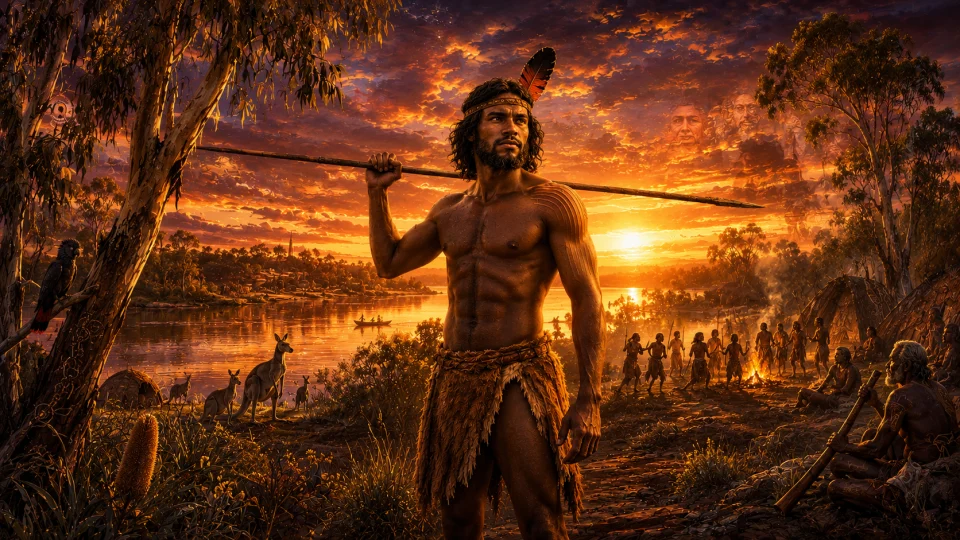
“You came to our country — you have driven us from our haunts, and disturbed us in our occupations. As we walk in our own country, we are fired upon by the [European] men; why should the [European] men treat us so?”
There are figures whose lives become larger than biography — whose names carry, across the centuries, the weight of a people’s grief, pride, and unbroken will. Yagan (c. 1795 – 11 July 1833) is such a figure. A warrior of the Whadjuk Noongar nation, a man of exceptional physical and spiritual authority, and a fearless defender of his people’s sovereignty over the land they had held and tended for more than forty thousand years, Yagan stands among the great resistance fighters of the nineteenth century. He is not remembered as a footnote in someone else’s history; he is honoured as a central ancestor in the story the Noongar tell about themselves. The Noongar do not merely remember him — they revere him. Ask any Noongar to name an iconic Aboriginal warrior, and many will declare one name: Yagan.
The Country and the People
To understand Yagan is first to understand the world he was born into — a world of extraordinary depth, complexity, and beauty that the British invasion would violently attempt to unmake.
The Whadjuk people are one of the fourteen language groups of the Noongar nation, the Traditional Custodians of the southwestern corner of what is now Western Australia. For more than forty thousand years, the Whadjuk had been the sovereign people of the land around the Derbarl Yerrigan — the Swan River — and its tributaries, a territory stretching from Mangles Bay in the south to Galup (Lake Monger) in the north and northeast to the Helena River. This was not empty, unclaimed land. It was a living archive: every waterway, every stand of banksia, every yam bed and animal pathway held meaning — ceremonial, ecological, and ancestral. The land was managed, known, and loved by a people who understood themselves as its custodians, bound to it by law and by spirit.
Noongar society was organized into interconnected clan groups of thirty-five to seventy people, bound by elaborate networks of kinship, ceremony, and mutual obligation. Leadership was earned rather than inherited — through demonstrated physical courage, ceremonial knowledge, and the wisdom to navigate the complex protocols that governed relations between clans. Land rights flowed along both maternal and paternal lines, giving accomplished individuals the authority to move through a wide territory and the responsibility to protect it. This was a mature, self-sufficient civilization, spiritually grounded and legally sophisticated. It required no European definition, no European validation, and no European governance to be complete.
The Man
Yagan was born into the Beeliar clan of the Whadjuk, the son of Midgegooroo — a man of great authority and deep respect among his people, the principal elder of the Beeliar clan whose standing extended far beyond his own country. From his father, Yagan inherited not only status but the full weight of a warrior’s obligation: to protect his people, enforce their law, and answer violence with justice.
He was, by every account, a figure of formidable presence. Taller than most of his contemporaries, broad-shouldered and powerfully built, he wore his hair to the shoulder and carried a full beard. On his right shoulder, he bore the ngoombart — ritual scarification marks that in Noongar law signified a man of high degree, a warrior who had passed through the ceremonies required to carry lethal authority. He had earned his status as Boo Gore Wardagaduk — a great warrior — through feats of skill that astonished even those who did not understand their significance: it was said he could drive a spear into an upright walking stick from twenty-three meters and bury one in a tree from fifty-five meters.
But Yagan was far more than a man of physical power. He was a man of deep cultural intelligence and ceremonial accomplishment. He was a master of ceremony, a gifted dancer, and a keeper of the living traditions of his people. In March 1833, just months before his death, he led a corroboree in the post office garden in Perth; the Perth Gazette recorded that he “was master of ceremonies and acquitted himself with infinite grace and dignity.” He wore on his headband the feather of the red-tailed black cockatoo, the totem of his clan — a visible sign of his relational obligations to land, ancestors, and kin.
The Law He Kept
Central to Yagan’s story — and misunderstood by almost every British account of his life — is the Noongar system of retributive justice. Under this framework, a killing must be answered with a killing: not necessarily of the individual perpetrator, but of a member of that person’s social group. This was not vengeance, as Europeans chose to characterize it. It was law — a precisely calibrated mechanism for maintaining social order, deterring future violence, and restoring equilibrium between aggrieved parties. A killing unanswered was a wrong unaddressed; a community that failed to enforce its law was a community that invited further harm.
Yagan never acted outside this law. Every death for which the British held him responsible was, in Noongar legal terms, a lawful execution — a proportionate response to prior violence inflicted on his people. The British, who refused to recognize any legal system but their own, called this murder. The Noongar recognised it as justice. That refusal of comprehension — wilful or otherwise — drove the conflict between Yagan and the invaders of his land to its tragic conclusion.
Invasion and Dispossession
When the British, under James Stirling, planted their occupation on the shores of the Derbarl Yerrigan in 1829, Yagan was approximately thirty-five years old. In the early years, the Noongar engaged the newcomers with the generosity characteristic of a people confident in their own sovereignty. In line with their cosmological understanding, many Noongar welcomed the Europeans as Djanga — the returned spirits of their dead — and extended to them the hospitality due to those re-entering the living world.
The British repaid that generosity with dispossession. Moving rapidly across the landscape, they fenced off vast tracts of land for farming and grazing, severing the Noongar from the country that sustained them. They destroyed the woyang and warrain — the native yam beds that Noongar women had tended and managed across generations, representing perhaps three-quarters of the community’s nutritional base. They drove away the kangaroo and other game on which the people relied. They built their houses on ceremonial grounds and their roads across songlines. What they called “settlement,” the Noongar experienced as slow strangulation — the systematic dismantling of an entire way of life.
Deprived of their means of subsistence on their own land, the Noongar began to take food from the fields and livestock. From a Noongar perspective, this was not theft — it was a people gathering food from land that was, cosmologically and legally, their own. The British named it crime. They had stolen a continent and called the people from whom they stole it criminals for eating.
The Resistance
Yagan’s actions in defence of his people crystallised around several key confrontations, each of which makes complete sense within Noongar law.
In August 1831, a British farmhand shot and killed a member of Yagan’s family group during a dispute at a farm near the Derbarl Yerrigan. Under Noongar law, the killing required an answer. Yagan, Midgegooroo, and other kinsmen enforced the law: a member of the perpetrator’s household was killed at the farmhouse. The British declared this an unprovoked murder; the Noongar understood it as justice rendered.
In June 1832, after further British violence, Yagan led an action near the Canning River in which a labourer, was mortally wounded. The British placed a bounty on Yagan’s head, marking him publicly as a target.
In April 1833, after Yagan’s brother Domjum was shot and fatally wounded by a British man during a confrontation at a Fremantle store, a large Noongar party gathered to enforce the law. Two British men — Tom and John Velvick, who had themselves previously been convicted of assaulting Aboriginal people — were killed at Bull Creek. Noongar law required one death for one death. The law was kept.
British officials responded by invoking the archaic English law of outlawry against Yagan, Midgegooroo and the elder Munday — a manoeuvre that placed these men outside the protection of British law and authorised any British subject to kill or seize them with impunity. A bounty of £30 was placed on Yagan’s capture, dead or alive. The occupiers who recognised no Indigenous law now used their own to strip the defenders of the land of any remaining protection.
Carnac Island and Robert Lyon
In October 1832, fishermen lured Yagan into a boat and handed him over to British control. He faced execution. He was spared only because of the intervention of a Scottish pastor, Robert Menli Lyon, who argued publicly that Yagan was not a criminal but a patriot; not a murderer but a prisoner of war entitled to protection. He compared Yagan to William Wallace and William Tell, writing that Yagan “greatly distinguished himself as a patriot and a warrior” and calling him “the Wallace of the age.” It was an uncomfortable truth for the British: it named their presence as invasion and Yagan’s response as national defence.
At Lyon’s urging, Yagan and two companions were exiled rather than killed, transported to Carnac Island under Lyon’s supervision. Lyon used the six weeks of their shared confinement to learn Yagan’s language and document Noongar customs, producing one of the earliest ethnographic records of the Whadjuk. Their relationship was remarkable: a profound exchange of knowledge across a vast cultural divide, forged in a place of confinement.
After approximately six weeks, Yagan and his companions escaped by taking an unattended dinghy and rowing to the mainland. The British chose not to pursue them, considering them “sufficiently punished.” For a brief period in early 1833, Yagan re-engaged with the wider community: leading corroborees, participating in spear-throwing competitions, and moving through country with his usual authority. This was the path not taken — a fragile possibility of coexistence that the British drive for land possession would extinguish.
The Killing of Midgegooroo
On 17 May 1833, Midgegooroo was captured on the Helena River with his young son Billy. He was given no fair trial. The British reviewed depositions and issued a death warrant. On 22 May, he was bound, blindfolded and fastened to the outer door of the Perth jail, then shot by a firing squad from the 63rd Regiment. Crowds watched and cheered. The elder of the Beeliar, sovereign man of Derbarl Yerrigan country, was buried in the grounds of the jail that had killed him.
The British attempted to hide the news from Yagan. When Yagan met George Fletcher Moore on 27 May, he asked directly whether his father still lived. Moore refused to answer. A servant offered a lie — that Midgegooroo was held on Carnac Island. Yagan, unconvinced, spoke the words history would remember: “[European] man shoot Midgegooroo, Yagan kill three.” It was not a threat but a declaration of legal obligation under Noongar law. Moore himself later wrote, “there is something in his daring which one is forced to admire.”
In an earlier conversation, Moore recorded Yagan’s indictment of invasion:
“You came to our country — you have driven us from our haunts, and disturbed us in our occupations. As we walk in our own country, we are fired upon by the [European] men; why should the [European] men treat us so?”
Betrayal and Death
On the morning of 11 July 1833, Yagan and several Noongar companions were travelling along the Swan River north of Guildford. They encountered two teenage British brothers, William and James Keates, who were herding cattle. The brothers recognised Yagan, warned him that bounty hunters were nearby, and invited him to rest with them. Yagan accepted, extending trust to people he knew.
While Yagan rested, William Keates shot him in the back. James fired at another Noongar, Heegan. The brothers fled. William was pursued and speared to death by Yagan’s kinsmen; James swam the river and later claimed the reward money. The Perth Gazette called the shooting “a wild and treacherous act … it is revolting to hear this lauded as a meritorious deed.”
The British who arrived shortly afterward cut off Yagan’s head, initially to prove the kill and claim the bounty, and skinned his back to preserve the ngoombart scarification as a trophy. For the Noongar, this treatment of a great warrior’s body was profoundly dishonourable.
The Long Exile of His Spirit
For the Noongar, what was done to Yagan’s body had deep spiritual consequences. In Noongar belief, a spirit’s journey after death requires the body to be whole and properly cared for. Because Yagan’s head was severed and taken, his spirit could not complete that journey and remained earthbound until his remains could be made whole and laid to rest in country.
Yagan’s head was smoked and preserved in Perth, then taken to London by Ensign Robert Dale. In London, surgeon Thomas Pettigrew exhibited it at private soirées, decorating it with red-tailed black cockatoo feathers and displaying it with a panoramic view of King George Sound. A hand-coloured aquatint by George Cruikshank served as the frontispiece to Dale’s pamphlet, transforming the remains of a man into a commodity of European curiosity.kooriweb+1
By 1835 the head was in Liverpool, presented to the Liverpool Royal Institution. In 1964, badly deteriorated, it was buried in an unmarked grave in Everton Cemetery alongside a Peruvian mummy and a Māori head. In 1968, twenty stillborn babies and two infants were buried over the same plot.
Beginning in the early 1980s, Noongar elders launched a campaign to bring Yagan home, led by activist Ken Colbung. Researcher Cressida Fforde traced the head in 1993; years of bureaucratic obstruction followed. In 1997, after intense pressure — including Colbung confronting the Australian Prime Minister in London — the British government agreed to exhumation. A forensic palaeontologist identified the skull, and on 31 August 1997 Yagan’s head was handed to a Noongar delegation at Liverpool Town.
Disagreements, delays and questions about the location of the rest of his bones meant that the head remained in storage, including in a bank vault, for more than a decade. On 10 July 2010 — one day before the 177th anniversary of his death — Yagan’s head was finally buried at Yagan Memorial Park in Belhus in a private Noongar ceremony. One hundred and seventy-seven years after his spirit was held by violence, Yagan could finally begin his journey.
The Living Name
Yagan has never left his people. His name is spoken with reverence by the Noongar, and his story stands at the center of Aboriginal resistance history in Western Australia.
In 1984, after years of advocacy that included an initial refusal from the state on the grounds that Yagan was “not important enough,” a bronze statue by Robert Hitchcock was unveiled on Heirisson Island in the Derbarl Yerrigan. The statue shows Yagan standing bare-chested with a spear across his shoulders, a sovereign man on his own land. In 1997, vandals beheaded the statue; it was later repaired, the repeated decapitation itself becoming a grim echo of the original act and a focus of analysis on racist reenactment and memorial violence.
In 2018, Yagan Square opened in central Perth as part of an urban renewal project designed in collaboration with Noongar representatives. It features the nine-meter Wirin figure by Noongar artist Tjyllyungoo, and embeds Noongar language, seasons, and cosmology into the fabric of the city. The former Upper Swan Bridge now bears his name. A 2.1-meter bronze sculpture of Yagan resides in the First Nations Gallery of the National Museum of Australia. His story is taught in Western Australian schools.
The 2012 documentary Yagan, directed by Ngarluma/Bunuba filmmaker Kelrick Martin, interweaves the story of his life with the community’s 180-year struggle to repatriate and rebury his remains. Poetry, theatre, and scholarship have all taken up his story. Across these forms, the emphasis remains the same: Yagan was a Noongar warrior who died defending his land and his people from invasion. His remains were butchered, stolen, and lost for generations, but his name and law endured.
Yagan’s Place in History
Yagan belongs to a global history of Indigenous resistance to European invasion and occupation. Like other warriors and leaders across the African diaspora and Indigenous worlds, he recognized that what was being done to his people was not inevitable and not just. He enforced his people’s law. He defended their country. He named the violence clearly, in words that still speak across time. Nearly two centuries after his death, the Noongar continue to ask that question. And Yagan’s name continues to carry the answer: we are still here; this is still our country; we have not forgotten that you stole our land.
References:
https://adb.anu.edu.au/biography/yagan-2826
https://adb.anu.edu.au/lifesummary/yagan-2826
https://en.wikipedia.org/wiki/Yagan
https://kids.britannica.com/students/article/Yagan/631538
https://simple.wikipedia.org/wiki/Yagan
https://ia.anu.edu.au/biography/yagan-2826
https://kooriweb.org/foley/museums/nma2004.pdf
https://research-repository.uwa.edu.au/en/publications/the-life-and-afterlife-of-yagan-a-corporeal-biography
https://www.liverpoolecho.co.uk/news/nostalgia/pensioner-decapitated-head-dead-ancestor-24371835
https://www.morethanourchildhoods.org/stories/ken-colbung/