
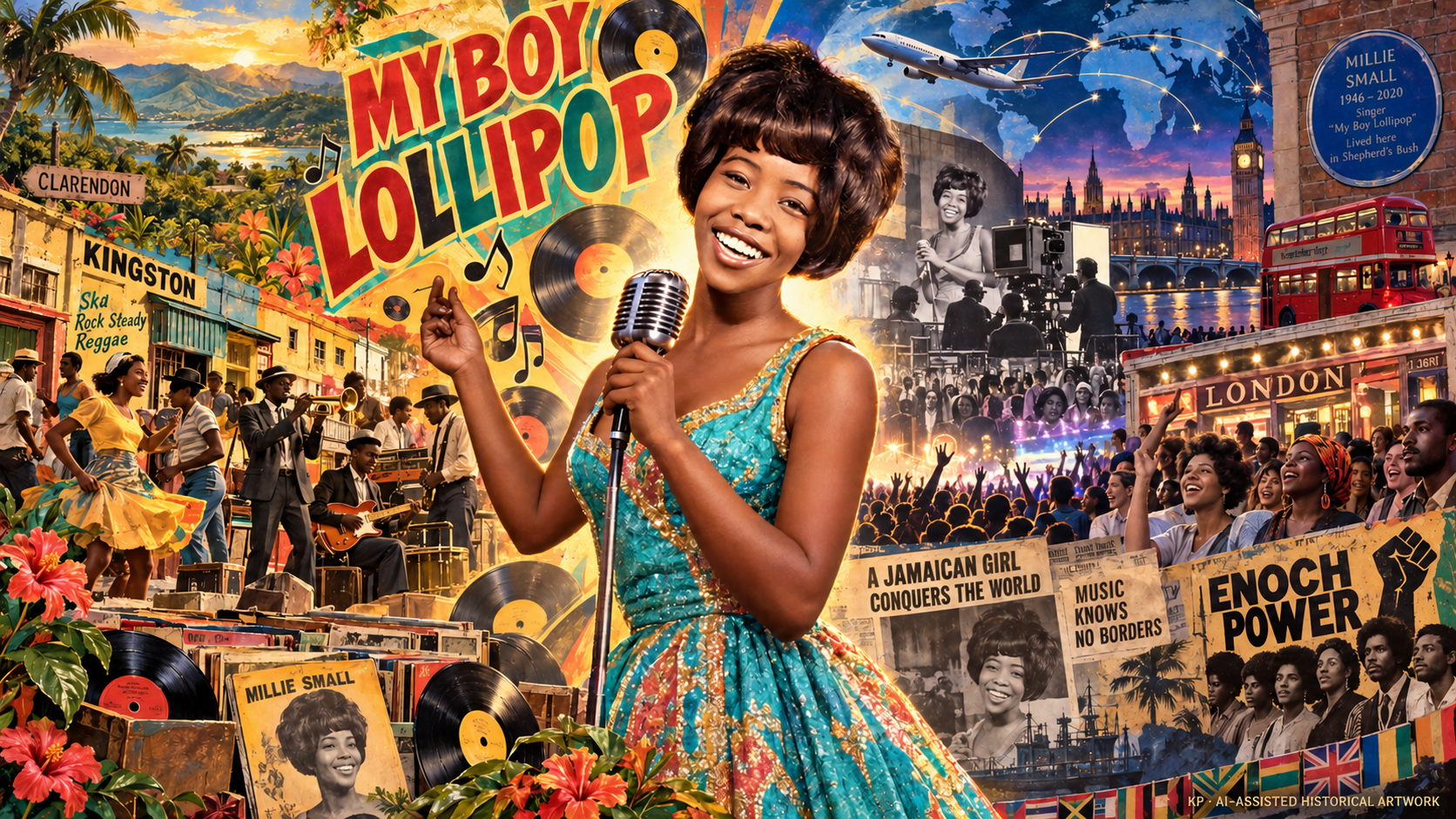
Millie Small was one of the first Jamaican performers to become a global pop star. With the joyous, high-pitched exuberance of “My Boy Lollipop,” she carried ska from Jamaica’s dancehalls into international charts in 1964—well before reggae’s worldwide ascent—and became a pioneering figure for Caribbean women in popular music.
Early life and Kingston beginnings
Millicent Dolly May Small was born on 6 October 1946 or 1947 in Clarendon, Jamaica. She grew up in a large family of thirteen children in a thatched house on a sugar plantation, where her father worked as an overseer. Singing became an early source of pleasure and possibility amid the family’s limited means.
Her talent emerged publicly when, at about twelve years old, she won the Vere Johns Opportunity Hour talent contest at Montego Bay’s Palladium Theatre. The victory helped set her on a path to Kingston, where she went to live with an aunt on Love Lane and entered the fast-moving world of Jamaican recording.
Clement “Coxsone” Dodd, the influential founder of Studio One, recognized the distinctive quality of Small’s voice. Its bright, high register recalled Shirley Goodman of the American R&B duo Shirley & Lee. Under Dodd’s guidance, she began recording and learned vocal technique and harmony alongside the singer Owen Gray. Their duet “Sugar Plum” became an early local success.
Small’s first major breakthrough came through her partnership with Samuel Augustus “Roy” Panton. As Roy & Millie, the pair scored a Jamaican number-one hit in 1962 with “We’ll Meet,” which reportedly held the top position on the local chart for six weeks. They followed it with further popular recordings, including “Marie,” and worked with leading Jamaican producers such as Dodd, Lindon Pottinger and Prince Buster.
From Jamaica to London
Small’s Jamaican records reached the attention of Chris Blackwell, the Anglo-Jamaican founder of the young Island Records label. Blackwell heard commercial potential in her voice that extended beyond Jamaica. With her mother’s permission, he became the teenage singer’s legal guardian and brought her to London in late 1963.
The move required a rapid adjustment. Blackwell enrolled her at the Italia Conti Stage School, where she received lessons in speech, diction and dance intended to prepare her for British television and the international music market. Her first British single, “Don’t You Know” / “Until You’re Mine,” released through Fontana in December 1963, did not make an immediate impact. Her next release would transform her life—and Jamaican popular music history.
“My Boy Lollipop”
Released in 1964, “My Boy Lollipop” made Millie Small an international sensation. American R&B singer Barbie Gaye originally recorded the song in 1956, but its reinvention as a brisk, buoyant ska record gave it an entirely new cultural force. Jamaican guitarist Ernest Ranglin helped shape the arrangement at Olympic Studios in London, turning the original R&B shuffle into a vibrant performance built around ska’s distinctive offbeat rhythm.
Small’s delivery was central to the record’s appeal. Her voice was youthful, playful and immediately recognizable; it gave the song a sense of spontaneous delight without diminishing her command as a performer. Marketed in Britain as “The Blue Beat Girl” and sometimes “Queen of the Bluebeat,” she became the public face of a sound that many listeners outside the Caribbean had never encountered.
“My Boy Lollipop” reached number two on the UK Singles Chart and number two on the US Billboard Hot 100. It sold more than 600,000 copies in Britain and eventually exceeded seven million sales internationally. The single also topped charts in countries including Australia and Canada.
For Island Records, the success was decisive. The small independent label used licensing agreements with Fontana in Britain and Smash Records in the United States to obtain the distribution necessary for a major global release. The record became Island’s first great international breakthrough and demonstrated that Jamaican music could succeed in the mainstream pop market.
The song’s impact was not merely commercial. It was a formative moment in the global circulation of Caribbean music. Small arrived before the international breakthroughs of Jimmy Cliff, Desmond Dekker, Toots and the Maytals, and Bob Marley. Through her, ska—one of the principal musical foundations from which reggae would develop—became audible to mass audiences in Britain, North America and beyond.
International stardom
In the wake of “My Boy Lollipop,” Small embarked on an exhausting schedule of television appearances, concerts and international travel. She appeared on major British programs including Top of the Pops, Ready Steady Go!, Juke Box Jury and Around the Beatles. In December 1964, she also made her acting debut in the ITV musical The Rise and Fall of Nellie Brown, appearing alongside the celebrated singer and actor Elisabeth Welch.
Her arrival in New York became a media event. Her flight was promoted as “The Lollipop Special,” and journalists met her at JFK Airport with a police escort and a ceremonial giant lollipop. She performed at the 1964 New York World’s Fair, where 12 August was designated “Millie Small Day,” and toured widely in Australia, New Zealand, Asia, Africa and South America.
When Small returned to Jamaica in 1964, her homecoming was marked by an official police-escorted motorcade and a meeting with Prime Minister Sir Alexander Bustamante. She had become a source of national pride: a young Jamaican woman whose success had made Caribbean music visible on an international stage.
She continued to record through the 1960s. “Sweet William” reached number 30 in Britain, while “Bloodshot Eyes” reached number 48. Her albums included More Millie in 1964 and Sings Fats Domino in 1965. Although none of these releases matched the extraordinary scale of “My Boy Lollipop,” they demonstrated her versatility and her continuing place within the evolving musical exchanges between Jamaica, Britain and the United States.
A political voice
By 1970, Small had moved to Trojan Records and released one of the most striking records of her later career: “Enoch Power.” Written in response to Enoch Powell’s 1968 “Rivers of Blood” speech and the hostile anti-immigration climate it represented, the song marked a decisive departure from the light-hearted pop image attached to her early success.
“Enoch Power” combined an apparently playful tone with a clear message of defiance, unity and resistance. Radio stations refused to play it, but the record nevertheless found an audience among Britain’s Caribbean communities. When Small performed it at the Caribbean Music Festival at Wembley Arena, audiences received it with enthusiasm.
The song stands as an important reminder that Small’s career cannot be reduced to one charming international hit. She understood the political pressures on Black and Caribbean people in Britain and used her music to respond. In doing so, she joined a wider tradition of Caribbean artists whose work carried both entertainment and social commentary.
Private years and recognition
After the release of her 1970 album Time Will Tell, Small largely withdrew from commercial recording. She later described the decision as the end of a dream that had reached its natural conclusion. In the years that followed, she lived in Singapore and New Zealand before returning to London.
Small’s life after stardom was not without difficulty. Despite the vast success of “My Boy Lollipop,” she later said that she had received no royalties from the record. In a rare 1987 interview, she revealed that she had experienced severe financial hardship and, at one point, lived in a London hostel with her young daughter, Jaelee. She met these hardships with notable dignity, describing them as experiences that let her see “how the other half live.”
Away from the music industry, Small turned to painting and writing, and devoted much of her energy to raising her daughter. She generally avoided publicity for decades, though she granted a substantial retrospective interview to Goldmine magazine in 2016.
Recognition gradually followed. In 1987, she returned to Jamaica to receive a Medal of Appreciation from Prime Minister Edward Seaga. In 2011, on the forty-ninth anniversary of Jamaican independence, she was appointed a Commander in the Order of Distinction for her contribution to the Jamaican music industry.
Death and legacy
Millie Small died in London on 5 May 2020 after suffering a stroke. She was seventy-two years old. She had spent her final decades in Shepherd’s Bush, west London, an area long associated with Caribbean migration and Black British cultural life.
In 2021, a blue plaque was unveiled at her former home in Shepherd’s Bush, commemorating her contribution to music and to Black British heritage. The honor reflected the growing recognition of her place in the cultural history of both Jamaica and Britain.
Small’s achievement was remarkable not simply because “My Boy Lollipop” became a worldwide hit, but because of what that success represented. She was among the first Caribbean women to enter the international pop mainstream as a star in her own right. She helped make ska intelligible, exciting, and commercially viable for listeners who had previously known little of Jamaican music. Her career opened a path for artists who followed, while “Enoch Power” showed that the singer behind the bright pop image could also speak to the realities of migration, racism and belonging.
More than six decades after its release, “My Boy Lollipop” remains one of the most recognizable recordings in Jamaican music history. Yet Millie Small’s larger legacy lies in her role as a cultural trailblazer: a young woman from Clarendon who took a distinctly Jamaican sound to the world, expanded the possibilities available to Caribbean performers, and left an enduring mark on the story of ska, reggae and Black British popular culture.
Sources:
https://en.wikipedia.org/wiki/Millie_Small
https://www.theguardian.com/music/2020/may/06/millie-small-obituary
https://www.npg.org.uk/whatson/exhibitions/2007/devotional/millie-small
https://www.bbc.co.uk/news/entertainment-arts-52557332
https://www.grammy.com/news/millie-small-jamaican-singer-songwriter-global-hit-my-boy-lollipop-and-ska-pioneer-dies/
https://www.lbhf.gov.uk/news/2023/10/jamaica-born-singer-millie-small-honoured-shepherds-bush-blue-plaque
https://www.reggaeville.com/artist-details/millie-small/about/
https://nlj.gov.jm/project/millicent-small-1946/