
Harold Arundel Moody was a Jamaican-born physician whose work in London joined medical care, Christian service, and the struggle against racial discrimination. As founder and president of the League of Coloured Peoples (LCP), he became a leading figure in Black British public life, challenging the barriers that denied Black people employment, accommodation, professional advancement, and equal treatment. His influence extended from a busy surgery in Peckham to government offices, church networks, and international debates about colonial freedom.
From Kingston to London
Moody was born in Kingston, Jamaica, the eldest child of Charles Ernest Moody and Christina Emmeline Ellis. His father became a successful pharmacist and was a strict Congregationalist. His mother, who had received little formal education and had worked in domestic service, exerted a lasting influence on her son’s character. The family placed considerable importance on education and religious commitment. Harold’s younger brothers included Ludlow, who became a doctor and government bacteriologist in Jamaica, and Ronald, who achieved distinction as a sculptor.
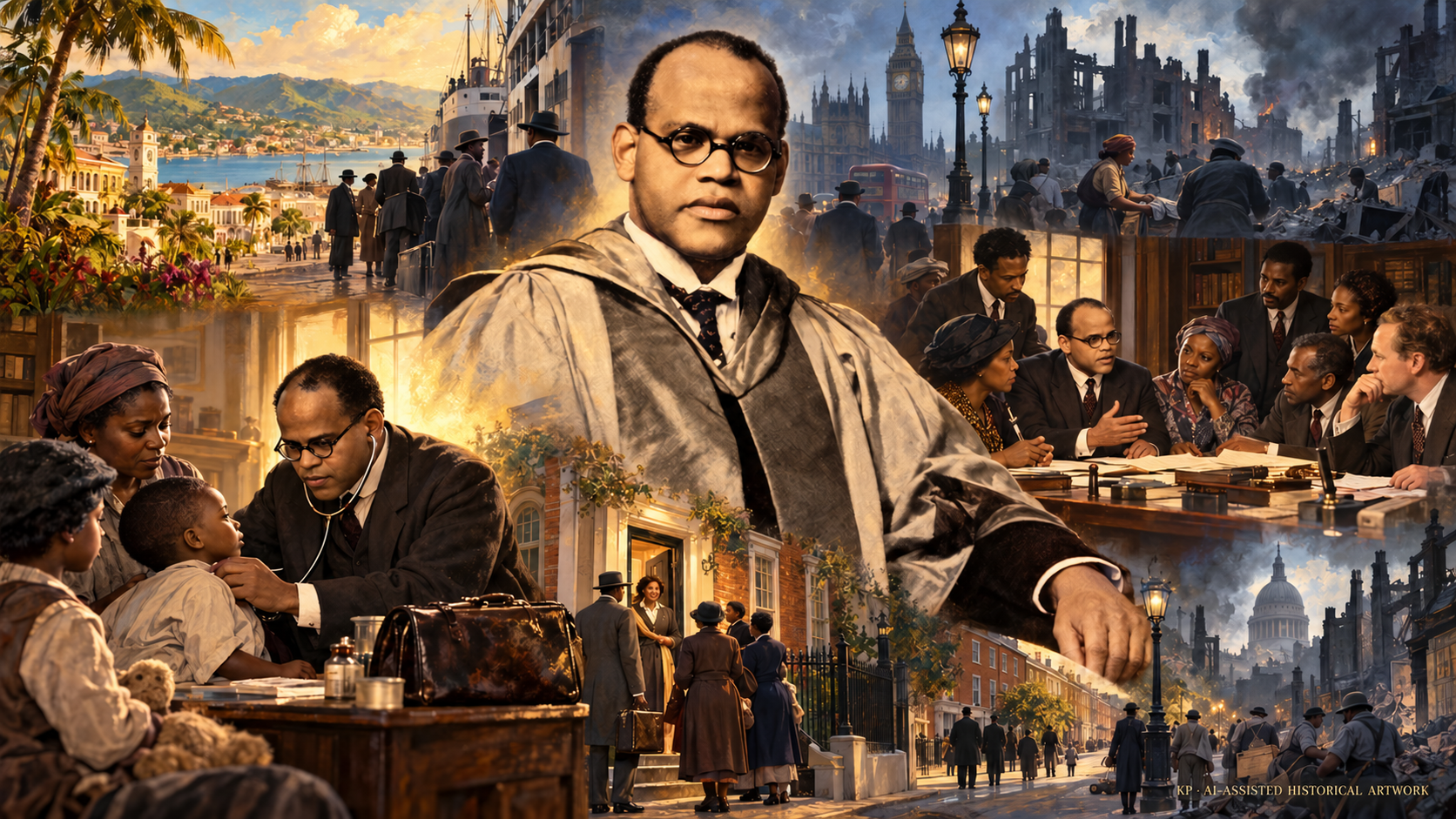
Educated at Wolmer’s Schools, Moody grew up within a colonial culture that encouraged identification with England. He initially sought to become as English as possible, an aspiration his experience in Britain would test. In September 1904, he arrived in London to study medicine at King’s College. Racial prejudice quickly disrupted his expectations: landlords refused him accommodation, and he encountered exclusion among fellow students.
He nevertheless excelled in his studies, qualified in medicine, and later earned a Doctor of Medicine degree from the University of London in 1919. Academic achievement did not secure equal professional opportunity. King’s College Hospital refused him an appointment because its matron objected to employing a Black doctor. He was also rejected for a medical officer’s post with the Camberwell Board of Guardians, whose authorities claimed that local patients would not accept treatment from him. These refusals exposed the distance between the promise of belonging as a British subject and the realities of racial exclusion.
A Doctor in Peckham
In February 1913, Moody established his own medical practice in Peckham, South London. That May, he married Olive Mable Tranter, an English nurse whom he had met at the Royal Eye Hospital. Their marriage encountered hostility and initial objections from both families, but it became an enduring partnership. They had six children.
Moody built a respected practice through clinical skill and sustained attention to his patients’ circumstances. In a working-class district where the cost of treatment could prevent families from seeking care, he frequently treated poor residents and children without charge. Through daily experience, his work challenged the claim that a Black physician could not earn the confidence of local patients.
In 1922, the family moved to 164 Queen’s Road, where Moody maintained his home and surgery for the rest of his life. The house also became a place of refuge for Black students, workers, and travelers denied rooms in hotels and boarding houses. Visitors came seeking accommodation, financial assistance, advice, or professional introductions. Among those welcomed there was the Jamaican writer, feminist, and broadcaster Una Marson.
His religious life provided another foundation for public service. A committed Congregationalist, Moody served as a lay preacher and held leadership positions in missionary organizations and the Christian Endeavor movement. He regarded racial prejudice as incompatible with Christianity and used church platforms to press that argument before audiences across Britain. Medicine, hospitality, and campaigning were connected expressions of the same obligation to serve.
Organizing Against the Color Bar
On 13 March 1931, Moody helped establish the League of Coloured Peoples, with support from the African American historian Charles Wesley. He remained its president until his death. The organization defended the social, educational, economic, and political interests of Black people, promoted international concern for their welfare, and sought cooperation across racial boundaries. European supporters could join, while Black leaders remained in charge.
The League confronted the “color bar”: the formal restrictions and everyday practices that excluded people because of race. Its work combined individual assistance with publicity, investigation, correspondence, and direct appeals to officials. Moody’s professional standing and church connections helped him obtain access to institutions that often dismissed Black grievances.
In July 1933, the League launched its quarterly journal, The Keys. Its title drew on the educator James E. K. Aggrey’s image of black and white piano keys working together to create harmony. The journal circulated news, opinion, and discussion of racial and colonial questions, connecting readers in Britain with communities overseas.
Among the League’s important campaigns was its defense of Black British merchant seamen who were treated as aliens and threatened with restrictions on employment. It also joined other Black organizations in challenging the racial barriers to military officer commissions. These efforts linked questions of citizenship to practical rights: the ability to work, serve, and receive recognition without racial exclusion.
Moody’s methods were not universally accepted. His willingness to work with officials and his support for the Colonial Office-backed student hostel Aggrey House brought him into conflict with more radical activists. Disputes over the League’s constituency and political direction became sufficiently bitter that he attempted to resign in 1934. Colleagues persuaded him to remain. His career therefore reflected not only resistance to British institutions, but also contested ideas within Black political life about how to pursue change.
War and Colonial Freedom
During the Second World War, Moody continued his medical work while helping organize civil defense in Peckham. Following a severe bombing incident in 1944, he was the first doctor on the scene and coordinated emergency treatment. Four of his children served in the armed forces or military medical services, including his son Charles, who became one of the early Black commissioned officers in the British Army.
The war also sharpened the League’s criticism of colonialism. The Atlantic Charter’s declaration of self-determination raised expectations that its principles would extend to colonized peoples. Britain’s refusal to apply those promises fully exposed a contradiction between the language of freedom and the continuation of colonial oppression.
At a London conference in July 1944, the League adopted a Charter for Coloured Peoples demanding full self-government for colonial territories and equal civil, economic, educational, and political rights regardless of race or gender. It also called for racial discrimination in employment and public places to be prohibited and punishable by law. These demands marked a shift from appeals for tolerance to political freedom and enforceable equality.
This increasingly explicit opposition to colonial oppression did not displace Moody’s commitment to political independence. He resisted binding the League to a particular political grouping and did not attend the Fifth Pan-African Congress in Manchester in 1945, although the organization subsequently published the congress’s principal declarations. His Christian humanitarianism and preference for negotiation remained central to his approach, even as his demands became more firmly anti-colonial.
Alongside these political campaigns, Moody sought to challenge the attitudes that sustained racial inequality. In 1944, the League established a committee to investigate how English schools handled questions of race. Its work produced the pamphlet Race Relations and the Schools, bringing the classroom within the organization’s wider campaign against prejudice. The inquiry recognized that equal treatment depended not only on changing official practices, but also on examining the ideas through which children learned to understand other peoples.
Education thus became another dimension of Moody’s pursuit of lasting change. While the League defended people facing immediate discrimination, its educational work addressed assumptions that could perpetuate exclusion across generations. Together, its classroom inquiry, civil rights campaigns, and demands for colonial self-government connected practical assistance with a broader effort to change institutions and attitudes.
Final Years and Legacy
In November 1946, Moody and Olive embarked on a five-month tour of North America and the Caribbean. He hoped to raise £50,000 for a Black cultural center in London that would provide a permanent home for the League and a welcoming space for people facing discrimination. Through lectures and church addresses, he sought support for a project that would extend the hospitality already offered in his Peckham home.
The tour brought only modest financial returns and took a heavy toll on his health. He returned to England seriously ill and died at 164 Queen’s Road on 24 April 1947, aged sixty-four. The proposed center was never built. Without his leadership, energy, and financial support, the League weakened and dissolved in the early 1950s.
Moody’s importance lies in the combination of practical care and organized resistance that defined his life. He offered treatment to patients who could not afford it, shelter to people excluded from accommodation, and a public voice to those denied equal rights. His campaigning belonged to the longer struggle that preceded post-war racial equality legislation, while his insistence on colonial self-government placed that struggle within an international horizon.
An English Heritage blue plaque, installed at his Peckham home in 1995, commemorates the place where he lived and worked. Yet his most substantial legacy is the example of a physician who refused to treat racial injustice as someone else’s responsibility. From the consulting room to the public platform, Harold Moody made service to others the basis of a sustained challenge to exclusion.
Sources:
Killingray, David. “‘To do something for the race’: Harold Moody and the League of Coloured Peoples.” In West Indian Intellectuals in Britain, edited by Bill Schwarz, 51–70. Manchester: Manchester University Press, 2003.
Ochiai, Takehiko. “Harold Arundel Moody and the League of Coloured Peoples.” Ryukoku Law Review 52, no. 1 (2019): 1–32.
Marty, Simeon. “Thinking Black in the Blitz: Harold Moody, the League of Coloured Peoples and its Shift of Pan-African Ideas in Second World War London.” Esboços 28, no. 48 (2021): 407–426. https://scispace.com/pdf/thinking-black-in-the-blitz-harold-moody-the-league-of-2nyupw4fur.pdf
https://en.wikipedia.org/wiki/Harold_Moody
https://www.kcl.ac.uk/people/dr-harold-moody
https://www.english-heritage.org.uk/visit/blue-plaques/dr-harold-moody/