
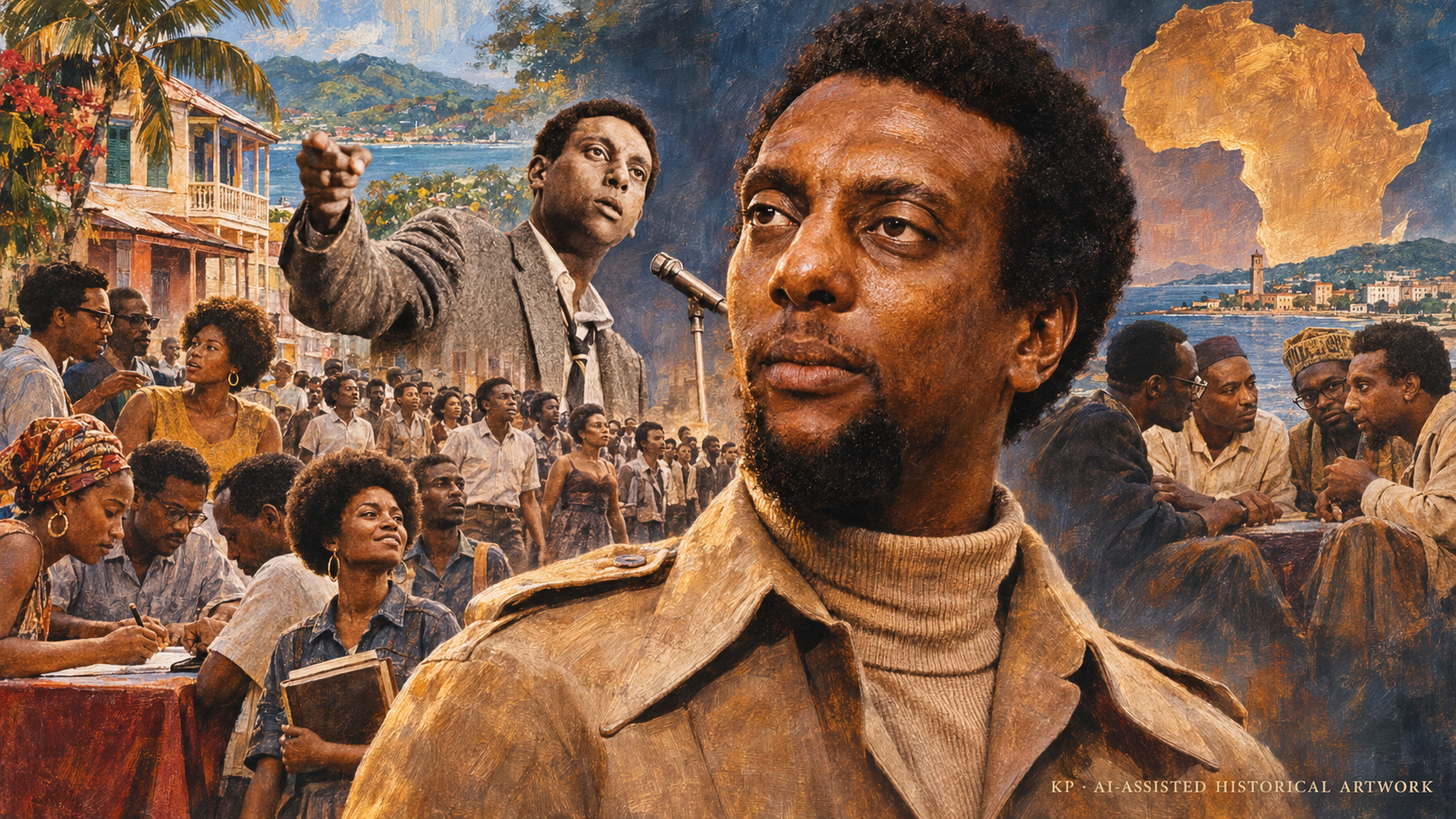
Kwame Ture, originally named Stokely Carmichael, was a prominent Trinidadian-American civil rights activist who advanced the struggle for Black freedom across continents. Born in Trinidad, raised between the Caribbean and New York, and politically shaped in the southern United States, he emerged as one of the most influential voices of the Black Power movement before settling in Guinea. His life bridged campaigns against American segregation with a broader vision of African unity, economic independence, and collective self-determination.
A dynamic leader of the 1960s civil rights movement, he brought extraordinary energy to voter registration, grassroots organizing, and public debate. His call for “Black Power” in Mississippi in June 1966 gave national force to demands that Black communities define their own priorities and build institutions to advance them. Yet the dramatic moment that made him internationally famous represented only one stage in a political life extending across nearly four decades. Ture devoted his later years to Pan-African organizing, insisting that the future of African-descended people everywhere remained connected to the future of Africa itself.
A Caribbean Childhood
Stokely Standiford Churchill Carmichael was born on June 29, 1941, in Port of Spain, Trinidad. His father, Adolphus Carmichael, was a skilled carpenter; his mother, Mabel, worked for a steamship line. After his parents migrated to the United States seeking better economic opportunities, he remained in Trinidad with his grandmother and two aunts. Their household provided the foundation of his early childhood before he joined his parents in New York in 1952, at eleven.
He attended Tranquility Boys Intermediate School, where a British-centered curriculum presented European achievement as the measure of historical significance. He later recalled the indignity of an education that diminished Caribbean people’s existence before European arrival. His subsequent insistence on African historical consciousness answered an injury he had encountered in the classroom long before he became a public figure.
Political curiosity appeared early. According to his later recollections, he tried to vote for the Trinidadian labor leader Uriah Butler when he was only seven. Turned away because of his age, he persuaded an aunt to cast her ballot instead. The childhood episode anticipated a lasting conviction: politics concerned ordinary people’s material lives, and participation mattered.
New York and the Making of a Political Consciousness
Reuniting with his parents brought Carmichael into the contrasting worlds of Harlem and, later, the East Bronx. He encountered the richness of Black urban life alongside overcrowded housing, economic inequality, and the exhausting work required to sustain a family.
His father’s experience left a particularly deep impression. Adolphus worked at carpentry, drove taxis, and took additional jobs to support the household. When he died of a heart attack in 1962, at forty-eight, his son understood the loss through the relationship between racial inequality and relentless labor. The promise that diligence alone would secure prosperity had failed to protect a man who had worked almost without rest.
Carmichael entered the Bronx High School of Science in 1956. Academically gifted and socially confident, he moved through racially mixed circles and visited the homes of affluent classmates. Such encounters sharpened rather than dissolved his awareness of inequality. Seeing Black domestic workers serving wealthy families made the distance between social acceptance and collective advancement painfully clear.
Televised images of southern student sit-ins helped turn that awareness into action. Young protesters endured humiliation and assault at segregated lunch counters, then returned to their seats. Their persistence moved him. He joined demonstrations supporting the sit-ins and, after finishing high school in 1960, chose Howard University in Washington, D.C. There he could pursue his education within a Black intellectual community while participating directly in the expanding freedom movement.
Howard University and the Freedom Rides
At Howard, Carmichael studied philosophy and joined the Nonviolent Action Group, a campus organization affiliated with the Student Nonviolent Coordinating Committee, widely known as SNCC. His university education unfolded alongside demonstrations, organizing meetings, and campaigns against segregation.
Howard offered more than proximity to protest. It placed him among students and teachers who treated Black intellectual life as a foundation for understanding and changing the world. The poet and professor Sterling A. Brown became an important influence. Carmichael’s philosophical interests developed within this environment, where questions about freedom, responsibility, and human dignity carried immediate practical consequences.
In 1961, he joined the Freedom Rides, which challenged segregation in interstate transportation. Arrested in Jackson, Mississippi, after entering a segregated terminal facility, he refused bail and spent weeks in custody, including imprisonment at Parchman Penitentiary.
The experience exposed him to calculated humiliation and brutal conditions. It also strengthened his commitment to collective resistance. Fellow activists remembered his humor, singing, and ability to sustain morale. Characteristics that later distinguished his public speaking—wit, defiance, and an instinct for shared feeling—were already evident behind prison walls.
He graduated from Howard in 1964 with a philosophy degree. Rather than pursue an academic career, he committed himself to full-time movement work.
Mississippi and the Limits of Political Inclusion
During the 1964 Freedom Summer campaign, Carmichael worked as a SNCC organizer in Mississippi. He helped register voters and supported political education in communities where Black participation could bring dismissal from employment, eviction, physical assault, or death.
This work depended on relationships built through patience and trust. Local people supplied the knowledge, courage, homes, and meeting places that made organizing possible. Carmichael’s development owed much to movement figures such as Fannie Lou Hamer, whose political clarity emerged from direct experience of poverty and racial violence.
The Mississippi Freedom Democratic Party challenged the state’s exclusionary Democratic delegation at the party’s national convention in Atlantic City that summer. Its representatives sought recognition for a political constituency systematically denied meaningful participation. National party leaders refused to seat the delegation on the terms its members sought.
For Carmichael, the outcome exposed the limits of appealing to liberal conscience without an independent political base. The problem was not simply prejudice among southern segregationists. National institutions could acknowledge injustice while protecting arrangements that perpetuated it. This realization helped move him toward a politics centered on collective leverage rather than promised acceptance.
Lowndes County: Building Independent Power
In 1965, Carmichael joined organizing efforts in Lowndes County, Alabama. Black residents constituted a substantial majority of the population but faced severe obstacles to voting and political representation. Violence and economic retaliation reinforced their exclusion.
Working with local activists, he helped develop the Lowndes County Freedom Organization, an independent political organization that offered an alternative to the established Democratic machinery. Its emblem, a black panther, communicated strength and the determination to defend a community’s interests. Huey P. Newton and Bobby Seale later adopted the symbol for the Black Panther Party in Oakland, California.
Lowndes County gave concrete meaning to ideas Carmichael would soon describe as Black Power. Registration mattered, but it was not enough. Communities needed political education, candidates accountable to them, and organizations through which they could act collectively.
His emerging position did not reject political participation. It challenged participation on terms that left Black communities dependent on institutions they could not effectively influence. The central question became whether those communities could translate their numbers, labor, and shared interests into durable political capacity.
The Call for Black Power
In May 1966, Carmichael succeeded John Lewis as SNCC chairman. His election reflected changes already developing among organizers frustrated by repeated violence, limited federal protection, and the slow translation of legal victories into everyday security.
The following month, he joined the March Against Fear after James Meredith, who had begun the walk from Memphis to Jackson, was shot and wounded. Movement organizations continued the march, combining public protest with voter registration.
On June 16, police arrested Carmichael in Greenwood, Mississippi. Released later that day, he returned to address the marchers. His declaration that the movement would now demand “Black Power” brought an answering chant from the crowd and propelled the phrase into national debate. He did not invent the expression. Its earlier history included Richard Wright’s 1954 book Black Power. Carmichael gave it a new immediacy through a mass movement confronting the unfinished business of freedom.
For him, Black Power meant the capacity to define collective goals, lead independent organizations, protect communities, and shape political and economic life. It also addressed the psychological injuries of racism. African heritage and Black identity were not obstacles to advancement; they were sources of knowledge, confidence, and solidarity.
His position unsettled many liberal supporters and generated disagreements within the movement. He increasingly argued that European American activists should confront racism within their own communities rather than expect leadership roles in Black organizations. He also distinguished nonviolence as a political tactic from nonviolence as an unconditional moral commitment. Although he had repeatedly risked his life in nonviolent campaigns, he defended Black communities’ right to self-defense.
Ideas, War, and State Surveillance
With political scientist Charles V. Hamilton, Carmichael published Black Power: The Politics of Liberation in 1967. The book developed an analysis of institutional racism: racial inequality could be reproduced through established practices and institutional decisions even without openly expressed personal hostility.
This distinction widened the terms of public discussion. Racism involved more than individual cruelty. Housing, employment, education, healthcare, and political representation could produce systematically unequal outcomes through their ordinary operation. Carmichael and Hamilton also argued that meaningful coalitions required an independent base of strength; goodwill could not substitute for the capacity to negotiate.
Carmichael’s opposition to the Vietnam War followed the same refusal to separate domestic injustice from international affairs. He challenged a government that demanded military service from Black Americans while failing to secure their freedom at home. His speeches connected African American struggles with peoples resisting foreign intervention and colonial exploitation.
His visibility also made him a target. The FBI’s COINTELPRO operations sought to disrupt Black political organizations through surveillance, disinformation, and the deliberate cultivation of mistrust. Carmichael faced efforts to discredit him and fracture his relationships with other activists.
He briefly served as honorary prime minister of the Black Panther Party, but differences over political strategy and alliances contributed to their eventual separation. His relationship with American movement politics was changing as his commitment to Africa deepened.
Guinea and the Making of Kwame Ture
In 1968, Carmichael married the South African singer and political campaigner Miriam Makeba. The following year, they settled in Conakry, Guinea. Their marriage brought together two internationally recognized figures whose work challenged racial exclusion and connected cultural expression with political struggle. They later separated and divorced.
Guinea became his home for the remaining decades of his life. There he developed close relationships with President Ahmed Sékou Touré and Kwame Nkrumah, Ghana’s first president after independence, who was living in Guinea following his removal from office.
Nkrumah’s vision of continental unity profoundly influenced him. Carmichael increasingly understood African-descended communities not as isolated minorities scattered across different countries, but as parts of a people whose struggles shared historical and material connections.
In 1978, he adopted the name Kwame Ture in recognition of Nkrumah and Touré. The change expressed a political identification that had been developing for years. His later marriage to Guinean physician Marlyatou Barry, with whom he had a son, Bokar, also shaped the family life he established in West Africa.
His attachment to Touré remained controversial because of the Guinean president’s repression of political opponents. Touré’s loyalty to his mentor formed a difficult part of his political legacy. In 1986, two years after Touré’s death, Guinea’s new military government briefly imprisoned Ture on suspicion of subversive activity. He nevertheless continued to make his home in the country.
Three Decades of Pan-African Organizing
For Ture, Pan-Africanism meant more than cultural affinity. He defined its objective as “the total liberation and unification of Africa under scientific socialism.” He envisioned political unity accompanied by economic arrangements directed toward collective needs rather than private accumulation.
As an organizer with the All-African People’s Revolutionary Party, he traveled across Africa, the Caribbean, Europe, and the United States. Much of this work received less attention than his speeches of the 1960s. It involved recruiting members, developing work-study circles, supporting African Liberation Day gatherings, and encouraging sustained political education.
He returned regularly to university campuses, including Howard, to speak with younger generations. His message emphasized organization rather than admiration for charismatic individuals. Anger and enthusiasm could open political possibilities, but neither could replace disciplined collective work.
His international commitments included solidarity with Palestinian movements and Indigenous organizing in the Americas. His collected speeches and essays, published as Stokely Speaks: From Black Power to Pan-Africanism in 1971, traced the widening geographical scope of his thought.
Across these decades, he retained a recognizable personal style: intellectually combative, humorous, direct, and impatient with complacency. His customary telephone greeting condensed that enduring commitment into four words: “Ready for the revolution!”
Final Years and an Unfinished Vision
Diagnosed with prostate cancer in 1996, Ture received treatment in Cuba and the United States. Friends and supporters organized benefits to help with medical expenses. The illness brought renewed public attention, but it did not lead to a retreat from his political convictions.
During his final visits to the United States, he reunited with former comrades and addressed audiences at Howard. He continued to question whether the increased visibility of Black elected officials had produced a corresponding redistribution of economic resources and political influence. Representation mattered, but he resisted treating it as the completion of liberation.
Kwame Ture died in Conakry on November 15, 1998, at fifty-seven.
Ture was buried in Conakry, Guinea, on November 22, 1998, one week after his death. A service at the University of Conakry preceded his burial in a public cemetery. Approximately 400 mourners attended the funeral, including Cuban and Libyan diplomats, Guinean political figures, and former colleagues from the American freedom movement.
Ture’s autobiography, Ready for Revolution, developed with Ekwueme Michael Thelwell, was published posthumously in 2003, preserving the breadth of a life too often reduced to a slogan.
His historical importance rests partly in the questions he compelled others to confront. Who defines freedom? What distinguishes inclusion from self-determination? Can political representation transform institutions without an organized community capable of holding representatives accountable? What responsibilities connect Africa and its dispersed peoples?
From southern voter-registration campaigns to Pan-African work-study circles, Ture pursued these questions through organizing and argument. His life joined the immediate demands of threatened communities to a far-reaching vision of African collective possibility. The voice that called for Black Power in Mississippi ultimately carried a larger insistence: freedom required the continuing work of people equipped to shape their own future.
Sources:
McCormack, Donald J. “Stokely Carmichael and Pan-Africanism: Back to Black Power.” The Journal of Politics 35, no. 2 (May 1973): 386–409. https://www.freedomarchives.org/Documents/Finder/Black%20Liberation%20Disk/Black%20Power!/SugahData/Essays/McCormack.S.pdf
Rogers, Mia. “Stokely Carmichael: From Freedom Now to Black Power.” Master’s thesis, Clark Atlanta University, 2008. https://radar.auctr.edu/flysystem/repo-bin/2025-01/2008_rogers_mia.pdf.
https://en.wikipedia.org/wiki/Stokely_Carmichael
https://scispace.com/pdf/the-tragedy-of-stokely-carmichael-1smmt7cand.pdf
https://www.npr.org/sections/codeswitch/2014/03/10/287320160/stokely-carmichael-a-philosopher-behind-the-black-power-movement
https://www.independent.co.uk/arts-entertainment/obituary-stokely-carmichael-1185438.html
https://web.viu.ca/davies/H323Vietnam/Carmichael.obit.1998.htm