
“Die, yes; surrender, no.”
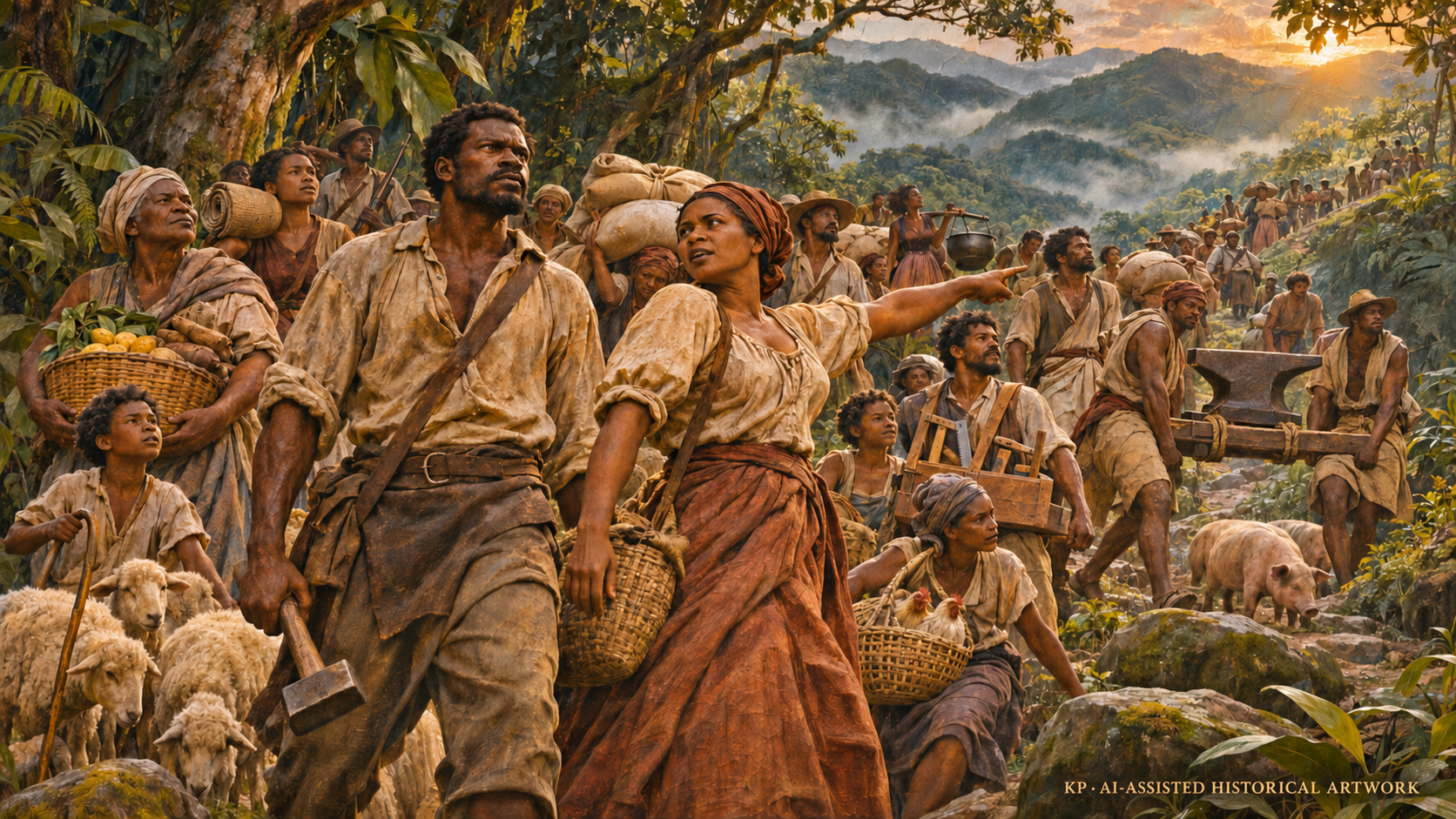
In November 1838, an estimated 200–400 African and Brazilian-born people left the coffee estates around Paty do Alferes, in Rio de Janeiro province, and entered the mountainous forests beyond the plantations. They carried provisions, livestock, clothing, agricultural implements, carpenters’ tools, and a blacksmith’s anvil. The evidence suggests that they intended not merely to escape but to establish an independent community.
Known as the Manuel Congo uprising, this collective flight towards freedom was led by the African-born blacksmith Manuel—or Manoel—Congo and the Brazilian-born Mariana Crioula. The uprising unfolded over several days; its judicial aftermath extended into 1839. Local armed forces dispersed the main gathering, captured its leaders, and destroyed supplies they could not remove. Manuel Congo was subsequently executed in Vassouras on 6 September 1839. Mariana was acquitted, although the verdict did not secure her freedom. Her refusal to surrender during the pursuit became one of the uprising’s most enduring expressions of resistance.
Coffee, Captivity, and the Making of a Frontier
The Paraíba Valley was becoming one of Brazil’s great coffee-producing regions. Expanding estates drew increasing numbers of captive workers into an agricultural economy built around exports, concentrated landholding, and coercive labor. Although Brazil had prohibited the transatlantic traffic in 1831, trafficking continued. The National Archives situates the uprising within a renewed expansion of this illegal commerce during the years immediately preceding 1838.
Paty do Alferes then formed part of the municipality of Vassouras. Its plantations belonged to a landscape in which coffee fields, work compounds, estate houses, roads, and mountain forests stood in close relationship. The forests offered concealment and independent settlement, but reaching them did not make freedom seekers impossible to pursue. Landowners could mobilise guards, local officials, trackers, and armed auxiliaries to recover people and property.
Among the region’s substantial landholders was Manoel Francisco Xavier, whose properties included the Freguesia and Maravilha estates. His inventory, completed in 1840, recorded 446 captive people across four properties.
Large estates brought together people with different origins, languages, occupations, and experiences. They also created opportunities for relationships to extend across workplaces and properties. The movement around Paty do Alferes emerged from this social world: one in which coercion was pervasive, but cooperation, communication, and collective purpose remained possible. The scale of the departure and the supplies assembled for it suggest that these connections mattered profoundly.
Manuel Congo: The Blacksmith as Organiser
The surviving judicial account preserves a few essential facts about Manuel Congo. During interrogation, he identified his place of origin as Congo and his occupation as blacksmith. Historical accounts also associate him with boiler-making. His birth date and the circumstances of his passage to Brazil remain uncertain.
Manuel’s occupation helps explain his position within the movement. Blacksmiths made and repaired equipment essential to plantation production. The judiciary’s historical account suggests that his work allowed him to move between properties, giving him opportunities to establish relationships beyond a single estate. Such mobility could support communication and organization, although no surviving statement by Congo explains exactly how the uprising was prepared.
The anvil carried into the forest gives his occupation a further significance. It represented a way to continue skilled work outside the plantation economy. Metalworking could help sustain cultivation, construction, repair, and defense. Its presence among the fugitives’ possessions connects Congo’s craft to the material possibilities of an independent community
The contemporary pursuit report described him as the group’s “king” and principal leader. It also mentioned a “vice-king” killed in the fighting. These titles were therefore recorded at the time, rather than invented later through commemoration. Their exact meaning is less certain. They indicate recognized leadership, but do not establish the full political structure the participants intended to create
Mariana Crioula and the Refusal to Surrender
Mariana Crioula stood alongside Congo as a leader of the movement. Brazilian-born and associated with the household of Francisca Xavier, she appears in historical accounts as the community’s “queen.” One of the most striking descriptions of her resistance comes from Francisco Peixoto de Lacerda Werneck, the commander responsible for the principal local pursuit. His report described a woman belonging to Francisca Xavier’s household who resisted capture and cried:
“Morrer sim, entregar não.”
“Die, yes; surrender, no.”
The words survive through an adversary’s account. Yet even in a report meant to celebrate the suppression of the uprising, her refusal to submit remained unmistakable.
The commander was particularly surprised that a woman regarded as valued within the household had resisted so fiercely. His surprise exposed the assumptions of the plantation order: preferential treatment was expected to produce loyalty, and proximity to the estate household was mistaken for consent. Mariana’s participation revealed the distance between a captor’s perception of favor and a captive person’s desire for autonomy.
Later narratives sometimes portray Mariana and Manuel as romantic partners, because of their shared leadership and the titles of king and queen.
The Killing That Preceded the Departure
The uprising followed other major episodes of resistance, including Carrancas in 1833 and the Malê uprising in Salvador in 1835. The Haitian Revolution also remained a powerful example of collective liberation. For captors and public authorities, these precedents intensified fears that collective flight could develop into a wider challenge to the plantation system.
The immediate catalyst at Paty do Alferes was the killing of a captive worker by an overseer. Later accounts identify the victim as Camilo Sapateiro and associate his death with movement between Xavier’s properties without permission. The judiciary’s historical account identifies the killing as the immediate cause of the uprising.
Yet the event that precipitated the departure should not be confused with the preparation that made it possible. The killing could have prompted collective action without having created, in a single moment, the relationships and plans necessary to sustain it. The judicial account identifies signs of prior organization, while the quantity and variety of the supplies carried into the forest suggest a purpose extending beyond immediate escape.
Accounts differ over the precise departure date. The Universidade Federal Fluminense reconstruction places it on the night of 5–6 November 1838; the judiciary’s summary, drawing on testimony in the proceedings, places it on the night of 6–7 November. Both accounts place the collective departure in the first week of November, when a substantial group left Xavier’s plantations and moved towards the mountains.
Carrying the Foundations of a New Community
The movement became known as the Quilombo de Manoel Congo and the Quilombo de Santa Catarina. The latter name refers to the mountain area associated with the fugitives’ movement in Rio de Janeiro province. The pursuit report describes successive stopping places and camps, suggesting a community still in motion rather than a settlement long established in one location.
Its preparations were nevertheless substantial. Lacerda Werneck’s report listed sugar, flour, bacon, meat, and other provisions, together with live chickens, pigs, and sheep. The group also carried cooking utensils, clothing, mats, blankets, agricultural implements, and tools for carpentry and metalworking. Money appeared among the recovered possessions
Each category points towards a practical requirement of independent life. Food sustained the immediate journey. Livestock offered resources beyond a single meal. Hoes and other implements made cultivation possible. Carpentry tools could support building shelters and furniture. Clothing, bedding, and cooking equipment belonged to the work of creating households, not merely maintaining a mobile armed band
The oppressors recognized the implications. An official observation quoted in the UFF reconstruction stated that the baggage contained what was necessary to establish “a new Fazenda”—a new agricultural estate. The comparison was revealing. Those pursuing the freedom seekers could understand the supplies as the foundations of productive settlement, even while refusing to recognize the participants’ right to establish one.
Pursuit Through the Mountains
The same preparations that made permanent settlement conceivable also complicated escape. Animals, heavy tools, food supplies, and household possessions slowed movement through steep, forested terrain. The group left tracks and substantial camps behind it. At one stopping place, the pursuers counted thirty-three shelters
Local oppressors responded quickly. The UFF reconstruction describes an initial force of approximately 160 men, predominantly National Guardsmen, accompanied by local participants. Trackers, forest specialists, and professional fugitive-catchers assisted the pursuit. The forces assembled on 10 November and moved to Fazenda Maravilha before following the freedom seekers into the mountains
The Confrontation of 11 November
The principal encounter occurred late in the afternoon of 11 November in the Santa Catarina mountain area. The freedom seekers resisted with firearms and edged weapons, but faced a better-armed force. Lacerda Werneck reported twenty-two captured, seven bodies found, and seven or eight seriously wounded people among those captured. He also recorded two deaths on the pursuing side.
The precise timing of the leaders’ capture remains uncertain. The UFF reconstruction places the capture of Manuel Congo and Mariana Crioula at approximately ten o’clock on the morning of 12 November. The National Archives’ introductory account associates Congo’s capture with the preceding confrontation. Both accounts place the destruction of the main gathering and the capture of its leadership within the same short sequence. The oppressors also destroyed supplies they could not transport.
Yet the encounter did not end with the capture of everyone. Nightfall and heavy rain helped people disperse. The National Archives observes that, even using the commander’s own estimate of approximately 150 people encountered, most were neither killed nor captured in that engagement
Lacerda Werneck further reported that Xavier was still missing between 250 and 300 people, including numerous skilled workers. That figure does not show how many remained permanently beyond his reach, but it prevents the battle from being described as an immediate and complete recovery of the fugitives.
The Unfinished Story of Those Who Dispersed
The capture of the best-known leaders has often supplied the narrative with an apparently decisive ending. The documentary record is less complete.
The UFF reconstruction gives a later total of sixty people captured and seven killed. It also records Xavier’s claim that most participants eventually returned after the leaders’ capture. These statements concern different moments and derive from sources with different interests. They cannot be combined into a precise account of every participant’s fate.
Some people were captured. Some returned. Others dispersed into the surrounding landscape, and their subsequent lives are not established by the records examined here. The evidence does not justify assuming that everyone who disappeared from official view necessarily achieved lasting freedom. It equally does not justify assuming that every freedom seeker was captured.
The uprising’s dispersal therefore belongs within its history. The unresolved fates of its participants mark the limits of a record chiefly concerned with prosecution and the restoration of plantation labor.
The Courts and the Criminalisation of Collective Freedom
In 1839, the confrontation moved into the courts. The legal framework made the participants’ objective itself a crime. Article 113 of Brazil’s 1830 Criminal Code defined insurrection as the gathering of twenty or more captive people to obtain freedom by force. It prescribed death at the highest degree for leaders, with other penalties for lesser degrees and corporal punishment for participants.
The judiciary’s account records that Manuel Congo received a death sentence for insurrection and was also condemned to death for the killing of two people. The insurrection and homicide proceedings were separate cases, that led to the legal route of his execution.
The UFF reconstruction identifies sixteen defendants. Published summaries record acquittals and sentences of 650 lashes, administered in daily instalments of fifty, together with three years wearing an iron restraint around the neck. The exact number receiving that sentence differs between accounts.
Mariana Crioula was acquitted. Acquittal, however, did not amount to release from captivity. Her acquittal is documented; her subsequent life remains far less visible.historia.uff+1
Manuel Congo’s Execution
The Rio de Janeiro judiciary dates Manuel Congo’s execution to 6 September 1839 in Vassouras. Although other dates circulate in later accounts. His execution made an example of a recognized organizer. It transformed the collective struggle of hundreds into the public punishment of a named individual. The courts identified a leader to condemn, while the plantation economy sought to recover the labor of those who survived.
The concentration on Congo also shaped later memory. His name became the most familiar designation for the uprising, sometimes leaving Mariana and the wider community in his shadow. Yet the movement depended on many forms of participation: gathering supplies, sharing information, transporting tools, moving through difficult terrain, constructing shelters, resisting pursuit, and sustaining collective resolve. Its history is larger than the biography of the man the oppressors executed.
African Leadership and the Language of Kingship
The uprising was substantially African in composition. Historian Flávio dos Santos Gomes characterises it as fundamentally African, while the participation of Mariana and other Brazilian-born people demonstrates that its relationships crossed differences of birthplace.
The recorded titles of king, queen, and vice-king make African political experience an important part of its interpretation. They suggest that participants recognised positions of authority through a language that may have carried meanings unavailable, or unimportant, to the officials recording it.
Although the evidence does not establish a complete reconstruction of any particular African political institution, it showed that African political agency remains central.
The strongest claim is also the clearest: people treated as the property of others asserted the capacity to recognise their own leaders and organise a collective future. The titles recorded by the pursuers are traces of that assertion, even though the full meanings attached to them have not survived.
Reading Beyond the Commander’s Account
Much of the uprising’s documentary detail survives because officials wanted to explain how it had been suppressed. Lacerda Werneck’s report praised officers, justified the operation, and presented the restoration of plantation control as a public achievement. A version appeared in the Jornal do Commercio on 24 November 1838, extending that account beyond official correspondence.
The report was therefore an argument as well as a record. Its descriptions of victory must be read alongside what it admitted: determined resistance, extensive preparations, recognised leadership, casualties among the pursuers, and hundreds still absent from Xavier’s properties.
Local rivalries further complicated the evidence. The National Archives’ discussion identifies political and economic tensions involving Xavier and networks associated with Ribeiro de Avelar and Lacerda Werneck. Concentrating responsibility on Xavier’s workers, while minimising participation from other properties, could serve interests within the region’s landholding elite.
These limitations do not make the uprising unknowable. They require attention to who produced each document, what its author wanted to achieve, and whose actions appear only indirectly within it.
A Community Interrupted
The Manuel Congo uprising belongs to the history of organized resistance in Brazil’s coffee valley, but its significance extends beyond the armed confrontation. Its participants attempted to transfer skills, resources, and decision-making away from the plantation. Their provisions and tools reveal a practical conception of independence: food to eat, ground to cultivate, shelters to build, trades to practice, and relationships through which a community could endure
The main gathering was dispersed, its leaders captured, and Manuel Congo executed. Mariana survived the prosecution, while the later lives of many others remain uncertain. These outcomes were devastating, but they do not erase what the movement attempted or the capacities it demonstrated.
The anvil carried into the mountains offers one of the clearest images of that attempt. It was heavy, difficult to transport, and useful far beyond the immediate moment of escape. Alongside hoes, livestock, cooking utensils, clothing, and carpenters’ tools, it belonged to a future the participants intended to make. The uprising was not only a departure from captivity. It was an effort to carry the foundations of another life into the forest.
Sources:
https://www.gov.br/arquivonacional/pt-br/sites_eventos/sites-tematicos-1/brasil-oitocentista/documentos/quilombo-de-manoel-congo
https://www.historia.uff.br/impressoesrebeldes/revolta/insurreicao-quilombola-de-vassouras
https://www.tjrj.jus.br/noticias/noticia/-/visualizar-conteudo/5111210/5477860
https://www.cambridge.org/core/books/boundaries-of-freedom/agrarian-empires-plantation-communities-and-slave-families-in-a-nineteenthcentury-brazilian-coffee-zone/02494BAB0B6BB2530BB266B4027865FA
https://biblioteca.fflch.usp.br/marianacrioula
https://www.uol.com.br/ecoa/noticias/deutsche-welle/2024/11/20/manuel-congo-comandou-a-maior-rebeliao-de-escravos-do-vale-do-paraiba.htm
https://www.geledes.org.br/a-saga-de-manoel-congo
http://planalto.gov.br/ccivil_03/leis/lim/lim-16-12-1830.htm