
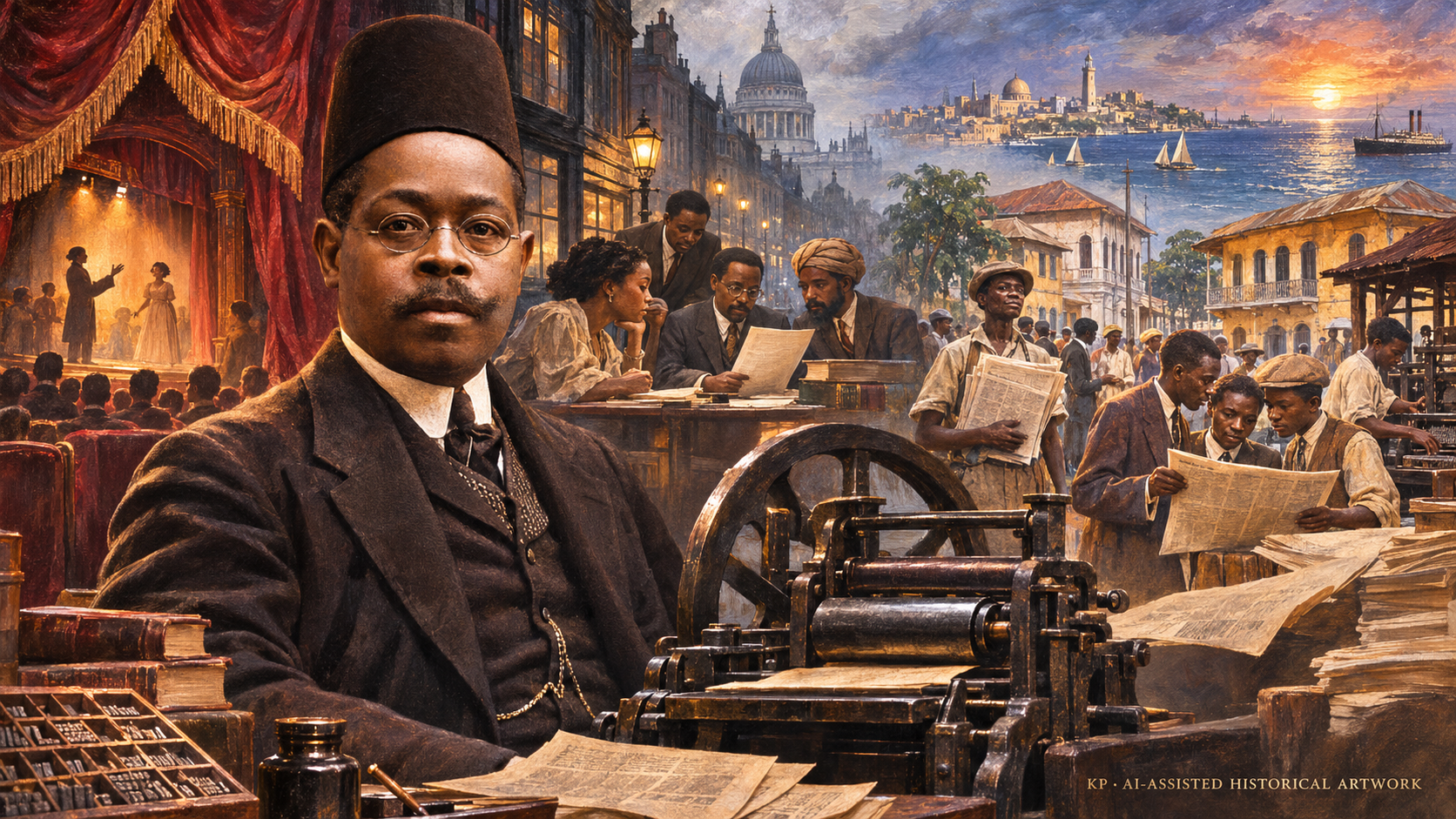
Dusé Mohamed Ali was an actor, playwright, historian, journalist, publisher, and political organizer whose career connected Africa, Europe, the Caribbean, and the United States. Across these overlapping worlds, he pursued a lasting purpose: to strengthen African and Asian peoples’ ability to represent themselves, defend their interests, and build relationships beyond European colonial structures.
Ali became internationally known through The African Times and Orient Review, the London periodical he founded in 1912, and The Comet, the Lagos newspaper he established in 1933. Between these ventures, he encouraged a young Marcus Garvey, participated in African American political and commercial networks, and supported Muslim cultural life. His achievements extended beyond his own writing. He created spaces in which people could meet, exchange knowledge, develop political ideas, and imagine a more independent future.
An Early Life Shaped by Displacement
Ali identified Alexandria, Egypt, as his birthplace and November 21, 1866, as his birth date. In his autobiographical accounts, he described an Egyptian father who served as an army officer and a Sudanese mother, Ayesha. His understanding of himself brought together Egyptian, Sudanese, Arab, and African inheritances—connections that later informed his political outlook.
According to his recollections, his father arranged English lessons during his childhood and sent him to Britain around 1875 or 1876 under the guardianship of a French officer, Captain Dusé. He subsequently adopted his guardian’s name. His father hoped that he would study medicine and eventually become an army surgeon.
Ali’s account of his adolescence centered on the British military assault on Egypt in 1882. He recalled returning to Alexandria that year, losing a brother during the naval bombardment, and learning that his father had died at the Battle of Tel el-Kebir. His mother and sisters traveled to Sudan for safety. Despite years of searching, he said he never found them.
These experiences became central to the life story he later presented. Yet parts of that story remain uncertain. His claimed studies at King’s College London have not been confirmed in the academic records researchers examined, and historians have questioned other details of his early years.
Finding a Voice on the Stage
Ali began his professional theatrical career in London in December 1883, appearing in Claudian at the Royal Princess’s Theatre. Over the following quarter century, he worked as an actor, reciter, playwright, and producer, performing across Britain and traveling to North America.
The stage provided a livelihood, but it also exposed the racial boundaries of British cultural life. Although his abilities attracted praise, managers repeatedly cast him in narrowly conceived African and Asian characters. Such parts offered visibility without the range available to European performers. His experience revealed a persistent contradiction: audiences could admire a Black actor while the theatrical profession restricted the characters he was permitted to embody.
Writing and producing offered him greater creative independence. His works included The Jew’s Revenge (1903), A Daughter of Judah (1906), and A Cleopatra Night (1907). In Hull, where he became an active participant in local cultural life, he helped establish the Hull Shakespeare Society in 1903. He also taught elocution, presented recitals, and organized concerts.
His theatrical ambitions found an especially revealing expression in Lily of Bermuda, a musical comedy he wrote with Bermudian performer Ernest Trimingham and had produced in Manchester in 1909. The story follows a flower whose scent causes people to abandon social and racial prejudices. Beneath the entertainment lay an imaginative challenge to the divisions governing everyday life. The flower gave theatrical form to a hopeful vision: that racial and social prejudices were learned barriers, not inevitable features of human life. By imagining their disappearance, Ali invited audiences to glimpse the relationships and freedoms those barriers denied.
The production failed financially. Ali reportedly pawned scenery and costumes to pay his performers’ fares back to London. The setback helped redirect his energies toward journalism, though theater remained part of his creative life. Years later, he returned to production in Lagos.
From Performance to Political Writing
Ali’s movement into journalism developed gradually. While living in Hull, he contributed historical writing, poetry, and correspondence to local publications. By 1909, he was writing for The New Age, the independent socialist weekly edited by A. R. Orage.
His essays challenged racial prejudice and the assumption that European societies possessed an unquestionable right to judge other peoples. In the satirical series “Western Civilization Through Eastern Spectacles,” he reversed the familiar direction of observation: an Egyptian commentator examined British society and exposed the distance between its professed values and its practices.
This reversal became a defining feature of his journalism. African and Asian peoples appeared not as objects of European description but as thinkers capable of scrutinizing Europe, interpreting international affairs, and speaking for themselves.
A speech by former American president Theodore Roosevelt in London in 1910 prompted Ali’s most prominent book. Roosevelt defended Britain’s coercive approach in Egypt. Ali initially intended to write a journalistic response, but Orage encouraged a longer work.
Published in 1911, In the Land of the Pharaohs challenged British intervention in Egypt and connected Egyptian political grievances with the wider experience of racial injustice. It established Ali’s reputation as a forceful political writer.
The book also attracted criticism for extensive borrowing from earlier publications, including works by Wilfrid Scawen Blunt and Theodore Rothstein. However, even with that limitation, it marked Ali’s emergence as a writer determined to bring an African-centered perspective into English-language debate.
Building an International Platform
In July 1912, Ali founded The African Times and Orient Review in London, working with Sierra Leonean businessman John Eldred Taylor and drawing support from West African commercial and intellectual networks. Its office at 158 Fleet Street became both a publishing headquarters and a meeting place.
The review brought African, Caribbean, African American, and Asian concerns into a shared conversation. Its contributors included W. E. B. Du Bois, Booker T. Washington, and other prominent public figures. Rather than treating struggles in Egypt, India, West Africa, and the Caribbean as unrelated, it explored the connections among racial discrimination, political exclusion, land appropriation, and economic exploitation.
Ali understood journalism as practical work. The review challenged misleading reporting, publicized abuses, defended African land rights, and promoted direct commercial relationships. Its office offered visiting students, merchants, and campaigners a place to seek advice and build contacts.
Economic independence was central to this vision. Ali believed that political aspirations required material foundations: businesses, cooperative ventures, reliable communications, and access to markets. African producers and communities across the diaspora needed relationships that did not depend entirely on European intermediaries.
His internationalism also embraced Asian peoples and Muslim networks. He sought cooperation without requiring every community to possess the same history or political identity. Shared interests could provide a basis for action across differences.
British police and intelligence agencies monitored his activities. Officers searched the Fleet Street office in December 1914, and wartime restrictions obstructed the review’s circulation in India and African territories controlled by Britain. Publication became intermittent. A successor, The Africa and Orient Review, appeared briefly in 1919–1920. These difficulties exposed the vulnerability of an independent international publication whose message challenged the governments controlling many of its distribution routes.
His Influence on Marcus Garvey
Ali’s relationship with Marcus Garvey became one of the most consequential connections of his London years. During 1912–1913, the young Jamaican worked with The African Times and Orient Review, gaining experience where journalism, commerce, and African internationalism intersected.
In October 1913, the review published Garvey’s essay “The British West Indies in the Mirror of Civilization: History Making by Colonial Negroes.” His participation placed him within a network connecting Caribbean questions with developments in Africa and the wider world.
Ali offered more than an opportunity to publish. His office demonstrated how a periodical could become the center of a political community: gathering information, sustaining correspondence, introducing visitors, and translating ideas into collective activity. Garvey encountered a working example of the press as an instrument of international organization.
Ali’s emphasis on economic self-reliance also helped shape the intellectual environment in which Garvey developed. Direct commerce, African enterprise, and cooperation between Africa and its diaspora became key elements of Garvey’s program. Ali was not the sole source of those ideas—Booker T. Washington was another major influence—but he helped make them tangible through publishing and commercial advocacy.
Their relationship was neither simple nor consistently harmonious. Differences emerged during the First World War, and a critical letter from Ali circulated among Garvey’s opponents in New York. Yet they later renewed their association. After moving to the United States, Ali joined the Universal Negro Improvement Association in 1922, worked in African affairs, and contributed to its newspaper, Negro World.
His existing West African contacts also assisted the movement’s communications. The relationship had become reciprocal: the younger man’s organization now provided an international platform for the older journalist.
Ali left the association in late 1924 to pursue independent ventures. Nevertheless, his assessment of Garvey remained appreciative. In a 1940 obituary, he credited Garvey with having “altered the economic and political consciousness of the African world over.” Their history illustrates influence without permanent agreement—a mentorship that developed into collaboration, disagreement, and enduring recognition.
Economic Cooperation and Muslim Community Life
Ali lived in the United States from 1921 to 1931. Alongside his journalism and work with Garvey’s movement, he pursued enterprises intended to strengthen commercial links between Africa and African Americans.
In 1923, he established the American African Oriental Trading Company. Later, he collaborated with Gold Coast entrepreneur Winfried Tete-Ansa on cooperative commercial initiatives and edited the short-lived magazine Africa in 1927–1928.
These ventures expressed a consistent conviction: solidarity needed an economic life. Producers required buyers, businesses needed dependable partners, and political communities needed resources of their own. His commercial projects faced difficulties, but their purpose remained closely connected to his broader pursuit of African independence.
In Detroit, Ali also participated in Muslim religious and cultural organizing. He helped establish the Detroit Central Islamic Society and served as its president. Through related associations, lectures, and performances, he encouraged encounters among people of African and Asian backgrounds.
His activities contributed to an environment in which African Americans could encounter Islam as part of a broader international cultural world. That contribution is significant without making him the founder of later movements or attributing to him developments shaped by many participants.
Lagos and the Making of The Comet
Ali settled in Lagos in 1931, initially attending to cocoa-trading interests. Journalism soon returned to the center of his working life. He contributed the column “About it and About” to the Nigerian Daily Times and briefly edited the Nigerian Daily Telegraph.
On July 27, 1933, he launched The Comet. The newspaper became an influential platform for international reporting, political commentary, literature, and public discussion.
Its accessibility mattered. Ali favored concise paragraphs, lively presentation, and direct explanation over elaborate prose. Readers did not have to surrender intellectual seriousness to enjoy an engaging newspaper. His approach helped broaden the audience for political journalism.
The Italian invasion of Ethiopia in 1935 gave his international coverage particular urgency. Through The Comet, readers in Nigeria followed an African country’s struggle against European military aggression. The conflict became an immediate political concern rather than a remote diplomatic event. Anthony Enahoro and Obafemi Awolowo later recalled the importance of Ali’s journalism in developing their awareness of African solidarity and political freedom.
His newspaper also sustained his literary imagination. He serialized fiction, including A Daughter of the Pharaohs and Ere Roosevelt Came, and published his autobiography, “Leaves from an Active Life,” between June 1937 and March 1938.
Ali’s Lagos office became another place of instruction and exchange. He conducted informal journalism classes and encouraged younger writers. Although he maintained relationships across competing political groups, his independence did not imply indifference. He supported African political advancement while resisting the reduction of his newspaper to an instrument of personal rivalry.
He also remained active in Muslim community life, advocating education alongside religious commitment. His public work joined cultural confidence with an openness to new knowledge.
Companionship, Final Years, and Legacy
Ali’s demanding public career unfolded alongside relationships that also supported his work. In 1901, he married Elizabeth Mary Brunyee, who died later that year. Beatrice Pardoe-Nash subsequently shared his London life and participated in the cultural and political networks surrounding him, contributing poetry to his review.
In the United States, he partnered with singer and actress Gertrude La Page. She accompanied him to Lagos in 1931, contributed to The Comet, and collaborated in theatrical activities. She returned to the United States in 1937.
Ali continued working into old age. The Comet became a daily newspaper in May 1944, and control subsequently passed to Nnamdi Azikiwe’s publishing enterprise. With his health declining, Ali remained connected to the company as a director.
He died in Lagos on June 25, 1945, aged seventy-eight. Thousands attended his funeral procession two days later, with Muslim and Christian representatives joining political and civic figures. He was buried at Okesuna Muslim Cemetery. His newspaper commemorated him with the headline “We Lose a Prince of the Pen.”
Ali’s legacy rests on the connections he made possible: between performance and politics, Africa and its diaspora, Muslim cultural life and Pan-African thought, commercial independence and political freedom. He used newspapers not simply to express opinions but to develop readers, nurture writers, and sustain communities of action.
His career also reveals the cumulative character of liberation movements. Before later organizations gained mass followings, individuals such as Ali built correspondence networks, maintained fragile publications, shared practical knowledge, and introduced people whose work would reach far beyond their first encounters. Across decades of financial uncertainty and geographic movement, he helped make African self-representation an enduring public practice.
Sources:
https://www.english-heritage.org.uk/visit/blue-plaques/duse-mohamed-ali/
https://en.wikipedia.org/wiki/Dus%C3%A9_Mohamed_Ali
https://era.ed.ac.uk/items/ba7010bd-dd01-40c7-b6db-de8c8290120f
https://www.bbc.co.uk/news/uk-england-humber-43033986
https://www.middleeasteye.net/discover/uk-duse-mohamed-ali-first-black-muslim-editor-fleet-street