
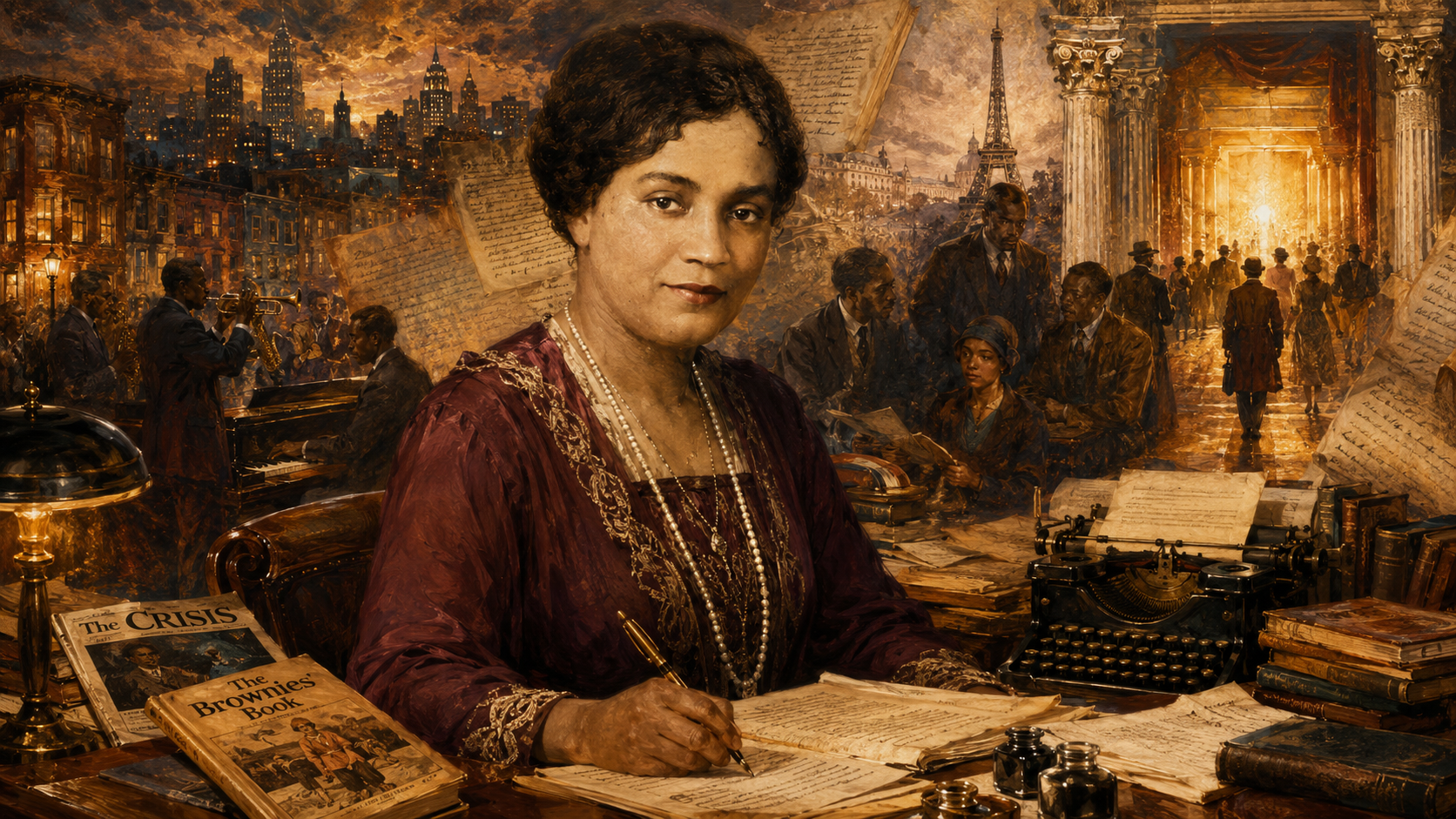
Jessie Redmon Fauset was an editor, novelist, poet, essayist, educator, and scholar whose labor helped make the Harlem Renaissance possible. Though she was long remembered chiefly as an encourager of other writers, Fauset was also a major creative force in her own right: a pioneering novelist of Black middle-class life, a rigorous editor with a remarkable eye for talent, and a woman whose career exposed the barriers that race and gender placed before Black intellectuals in early twentieth-century America.
Fauset was born on 27 April 1882 in Fredericksville, New Jersey—now Lawnside—the seventh child of Annie Seamon Fauset and Redmon Fauset, a minister in the African Methodist Episcopal Church. Her early life was shaped by faith, family obligation, educational ambition, and financial insecurity. After the death of her mother, her father married Bella Huff, a Jewish widow who had converted to Christianity. The family later moved to Philadelphia, where Fauset grew up in what she described as a “very conservative, very religious household.” The Fauset home prized education, even as poverty placed serious limits on the family. When her father died while she was still young, Bella Fauset carried the responsibility of supporting a large household that included very small children.
Fauset’s academic ability became apparent early. She attended the Philadelphia High School for Girls, one of the city’s most demanding academic institutions. As the only Black pupil in her class, she encountered racial hostility and the painful withdrawal of non-Black schoolmates whom she had believed were friends. Yet she excelled, graduating as class valedictorian in 1900 and probably becoming the school’s first African American graduate. Her achievement should have brought a scholarship to Bryn Mawr College, the customary reward for the school’s valedictorian. Instead, Bryn Mawr’s president, M. Carey Thomas, resisted admitting Black students. They raised funds to enable Fauset to attend Cornell University instead.
At Cornell, where she entered in 1901, Fauset became the first Black woman to attend. She studied classical languages, lived at Sage College, and graduated in 1905. She was elected to Phi Beta Kappa, an important distinction that testified to her scholarly attainment. Claims that she was the first Black woman elected to the society, however, should be treated cautiously: later research identifies Mary Annette Anderson as having preceded her. Fauset’s education was not simply a personal triumph. It demonstrated the high intellectual ambitions of Black Americans in an era when elite institutions frequently closed their doors to them.
A degree from Cornell did not, however, remove the barriers of discrimination. Fauset wanted to teach in Philadelphia, but the city’s public schools refused to employ her because she was both Black and a woman. She began instead at Douglass High School in Baltimore, then moved to Washington, D.C., where she spent fourteen years teaching French and Latin at M Street High School, later renamed Dunbar High School. While teaching full time, she continued her own studies and earned a Master of Arts degree in French from the University of Pennsylvania in 1919. During school vacations, she traveled to Paris to study at the Sorbonne.
Even before she left the classroom, Fauset had begun to build a literary career. From 1912 onward, she submitted poems, essays, and stories to The Crisis, the journal of the National Association for the Advancement of Colored People. By the summer of 1918, she was contributing regularly to its “Looking Glass” column. W. E. B. Du Bois, the magazine’s editor, recognized her unusual intelligence, literary judgment, and organizational ability. In October 1919, she moved to New York and became The Crisis’s literary editor.
Fauset’s tenure at The Crisis, from 1919 to 1926, established her as a central figure of the Harlem Renaissance. She shaped the magazine during its most productive literary period, selecting, editing, and encouraging work that enlarged the possibilities of Black writing in the United States. Her influence extended beyond the printed page. She gave young writers a serious national platform and encouraged representations of Black life that were complex, dignified, and recognisably human rather than confined by racist convention.
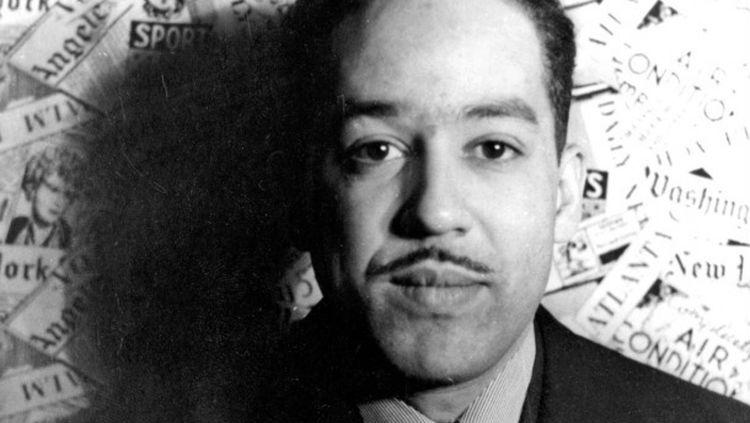
Among the writers whose early careers she encouraged or published were Langston Hughes, Countee Cullen, Jean Toomer, Claude McKay, Nella Larsen, George Schuyler, Georgia Douglas Johnson, Anne Spencer, and Arna Bontemps. Fauset is widely credited as the first person to publish Hughes, initially in The Brownies’ Book, the children’s periodical she helped manage and edit, and later in The Crisis. Hughes subsequently paid tribute to her in The Big Sea, naming Fauset, Charles S. Johnson, and Alain Locke as the people who “midwifed the so-called New Negro Literature into being.” The phrase has endured because it captures her decisive role in bringing a generation of writers before a national readership. Yet it can also obscure the extent of her own authorship. Fauset was not merely a midwife to others’ work; she was a major novelist and intellectual of the movement herself.
Her first novel, There Is Confusion, appeared in 1924. Its publication followed resistance from white publishers, some of whom doubted that readers would accept a novel centred on educated, middle-class Black people. The book challenged precisely that narrow expectation. Its characters possessed ambition, professional aspirations, family histories, emotional lives, and social complexity—qualities too often denied to Black characters in mainstream American fiction.
A dinner held at the Civic Club in Manhattan on 21 March 1924, associated with the launch of There Is Confusion, brought together Black writers and intellectuals with white publishers and critics. It is best understood not as the uncontested “birthplace” of the Harlem Renaissance, but as one of the key events that helped consolidate the movement’s public identity and networks.
Fauset went on to publish three further novels: Plum Bun: A Novel Without a Moral in 1928, The Chinaberry Tree in 1931, and Comedy, American Style in 1933. In these works, she returned repeatedly to questions of colour, class, respectability, belonging, and women’s self-definition. Plum Bun, often regarded as her most acclaimed novel, examines racial passing and the personal costs of attempting to escape a society structured by colour prejudice. The Chinaberry Tree explores family, social aspiration, and the boundaries imposed on Black middle-class life. Comedy, American Style, her last novel, gives a darker account of “color mania”—internalised colour prejudice—and its destructive effects within a family.
Fauset’s fiction was radical not because it offered a single portrait of Black experience, but because it insisted upon its range. At a time when popular literature repeatedly reduced Black people to stereotypes of servitude, degradation, or exoticism, she portrayed teachers, professionals, parents, daughters, friends, and aspiring artists. Her novels also took Black women’s inner lives seriously. They considered the intersecting pressures of racism, sexism, class expectations, and colour hierarchy, while allowing women intellectual, sexual, social, and moral complexity. In this respect, Fauset anticipated later Black feminist criticism and fiction.
Her relationship with Du Bois was professionally productive but complicated. Their work together at The Crisis placed her at the heart of the movement’s literary infrastructure, but it also left her vulnerable to being overshadowed by his greater public stature. Over time, conflicts and personal strain contributed to her departure from the magazine. The documentation supports the broad dates of her literary editorship—1919 to 1926—although a precise final month varies among accounts. Much historical credit for The Crisis’s literary achievements was later given to Du Bois, even though Fauset performed substantial editorial work that made the journal a training ground for new writers. Her later obscurity stemmed not from a lack of accomplishment, but from the gendered ways literary history often remembered women’s work as auxiliary to that of more famous men.
After leaving The Crisis, Fauset sought work in publishing but met the same racial barriers she had faced earlier in Philadelphia. She returned to teaching, working in New York City public schools and teaching French at DeWitt Clinton High School in the Bronx from 1927 until her retirement in 1944. At the same time, she continued to write. In 1929, at the age of forty-seven, she married Herbert Harris, an insurance broker. The couple had no children and eventually settled in Montclair, New Jersey. After Harris died in 1958, Fauset returned to Philadelphia, where she died of heart disease on 30 April 1961. She was buried at Eden Cemetery in Collingdale, Pennsylvania.
By the end of her life, Fauset had receded from public literary memory. Feminist scholarship in the 1970s began to recover her work and reassess her central role in the Harlem Renaissance. This recovery has made it increasingly difficult to tell the period’s history as a story of a few celebrated male authors. Fauset built institutions, discovered talent, and wrote in ways that expanded the imaginative territory available to Black fiction.
To remember Jessie Redmon Fauset properly is to recognize both the brilliance of her individual achievement and the systems that made that achievement easier to overlook. She helped create the conditions for a generation of writers to flourish. She also wrote four novels that demanded readers see Black life beyond the limits of stereotype. Her legacy lies not only in the authors whose early work she championed, but in her own unwavering insistence that Black people—particularly Black women—were entitled to complexity, education, aspiration, love, error, and full humanity.
Endnote: Most biographical sources date Fauset’s M.A. in French from the University of Pennsylvania to 1919. The Pennsylvania Center for the Book gives 1929. The discrepancy should be checked against University of Pennsylvania records before final publication.
Sources:
https://en.wikipedia.org/wiki/Jessie_R._Fauset
https://pabook.libraries.psu.edu/literary-cultural-heritage-map-pa/bios/fauset__jessie_redmon
https://www.panmacmillan.com/blogs/classics/jessie-fauset-role-the-harlem-renaissance
https://reedwriteandcreate.com/blog/who-was-jessie-redmom-fauset-novelist
https://ecommons.luc.edu/cgi/viewcontent.cgi?article=5071&context=luc_theses
https://historicalnovelsociety.org/into-the-light-victoria-christopher-murray-reclaims-the-hidden-story-of-jessie-redman-fauset/