
“I have no doubt in my mind that the British are determined to execute me. I have committed no crime. My only crime is that I am a Kenyan revolutionary who led a liberation army. Now if I must leave you and my family I have nothing to regret about. My blood will water the tree of independence.” — Field Marshall Dedan Kimathi (to his wife, Mukami, on the morning of his execution)
Dedan Kĩmathi Waciũri was thirty-six when the British hanged him at Kamiti Prison on 18 February 1957. A former teacher, laborer and political organizer, he had become one of the foremost leaders of the Kenya Land and Freedom Army (KLFA), fighting for the recovery of African land and an end to British oppression. His execution ended his life before Kenya achieved independence, but it did not extinguish the demands for which he had fought.
Kimathi brought more than military leadership to the liberation struggle. He wrote letters, encouraged commanders to preserve records, organized councils, and sought to articulate a future beyond colonial occupation. The forest was both a place of armed resistance and a setting in which he and his comrades debated the foundations of a free Kenya. His surviving words reveal a political thinker as well as a commander: a man concerned with collective purpose, historical memory and the lives of those who would inherit the country.
Childhood in a Dispossessed Country
Kimathi was born on 31 October 1920 in the Tetu area of Nyeri, in central Kenya. Accounts variously identify his birthplace as Kanyinya or Thenge. He grew up in a rural Gĩkũyũ family whose livelihood depended on agriculture, within a society profoundly disrupted by European appropriation of African land.
His childhood fell within a wider history of dispossession. Across central Kenya and the Rift Valley, African communities faced restricted access to ancestral land, racial discrimination and demands for labor. Families who cultivated colonial estates found their residence and livelihoods dependent on the demands of European landstealers. These conditions formed the social landscape from which Kimathi’s political commitments emerged.
He began formal schooling relatively late, attending Karunaini Primary School before continuing his education at Tumutumu. He developed an aptitude for English, writing, poetry and debate. His education was interrupted, however, and accounts of his departure from school differ in their emphasis on disciplinary disputes and financial difficulties. What remained was an enduring confidence in the written word—an ability that would distinguish his later political and military work.
His early adulthood was unsettled. He undertook various jobs, including agricultural work and clerical employment, before teaching without formal qualifications at Karunaini. He also organized literacy teaching beyond the ordinary classroom. His experiences carried him between rural communities and settler agricultural districts, exposing him to different expressions of the same inequalities.
In 1948, he married Mukami, who would share the consequences of his commitment to liberation. Their family life unfolded amid increasing surveillance, underground organizing and, eventually, imprisonment and separation. Mukami’s contribution to the struggle and her later work to preserve its memory became inseparable from the public remembrance of her husband.
From Political Organizer to Forest Fighter
During the late 1940s, Kimathi became active in the Kenya African Union, working around Ol Kalou and Thomson’s Falls, now Nyahururu. He served as a local branch secretary, bringing his literacy, organizational ability and public speaking to an expanding movement for African rights.
Political organizing increasingly intersected with underground networks whose members believed that petitions and delegations had failed to secure meaningful change. Kimathi became involved in administering oaths that bound participants to secrecy, solidarity and the struggle for land and freedom. These ceremonies helped create commitments across communities under surveillance and repression.
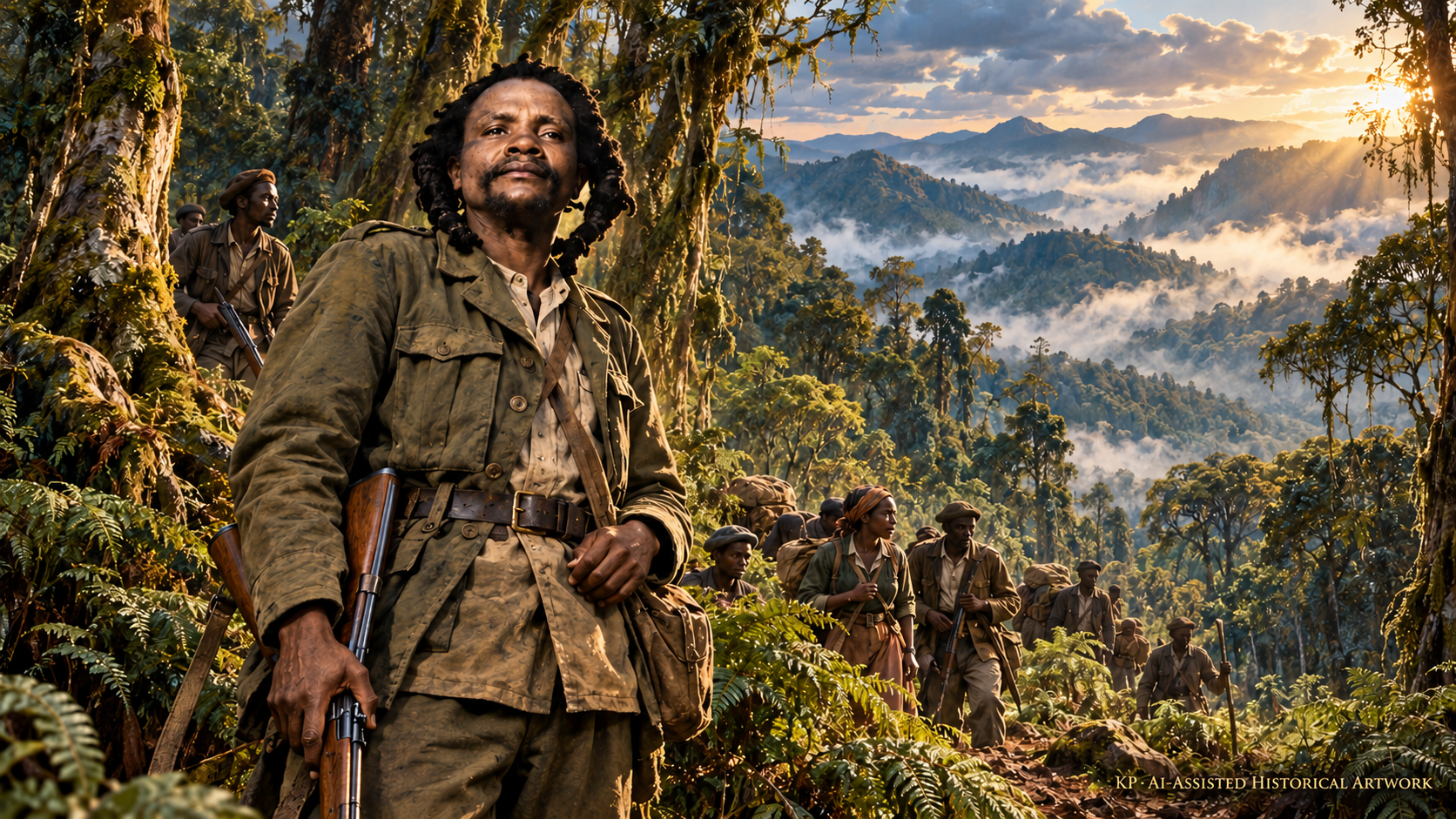
On 20 October 1952, the colonial administration declared a State of Emergency. Arrests and restrictions intensified, while growing numbers of Africans entered the forests rather than submit to detention. Kimathi escaped custody and joined the armed resistance in the Nyandarua forests, also known as the Aberdares. The mountains and forests around Nyandarua and Mount Kenya became central locations of the liberation war.
The movement became widely known as “Mau Mau,” a name whose precise origin remains disputed. Its uncertain etymology should be distinguished from the disparaging associations attached to it in British colonial discourse. “Kenya Land and Freedom Army” expressed the fighters’ political objectives more directly: the recovery of land and the achievement of freedom.
Organising the Kenya Land and Freedom Army
Kimathi’s importance lay partly in his efforts to bring greater coordination to a dispersed resistance. Forest fighters operated in separate formations, often with their own commanders, local relationships and methods of obtaining food and intelligence. Distance, difficult terrain and the constant threat of attack complicated communication.
In 1953, Kimathi helped establish the Kenya Defence Council to coordinate military activity and improve cooperation among commanders. He adopted the rank of Field Marshal and became a leading figure in the Nyandarua resistance. Yet the KLFA was not a seamlessly unified army. Other commanders retained considerable independence, and Kimathi’s attempts to consolidate leadership generated both support and disagreement.
The fighters faced an opponent with far greater access to weapons, transport, aircraft, and supplies. They relied on mobility, knowledge of the terrain, raids and the seizure or manufacture of weapons. Their survival depended equally on people outside the forest: those who carried food, relayed messages, provided intelligence and maintained connections between armed formations and surrounding communities.
Women participated throughout these networks, as organizers, couriers, suppliers and combatants. Kimathi’s forest organization also included women in positions of responsibility. Their involvement challenges any account that reduces the liberation struggle to a succession of male commanders; the armed resistance could not have endured without the labor and risks undertaken beyond the battlefield.
Kimathi demanded discipline, but his leadership was not uncontested. Disputes over negotiations, military priorities and the treatment of fellow fighters became increasingly serious as conditions deteriorated. Such disagreements were not incidental to the struggle. They reflected the difficulty of maintaining collective action under hunger, isolation and relentless pursuit.
Writing a Future from the Forest
Among Kimathi’s most distinctive commitments was his insistence on documentation. He encouraged commanders to record meetings, operations, and decisions. Letters and written instructions sustained communication, but they also asserted that the fighters had political intentions and a history worth preserving.
His attention to records challenged the colonial presentation of the resistance as mere criminal activity. The surviving documents disclose deliberation: arguments about leadership, discipline, representation and the country’s future. They preserve traces of people who understood themselves as participants in a national liberation struggle, not simply fugitives in a forest.
The assembly known as the Kenya Parliament extended this ambition. Convened in the forest in 1954, it represented an effort to give organized political expression to the struggle, with Kimathi identified as its prime minister. Although wartime conditions and internal disagreements limited its practical reach, its significance lay in its claim: Africans could form their own institutions and speak for their country’s future.
Kimathi also used letters to communicate beyond the forest. His correspondence included appeals for peace and proposals for ending the fighting. Armed resistance and negotiation were not necessarily opposites in his political thinking. The question was whether an agreement could address the conditions that had driven people into the mountains rather than merely require their submission.
Capture: 21 October 1956
By 1956, sustained military operations and the disruption of civilian support networks had severely weakened the forest resistance. Food shortages, defections and intelligence gathered from captured or former fighters narrowed Kimathi’s movements. British police officer Ian Henderson played a leading role in the effort to locate him.
On the morning of 21 October 1956, Kimathi was shot and captured near the forest boundary in Tetu. The man identified as having shot him was Ndirangu, an African policeman serving the colonial administration. Wounded in the leg, Kimathi was taken into custody with a revolver and ammunition.
The circumstances of the encounter later became central to his defense. Colonial accounts presented the arrest as the successful culmination of a prolonged hunt. Kimathi maintained that he had left the forest intending to surrender and had been shot while resting beneath a tree. The colonial administration publicized his capture extensively. Photographs of the wounded commander on a stretcher circulated as evidence that a leading figure in the resistance had been overcome. His capture was a major setback, but it did not immediately end armed resistance, nor did it bring the Emergency to a close.
Trial and the Surrender Defence
Kimathi’s trial opened in Nyeri on 19 November 1956. Still recovering from his wound, he faced proceedings that lasted eight days. The trial concluded with his conviction and death sentence on 27 November.
The charges that sent him to the gallows concerned unlawful possession of a firearm and ammunition under the Emergency Regulations. He was not executed following a murder conviction. This distinction is essential: colonial emergency legislation made weapons possession itself a capital offence.
Kimathi did not deny that he had the revolver. Instead, he disputed the interpretation of that possession. The transcript records his explanation:
“The reason I had this arm with me was because I was coming out to surrender. I did not leave it behind me. Government instructions were that anyone who intended to surrender should not leave his arms behind.”
His argument placed the government’s surrender instructions at the center of the case. If people leaving the forest were instructed to bring their weapons, possession alone could not explain their intentions. Kimathi maintained that he was attempting to comply with those instructions when he was shot. The court rejected his defense.
The proceedings also disclosed aspects of his life often absent from heroic portraits. He testified that he had experienced seizures since childhood, introducing this history to explain his condition during the encounter with police. The wounded defendant in Nyeri was not simply the commanding figure of photographs and commemorative art; he was also a man living with illness, pain and the prospect of death.
His appeal to the Court of Appeal for Eastern Africa was dismissed on 27 December 1956. On 14 February 1957, the Judicial Committee of the Privy Council refused permission for a further appeal.
Final Letters and Execution
Awaiting execution at Kamiti, Kimathi turned his attention to his family. His surviving letter to Father Nicola Marino, dated 17 February 1957, provides an intimate record of his concerns. He asked the priest to arrange schooling for his son, comfort his elderly mother and support Mukami, who was also detained at Kamiti.
He returned insistently to education:
“I conclude by telling you only to do me favour by getting education to my son.”
The request joined his earlier life as a teacher to his final responsibilities as a father. Amid preparations for death, he sought to secure a child’s future. His concern for Mukami’s loneliness and his mother’s grief also reveals the family relationships that imprisonment had fractured.
On 18 February 1957, the British colonial oppressors hanged him at Kamiti. He was thirty-six. His body was buried in an unmarked grave within the prison grounds, leaving his family without an identified resting place at which to mourn.
The statement “My blood will water the tree of independence” became closely associated with Kimathi through accounts of his final meeting with Mukami. It belongs to the remembered history of his death; his surviving prison letter offers a separately documented record of his final concerns. Both have shaped how later generations encounter him, but they represent different kinds of historical evidence.
Independence and the Struggle over Memory
Kenya achieved independence in December 1963, almost seven years after Kimathi’s execution. Yet independence did not bring immediate recognition or security to all who had fought for it. Veterans and their families continued to face poverty and exclusion, while public acknowledgement of the armed struggle remained politically contested.
Under Jomo Kenyatta and later Daniel arap Moi, official commemoration frequently sidelined the movement. The prohibition on Mau Mau remained in place long after the departure of the British oppressors. Families, veterans, writers and community networks nevertheless preserved the names and experiences that official narratives neglected.
Literature became an important site of remembrance. Ngũgĩ wa Thiong’o and Mĩcere Gĩthae Mũgo’s 1976 play, The Trial of Dedan Kimathi, placed him at the centre of a collective struggle for liberation. Rather than treating the colonial courtroom’s judgment as the final account of his life, the playwrights reclaimed the political meaning of his resistance. The work is a dramatic interpretation, not a substitute for the trial transcript, but its influence on cultural memory has been substantial.
Formal recognition expanded after Mwai Kibaki became president. The prohibition on Mau Mau was lifted in 2003, and on 18 February 2007, the fiftieth anniversary of Kimathi’s execution, a bronze statue was unveiled in central Nairobi. His name also lives through educational institutions, including Dedan Kimathi University of Technology, and through streets and public commemorations.
Mukami remained a central custodian of this memory. She campaigned for recognition of the struggle and the recovery of her husband’s remains. When she died in May 2023, she had not seen his remains identified and reburied. The unresolved burial stood in painful contrast to the public monuments erected in his honor.
A Life Beyond the Monument
The recovery and publication of Kimathi’s trial records have made it possible to encounter him beyond both colonial denunciation and commemorative certainty. The documents reveal a commander who pursued coordination but faced dissent, an advocate of armed liberation who also explored negotiation, and a prisoner whose defense rested on an intention to surrender. These complexities deepen rather than diminish his historical significance.
Kimathi’s life centered on freedom, understood not simply as a change of flag but as release from dispossession, racial humiliation and British oppression. His organization, correspondence and final concern for his son’s education connect the public struggle to the ordinary possibilities it was meant to secure. He did not live to see an independent Kenya. His enduring place in its history rests on the future he helped make imaginable—and on the continuing obligation to remember those whose sacrifices made that future possible.
Sources:
https://en.wikipedia.org/wiki/Dedan_Kimathi
https://www.dkut.ac.ke/downloads/The%20Trial%20of%20Dedan%20Kimathi%20-%20Ngugi%20wa%20Thiong’o.pdf
https://uplopen.com/reader/books/pdf/14356
https://heroes.kenyanism.com/old-school/dedan-kimathi/
https://kenyanhistory.com/dedan-kimathi-a-comprehensive-profile/