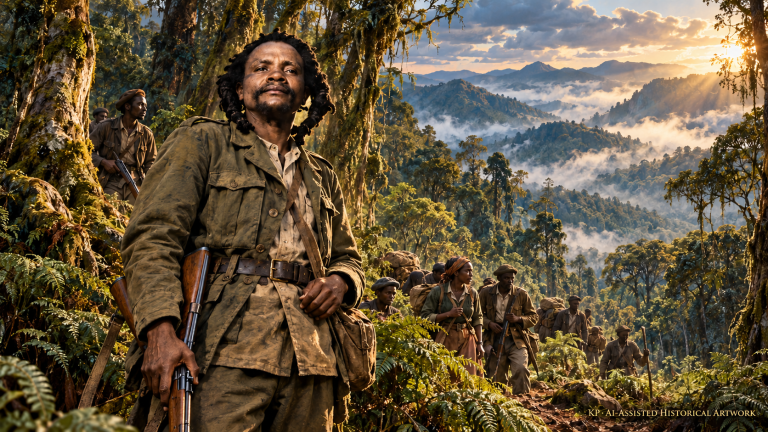


John Caesar (c. 1763–15 February 1796), known as “Black Caesar”, is widely recognized as Australia’s first bushranger. An African-descended convict transported with the First Fleet, he repeatedly escaped from custody and survived beyond the colonial extractive enclave by taking food and other supplies. His life reveals an early Black presence in colonial Australia, as well as the harsh conditions of convict labor and punishment.
Little is known for sure about Caesar’s early life. He may have been born in Madagascar, although his birthplace remains uncertain. By 1786, he was working as a servant in the parish of St Paul, Deptford, England. On 13 March that year, he was tried at Maidstone, Kent, for stealing approximately £12 from a dwelling house and sentenced to seven years’ transportation. Initially confined aboard the prison hulk Ceres, he embarked on the convict transport Alexander on 6 January 1787. The ship reached Botany Bay with the First Fleet on 19 January 1788.
In the colony, Caesar earned a reputation as a strong, conscientious laborer. He also struggled with hunger: accounts describe him taking food and possessing an unusually large appetite. These descriptions must be read critically because much of the surviving record was written by colonials who portrayed him in racist and dehumanizing terms.
On 29 April 1789, Caesar was convicted of theft again and sentenced to transportation for life. A fortnight later, he escaped into the bush with a stolen firearm. Unable to sustain himself independently, he took provisions from the settlement. He was recaptured on 6 June and put to work in chains at Garden Island. After being allowed to work without chains, Caesar escaped again on 22 December 1789, taking a canoe and obtaining another gun. According to colonial accounts, he raided gardens and threatened Aboriginal people to obtain their food. On 31 January 1790, he returned to the colonial enclave wounded after being speared by Aboriginal people.
On 4 March 1790, Arthur Phillip sent Caesar to Norfolk Island aboard the Supply. There, he gained a degree of independence. By July 1791, he was supporting himself on a small holding at Queenborough and had been issued with a pig. In January 1792, he received an acre of land and was required to work three days a week.
On Norfolk Island, Caesar formed a relationship with Anne Power, a convict who had arrived aboard the Lady Juliana in 1790. They had a daughter on 4 March 1792. About a year later, Caesar returned to Port Jackson aboard the Kitty, leaving Anne and their child on the island.
In July 1794, Caesar escaped once more but was soon recaptured and severely punished. David Collins, the colony’s judge-advocate, reported that Caesar declared that “all that would not make him better”. The statement survives through Collins’s account, not through any writing Caesar himself left.
Late in 1795, Caesar was with a party at Botany Bay when it was targeted by Aboriginal warriors led by Pemulwuy, the Bidjigal resistance leader. Caesar wounded Pemulwuy during the encounter. This episode places him within the wider conflict between the expanding British dispossession and Aboriginal people defending their country. His own resistance to convict colonials did not prevent him from participating in violence against Indigenous resistance.
Caesar escaped for the final time in December 1795 and led a group of other fugitives around Port Jackson. Collins recorded that “every theft that was committed was ascribed to him”—a revealing indication that Caesar’s reputation could exceed what the colonials actually knew about his activities. On 29 January 1796, John Hunter offered five gallons of spirits as a reward for his capture.
On 15 February 1796, John Wimbow shot Caesar at Liberty Plains, in the area now known as Strathfield. Caesar was carried to Thomas Rose’s hut, where he died.
His daughter survived him. Baptized Mary Ann Fisher Power in 1806, she later moved to Tasmania around1813.
Caesar’s story is preserved chiefly in records produced by colonials who pursued and punished him. Those records establish the main events of his life in Australia, but offer only a partial and often hostile portrait of the man himself. Remembering him requires attention to both his place in Australian history and the prejudices through which that history was recorded.
Source:
http://adb.anu.edu.au/biography/caesar-john-black-12829
https://en.wikipedia.org/wiki/John_Caesar