
In October 1937, the Dominican dictatorship of Rafael Leónidas Trujillo turned a landscape of farms, market towns, and interconnected families into a killing ground. Acting on his orders, Dominican forces murdered thousands of Haitians and people of Haitian descent, particularly in the country’s northern borderlands. The victims included agricultural laborers, small farmers, traders, women, and children. Many had lived in the Dominican Republic for years; some had been born there. Historian Edward Paulino estimates that approximately 15,000 people were killed, although the precise death toll remains uncertain.
Widely known as the “Parsley Massacre,” the atrocity was neither a spontaneous clash between neighboring peoples nor simply an attack on a temporary migrant workforce. It was a state-directed campaign that destroyed established communities and helped impose a more rigid, racially exclusive understanding of Dominican nationality. To understand the massacre is therefore to examine not only the machinery of murder, but also the world that existed before it—and the interests served by that world’s destruction.
A borderland of shared lives
Before the massacre, the frontier between Haiti and the Dominican Republic was more than a line separating two states. It was a region of movement and exchange. People crossed to trade, cultivate land, attend school, visit relatives, and seek work. People spoke Haitian Creole and Spanish in overlapping communities, and marriages and kinship networks connected families across the border. National differences existed, but they did not prevent people from building lives together.
This history complicates descriptions of the victims solely as “Haitian laborers.” Such language can obscure the rootedness of those targeted: their homes, gardens, livestock, friendships, and family histories. The people the dictatorship presented as intruders often lived everyday lives in the region. Some families included both Haitian and Dominican members, making the regime’s division between national insider and foreign outsider particularly destructive.
Survivor testimony preserves something of that lost world. Germéne Julien recalled the cultivated land her father abandoned when their family fled, including cassava and rice crops. Francisco Pierre, whose parents were Haitian and Dominican, remembered a neighbor warning his family to leave because killings were taking place nearby. These recollections restore individual lives to a history too often reduced to a death toll. They also reveal that the campaign ruptured relationships as well as destroying property and taking lives.
Trujillo’s order
The principal wave of killing occurred in early October 1937, commonly dated to 2–8 October. The wider campaign extended beyond that concentrated period: Paulino places the violence in late September and October. Its chronology should therefore not be compressed into a single day, even though 2 October has become an important anniversary of remembrance.
On that date, Trujillo spoke in Dajabón, a Dominican town near the Haitian border. Claiming that Haitians were stealing from Dominican farmers, he referred openly to murders already committed:
“Three hundred Haitians are now dead in [the town of] Bánica. This remedy will continue.”
The language of a “remedy” transformed human beings into a problem to be eliminated. It also supplied an official justification for violence. Yet the massacre that followed was not a lawful response to particular offenses. It was a campaign against people selected because they were identified as Haitian. Dominican soldiers carried out the killings, with civilian participation that included people compelled to assist. They used machetes and knives. Their use served a political purpose as well as a murderous one: it helped the regime present the deaths as the outcome of peasant clashes rather than a military operation. The dictatorship subsequently promoted the claim that Dominican farmers had risen against Haitian “cattle rustlers.”
Survivor accounts and diplomatic records contradict that explanation. Paulino cites contemporary American diplomatic correspondence describing “a systematic campaign of extermination.” The dictatorship, not an allegedly uncontrollable outbreak of popular hostility, bore responsibility.
Race, territory, and the making of outsiders
No single explanation fully accounts for Trujillo’s decision. The massacre brought together racial persecution, the consolidation of authoritarian power, and an effort to impose central government control over a border region whose social and economic life crossed national boundaries.
Anti-Haitian nationalism provided an ideological framework. The regime promoted a Dominican identity associated with Spanish ancestry and Catholicism, while depicting Haiti through racist representations of Blackness and foreignness. In this political vision, Haitian ancestry could be treated as incompatible with Dominican belonging, regardless of how long a person or family had lived in the country.
The frontier also posed a problem for a dictatorship intent on extending its regime. Cross-border networks facilitated movement beyond the government’s effective reach, including escape routes for Trujillo’s opponents. Communities whose relationships crossed the border did not fit neatly into the bounded national order the regime sought to establish.
After the massacre, the government pursued the Dominicanización de la frontera—the “Dominicanisation of the border.” New institutions, settlement by people from the Dominican interior, and changes to place names helped remake the region. The killings were thus connected to a broader transformation of territory: the removal of people was followed by efforts to redefine the landscape and its identity.
The violence should not be understood as proof of an inevitable, timeless hatred between Haitians and Dominicans. The history of intermarriage, trade, friendship, and mutual assistance points to another reality. State policy did not simply express existing divisions; it intensified them and violently imposed new ones. Historian Richard Turits’s formulation, quoted by Paulino—“A World Destroyed, A Nation Imposed”—captures that relationship.
The story of “parsley”
The massacre’s best-known name derives from perejil, the Spanish word for parsley. According to the familiar account, soldiers asked suspected Haitians to pronounce the word, using their speech to determine whether they would be killed. The story has become a powerful symbol of language turned into an instrument of persecution.
However, the pronunciation test is a popular but unconfirmed story. Paulino discusses it while noting that many people in the targeted communities were bilingual, making such a test unreliable or unnecessary. It should not be presented as a universally documented method for identifying victims.
The name El Corte, “the cutting,” offers another way to remember the atrocity. Neither name, however, should eclipse the essential fact: the campaign targeted human beings whom the state had marked as outside the nation. Its victims cannot be understood through a linguistic anecdote alone.
Flight, loss, and an uncertain death toll
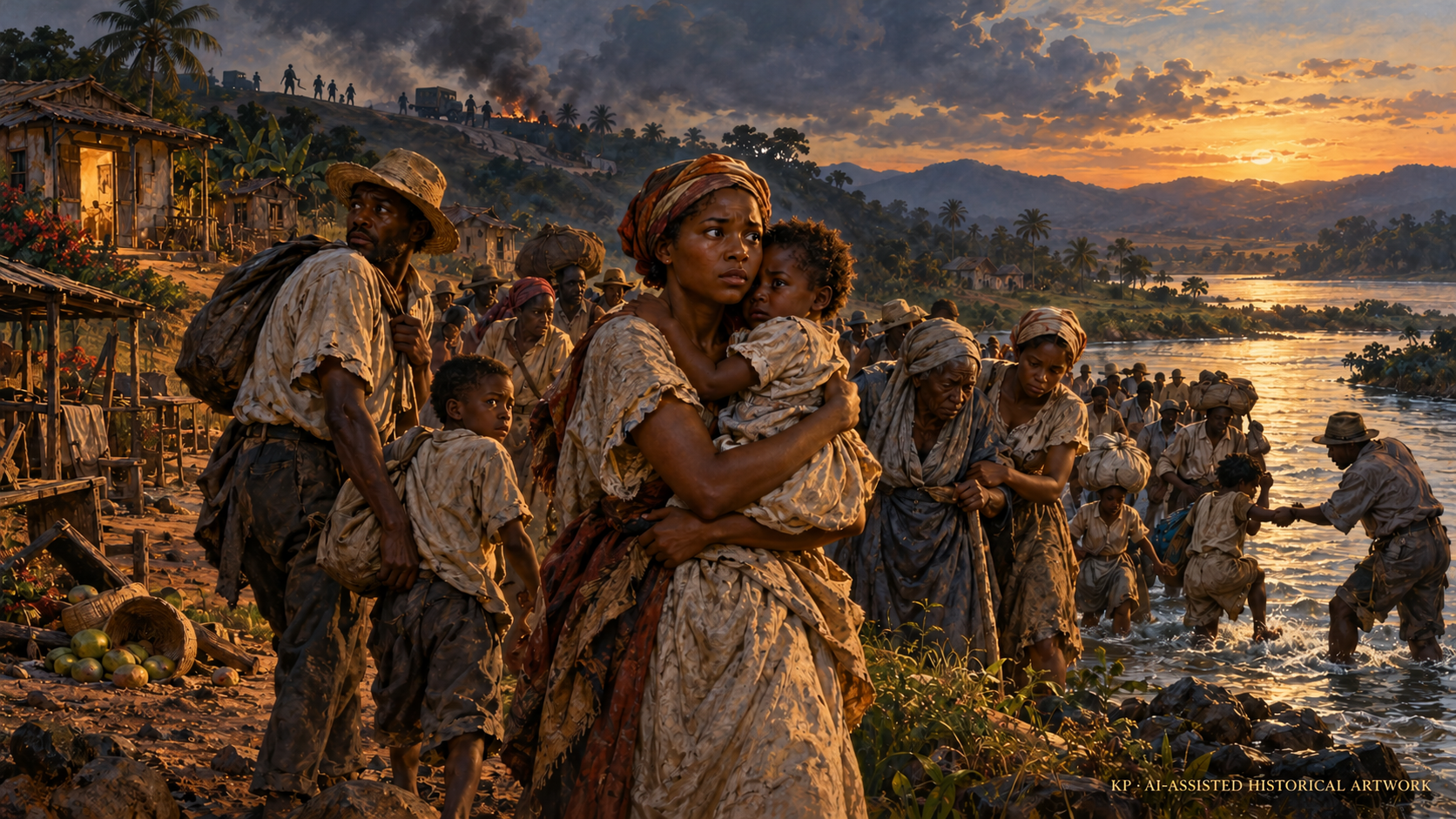
As the killings spread, people attempted to reach Haiti, abandoning homes, crops, animals, and possessions. The Dajabón River became an escape route. It is also known as the Massacre River, although that name predates the 1937 events and should not be explained as originating with Trujillo’s campaign.
Survivors faced more than displacement across a border. Families had been separated, livelihoods destroyed, and familiar communities dismantled. Some refugees settled in colonies established in Haiti, where they began the difficult work of rebuilding their lives. Survival did not erase the loss of the places and relationships that had driven them away.
The number murdered remains disputed. The BBC reports estimates of approximately 9,000–20,000, while Paulino estimates 15,000. These figures should be treated as estimates rather than a verified count. Uncertainty over the total, however, does not undermine the established character of the atrocity: thousands of civilians were murdered in an organised campaign ordered by Trujillo.clacs.
Compensation without accountability
The massacre provoked international pressure, including intervention by the United States, Mexico, and Cuba. In 1938, the Dominican government paid the Haitian government an indemnity of $525,000. Part of the money supported refugee settlements.
A diplomatic settlement was not justice. Neither Trujillo nor the senior members of his regime responsible for the massacre were brought to account for it. Payments between governments could not restore the dead, rebuild the destroyed communities, or replace recognition of individual responsibility.
The aftermath also exposed a central contradiction in the dictatorship’s treatment of Haitians. Even as the state expelled and murdered people it defined as undesirable foreigners, the Dominican economy continued to depend on Haitian workers. Paulino notes that the state continued to import Haitian sugarcane cutters during this period. Racial exclusion and economic exploitation operated alongside one another: Haitian labor could be sought while Haitian belonging was denied.
Remembering the people, recovering the world
The massacre’s legacy extends beyond October 1937. It helped institutionalize an anti-Haitian nationalism that outlived Trujillo, while leaving survivors and their descendants to preserve memories of communities the state had attempted to erase. Remembering the atrocity therefore requires attention both to the killings and to the political ideas that made them possible.
It also requires remembering those Dominicans who warned neighbors, helped people escape, or resisted the demand to treat familiar people as enemies. Their actions challenge any account that assigns collective guilt to an entire population. Distinguishing a state-directed campaign from individuals’ varied responses is essential to understanding what happened.
Since 2012, Border of Lights has brought together people from Haiti, the Dominican Republic, and their diasporas to commemorate the victims. Candlelight gatherings and other acts of remembrance on both sides of the frontier acknowledge the violence while recovering the history of connection that preceded it.
The 1937 Haitian Massacre was an attempt to decide, through terror, who had the right to inhabit a place and belong to a nation. Its history is not only a record of how thousands died. It is also the history of people who farmed, traded, raised children, formed friendships, and made homes—and whose ordinary lives deserve to be remembered alongside the crime that destroyed them.
Sources:
https://clacs.berkeley.edu/dominican-republic-bearing-witness-modern-genocide
https://www.npr.org/sections/parallels/2017/10/07/555871670/80-years-on-dominicans-and-haitians-revisit-painful-memories-of-parsley-massacre
https://www.bbc.co.uk/news/world-latin-america-19880967