
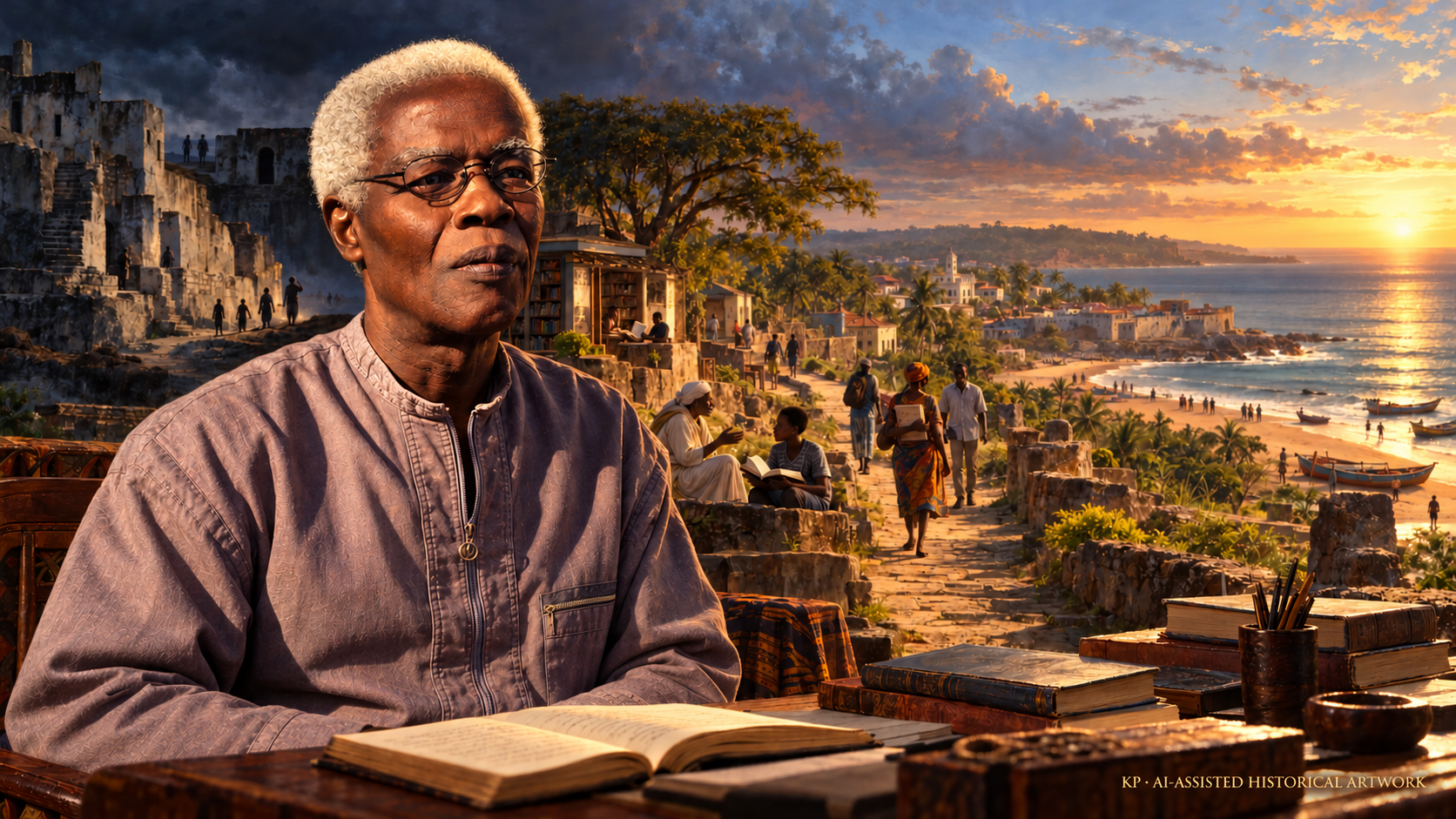
Ayi Kwei Armah is a Ghanaian novelist, essayist, and Pan-African thinker whose writing confronts the betrayal of freedom and the work of rebuilding African societies. His novels examine corruption, materialism, and the estrangement of educated Africans from their communities, while searching African histories and knowledge traditions for resources of renewal. From the unsettling imagery of The Beautyful Ones Are Not Yet Born to the collective storytelling of Two Thousand Seasons, he has made literature a space for questioning how people lose their way—and how they might recover a shared purpose.
Armah’s commitment extends beyond the page. As a teacher, Kiswahili advocate, and co-founder of an independent publishing collective in Senegal, he has pursued the practical foundations of African intellectual independence. His career connects the freedom to write with the capacity to educate, publish, and sustain institutions on African terms.
Early Life and Education
Armah was born on 28 October 1939 in Sekondi-Takoradi, a port city in the territory then named the Gold Coast, now Ghana. He grew up in a Fante-speaking family with Ga ancestry on his father’s side. He attended Achimota School near Accra, where he studied before receiving a scholarship to continue his education in the United States in 1959.
After attending Groton School in Massachusetts, he studied sociology at Harvard University. He later undertook graduate study in creative writing at Columbia University in New York. His years in the United States introduced him to institutions whose prestige would become a subject of searching scrutiny in his fiction: places that offered knowledge and opportunity while leaving unresolved questions of racial inequality, cultural belonging and responsibility to home.
Armah’s working life developed across several countries. In Algeria, he translated for Révolution Africaine. Returning to Ghana in 1964, he worked as a television scriptwriter and taught English at Navrongo Secondary School in the north. He subsequently worked in Paris as an editor for the Pan-African magazine Jeune Afrique. These experiences brought journalism, education and African liberation struggles into the same field of attention.
Alongside this work, he began publishing short stories, poetry and essays in periodicals including Okyeame, Harper’s Magazine, The Atlantic Monthly and New African. His emergence as a novelist grew out of this broader engagement with writing and public debate.
The Promise and Betrayal of Independence
Armah’s first novel, The Beautyful Ones Are Not Yet Born, appeared in 1968. Set in Ghana during the final years of Kwame Nkrumah’s government, it follows an unnamed railway worker who refuses to accept the dishonesty around him. His resistance brings neither comfort nor admiration. Instead, it exposes the pressures on someone who refuses to treat corruption as the ordinary price of survival.
The novel’s imagery is deliberately abrasive. Filth, bodily waste and decay give physical form to a society in which public responsibility has yielded to private enrichment. Against this stands the attraction of wealth—the “gleam” of desirable possessions, comfortable homes and the status they confer. Armah makes that attraction hard to dismiss: the railway worker’s integrity affects his family as well as himself.
The book established Armah’s international reputation and provoked debate about the responsibilities of African literature. Its severity troubled readers who found its portrait of Ghana excessively bleak. Yet its central concern was not simply disappointment. It asked what independence could mean when those entrusted with its promise reproduced the habits of extraction and privilege that freedom was meant to end.
The Returning Intellectual
In Fragments (1970), Armah moved from the compromised public world of politics to the intimate pressures of family life. Its protagonist, Baako, returns to Ghana after studying in the United States. He hopes to work as a writer, but his family expects something different: education abroad should bring money, imported goods, and visible advancement.
Baako’s predicament exposes the distance between intellectual vocation and social recognition. His value is measured less by what he might create than by what he can provide. Armah also examines how cultural practices become opportunities for material gain, showing how the pursuit of wealth can hollow out relationships and ceremonies meant to sustain communal life.
Why Are We So Blest?, published in the early 1970s, extends this exploration of estrangement. It examines the racial and psychological injuries experienced by an African intellectual educated in the United States, while questioning the conduct of liberation leaders who remain insulated from the suffering of those fighting for freedom. In this vision, education offers no automatic route to emancipation. Its worth depends on the relationships and purposes it serves.
Frantz Fanon was an important intellectual influence on Armah. Fanon’s examination of racial injury and his criticism of privileged African leadership helped inform Armah’s attention to the distance between the language of liberation and the behavior of those claiming to represent it.
History Told Through a Collective Voice
With Two Thousand Seasons (1973), Armah widened the scale of his fiction. Rather than organizing the narrative around a solitary protagonist, he adopted a collective voice to tell a long history of African dispossession, resistance and survival. The novel draws on oral storytelling, repetition and communal remembrance to make a people, rather than an exceptional individual, the center of its account.
Its historical vision is uncompromising. Armah depicts the violence of Arab and European enslavers while also confronting African rulers and intermediaries who participated in the destruction of their own communities. He refuses to exempt ancestry from moral judgment. In his work, a usable African past must be examined rather than merely celebrated.
At the heart of the novel is “the way”: an ethic of reciprocity, shared responsibility and resistance to exploitation. Remembering the way means recovering practices through which people sustain one another. Forgetting it opens the path to hierarchy, greed, and treating human beings as expendable.
Armah admired the Sotho writer Thomas Mofolo, whose Chaka offered an important example of the possibilities of African historical fiction. His own historical novels similarly bring political power, spiritual vision, and the consequences of leadership into close relationship.
Healing a Divided Society
In The Healers (1978), Armah turned to nineteenth-century Asante and the upheavals surrounding British military aggression. The novel places healers at the center of a wider struggle over society’s future. Their work extends beyond treating individual illness to repairing damaged human relationships.
Healing becomes a way of understanding political life. Division, ambition and manipulation weaken communities; cooperation and patient understanding make recovery possible. Armah contrasts the healer’s commitment to integration with forms of leadership sustained by rivalry and coercion. The novel thus develops a question already present in his earlier fiction: what kinds of knowledge and conduct can restore a society taught to work against itself?
Teaching and Pan-African Commitment
Armah’s teaching career took him to institutions in Tanzania, Lesotho and the United States, including the Teachers’ College in Dar es Salaam, the National University of Lesotho, the University of Massachusetts Amherst, Cornell University and the University of Wisconsin–Madison. His movement across these settings was accompanied by a growing concern that education was a foundation for African renewal.
For Armah, Pan-African unity requires more than declarations of solidarity. It requires shared means of communication and institutions that can support sustained intellectual exchange. His advocacy of Kiswahili as a common continental language fits this practical vision: a way to connect Africans across borders and reduce dependence on the European languages through which much formal education and public administration still operate.
Publishing on African Terms
In the 1980s, Armah settled in Senegal, where he helped establish Per Ankh: the African Publication Collective in the coastal village of Popenguine. Independent publishing gave institutional form to a conviction that ran through his work: Africans needed greater control over the production and circulation of their own knowledge.
Per Ankh provided a way to publish his books without relying on Western publishing houses. It also connected authorship to the less visible work of production and distribution. Intellectual freedom required not only a manuscript and an audience, but also structures that could bring the two together.
His work also circulated through African-American independent literary networks. Third World Press in Chicago published an American edition of Two Thousand Seasons in 1979, and Black literary periodicals also covered his fiction. These connections placed his writing within a wider African and diasporic conversation about history, freedom, and collective responsibility.
African Knowledge and the Work of Renewal
Armah’s later novels—including Osiris Rising (1995), KMT: In the House of Life (2002) and The Resolutionaries (2013)—give increasing attention to education and the recovery of African historical knowledge. Ancient Egyptian history and the Isis–Osiris tradition become resources for imagining how fragmented communities might reassemble their intellectual and social lives.
His nonfiction develops these concerns more directly. The Eloquence of the Scribes (2006) reflects on his formation as a writer, while Remembering the Dismembered Continent (2010) brings together arguments about African history, cultural agency and the reconstruction of continental relationships. His educational interests also extended to younger readers: he co-authored Hieroglyphics for Babies with Aboubacry Mousa Lam, published in 2002.
Across these forms, Armah’s work moves from exposing damage to imagining the conditions for repair. His early novels ask how integrity can survive amid corruption and estrangement. His historical fiction examines the long processes that have divided communities. His later writing and publishing initiatives pursue the knowledge, relationships, and institutions through which Africans might shape a more self-determined future. The connecting thread is a demanding understanding of freedom: not simply release from another’s power, but the sustained work of creating a life in common.
Sources:
https://en.wikipedia.org/wiki/Ayi_Kwei_Armah
https://writersinspire.org/content/ayi-kwei-armah
https://www.researchgate.net/publication/398457034_29531_Ayi_Kwei_Armah_Two_Thousand_Seasons_1973
https://open.uct.ac.za/server/api/core/bitstreams/247a7e8d-b1db-4210-96c0-6883f0f64260/content
https://dspace.uni.lodz.pl/xmlui/bitstream/handle/11089/45999/Rozprawa_8.pdf?sequence=1&isAllowed=y
https://journals.lib.unb.ca/index.php/IFR/article/view/14023/15105