
“Whatever a man prefers to God, that he makes a god to himself.”
Saint Cyprian of Carthage—bishop, theologian, pastor, and martyr—was one of the most influential Christian leaders of third-century Roman Africa. Born c. 200–210 CE, probably in or near Carthage, in present-day Tunisia, he came from a prosperous family and received the classical education expected of a member of the urban elite. Before converting to Christianity, he was celebrated for his rhetorical ability and seems to have practiced public advocacy, taught rhetoric, or perhaps done both.
His Latin name was Thascius Caecilius Cyprianus. He lived in the Roman province of Africa Proconsularis, a region that was at once African, Roman, Mediterranean, and culturally diverse. Carthage was one of the great cities of the Roman world: a place shaped by Punic, Amazigh, Roman, and wider African and Mediterranean histories. Cyprian should therefore be remembered first as a North African Christian intellectual and bishop, whose life, ministry, and writings were rooted in Africa.
Cyprian converted to Christianity about 246 CE. The early tradition connects his conversion particularly with the influence of Caecilius, a Carthaginian presbyter, from whom he took the name Caecilius. He also read and was deeply influenced by Tertullian, the earlier Christian writer from Roman Africa whose powerful Latin style and theological ideas helped shape Cyprian’s thought.
In his letter To Donatus, Cyprian recalled the spiritual darkness of his former life. He wrote of having been trapped in “the gloom of a dark night,” distant from truth and unable to imagine the possibility of renewal. Through baptism, however, he experienced what he understood as a radical transformation: a movement from darkness into light, from inner bondage into freedom. The letter remains one of the most moving early Christian accounts of conversion.
After becoming a Christian, Cyprian used his wealth for charitable purposes and distributed property and estate proceeds for the benefit of people in poverty. The ancient account written by Pontius, Cyprian’s deacon and biographer, presents this renunciation of privilege as a major feature of his new life. Soon after his baptism, Cyprian entered the clergy. By 248 or 249 CE, he had been elected bishop of Carthage—a remarkably rapid rise that caused resentment among some clergy and laypeople, but which also reflected his standing among many Christians in the city.
An African Father of Christianity
Cyprian is often honoured in Black Christian, Pan-African, and Afrocentric writing as a Black African father of the church. This recognition has an important purpose. For generations, popular religious imagery and European-centred accounts of Christian history have often made the African foundations of Christianity less visible, or have presented major African church figures through European visual and cultural assumptions.
Cyprian was unquestionably African: he was born and lived in Roman North Africa, led the church of Carthage, and belongs to the rich intellectual and spiritual inheritance of African Christianity. He stands alongside other major Christian writers associated with Roman Africa, including Tertullian and, later, Augustine of Hippo. Africa was not marginal to the history of Christianity. It was one of the faith’s earliest and most influential centres of theological thought, biblical interpretation, church organisation, worship, and martyrdom.
At the same time, historical precision requires care. “Black” is a modern racial category, shaped by the histories of colonialism, the Maafa, anti-Black racism, and the cultural and political solidarities formed in resistance to them. Ancient Romans did not organise identity through the same racial categories that later developed in Europe and the Atlantic world.
The surviving evidence does not securely tell us Cyprian’s complexion, ancestry, or ethnic self-identification. It is therefore not possible to state, as a settled historical fact, that he understood himself as “Black” in a modern sense. Nor is there firm evidence allowing us to identify him definitively as Amazigh or Berber, although that description is sometimes repeated in modern popular accounts.
This does not make Cyprian’s Africanness uncertain. His African identity is historically clear in the geographical, social, cultural, and ecclesiastical sense: he was a Carthaginian bishop in Roman Africa. Rather, it means that modern readers should distinguish between a securely documented ancient African identity and the later racial categories through which people may honour, interpret, and reclaim that inheritance.
To call Cyprian a Black African father of Christianity can therefore be meaningful when it is understood as a modern act of historical recovery—one that resists the Europeanisation of early Christian history and affirms Africa’s central role in the formation of Christian thought. It should not, however, be presented as though a modern racial label were Cyprian’s own recorded identity.
Bishop During Persecution
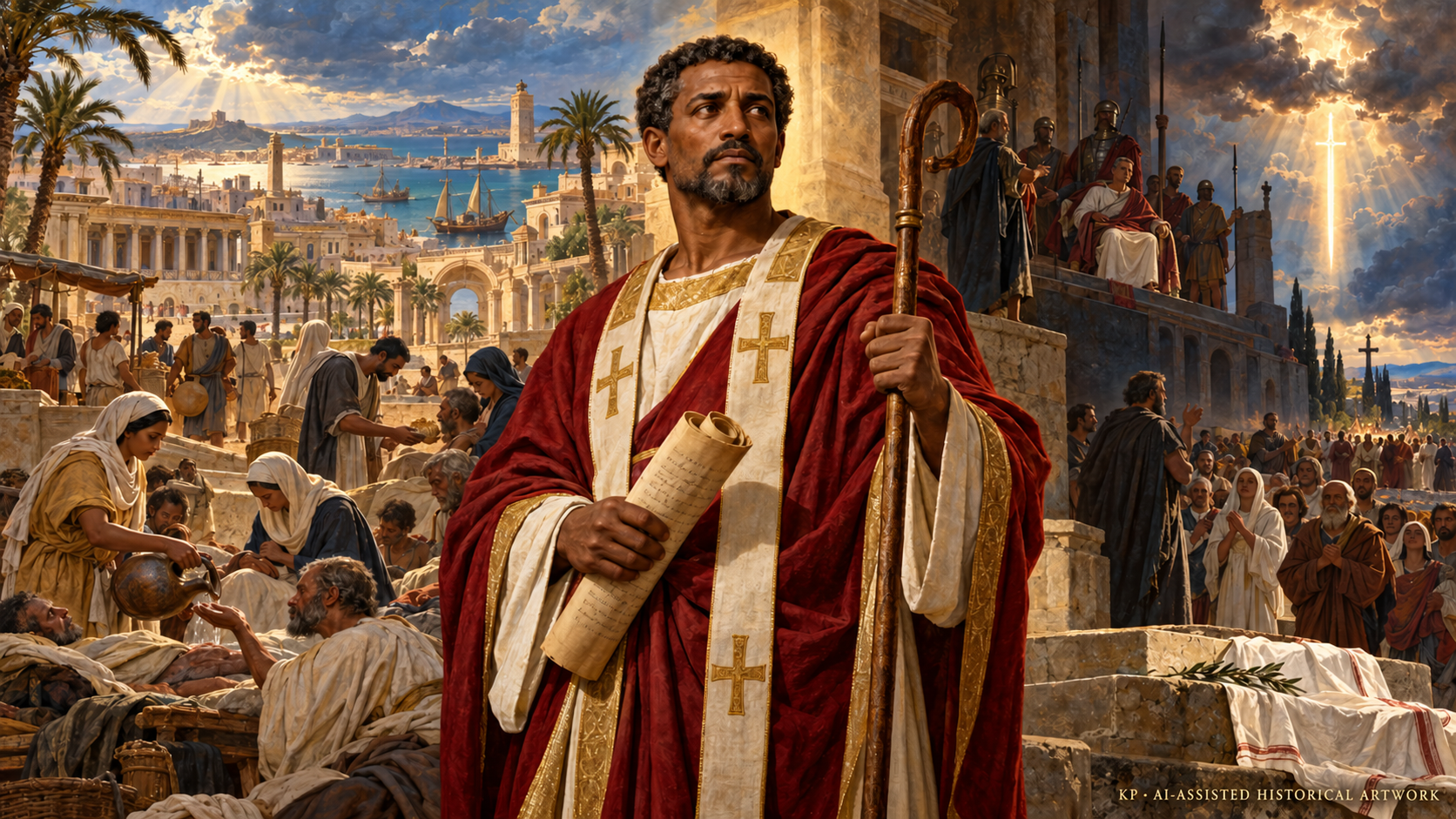
Cyprian became bishop shortly before the persecution ordered by Emperor Decius in 250 CE. Roman authorities required inhabitants of the empire to demonstrate public loyalty through sacrifice to the traditional gods. Christians who refused could face confiscation, imprisonment, torture, or death.
When the persecution began, Cyprian left Carthage and directed the church from concealment through letters and trusted representatives. His decision was controversial. Some Christians believed that a bishop should remain openly with his congregation, regardless of the personal danger. Cyprian defended his departure as obedience to a divine warning and as a practical effort to preserve pastoral leadership during a period of severe repression.
He returned to Carthage early in 251 CE. One of the most difficult questions he faced involved the lapsi: Christians who had sacrificed to the Roman gods, or obtained certificates claiming that they had done so, under the pressure of persecution. Cyprian argued neither for permanent exclusion nor for easy restoration. Instead, he advocated a disciplined process of penitence, pastoral examination, and reconciliation under the authority of the bishop and church community.
His leadership during this crisis made him a central figure in debates about repentance, forgiveness, authority, unity, and the nature of the church. His writings, especially his treatise On the Unity of the Catholic Church, later became highly influential in Christian thought about episcopal authority and communal unity.
The Plague and Care for Others
During Cyprian’s episcopate, a devastating epidemic spread through the Roman world. Often called the Plague of Cyprian because he wrote movingly about its effects, the outbreak began around 249 or 250 CE and continued through much of the following decade. Its precise disease identity remains uncertain, though it was evidently catastrophic.
The plague brought fear, bereavement, economic distress, and social breakdown. In this setting, Cyprian called on Christians to practise mercy not only toward fellow Christians, but toward all who were suffering. Pontius’s account describes him urging the Carthaginian church to organise practical relief, with people contributing money, labour, and personal service to care for the ill and the dead.
This tradition should not be romanticised as proof that every Christian acted heroically, nor should it be used to claim that Cyprian created a modern health-care system. Yet it does preserve an important image of Christian communal responsibility during a public catastrophe: care was not to be limited to one’s own religious group, friends, or allies. The moral claim was broader—the suffering of another person created an obligation to act.
Exile, Martyrdom, and Legacy
A further persecution arose under Emperor Valerian. In 257 CE, Cyprian was summoned before the Roman proconsul Aspasius Paternus and ordered to participate in the state cult. When he refused, he was exiled to Curubis, on the coast of present-day Tunisia.
In 258 CE, imperial policy became more severe. Cyprian was brought back to the vicinity of Carthage, arrested on 13 September, and held overnight under guard. The next day, 14 September 258, he appeared before the proconsul Galerius Maximus. He was condemned to death by the sword.
According to the ancient martyrdom account, Cyprian responded to his sentence, “Thanks be to God.” A large crowd followed him to the execution site. The account relates that he removed his outer garments, knelt in prayer, and covered his own eyes before he was beheaded. It also reports that he instructed friends to give the executioner twenty-five gold pieces. That last detail belongs to the martyrdom tradition and should be treated as such, rather than as an independently verifiable fact.
Cyprian became the first bishop-martyr of Roman Africa. His death gave particular force to writings already marked by questions of Christian witness, church discipline, mercy, suffering, unity, and courage. His letters and treatises remain among the most important surviving sources for understanding third-century Christianity in North Africa.
A London Dedication
St Cyprian’s Church at Clarence Gate, Marylebone, London, is dedicated to Cyprian of Carthage. Designed by Sir Ninian Comper and completed in 1903, it is a distinguished Gothic Revival church near Regent’s Park. Comper described the church in Eucharistic imagery: it was to be “a lantern, and the altar is the flame within it.”
The dedication is fitting. Saint Cyprian’s life was shaped by intellectual seriousness, public responsibility, generosity, and martyrdom. But it also points beyond individual sanctity. Cyprian’s story reminds us that Africa was not simply a distant setting in early Christian history. It was a place from which some of Christianity’s most influential voices emerged—and from which they helped illuminate the wider world.
Sources:
“Black Star: The African Presence in Early Europe” by Runoko Rashidi.
https://www.britannica.com/biography/Saint-Cyprian-Christian-bishop
https://www.newadvent.org/fathers/0505.htm
https://dacb.org/stories/tunisia/cyprian
https://www.nationalchurchestrust.org/church/st-cyprian-marylebone
https://www.stcyprians.org.uk/history-architecture
https://atom.aim25.com/index.php/saint-cyprians-saint-marylebone-clarence-gate-westminster