
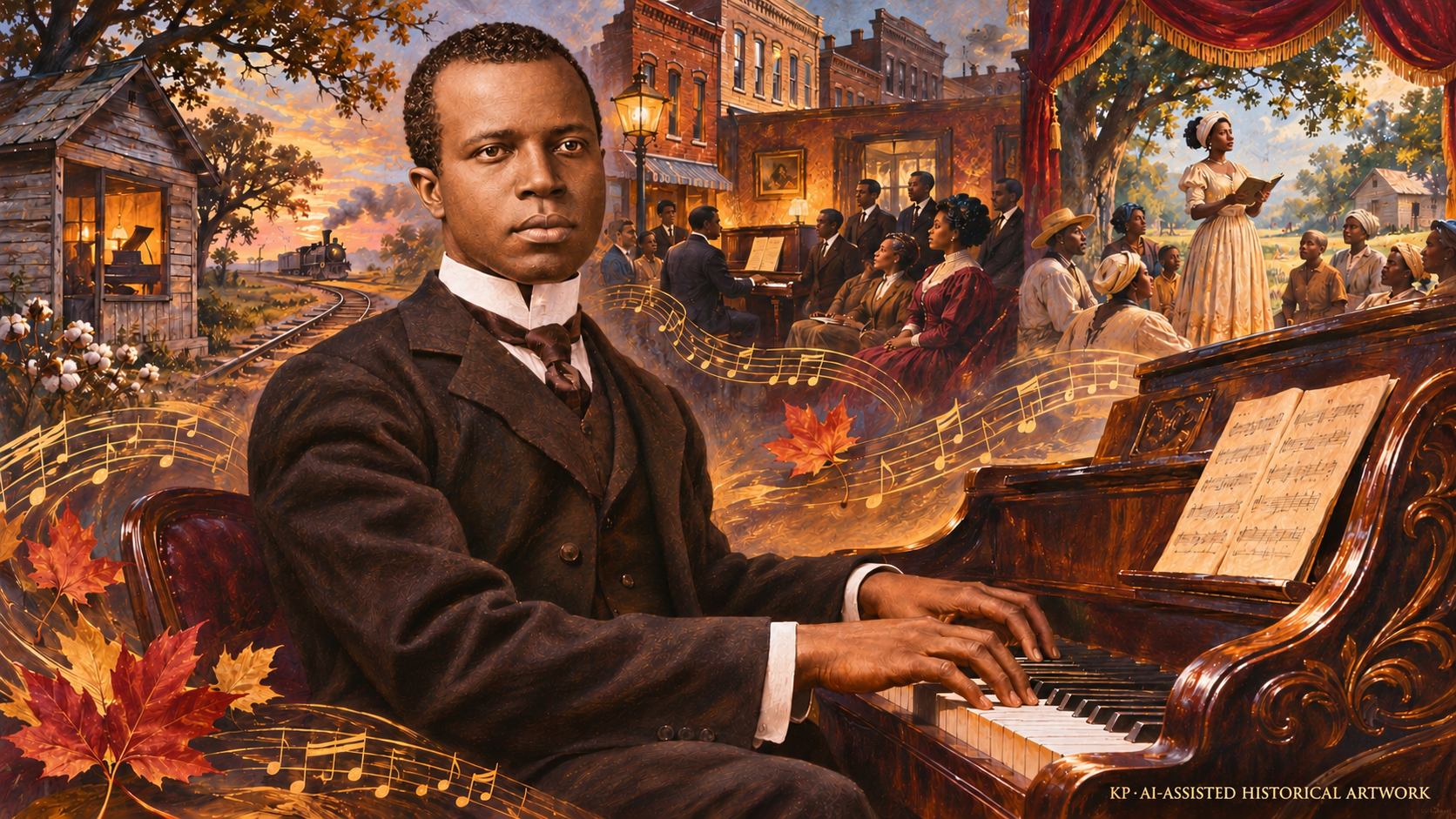
Scott Joplin stands as one of the most transformative figures in American cultural history. Drawing on African-American musical traditions and European musical forms, Joplin helped establish classic ragtime as a distinctive and enduring compositional art, bringing extraordinary rhythmic vitality, formal balance, and expressive depth to the genre. Following the success of “Maple Leaf Rag,” Joplin became widely known as the “King of Ragtime Writers”. Joplin’s revolutionary contributions saw a major revival in the 1970s through best-selling albums, the hit film The Sting, and a posthumous Pulitzer Prize, ultimately cementing his legacy in music history.
Musical Upbringing and Formative Education in East Texas
Scott Joplin was born in eastern Texas between mid-1867 and early 1868, the second of six children born to Giles Joplin and Florence Givens Joplin. His family had a rich musical heritage; his father, a railroad worker, played the violin at community gatherings, while his mother, from Kentucky, sang and played the banjo. After the family relocated to Texarkana near the Texas-Arkansas state line around 1875, young Joplin learned the basics of stringed instruments on a family guitar.
Raised in a musical household, Joplin began learning music early. According to later accounts, he gained access to a piano in a home where his mother worked as a domestic employee. Recognized for his natural aptitude, Joplin was encouraged by his mother to practice while she completed her duties.
Joplin’s formal development received a monumental impetus between the ages of eleven and sixteen through the mentorship of Julius Weiss, a German-born music professor residing in Texarkana. Impressed by the youth’s raw talent, Weiss provided Joplin with free instruction in piano performance, sight-reading, harmony, and composition. Crucially, Weiss introduced Joplin to European classical traditions, folk melodies, and grand opera, instilling a lifelong conviction that music was a high art form rather than mere commercial entertainment. Weiss also helped the family obtain a second-hand square piano. According to Lottie Joplin, he remembered Weiss with gratitude and sent him money in his old age.
During the early 1880s, family tension emerged regarding Joplin’s future. While his father urged him to seek practical manual labor to supplement the household income, his mother strongly advocated for his continued artistic education. This disagreement contributed to his parents’ separation, after which Joplin embarked on an independent musical path.
The Itinerant Journey and Early Professional Breakthroughs
By age sixteen, Joplin formed a vocal quartet in Texarkana, performed at local social events, and taught mandolin and guitar. In the late 1880s, he gave up manual railroad labor entirely to pursue a career as a traveling musician. Traveling throughout the Midwest and mid-South, he performed pre-ragtime syncopated music—then known as “jig-piano”—in saloons, dance halls, and social venues. In July 1891, he briefly returned to Texarkana to perform with the Texarkana Minstrels.
A pivotal moment occurred in 1893 during the World’s Columbian Exposition in Chicago. Although African-American artists faced severe restrictions regarding formal participation inside the official fairgrounds, Joplin formed a brass ensemble in which he played cornet and arranged scores, performing in the popular saloons and cafes surrounding the exposition. The fair drew tens of millions of visitors, serving as a primary catalyst for spreading syncopated ragtime to a national audience. During this period, fellow performer Otis Saunders encouraged Joplin to commit his original improvisations to paper.
In 1894, Joplin settled in Sedalia, Missouri, a bustling railroad hub that quickly became an epicenter for ragtime development. He performed as a soloist, joined the Queen City Cornet Band, formed a six-piece dance orchestra, and entertained at prominent African-American social venues, including the Black 400 Club and the Maple Leaf Club.
Joplin recognized that formal notation was essential for securing his artistic legacy. Around 1896, Joplin appears to have attended music classes at George R. Smith College, an African-American institution in Sedalia. The college’s records were later destroyed by fire, leaving the extent and content of his studies uncertain. However, this academic training seems to have enabled him to translate complex syncopated polyrhythms into precise written notation. Concurrently, he began mentoring younger ragtime composers, including Arthur Marshall, Scott Hayden, and Brun Campbell, frequently collaborating with them on vocal and instrumental works.
Joplin’s first published songs, “Please Say You Will” and “A Picture of Her Face”, appeared in 1895 while he toured with his singing group, the Texas Medley Quartette. In 1896, while visiting Temple, Texas, he published three instrumental pieces, including the “Great Crush Collision March”, a descriptive composition commemorating a staged head-on train collision on the Missouri–Kansas–Texas Railroad.
Joplin’s ultimate commercial and artistic breakthrough came in 1899.
In August 1899, with help from the young Sedalia lawyer Robert Higdon, Joplin reached an agreement with publisher John Stark for “Maple Leaf Rag.” The contract provided a royalty of one cent per copy, giving him a modest but lasting source of income. The “Maple Leaf Rag” became an extraordinary national hit, selling hundreds of thousands of copies over the subsequent decade and establishing the structural archetype for what musicologists term the “classic rag.”
Synthesizing High Art: Masterworks, Experimental Rags, and Dramatic Compositions
Following his success in Sedalia, Joplin moved to St. Louis in 1901, where he experienced a highly productive period of composition. His structural model for the classic rag combined the multi-strain sectional form of the traditional march with complex African-American syncopation and European harmonic structures. Outstanding works from this era include “The Easy Winners” (1901), “Elite Syncopations” (1902), and “The Entertainer” (1902). He also composed descriptive pieces like “The Cascades” (1904), written to mirror the cascading water displays at the St. Louis World’s Fair, and “The Chrysanthemum” (1904).
Joplin consistently sought to integrate ragtime syncopation into extended classical genres. In 1899, he composed a ragtime ballet, “The Ragtime Dance”. In 1902, inspired by Booker T. Washington’s historic dinner with President Theodore Roosevelt, he composed his first grand opera, “A Guest of Honor”. Joplin formed a thirty-person company to tour the opera in 1903; however, after tour receipts were stolen in Kansas or Illinois, the company could not meet payroll or boarding expenses, resulting in the confiscation and permanent loss of the score.
In 1907, Joplin relocated to New York City, seeking new publishers and financial backing for his stage works. His arrival in Manhattan initiated an era of daring harmonic experimentation. “Euphonic Sounds” (1909), subtitled “A Syncopated Novelty,” was among Joplin’s most adventurous piano works. Its recurring rondo theme, chromatic harmony, and unusually mobile left-hand accompaniment expanded the expressive and technical possibilities of his ragtime writing. The composition was so technically demanding that stride piano masters such as James P. Johnson, Eubie Blake, and Willie “The Lion” Smith adopted it as a benchmark test piece for keyboard virtuosity.
During this period, Joplin produced other groundbreaking works: “Wall Street Rag” (1909), a programmatic piece depicting the emotional shifts of financial panic and recovery; “Solace: A Mexican Serenade” (1909), constructed around a continuous Latin American habanera bass rhythm; and “Magnetic Rag” (1914), a self-published masterwork blending syncopation with melancholic expressiveness.
To protect his artistic vision, Joplin published a pedagogical guide in 1908 titled School of Ragtime: Six Exercises for Piano. Emphasizing that genuine ragtime was a serious, complex art form, he condemned the sensationalized speed of saloon performers and published a definitive performance directive: “It is never right to play Ragtime fast at any time.” Furthermore, Joplin steadfastly refused to attach racially derogatory lyrics to his sheet music, rejecting prevailing commercial caricatures in favor of artistic integrity.
Personal Joys, Tragedies, and Devotion to Operatic Vision
Scott Joplin’s private life was marked by profound loss and partnerships that sustained his artistic ambitions. Around 1901, Joplin established a household with Belle Jones, the widow of Scott Hayden’s brother. Their relationship ended after the death of their infant daughter.
The following year, Joplin found love again with Freddie Alexander, whom he met in Little Rock, Arkansas, and to whom he dedicated “The Chrysanthemum.” They married on June 14, 1904, but Freddie died of pneumonia on September 10, less than three months later. Her death preceded the publication of “Bethena” in 1905. Later commentators have associated its poignancy with Joplin’s bereavement, while some have also suggested that Freddie helped inspire the heroine of Treemonisha.
In New York, Joplin formed a lasting partnership with Lottie Stokes, generally described as his third wife. She ran a boarding house and supported his musical work. Together, they established their publishing company in 1913 and issued “Magnetic Rag” the following year. After his death in 1917, she continued to manage his estate.
During these final years in New York, Joplin devoted himself to his most ambitious undertaking: Treemonisha, a 230-page grand opera for which he wrote both the libretto and the score. Set in 1884 in a post-emancipation community near Texarkana, the opera centers on an educated eighteen-year-old woman who challenges exploitative conjurers and leads her community toward a future grounded in literacy, education, and collective responsibility. Through her leadership, Joplin presented knowledge and solidarity as foundations for advancement and self-determination.
Despite repeated efforts, Joplin did not secure a fully staged production of Treemonisha during his lifetime. Accounts describe a private piano-accompanied presentation in 1915, but its circumstances remain uncertain. A documented performance that year presented the opera’s Act II ballet at a concert involving the Martin-Smith Music School.
Decline, Posthumous Revival, and Enduring Legacy
By 1916, Joplin suffered severe motor coordination loss, tremors, and cognitive decline caused by tertiary neurosyphilis. His final piano rolls, recorded for the Connorized and UniRecord labels in 1916, document his declining physical execution while preserving his interpretative spirit. After entering Bellevue Hospital in January 1917, Joplin was transferred to Manhattan State Hospital in early February. He died there on April 1, aged about forty-nine. He was buried in an unmarked grave at St. Michael’s Cemetery in Queens, New York.
After his death, his widow, Lottie Stokes Joplin, maintained his legal heritage by renewing copyrights on his compositions. Decades later, copyright attorney Alvin Deutsch collaborated with musicologist Vera Brodsky Lawrence to protect the estate’s rights under the Trust of Lottie Joplin Thomas, successfully securing copyright enforcement and recovering $60,000 in royalties for Treemonisha.
In the 1970s, a remarkable revival of interest in Scott Joplin’s music restored him to international prominence. Classical pianist Joshua Rifkin’s Scott Joplin: Piano Rags, released by Nonesuch Records in 1970, introduced his compositions to a new generation of listeners and eventually sold more than a million copies. Scholarly recognition gathered momentum alongside this popular success. In 1971, critic Harold C. Schonberg published an influential essay in The New York Times calling for greater recognition of Joplin’s achievement, while Vera Brodsky Lawrence’s edition of The Collected Works of Scott Joplin made his music more widely available for study and performance.
The revival soon brought renewed attention to his operatic ambitions. In 1972, Treemonisha received its full stage premiere in Atlanta through the efforts of Morehouse College and the Atlanta Symphony Orchestra, finally reaching the stage more than half a century after its publication. The following year, director George Roy Hill’s Oscar-winning film The Sting, with musical adaptations by Marvin Hamlisch, carried Joplin’s rags to an even wider audience. Hamlisch’s recording of “The Entertainer” became a major popular hit in 1974, the same year that a formal headstone was dedicated at Joplin’s previously unmarked grave. This period of rediscovery culminated in 1976, when Joplin received a posthumous Pulitzer special award “for his contributions to American music.”
Recognition continued in the decades that followed. Joplin appeared on a U.S. Postal Service Black Heritage stamp in 1983 and received a star on the St. Louis Walk of Fame in 1989. In 2002, his 1916 piano rolls were selected for the Library of Congress’s National Recording Registry, preserving another dimension of his musical legacy. His name subsequently travelled beyond the concert hall and the archive: a crater on Mercury was named in his honour in 2012, and the open-source note-taking application Joplin, whose development began in 2016, also bears his name. In 2026, the Barbershop Harmony Society bestowed posthumous Honorary Life Membership upon him.
His preserved St. Louis home, now a State Historic Site, offers a more intimate connection to the life behind these honours. Together, the house, the surviving compositions, and their continuing performance bear witness to an achievement that outlasted the obstacles of his lifetime: a distinctive synthesis of African-American syncopation and formal musical architecture that secured ragtime an enduring place in American cultural history.
Sources:
https://en.wikipedia.org/wiki/Scott_Joplin
https://www.tshaonline.org/handbook/entries/joplin-scott
https://www.loc.gov/item/n50039880/scott-joplin-1868-1917/
https://www.pianistmagazine.com/blogs/scott-joplin-and-the-history-of-ragtime/
https://oxfordphil.com/news/scott-joplin-and-samuel-coleridge-taylor/
https://www.academia.edu/123845062/Euphony_and_Experimentation_Scott_Joplin_s_Euphonic_Sounds_and_the_Expansion_of_the_Classic_Rag_Genre
https://www.ragtimepiano.ca/rags/joplin.htm
https://historicmissourians.shsmo.org/scott-joplin/