
Samora Moisés Machel stands as one of the twentieth century’s most inspiring and influential African leaders—a visionary guerrilla commander, the dynamic president of FRELIMO, and the first President of independent Mozambique. His life’s work is inseparable from the epic struggle against Portuguese colonial oppression in Mozambique and the broader liberation of southern Africa. But Machel’s path to leadership began not in the privileged halls of power or academia, but in the resilient heart of rural Gaza Province. There, among family histories marked by dispossession, religious strife, migratory labor, and the daily indignities of colonial rule, he forged his commitment to justice and freedom. For Machel, revolution meant far more than seizing state power: it was the arduous task of transforming society itself—remaking social bonds, awakening political consciousness, and instilling a new moral purpose in those who aspired to lead.
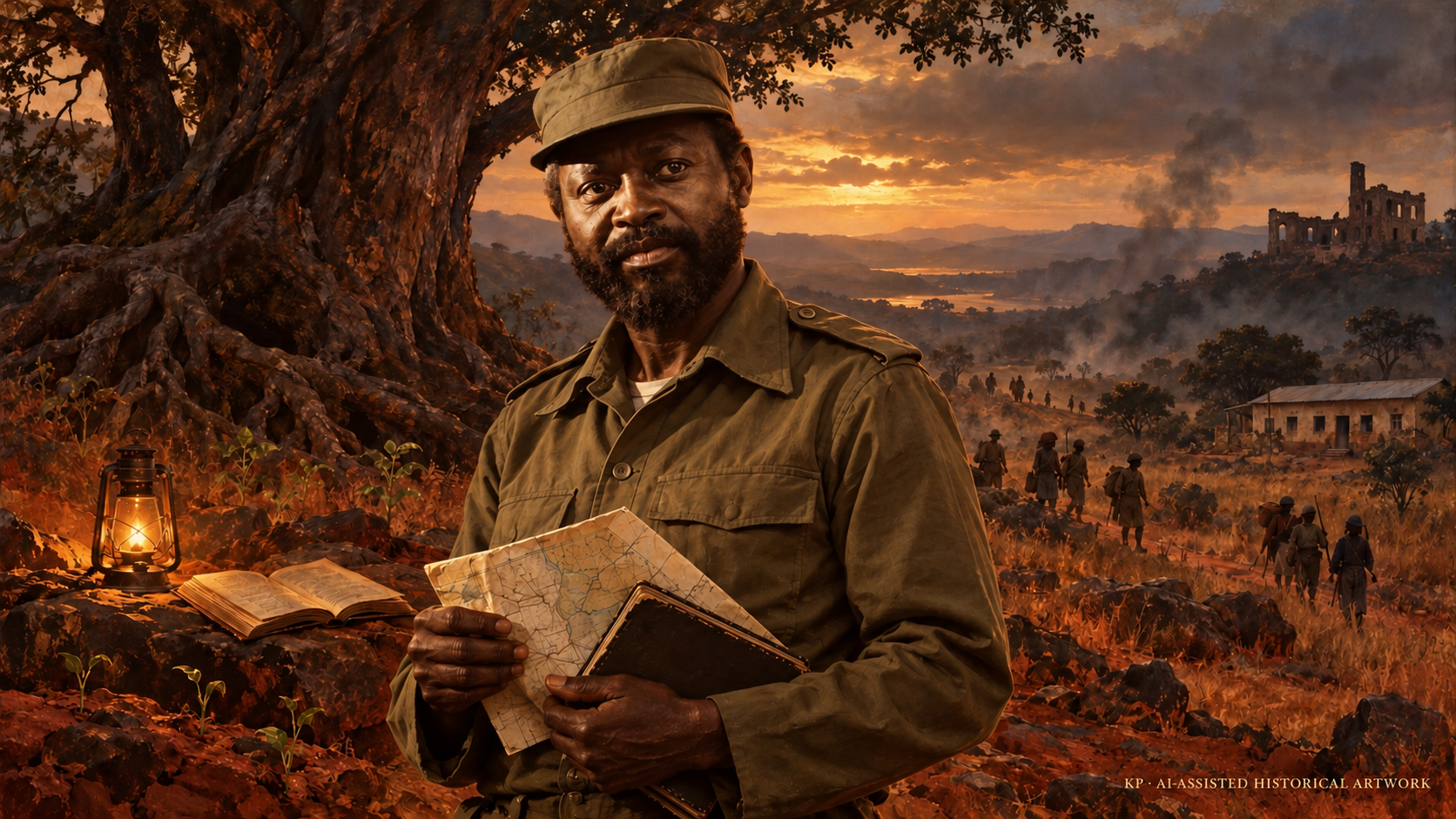
Machel was born on 29 September 1933 in Xilembeni, in the Chokwé district of Gaza Province, the third son of the peasant farmer Moisés Machel. He grew up in a landscape dense with memories of anti-colonial resistance. As a young boy herding his father’s cattle, he regularly sat beneath a great tree near the family’s cultivated field. In the 1890s, local memory says Maguiguane Khosa—a military leader under Ngungunhane—used that place while resisting Portuguese conquest south of the Zambezi. Though Ngungunhane was captured in 1895, Maguiguane continued fighting for two years. Machel’s own grandfather had been among the resistance fighters.
The stories of this earlier struggle were not distant folklore to him. They were part of his household’s and village’s moral inheritance. Machel did not know his grandparents personally, but an elderly relative, described as a centenarian marked by war, told him of his grandfather’s exploits and of the violence of colonial predation. These recollections established a continuity between the defeated nineteenth-century resistance and the twentieth-century liberation struggle in which Machel himself would become a central figure. The colonial occupation had not erased resistance; it had forced it into family memory, local speech, and forms of moral instruction that survived into a later generation.
Protestant Christianity also shaped Machel’s early formation. His father was an early convert to the Free Methodist Church, and Machel often stayed at Pastor Abel Chambalale’s home near his school. The Portuguese colonial administration, closely allied with the Roman Catholic Church, treated Protestant communities with suspicion. Under the 1940 Concordat between Portugal and the Vatican, the Catholic Church received responsibility for education in Portugal’s African colonies. Protestants, however, encouraged education and habits of independent thought that colonial officials understood as a threat to the existing order.
Machel later remembered the Protestant elders of his region as early teachers of resistance. They had endured persecution, he said, and their conversion itself could be understood as an act of opposition to colonial authority. He insisted that before Marxist books or anti-colonial texts reached his community, “our books were these elders.” They explained what colonialism was, taught the young about its violence, and kept alive the conviction that foreign oppression could be resisted. African oral history, community memory, and lived experience were at the foundation of Machel’s political education.
His formal education exposed him to the colonial school system’s coercive character. In the Catholic mission schools, religious instruction dominated the curriculum, while African pupils often spent years attempting to advance beyond rudimentary grades. At the mission of São Paulo de Messano, where he was sent to complete his fourth year, pupils were required to work in the fields from early morning until lunchtime, leaving only the afternoon for schoolwork. Before Machel could sit the examination for the fourth grade, priests required that he be baptized as a Catholic. The ultimatum had real consequences: without the qualification, Africans were effectively excluded from employment beyond the lowest levels of manual labor. He accepted baptism under pressure and passed the examination in 1950, shortly before his seventeenth birthday.
Despite his evident ability, Machel was not allowed to pursue a normal secondary education. The colonial system reserved advanced learning for a small section of the African population, and the main route open to an African who wanted to continue studying was a religious vocation. When Machel applied for secondary schooling, they rejected him and instead encouraged him to enter a seminary. He declined. Rather than become a priest, he trained as a nurse at the Miguel Bombarda Hospital in Lourenço Marques, the colonial capital later renamed Maputo. His wages enabled him to continue some private study, but the broader educational path remained closed. In this sense, Machel became largely self-taught: educated through reading, political discussion, work, training, and participation in the liberation movement rather than through the institutions that colonial society excluded most Africans from.
The political lessons of his childhood were reinforced by his home region’s economic history. Colonial labor policies shaped the Limpopo Valley, making southern Mozambique a reservoir of workers for South African mines. Machel’s father had worked in the mines before establishing himself as a farmer. Beginning his first contract in 1912, he managed, through severe saving and careful management, to marry, purchase a plow, and eventually cease migrant labor. Yet the mines exacted a harsh price from families throughout the region. Machel’s eldest brother died while working there, and the family received only a fraction of the compensation promised for his death.
During the 1940s, the Limpopo Valley’s relatively stable life was disrupted further. Colonials introduced compulsory cotton cultivation and used corporal punishment against those who tried to evade it. Because cotton displaced food production, families were left more vulnerable to drought and hunger. At the same time, forced labor built an irrigation scheme designed for Portuguese settler agriculture. African farmers were removed from fertile river land and pushed towards drier, sandier soils in the interior. These policies diminished production, weakened communities, and made the colonial state’s priorities unmistakable: African land and labor were to serve settler accumulation and external economic interests.
Machel’s work as a nurse gave him an equally direct view of racial hierarchy. Black and white trainees might undergo instruction together, but after graduation their treatment diverged sharply. White workers received higher wages and greater respect; Black workers encountered lower pay, diminished status, and systematic discrimination. Machel later described this experience as a turning point. He came to understand that an individual acting alone could not overcome an entrenched colonial order. What was required was collective action: political organization capable of transforming not simply particular injustices but the social structure that produced them.
Events beyond Mozambique widened his political horizon. Ghana’s independence under Kwame Nkrumah, the revolution in Guinea under Sékou Touré, the upheavals accompanying Congolese independence, and the broader anti-colonial advance across Africa showed that colonialism was not permanent. At the same time, the 1960 massacre of peaceful demonstrators at Mueda made clear the Portuguese regime’s unwillingness to permit meaningful African political representation. When armed revolt began in Angola in 1961, and when Eduardo Mondlane visited Mozambique that year, the possibility of an organized Mozambican liberation movement became more tangible.
In 1963, after a period of clandestine political activity, Machel left Mozambique through Swaziland, South Africa, and Malawi, reaching Dar es Salaam in Tanzania. There he joined the recently formed Frente de Libertação de Moçambique, or FRELIMO. Unlike other young exiles who sought further academic opportunities, Machel chose what the document calls “the study of struggle.” He volunteered for military training and became one of the early FRELIMO recruits sent to Algeria, whose anti-colonial revolution had already become a key reference point for liberation movements across Africa.
Machel absorbed lessons from the Algerian example but did not treat any foreign revolution as a blueprint. As FRELIMO’s struggle developed, he increasingly insisted that Mozambicans had to build their own political and military model out of their own conditions. He studied the theory of people’s war in the writings of Mao Zedong and General Võ Nguyên Giáp, drawing from them a central principle: military technology alone could not determine the outcome of a war. Political consciousness, moral discipline, organizational capacity, and enduring popular support were decisive. A liberation army had to serve the people, not merely operate among them.
After returning to Tanzania, Machel assumed important responsibilities at FRELIMO’s first training camp at Kongwa. The camp was built largely by hand and soon pursued food production and self-reliance as part of its daily life. These experiences strengthened Machel’s belief that combat, study, and productive labor belonged together. Guerrillas were not simply fighters; they were to become disciplined political cadres capable of working with communities and helping to create the foundations of a new society. One standing instruction to militants expressed the relationship in concise terms: “Respect the people, help the people, defend the people.”
The armed struggle began on 25 September 1964. Machel later moved into a senior role at the movement’s rear base and training center in Nachingwea, southern Tanzania. In October 1966, after the assassination of FRELIMO’s overall military commander, Filipe Samuel Magaia, he became Secretary for the Department of Defense and assumed overall military command. Under his leadership, FRELIMO strengthened coordination between its political and military work, expanded its liberated areas, developed schools and health posts, and built structures of popular mobilization in regions where Portuguese authority had weakened.
The struggle was not without internal conflict. Between 1967 and 1969, FRELIMO underwent a major crisis concerning ideology, strategy, leadership, and the political purpose of the war. Machel, the military wing, and revolutionary intellectuals such as Marcelino dos Santos came to represent a tendency that insisted that armed struggle had to become social revolution. They opposed approaches that treated the army as a mere instrument through which an elite could inherit power after the Portuguese. Machel’s influence grew because he argued that the liberation movement had to confront its internal contradictions, deepen unity on revolutionary principles, and remain answerable to the people in the liberated zones.
Following the assassination of FRELIMO’s founding president, Eduardo Mondlane, in 1969, Machel served on the provisional Council of the Presidency. When the council dissolved in May 1970, he was elected FRELIMO President. He subsequently helped move key movement institutions out of the political atmosphere of exile in Dar es Salaam and closer to Mozambique and the liberation front. Medical, educational, and organizational functions were relocated to other Tanzanian locations, while FRELIMO extended the armed struggle across the Zambezi River and into Tete, Manica, and Sofala. By 1974, the Portuguese dictatorship had itself fallen in the Carnation Revolution, weakened in no small part by the colonial wars in Africa.
Machel led FRELIMO’s delegation in negotiations with Portugal’s new government in Lusaka, Zambia, where an agreement of 7 September 1974 set the transfer of power to FRELIMO in motion. On 25 June 1975, Mozambique achieved independence, and Machel became President of the People’s Republic. Victory, however, inaugurated a task as demanding as the war itself: converting the political discipline, social ideals, and moral claims of the liberation struggle into the institutions of a new nation.
Machel’s distinctive conception of leadership shaped this task. He rejected the cult of the individual, once revising a draft interview by crossing out every instance of “I” and substituting “we.” The gesture captured his conviction that an organized people, not a single leader’s personality, made revolution. Unity, in his view, could not rest on declarations alone; it had to be forged through shared work, mutual criticism, and comrades’ responsibility to help one another advance.
At FRELIMO’s Third Congress in 1977, the movement formally embraced Marxism-Leninism and remade itself from a liberation front into a party. Yet Machel resisted the mechanical adoption of imported models. Revolutionary theory, he held, had to emerge from a people’s own historical circumstances and be continually tested in practice. Mozambique’s political experience therefore could not be measured simply against foreign formulas. Its leadership and organizational forms had been forged in the armed struggle itself, through the alliance of guerrilla warfare, political education, rural mobilization, and the construction of liberated zones.
The habits Machel had developed during the war remained central to his public image after independence. He was known for physical stamina, austerity, and his insistence on staying close to ordinary people. During the liberation struggle, he walked through the zones of Niassa and Cabo Delgado, speaking with villagers and fighters while sharing the campaign’s difficult logistics. The transition to state office brought the presidential residence, official protocol, escorts, and the burdens of governing a country still facing conflict and scarcity. For Machel, the central danger was that power might separate leaders from those they governed in its name. He sought to preserve an ethic of service and to resist the privileges, flattery, and self-enrichment that could accompany office.
His private life also revealed the human costs of revolutionary struggle. His first wife, Josina Machel, was herself a leading FRELIMO militant and an important advocate of women’s emancipation. Her death in 1971 devastated him. In his elegy, Josina, You Are Not Dead, he remembered her not only as his wife but as a sister, friend, and comrade-in-arms. Grief became a pledge of continuity: her sacrifice, imagined through images of earth, cultivation, flowers, and renewal, would nourish further struggle and the emergence of what he called “the new power and the new woman.”
After independence, Machel married Graça Simbine on 7 September 1975. Graça, a FRELIMO educator and Mozambique’s Minister for Education and Culture, became a major political figure in her own right, closely associated with the new state’s commitment to education and social transformation. Together they had two children: a daughter, Josina, born in 1976, and a son, Malengane, born in 1978.
Machel was also the father of children from earlier relationships, including four children with Sorita Tchaiakomo and a daughter with Irene Buque, both of whom he had known during his years as a nurse in Lourenço Marques. After independence, he brought his children from three mothers into a single household at the Ponta Vermelha presidential residence in Maputo. The arrangement reflected both a desire to assume responsibility for his children and the demanding realities of a family formed across years of separation, clandestine work, exile, and war. Graça later recalled that creating a unified household was emotionally difficult for the children, who had endured long absences and abrupt changes in family life.
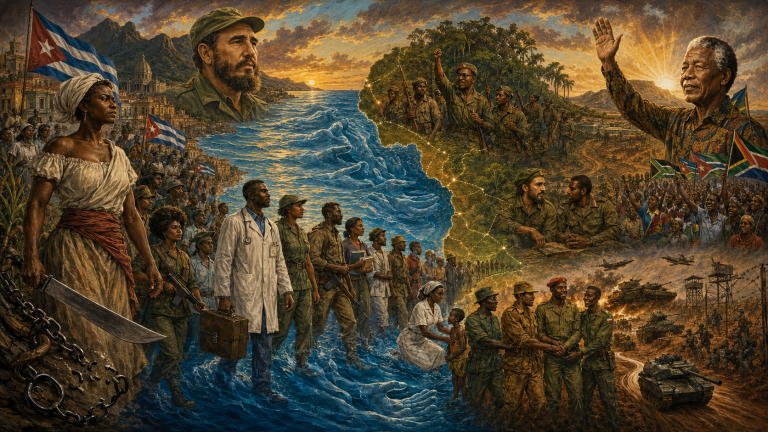
The pressures and dislocations visible within Machel’s own household were, in different forms, reflected in the larger national inheritance that confronted the new government. The independent state inherited a far harsher environment than the 1975 celebrations suggested. Machel’s government expanded education and health services, nationalized major sectors, and sought to reorganize social life around socialist principles. Mozambique also continued to support regional liberation movements, providing an important rear base for ZANU during the struggle against Rhodesian rule and for the African National Congress in its resistance to apartheid South Africa. These commitments brought grave consequences. Rhodesia and later apartheid South Africa backed RENAMO, whose insurgency helped plunge Mozambique into a devastating civil war, inflicting immense suffering and further draining an already fragile economy. In 1984, under severe military and economic pressure, Machel’s government signed the Nkomati Accord with South Africa, a non-aggression pact intended to halt cross-border destabilization and curtail support for the ANC.
The revolutionary project also produced serious internal contradictions. Machel’s administration used re-education centers, forced relocations under programs such as Operation Production, and repression against political opponents and former FRELIMO dissidents. Any account of his presidency must therefore hold together its opposing realities: a determined effort to extend anti-colonial sovereignty, education, public health, women’s participation, and regional liberation; and forms of coercion that caused profound harm and restricted political freedom.
On 19 October 1986, Machel was returning to Maputo from a regional meeting in Mbala, Zambia, when his presidential Tupolev Tu-134 crashed at Mbuzini in South Africa’s Lebombo Mountains, close to the Mozambican and Swazi borders. He and 33 others died; nine passengers survived. The crash took place amid acute hostility between Mozambique and apartheid South Africa, and it immediately generated suspicions of state involvement.
South Africa’s official Margo Commission attributed the disaster principally to errors by the Soviet flight crew. Mozambican and Soviet investigators rejected that explanation, arguing that the aircraft may have been diverted from its intended route by a false radio-navigation beacon, allegedly deployed by South African military intelligence. Later claims by former apartheid-era operatives, calls for a renewed inquiry, and testimony considered by South Africa’s Truth and Reconciliation Commission sustained those suspicions. No universally accepted conclusion has emerged. Machel’s death therefore remains an unresolved and deeply contested episode: officially attributed to pilot error, yet persistently associated with the possibility of apartheid South African sabotage.
His death transformed him into a figure of mourning throughout Mozambique and southern Africa, reinforcing the sense that Mozambique’s destiny had been bound to the region’s wider liberation. Machel’s legacy is necessarily complex. He was a formidable anti-colonial commander, an advocate of popular power, social equality, education, and women’s emancipation, and a leader admired for personal austerity and resistance to private enrichment. Yet his record also bears the weight of political repression and coercive state practices. His life cannot be reduced either to heroic commemoration or to indictment alone.
From the remembered defeats of nineteenth-century African resistance to the presidency of an independent Mozambique, Machel’s trajectory was shaped by colonial violence, restricted schooling, family loss, migrant mine labour, land dispossession, racial discrimination, exile, guerrilla war, and ideological conflict. His enduring importance lies in his insistence that independence was not an endpoint. For him, political freedom demanded continued, collective labor to enable the formerly dispossessed to shape their own social future.
Sources:
https://en.wikipedia.org/wiki/Samora_Machel
https://sahistory.org.za/people/samora-machel
https://nation.africa/kenya/news/gender/from-samora-machel-to-nelson-mandela-the-remarkable-love-story-that-shaped-africa-s-history-5580052
https://theconversation.com/samora-machels-vision-for-mozambique-didnt-survive-what-has-taken-its-place-260110
https://www.marxists.org/subject/africa/machel/introduction.htm
https://www.marxists.org/subject/africa/machel/1970/machel-9-70.pdf
https://www.marxists.org/subject/africa/machel/1972/sowing-seeds.htm
https://www.marxists.org/subject/africa/machel/1976/machel-4-76.pdf
https://www.marxists.org/subject/africa/machel/1985/selected-writings.pdf