
“I write to tell the truth about the Black condition as I see it. Therefore, I write to offer a Black woman’s view of the world… The most fundamental truth to be told in any art form, as far as Blacks are concerned, is that America is killing us. But we continue to live and love and struggle and win.” ~Sonia Sanchez
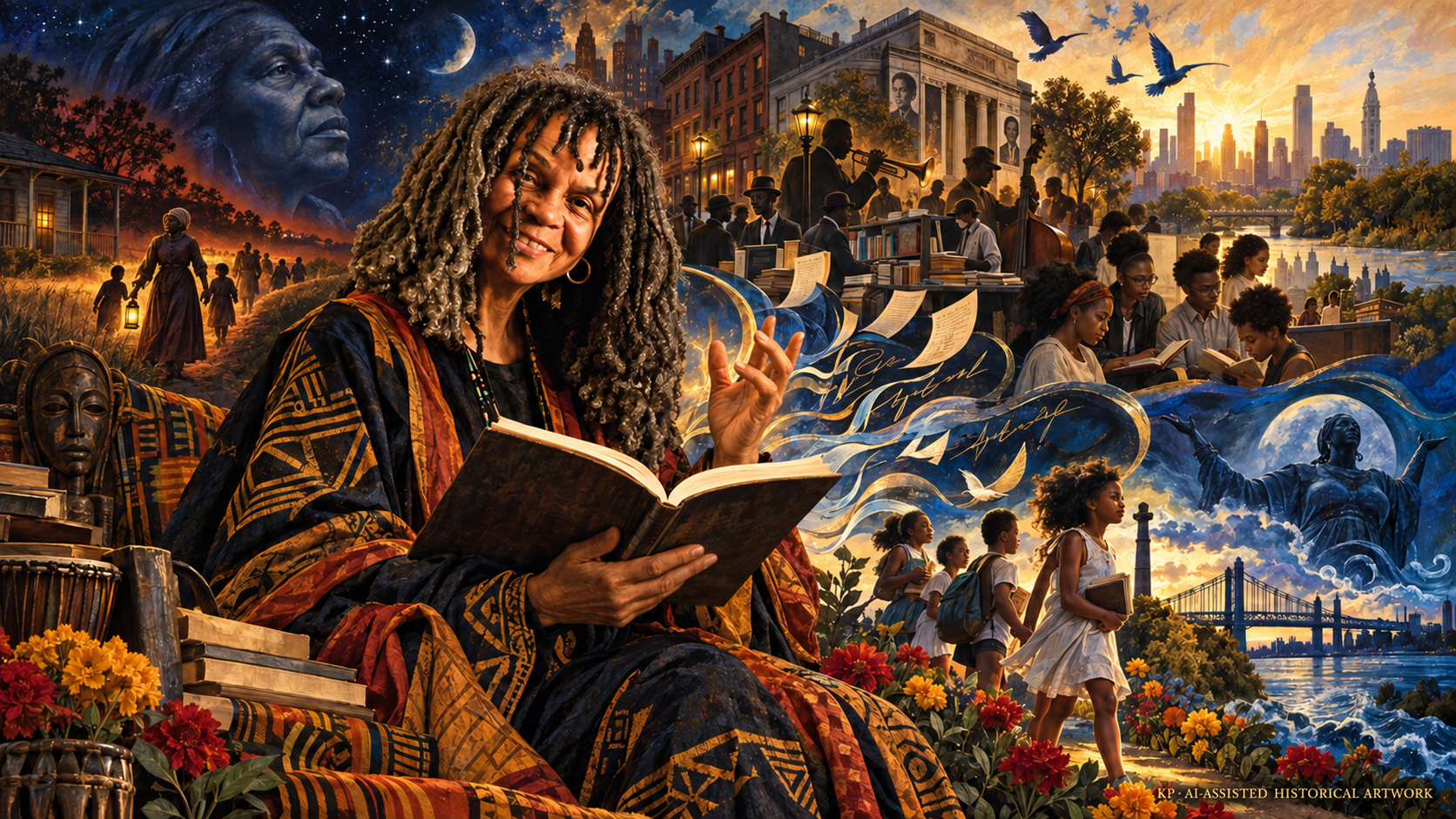
Sonia Sanchez is one of the defining poetic voices of the Black Arts Movement: a writer whose work has joined sound, memory, political witness, spiritual inquiry, and Black feminist thought across more than six decades. Born Wilsonia Benita Driver on 9 September 1934 in segregated Birmingham, Alabama, she became a poet, playwright, teacher, and activist whose art has consistently affirmed the beauty, complexity, endurance, and self-determination of Black life. Her poems are made to be heard as well as read: they carry the cadences of speech, blues and jazz improvisation, silence, grief, laughter, rage, prayer, and the intimate music of everyday survival.
Loss and the sustaining force of women’s voices shaped her earliest years. Sanchez’s mother, Lena Jones Driver, died when she was an infant, and she and her older sister Patricia spent part of their childhood in the care of relatives before living with their paternal grandmother in Birmingham. Her grandmother’s speech—its cadence, color, and musical phrasing—became an enduring source for Sanchez’s imagination. When her grandmother died while Sanchez was still a small child, she developed a severe stutter and became increasingly inward. Yet the condition also sharpened her relationship to language. Reading became a refuge, and the young girl began to attend closely to the weight of words, the breaks between them, and the rhythms that could make speech both difficult and liberating. She later described herself as an “ordained stutterer,” a phrase that suggests not defeat but transformation: what had been a wound became part of the distinctive sonic intelligence of her poetry.
In 1943, Sanchez moved to Harlem with her sister to live with her father and stepmother. Harlem offered a different cultural and intellectual world from the segregated South of her childhood. There she attended public school, found ways to manage her stutter, and gradually recognized writing as her calling. Her early education was complemented by a formative encounter with the Schomburg Library after she had graduated from Hunter College with a degree in political science in 1955. Having been offered—and then denied—a job because of racial discrimination, she found herself at the Schomburg, where its curator, Jean Hutson, introduced her to foundational works by Booker T. Washington, W. E. B. Du Bois, and Zora Neale Hurston. That encounter opened a sustained, self-directed study of Black literature and history. Hutson, along with Harlem booksellers such as Lewis Michaux and Richard Moore, helped nourish a reading life that deepened Sanchez’s historical consciousness and strengthened her sense of literary inheritance.
She continued her literary education through postgraduate study at New York University, where she worked with the poet and critic Louise Bogan. Bogan’s teaching left a durable mark. Although Sanchez initially resisted an emphasis on inherited European forms such as the sonnet and villanelle, she came to understand that disciplined form need not constrain a Black poet’s voice. “Form will not deform you,” she recalled learning. Bogan also impressed upon her the importance of performance, teaching that “the poem is the dance of the page.” Sanchez absorbed both lessons, becoming a writer of extraordinary formal range whose poems nonetheless retain the urgency and directness of speech. Her later work would draw on haiku, tanka, blues, jazz, Black oral tradition, African American Vernacular English, experimental spelling, repetition, spacing, and silence—making the page a score for a voice in motion.
During the 1960s, Sanchez emerged in the literary and political ferment that produced the Black Arts Movement. She joined writers’ workshops in New York and became associated with a generation that included Amiri Baraka, Larry Neal, Haki R. Madhubuti, Nikki Giovanni, and Etheridge Knight. Alongside Giovanni, Knight, and Madhubuti, she formed the Broadside Quartet, a group promoted by the publisher Dudley Randall. These writers rejected the idea that art could stand apart from social struggle. They sought instead a “functional art,” one that might speak plainly to Black communities, confront racial violence and economic injustice, recover African and diasporic cultural inheritance, and help imagine liberation. Sanchez’s first major poetry collections, Homecoming (1969) and We a BaddDDD People (1970), established her as one of the movement’s most vital voices. Their vernacular energy, compressed lyricism, fierce humor, and musical force helped redefine the possibilities of American poetry.
Her politics developed alongside her art. In the early 1960s, Sanchez worked with the Congress of Racial Equality, initially identifying with integrationist activism. Hearing Malcolm X, however, proved decisive. His analysis of racial power, Black dignity, history, and global struggle moved her away from integrationism and toward a more explicitly Black nationalist and internationalist perspective. Later, while teaching at Amherst College, she encountered Shirley Graham Du Bois, who broadened her engagement with African and diasporic intellectual life and introduced her to what Sanchez understood as “international Blackness.” Writers such as Chinua Achebe and Ngũgĩ wa Thiong’o became part of a wider literary and political horizon in which Black American struggle could not be separated from anti-colonial movements elsewhere.
Sanchez’s commitments were never static, and her work repeatedly questioned the limitations of movements to which she was otherwise deeply allied. She joined the Nation of Islam in 1972 but left three years later, finding its attitudes toward women incompatible with her own feminist principles. This refusal to subordinate women’s lives and voices to male authority became a defining ethical strand of her writing. Within a Black Arts world often marked by masculinist rhetoric, Sanchez created poems and plays that made room for Black women’s emotional lives, intellectual power, erotic autonomy, domestic vulnerability, anger, and creative authority. Her work did not abandon collective liberation; rather, it insisted that liberation could not be credible if it ignored sexism, misogyny, abuse, or the private injuries that women endured within supposedly revolutionary spaces.
Her plays extended this intervention. Works such as The Bronx Is Next, Sister Son/ji, Uh Huh: But How Do It Free Us?, Malcolm Man/Don’t Live Here No Mo’, and I’m Black When I’m Singing, I’m Blue When I Ain’t brought her political imagination to the stage. They examine race, power, gender, community, and the contradictory pressures placed on Black women. Sanchez also wrote for children, producing books including It’s a New Day: Poems for Young Brothas and Sistuhs, The Adventures of Fat Head, Small Head, and Square Head, and A Sound Investment and Other Stories. In these works, as in her teaching, she recognized children as inheritors of culture and as readers entitled to see their language, imagination, and humanity treated with seriousness and delight.
Teaching formed another major part of Sanchez’s life’s work. Before becoming a university professor, she taught fifth grade at the Downtown Community School in New York. She later helped pioneer Black Studies in American higher education, teaching some of the earliest university-level Black Studies courses at San Francisco State University and developing what is described as the first U.S. seminar devoted specifically to Black women’s literature at the University of Pittsburgh in 1969. Her career also included appointments at a number of institutions before she joined Temple University in Philadelphia as its first Presidential Fellow and Laura Carnell Chair in English. She taught there from 1977 until her retirement in 1999, leaving an academic legacy inseparable from her conviction that education should recover suppressed histories, enlarge intellectual possibility, and serve communities beyond the university.
Across the decades, Sanchez’s poetry has grown more expansive without losing urgency. Her 1974 collection A Blues Book for Blue Black Magical Women brought ancestral memory, dream, motherhood, African spiritual traditions, and the figure of her deceased mother into an intensely personal yet communal poetic space. Homegirls and Handgrenades (1984), which received the American Book Award, demonstrated her ability to move among poetry and prose while sustaining a powerful concern with love, family, survival, and social responsibility. In Wounded in the House of a Friend (1995), she confronted domestic trauma and the emotional wounds inflicted within intimate relationships. The collection includes “This Is Not a Small Voice,” a poem that honors the strength, intelligence, and creative vitality of Black children and young people, refusing narratives that reduce urban Black life to deprivation alone.
Perhaps no later work reveals Sanchez’s capacity for tenderness and witness more fully than Does Your House Have Lions? (1997), a book-length poem written in response to her brother’s illness and death from AIDS. The work attends to grief, family, sexuality, caregiving, stigma, and mortality with a rare emotional directness. Its subject matter represented a significant challenge to silences surrounding AIDS and queer life, particularly in contexts shaped by conservative gender and sexual politics. The poem was a finalist for the National Book Critics Circle Award, but its greater achievement lies in its refusal to reduce love, suffering, or the life of one person to abstraction.
Sanchez’s long engagement with haiku offers another measure of her originality. She found in the form a discipline of compression and revelation, but she did not treat it as detached observation. In her hands, haiku could hold the afterlife of enslavement, the violence of racism, the memory of political struggle, and the possibility of collective healing. Images of fire, blood, iron, weather, and morning recur not as decorative nature imagery but as elements bound to historical experience. Her poems responding to the 1985 MOVE bombing in Philadelphia make landscape bear witness to catastrophic state violence; her work on the Soweto uprising revises the language of the seasons in solidarity with children resisting apartheid; and her “Haiku and Tanka for Harriet Tubman” imagines Tubman through the spiritual and elemental force of an orisha, “riding thunder” through a history of Black freedom. Such writing reaches toward ubuntu: an understanding of human life as bound to ancestors, descendants, community, and the more-than-human world.
The honors Sanchez has received testify to the breadth of her influence, though no award can fully contain it. She has been recognized with the Robert Frost Medal, the Wallace Stevens Award, the Anisfield-Wolf Lifetime Achievement Award, the Dorothy and Lillian Gish Prize, the Ruth Lilly Poetry Prize, the Jackson Poetry Prize, and the Edward MacDowell Medal, among other distinctions. In 2011, she was appointed Philadelphia’s first Poet Laureate, serving from 2012 to 2014. Yet her greatest legacy lies in the generations of writers, students, activists, and readers who have encountered in her work a model of artistic courage: poetry that is formally adventurous without being obscure, politically engaged without surrendering emotional complexity, and deeply rooted in Black histories while remaining open to the fragile intimacies of ordinary life.
Sonia Sanchez has spent her career making language answerable to life. From the rhythms of her grandmother’s Birmingham speech to the streets of Harlem, from the classrooms of Black Studies to the stage, from the short breath of haiku to the sustained mourning of elegy, she has treated poetry as a living practice of remembrance and transformation. Her work asks readers not merely to admire language, but to listen—to the voices history has tried to silence, to the wounded and the resilient, to children and elders, to ancestors and those yet to come. In that listening, Sanchez’s poetry continues to make room for what she has always defended: Black beauty, Black survival, Black love, and the uncompromising possibility of freedom.
Sources:
Bazemore, Chanae D. “The Between Story: Physical and Psychic Trauma in the Poetry of Sonia Sanchez and Lucille Clifton.” Culture & History Digital Journal 2, no. 2 (2013): e030. https://doi.org/10.3989/chdj.2013.030.
https://en.wikipedia.org/wiki/Sonia_Sanchez
https://thehaikufoundation.org/juxta/juxta-4-1/sonia-sanchezs-magic-now-black-history-haiku-and-healing/
https://www.poetryfoundation.org/poets/sonia-sanchez
https://poets.org/poet/sonia-sanch
https://www.thehistorymakers.org/biography/sonia-sanchez-39ez
https://soniasanchez.net/bio/
https://www.blackwomenradicals.com/blog-feed/this-is-not-a-small-voice-exploring-the-transformative-work-of-sonia-sanchez
https://www.afropoets.net/soniasanchez.html
https://pabook.libraries.psu.edu/literary-cultural-heritage-map-pa/bios/sanchez__sonia
https://now.temple.edu/news/2024-10-01/philadelphias-first-poet-laureate-sonia-sanchez-returns-temple-reading-conversation-0
https://www.bostonreview.net/articles/sonia-sanchez-christina-knight-straight-down-bones/