

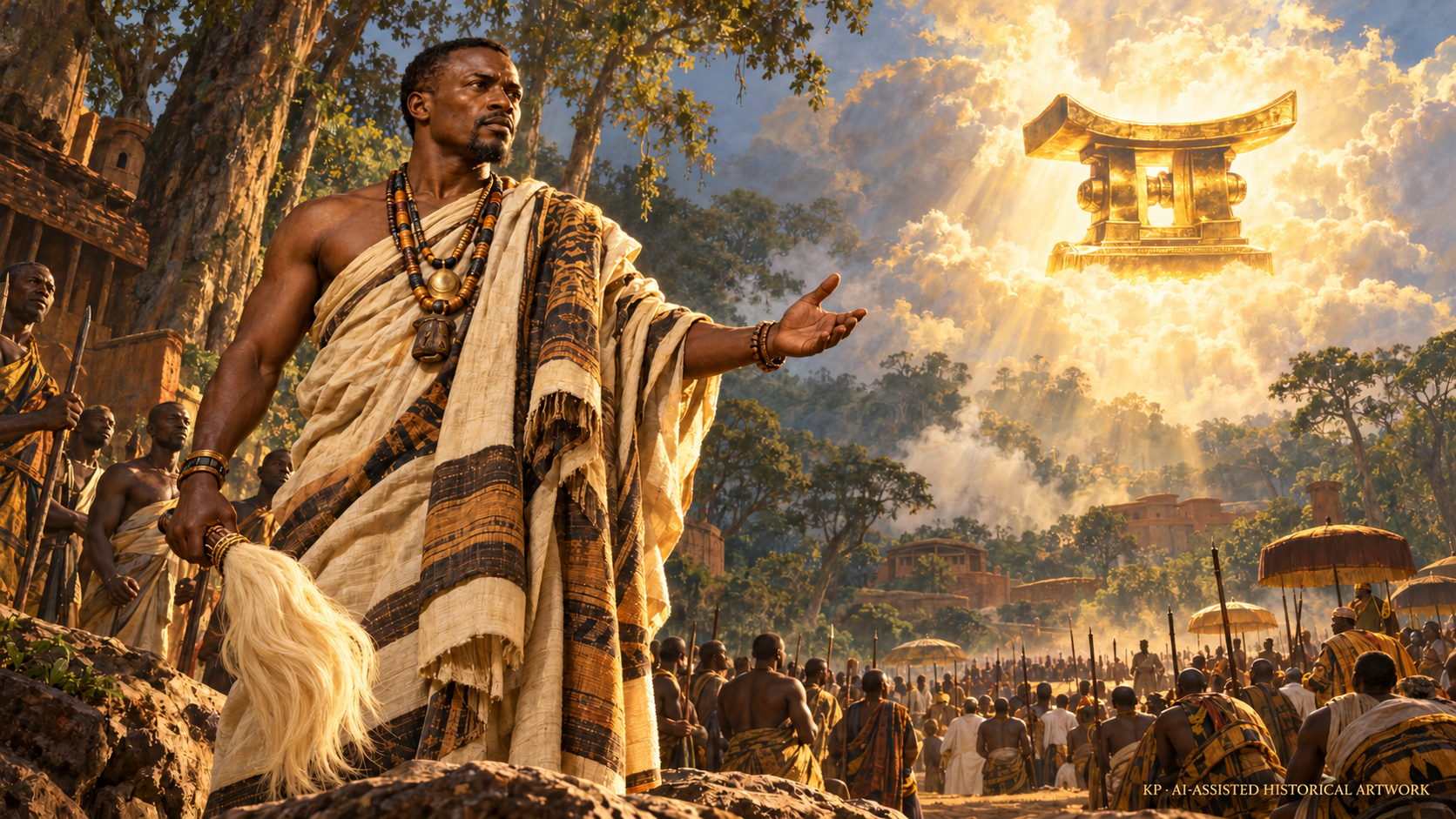
Okomfo Anokye occupies a foundational place in Asante history. A priest, healer, counselor, and political thinker, he is remembered alongside Osei Tutu I as a co-founder of the Asante nation in the late seventeenth and early eighteenth centuries. Their partnership brought neighboring Akan communities into a durable union centered on Kumasi, with shared institutions and a sacred emblem of collective belonging: the Golden Stool. In Asante historical tradition, Anokye helped give that union spiritual coherence, constitutional principles, and a sense of common purpose.
His biography also extends beyond the familiar boundaries of a historical life. Accounts of his birth, journeys, ritual work and disappearance belong to an extensive oral inheritance in which extraordinary deeds convey ideas about responsibility, communal survival and the relationship between the living and the spiritual world. These traditions preserve more than memories of an exceptional individual. They express an understanding of how a nation came into being and what its people owed to one another.
The surviving accounts do not establish every episode with equal certainty. His parentage, birthplace and final years remain disputed, while the relationship between early written descriptions and later accounts of his national significance requires careful attention. Anokye’s biography therefore holds together two connected subjects: the priest who lived during the formation of Asante and the ancestral figure through whom successive generations have understood that achievement.
Origins and Early Life
Anokye is generally placed in the second half of the seventeenth century, with about 1655 commonly given as his birth year. Awukugua, in the Akuapem area of present-day Ghana, is the birthplace most frequently associated with him. In the tradition maintained there, his father was Ano and his mother was Yaa Anubea. Other accounts locate his beginnings at Adansi Akrokyere or Agona Asante, while some Asante traditions describe an Asante mother and an Adansi father. His personal name appears in several forms, including Kwame Agyei Frempon and Kwame Anokye Frimpon Kotobre. “Okomfo” identifies his priestly vocation.
These differences shape how people remember him. Several communities locate him within their own ancestral and sacred landscapes, preserving relationships that cannot be reduced to a single uncontested genealogy.
The Awukugua birth narrative presents his spiritual calling as evident from his first moments. According to this account, he entered the world holding a short cow-tail whisk in one hand, while the other remained tightly closed around a protective object. When his father approached, the infant opened his hand and said, “Ano … kye”—rendered as “Ano … see.” That encounter explains the name Anokye.
Stories of his childhood develop the same theme of an unusual vocation. He preferred elders’ company to children’s games and astonished adults with his speech, insight, and knowledge. Accounts of prolonged fasting and disciplined conduct portray a young person preparing for responsibilities beyond ordinary domestic life.
A Priest’s Education
Anokye’s early journeys are associated with acquiring religious and therapeutic knowledge. Traditions place him at spiritual centers in Akuapem, including Awukugua and Apirede, and describe wider travels during which he learned from experienced priests.
His education encompassed herbal preparations, protective medicines, divination and ritual practice. These were not neatly separated fields. Healing could involve the body, a person’s relationships, ancestral obligations and the condition of the wider community. A priest’s responsibilities might therefore include attending to illness, interpreting misfortune, advising leaders and preparing a community for danger.
The accounts of Anokye’s learning place him within this interconnected intellectual and spiritual world. His later reputation rested not simply on extraordinary performances but on his ability to interpret circumstances, inspire confidence, and link practical decisions to sacred obligations.
The Partnership with Osei Tutu
The decisive relationship in Anokye’s public life was his association with Osei Tutu I. Their earliest meeting is uncertain. Some traditions connect it with Akwamu or Denkyera, where both men are said to have spent time before returning to the forest communities that became the center of Asante.
Osei Tutu provided political and military leadership; Anokye offered priestly counsel, persuasive speech, and a framework of shared ritual commitment. Their responsibilities overlapped, but Asante remembrance consistently presents them as complementary figures.
The challenge before them was substantial. Communities with their own leaders, ancestral histories and local loyalties needed a basis for sustained cooperation. Opposition to Denkyera brought them together, but a wartime alliance alone could not guarantee an enduring nation.
Anokye’s contribution lay in making unity meaningful beyond immediate military necessity. Through ceremonies, oaths, and shared sacred commitments, the participating communities were invited to see themselves as part of a larger body. Kumasi became the center of this developing political order, while councils and collective observances gave the union institutional form.
The Golden Stool and the Asante Nation
The most celebrated account of Anokye’s work concerns the Golden Stool, Sika Dwa Kofi, commonly rendered as the “Golden Stool born on Friday.”
According to Asante tradition, Anokye assembled the participating leaders in Kumasi and called the stool down from the sky. It descended onto Osei Tutu’s knees, identifying him as Asantehene and affirming the sacred foundation of the new union.
The stool’s significance extended beyond recognizing a king. Anokye declared it the dwelling place of the collective spirit, or sunsum, of the Asante people. It represented a community larger than any individual officeholder, lineage, or locality. Allegiance to it expressed membership in that community.
This distinction is central to the stool’s historical importance. It was not merely an ornament associated with a royal household. It embodied the nation’s continuity and the obligations that bound its constituent communities together. The traditions connecting Anokye with its descent therefore explain both the origins of Asante unity and the spiritual basis on which that unity was to endure.
The same body of tradition links him to the recognition of Osei Tutu’s Oyoko lineage as the source of future Asantehene and to restrictions on competing gold-covered stools. These provisions protected the national emblem’s singular standing while locating leadership within an established framework of succession.
Law, Councils and Collective Responsibility
Anokye is also remembered as the source of the Seventy-Seven Laws, a body of constitutional, judicial, and ethical provisions associated with Asante’s formation. These laws are presented as bringing existing customs into a shared framework rather than creating social order from nothing. The participating communities already possessed institutions, procedures and moral expectations. Anokye’s achievement was coordinating these elements within a larger political community.
Among the provisions associated with him were reserving final decisions on capital punishment for the Asantehene, formal oaths binding regional leaders to the nation, and compulsory participation in important collective gatherings. The traditions also assign him a role in establishing judicial procedures and affirming the okyeame’s place in public deliberation as court speaker and interpreter.
The national council, Asanteman Hyiamu, provided a setting in which leaders could consider matters affecting the wider union. The Odwira festival, associated with cleansing and renewal, likewise linked religious observance to political responsibility. Gathering together reaffirmed relationships that agreement in name alone could not sustain.
Not every measure attributed to Anokye was conciliatory. The collected accounts include severe penalties intended to discourage divisions based on separate ancestral origins. These traditions reveal the tensions within the project of unification: creating a shared identity could also restrict the public expression of differences.
The Seventy-Seven Laws are best understood as a constitutional inheritance attributed to Anokye, rather than as a complete, contemporary written code. Their importance lies in the leadership they convey: office carried obligations, national cohesion required ongoing care, and departures from foundational commitments could endanger the whole community.
The Struggle Against Denkyera
The formation of Asante was closely tied to the struggle to end Denkyera’s demands on the participating forest communities. The conflict culminated in the Asante victory at Feyiase in 1701. Anokye’s remembered contribution was chiefly spiritual and organizational. He prepared ritual medicines, strengthened combatants’ resolve, and helped sustain cooperation among leaders whose communities had previously pursued separate interests.
Accounts of these preparations include seventy-seven perforated vessels, known as nkosena, in which he prepared medicines without losing any of the contents. Other narratives describe him observing the Denkyera camp from a tree, turning aside bullets with his flywhisk and directing bees against opposing soldiers.
The traditions also remember costly acts of commitment by participating leaders, including Tweneboa Kodua of Kumawu, Duku Pim of Edweso and Bobie of Bonwire. Their inclusion places sacrifice, rather than triumph alone, at the center of the national story.
The victory at Feyiase secured Asante’s independence from Denkyera and changed its regional relationships. It also opened new opportunities for coastal commerce, including claims tied to the Dutch rent arrangement at Elmina. Anokye’s place in this transformation rests on his role in giving the alliance a shared purpose before, during, and beyond the fighting.
The Sword at Kumasi
Alongside the Golden Stool, the sword associated with Anokye is among the most enduring material expressions of his legacy.
Tradition holds that he drove it into the ground at Kumasi and declared that Asante’s cohesion depended on it remaining undisturbed. The site is preserved on the grounds of the Komfo Anokye Teaching Hospital, named in his honor.
Stories of unsuccessful attempts to extract the sword have accumulated around it. These include accounts involving construction machinery and a visit by the boxer Muhammad Ali.
The sword makes a foundational commitment visible in a particular place. Where the Golden Stool embodies collective belonging, the sword expresses continuity and rootedness. Together, they locate Anokye’s memory in sacred objects that connect national history with the physical landscape.
Sacred Landscapes and Everyday Memory
Anokye’s remembered deeds extend across rivers, trees, stones, and settlements. At Awukugua and Gyaakye, people attribute stone oware boards to his fingers. Elsewhere, traditions credit him with bringing forth water, redirecting rivers and leaving footprints in rock or tree trunks.
Accounts of his relationship with rain are especially striking. He is said to have lived in a roofless house into which rain did not fall. Other stories describe plantains bearing fruit on the day they were planted and a kola tree growing from a seed he spat onto the ground.
These narratives locate sacred significance in familiar surroundings. A watercourse becomes evidence of care for a community; a stone board links religious distinction with a widely played game; a tree preserves the memory of a decisive journey or encounter.
They also show how Anokye’s biography has been transmitted outside formal chronicles. Places, objects, and repeated acts of storytelling carry historical relationships across generations. People remember his life not only through what they say about him, but through where they tell those stories.
Family and the Limits of the Record
Anokye’s public and sacred reputation largely overshadows his domestic life. Some traditions portray him as an ascetic figure, while others describe marriages and children.
One account names two sisters, Afua and Asiedua, as his wives and identifies children called Agyapa and Beresiama. The surviving material does not provide a sufficiently secure basis for a complete family history or a precise chronology of these relationships.
These fragments nevertheless complicate the image of an entirely solitary priest. They suggest that at least some communities remember him through networks of marriage, descent, and inherited responsibility, as well as through his association with Osei Tutu.
The Search for an Antidote to Death
Anokye’s final years are generally placed around 1717–1719, but neither the date nor the circumstances of his death are securely established.
The best-known account describes a journey undertaken to obtain Owuo ano aduro, an antidote to death. Having helped secure the community’s future, he sought to address the loss that no political settlement could prevent.
Before entering a trance or departing for the spiritual realm, he instructed those around him not to mourn, conduct funeral observances, or fire guns. Some versions specify a seven-year, seventy-seven-day absence.
The prohibition was broken. In one telling, a woman began to lament his death. In another, his nephew declared him dead and arranged a funeral. When they opened his room, it was empty.
A further episode describes Anokye returning with the remedy and meeting a traveler who explained the distant sounds of mourning. Learning that his own funeral was taking place, he declared that the undertaking had been undone. He sent his flywhisk back as evidence of his return and disappeared.
The narrative explores mortality, grief, and the difficulty of sustaining trust in the face of absence. It also leaves his own ending unresolved. A traditional eulogy expresses that uncertainty: no one knows whether Anokye died or departed; only God knows.
An Enduring Presence
Anokye remains present in Ghanaian public life through the hospital bearing his name, memorial places at Awukugua, the sword sanctuary in Kumasi and ceremonies associated with Asante leadership. Oral poetry continues to join him with Osei Tutu as an inseparable founding pair.
Anokye is thus both a priest of Asante’s formative generation and an ancestral presence through whom later generations have considered unity, leadership, loss, and belonging.
Sources:
https://en.wikipedia.org/wiki/Okomfo_Anokye
https://www.britannica.com/biography/Okomfo-Anokye
https://www.academia.edu/9340673/The_Komfo_Anokye_Story
https://www.researchgate.net/publication/312588695_Disobedient_Asante_shall_die_but_Okomfo_Anokye_will_live_forever_A_note_on_an_Asante_eschatological_response_to_the_mystery_of_Death
https://jangplatvoet.nl/content/uploads/2017/11/RenewalByRetrospection.pdf