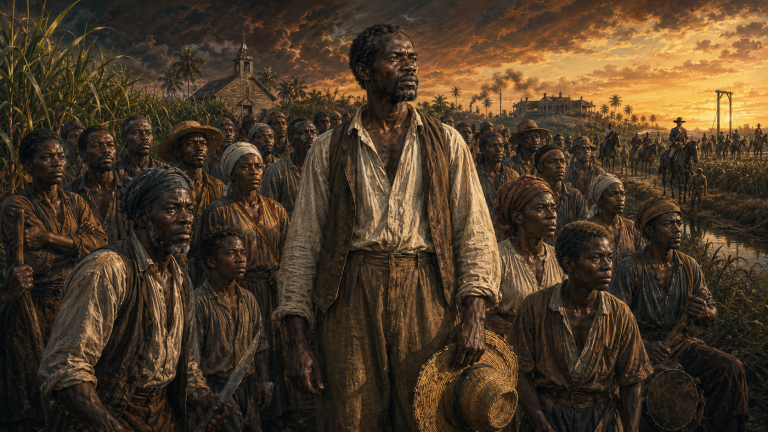

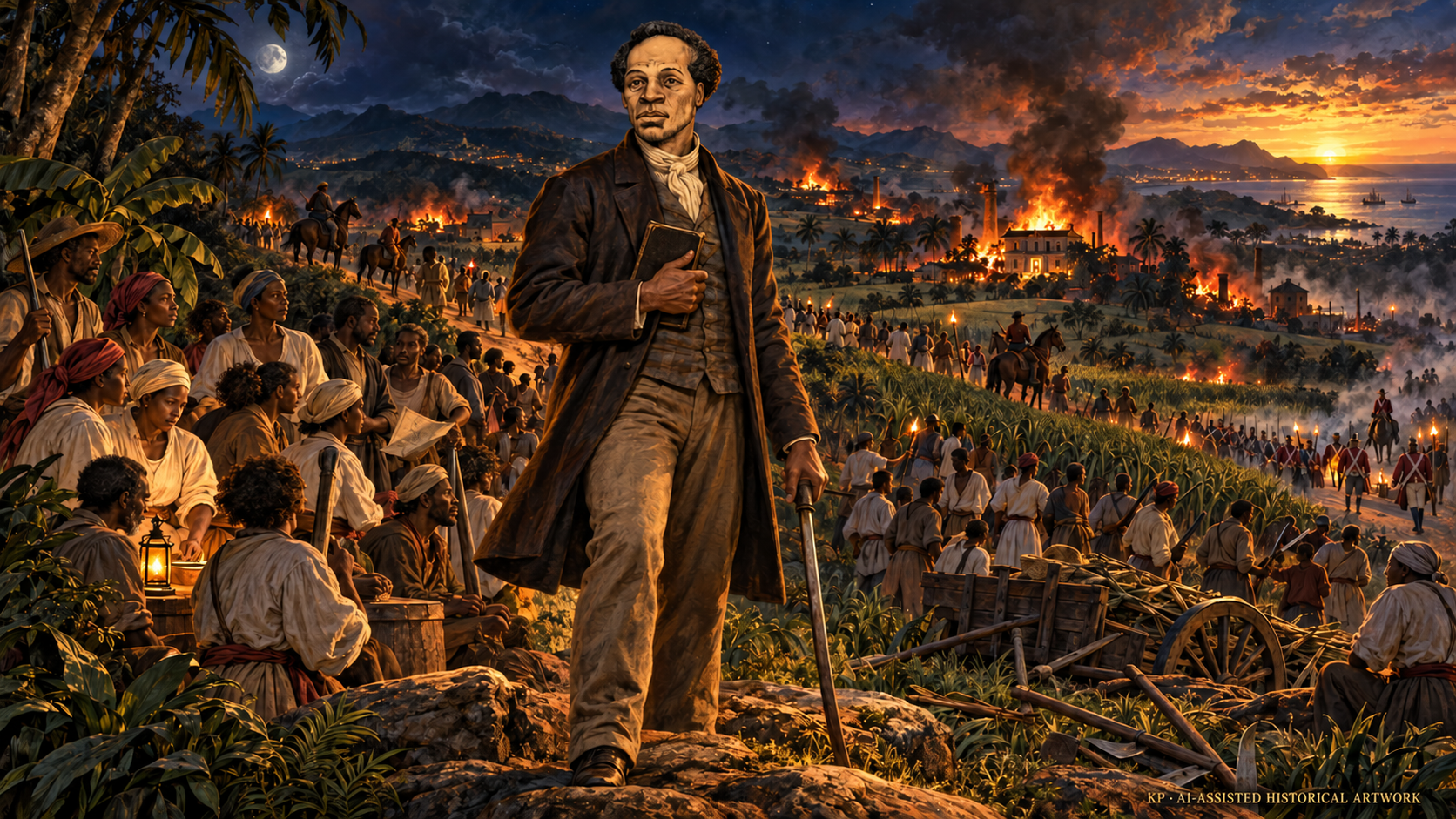
Samuel “Sam” Sharpe was one of the principal leaders of the Baptist War, the largest uprising of captive people (Xaymacans) in Jamaican history and the Caribbean territories under British oppression. Also known as the Christmas Rebellion, the Rising began in western Jamaica on 27 December 1831 and spread rapidly through St James, Hanover, Westmoreland, St Elizabeth, Trelawny, and neighboring districts. It was a coordinated struggle against the Maafa in which Xaymacans refused plantation labor, destroyed symbols of colonial oppression, and, when attacked, defended their claim to freedom by force.
The first concentrated phase of the Rising was suppressed in early January 1832, though armed resistance and the colonial counter-offensive continued in parts of western Jamaica into late January. The Jamaican Assembly later recorded serious damage to more than 200 properties and calculated planter losses at more than £1.15 million, excluding substantial military expenditure. The Baptist War did not alone abolish the Maafa; it intensified a struggle sustained through generations of Black resistance and helped accelerate the imperial crisis that produced the Slavery Abolition Act of 1833.
Much about Sharpe’s early life remains uncertain. A “Return” recording his death in 1832 identified him as “Archer, alias Samuel Sharpe,” the son of Eve. However, an earlier 1817 return reportedly lists a twelve-year-old Archer on the Sharpe estate with a mother named Juda Bligom and siblings Joe and Eliza. “Samuel Sharpe” was also the name of the man who held him in captivity, Samuel Sharpe Esq.; the surviving evidence does not establish when Archer came to be known by that name.
Although held in captivity, Sharpe learned to read and write. He became a respected Baptist deacon associated with the congregation led by Thomas Burchell in Montego Bay. Sharpe read newspapers and was aware of anti-Maafa sentiment and parliamentary debate in Britain. Like many captive people in Jamaica, he believed emancipation was near. He was also remembered as an accomplished speaker who addressed the injustice of the Maafa with great force. In one recollection, he invoked the biblical statement that “no man can serve two masters” and argued that Buckra had no greater right to hold Xaymacans in captivity than Black people would have had to hold them.
His religious role gave him a degree of mobility unusual under the plantation regime. As a trusted Baptist deacon, he travelled through western Jamaica, attended and led religious meetings, and acquired a reputation for intelligence, composure, and eloquence. This relative mobility did not make him free. It did, however, enable him to communicate across the separated estates and districts through which the plantation system sought to control captive people.
Sharpe’s membership in the Baptist Church was central to his public role. Baptist congregations created spaces in which Xaymacans could meet, pray collectively, preach, exchange information, and exercise forms of leadership denied to them elsewhere. Black deacons carried religious teaching across plantations and rural districts. Their churches also provided a social infrastructure of trust through which people could assess danger, share news, and imagine a common future.
For Sharpe, religious teaching was inseparable from the question of freedom. Accounts from people who attended his meetings describe him speaking of the “manifold evils and injustices” of bondage and asserting the natural equality of human beings in relation to freedom. Biblical language became political language. Passages concerning truth, liberty, and equality challenged a society structured around the oppression of Black people.
Sharpe’s authority rested not only on his words but also on the credibility he possessed among ordinary people. One later witness explained that people trusted him because he had been born and raised around Montego Bay, could read, held standing in the Baptist church, and brought information from the town into the interior. He was known as “Daddy” Sharpe, a title of respect. In a society intended to isolate Xaymacans on separate properties, a literate and mobile Black deacon could become a crucial bearer of information and a link between distant communities.
Sharpe’s initial strategy was a general strike. Xaymacans would refuse to labour after Christmas unless they received wages, often remembered as “half pay,” and unless their grievances were acknowledged. The timing was strategic: the sugar harvest was the period in which estate owners depended most urgently upon captive labour to cut and process cane before it deteriorated. A mass refusal to work therefore threatened the plantation economy at one of its most vulnerable moments.
At secret meetings, participants reportedly took an oath over a Bible. Robert Rose later testified that Sharpe placed the book on a table and asked those present whether they would agree to “sit down.” In Rose’s recollection, the pledge was not to “trouble anybody” or begin a rebellion. Edward Barrett similarly recalled Sharpe saying that they were free and must not work again unless they received half pay. The language of “sitting down” described a refusal of coerced labour. The Xaymacans were not asking whether captivity could be made kinder; they were asserting that they could no longer continue to work as captive people.
Sharpe appears initially to have hoped that this resistance could be conducted with restraint. Testimony suggests that organizers instructed followers not to kill buckra and, if property had to be attacked, to target estate houses rather than cane fields, factories, or provision grounds. The intention was to compel negotiation without destroying the resources that the people themselves would require to live. It also indicated an ethic that did not confuse the demand for freedom with indiscriminate revenge.
But a mass withdrawal of labour confronted a system maintained by violence. When the planned strike was met by militia mobilization, military force, and the intransigence of the plantation class, the conflict moved rapidly beyond its original limits. The burning of Kensington Estate on 27 December marked the open beginning of the Rising. Sharpe’s followers and others refused labor, burned plantation buildings, gathered weapons, and moved through western Jamaica. The revolt spread with remarkable speed.
Colonial oppressors identified Sharpe as “General Ruler Samuel Sharpe,” offered a reward for his capture, and named him alongside Gardner, Dove, and Johnson as one of the movement’s principal leaders. Such language shows that the colonial regime recognized the Rising as more than local disorder. It confronted an organized challenge to the plantation system’s oppression.
Testimony from Sharpe’s trial complicates the familiar image of him solely as the planner of a nonviolent strike. Two witnesses stated that, after the Rising began, they joined a company personally commanded by Sharpe. On the day after that company’s successful engagement with the militia at Struie, near the St James–Westmoreland boundary, James Clarke, a captive man, recalled Sharpe declaring that freedom had been due to them long before and that they must now seek it and fight for it. Clarke further testified that Sharpe demanded steadiness in battle: if any man turned back when the company went to fight, another was to shoot him.
A reported visit to Ginger Hill Estate on the Rising’s third day likewise presents Sharpe as a leader prepared to defend the movement by force while maintaining a stated moral limit. He reportedly said that he did not wish to take the life of anyone who did not stand between him and his rights. Yet he insisted that freedom was their right and that “freedom they would have.” The statement links the claim of liberty to the need to defend it against those who sought to deny it.
Robert Gardner’s testimony also indicates the scale of Sharpe’s operational authority. Gardner stated that, on the Tuesday night after Christmas Day, Sharpe sent him a large body of men to command and instructed people around Greenwich and Belvedere Estates to join him. Gardner was to lead this force toward Westmoreland and Hanover. The men reportedly told him that Sharpe had “a multitude of people under his command.” Sharpe’s and Gardner’s companies then carried out a combined operation against the militia at Struie, with Sharpe commanding the party that travelled with him.
Evidence that Sharpe bore arms during the Rising reinforces this picture. Two witnesses at his trial said they had seen him carrying a gun and a small pistol, while other evidence suggests that he exchanged a machete for firearms. These statements came from a colonial legal system that was determined to secure his conviction. However, taken alongside the testimony of Clarke and Gardner, they make an exclusively pacifist interpretation of Sharpe difficult to sustain.
Sharpe’s political strategy seems to have developed under pressure. He appears to have conceived an organized withdrawal of labor intended to win wages, recognition, and freedom without unnecessary loss of life. Yet plantation captivity did not permit a peaceful challenge to colonial oppression. Once militia and regular troops moved against the Rising, Xaymacans faced the practical question of how to defend themselves. Sharpe’s reported words at Struie and Ginger Hill present him as a commander who understood that freedom could not be secured by submission once open conflict had begun.
Sharpe was a Baptist deacon shaped by an ethic of restraint. He was also a political leader who, amid colonial violence, accepted armed resistance as necessary to the defence of freedom. His authority drew on both capacities: he could persuade people through spiritual and moral language, and he could help organize them when persuasion encountered force.
After the Rising was defeated, Sharpe became a target of exemplary punishment. The exact circumstances of his capture are unclear. Some accounts suggest that he surrendered; others state that he was taken into custody. He was tried on 19 April 1832, convicted of rebellion or insurrection, and sentenced to death.
While imprisoned, Sharpe was visited by the Baptist priest Henry Bleby, who described him as “the most intelligent and remarkable” man he had met among the captive people. Bleby recalled hearing him speak extemporaneously on religious subjects to fellow prisoners, many of whom had participated in the Rising, and observed the command he held over their attention. Other accounts similarly described listeners as “spellbound” when Sharpe spoke of captivity and freedom.
Sharpe was hanged in Montego Bay on 23 May 1832. He is remembered for the words attributed to him before his execution: “I would rather die upon yonder gallows than live in slavery.”
Sharpe’s death did not end the struggle he had helped to articulate. The Baptist War and the colonial reprisals that followed it convinced many in Britain that the Maafa in Jamaica could not continue. The Rising exposed the political capacities of Xaymacans, the fear and violence of the plantation class, and the impossibility of preserving a labor regime founded on coercion. Parliament passed the Slavery Abolition Act in 1833, but the legislation also compensated buckra and imposed apprenticeship upon most Xaymacans. Full emancipation did not arrive until 1838. Sharpe did not live to see that outcome, but the Rising associated with his name decisively hastened it.
In 1975, Jamaica declared Samuel Sharpe a National Hero. His name joined the official pantheon of figures who shaped the nation’s historical destiny; his likeness appeared on Jamaican currency, and the Montego Bay square where he was executed became Sam Sharpe Square. These acts of commemoration mattered because colonial education had long marginalized and distorted the history of Xaymacan resistance. To honor Sharpe publicly was to acknowledge that Jamaican freedom had been advanced by people who defied captivity and accepted enormous risk in pursuit of liberty.
Although Sharpe must be remembered as a powerful leader of the Baptist War, he did not fight as a solitary figure. His life is most meaningfully understood in relation to the people who organized and fought alongside him: Johnson, Campbell, Gardner, Dove, Taylor, Tharp, Susan, Bina, Charlotte, Eliza Lawrence, Ann Guy, Kitty Scarlet, and countless others. The Baptist War was made by a community of people who refused the idea that their futures belonged to buckra.
Sam Sharpe’s greatness rests in his ability to translate moral conviction into collective political action. He used the authority of the Baptist deaconate, the reach of Black religious networks, and the strategic vulnerability of the sugar harvest to help build an island-wide challenge to the Maafa. Sharpe gave the Xaymacans’ desire for freedom a language, organization, and urgency at a decisive historical moment. His life and death testify that emancipation was demanded, organized, defended, and fought for by Xaymacans themselves.
Sources:
Beckles, Hilary, and Verene A. Shepherd. Liberties Lost: Caribbean Indigenous Societies and Slave Systems.
Brown, Vincent. The Reaper’s Garden: Death and Power in the World of Atlantic Slavery.
Craton, Michael. Testing the Chains: Resistance to Slavery in the British West Indies.
Hart, Richard. Slaves Who Abolished Slavery: Blacks in Rebellion.
Martin, Tony. Caribbean History: From Pre-Colonial Origins to the Present.
https://lithub.com/sam-sharpe-and-the-revolt-that-ended-british-slavery/?fbclid=IwAR3eiho2l5rgxkVFCq_2eTjxBz1ADc8BExhwEUD8NchhKQzOVOoPpGcUvN0
http://jis.gov.jm/heroes/samuel-sharpe/
https://en.wikipedia.org/wiki/Samuel_Sharpe