

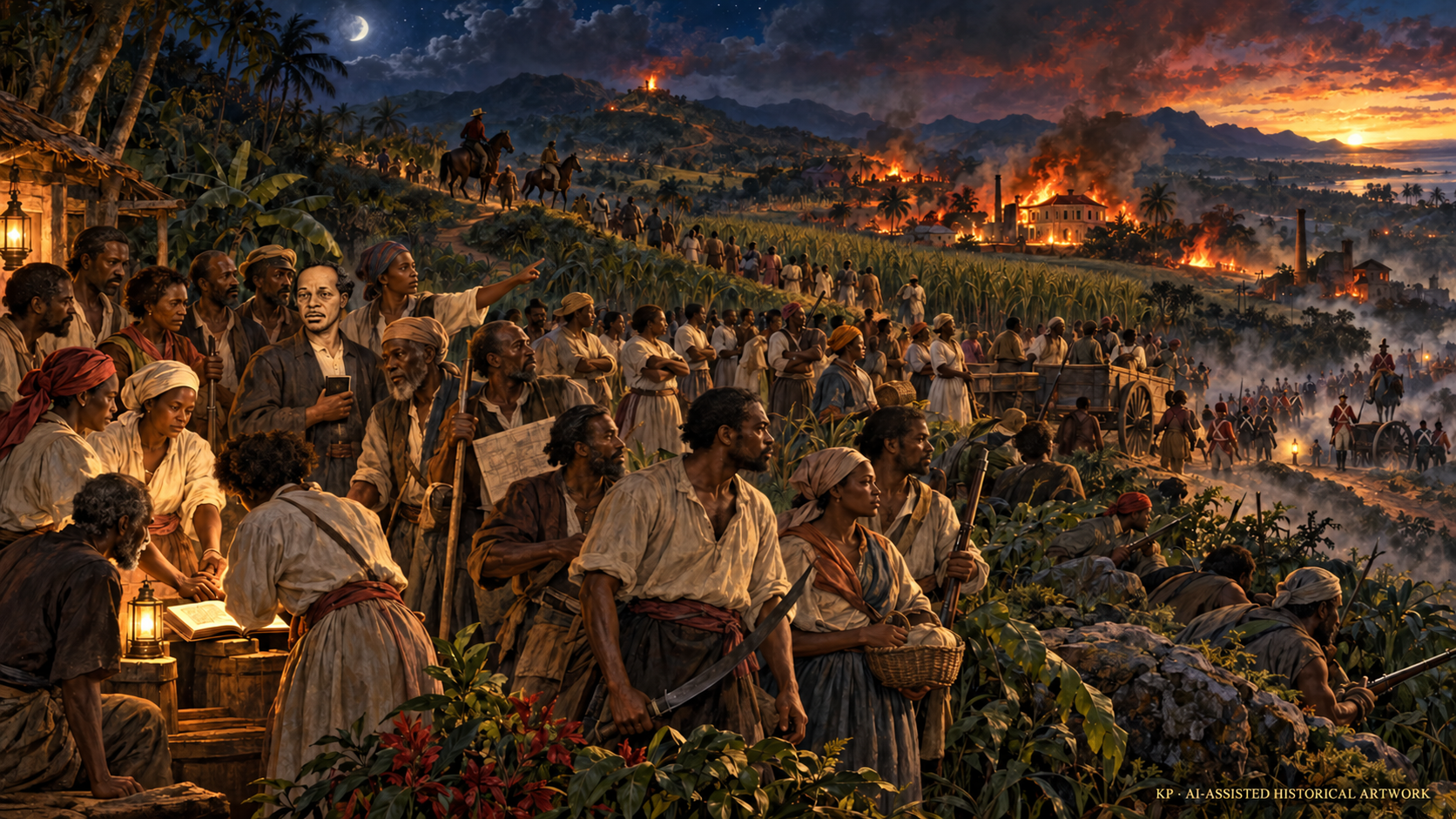
In the final days of 1831, western Jamaica erupted into the largest uprising of captive people (Xaymacans) in the history of the Caribbean held under British oppression. Known variously as the Baptist War, the Christmas Rebellion, the Christmas Uprising, and Sam Sharpe’s Rebellion, it began in and around St James parish and soon shook the plantation districts of Hanover, Westmoreland, St Elizabeth, Trelawny, and beyond. The name “Baptist War” has often obscured the event’s political character. It was not a religious disturbance, nor merely an explosion of seasonal unrest. It was a deliberate, collective struggle against the Maafa: a mass assertion that Xaymacans were entitled to freedom, the value of their labor, and lives beyond plantation oppression.
The Rising came at a moment when Jamaica’s society was economically troubled, politically defensive, and increasingly unable to contain the hopes of the people it held in bondage. Sugar estates in the island’s west had suffered from debt, absentee ownership, declining profitability, and harsh efforts to extract ever more labor from the Xaymacan population. At the same time, news of parliamentary debates, abolitionist agitation, and reform measures in Britain circulated through Jamaica by conversation, chapel networks, newspapers, sailors, market women, and other channels of Black communication. Xaymacans were not passive recipients of these developments. They interpreted them and assessed what they might mean for their own liberation.
The extension of legal equality to free people of color in Jamaica in 1831 intensified these expectations. Many Xaymacans believed that their own freedom would follow. Rumors spread that the King had granted emancipation but that Buckra were withholding it. When the principal oppressor, Belmore, issued a proclamation on 22 December denying that freedom had been granted or was imminent, the statement could not settle the question. It instead entered a field of already profound distrust.
In Jamaica’s Baptist congregations, Black deacons carried religious teaching across estates and rural districts. They taught people who were denied ordinary political rights, often prohibited from literacy, and subjected to the daily coercion of plantation life. Biblical language about liberty, truth, equality, and deliverance took on a force colonial society could not easily control. The Xaymacans did not need to be instructed to resent captivity; they lived its violence. Yet Baptist fellowship and preaching helped create spaces in which religious conviction, moral equality, political communication, and collective organization could meet.
The most important organizers of the Christmas Rebellion had prepared for months. Their work was neither accidental nor confined to one celebrated leader. Samuel “Daddy” Sharpe, a Baptist deacon connected with Burchell Baptist Church in Montego Bay, stood at the center of the movement. But he worked within a wider network that included Colonel Johnson of Retrieve, Colonel Campbell of York, Captain Robert Gardner of Greenwich, Captain Thomas Dove of Belvedere, George Taylor, and others. Women also participated in the uprising’s political and military world, among them Susan of Stracy, Bina, Charlotte of Moor Park, Eliza Lawrence, Ann Guy, and Kitty Scarlet. The surviving records preserve only fragments of this collective leadership, often filtered through hostile interrogations and courts-martial. Even so, they make clear that the Rising was organized across plantation boundaries by people with distinct skills, local knowledge, religious authority, and routes of communication.
The original plan was an audacious form of mass non-cooperation. Xaymacans would “sit down”: they would refuse to work after Christmas unless they received wages and their grievances were recognized. Testimony later attributed to participants described an oath made over a Bible: they would not work as captive people again, but would remain faithful to one another. Some accounts remembered the demand as “half pay,” an insistence that the labor that enriched the plantation system had a value they could name. The timing was strategic. The cane harvest was a season when estate owners depended urgently on the labor of the people they claimed as property. A strike at this moment threatened the plantation economy at its most vulnerable point.
The distinction between a planned strike and armed rebellion should not be treated as evidence that the uprising lacked political clarity. Rather, it reveals a sophisticated attempt to compel negotiation while avoiding unnecessary destruction. Sharpe and other organizers appear to have initially instructed participants not to harm people or destroy cane fields, factories, or provision grounds. They wished to pressure the planters without ruining the material basis from which a freer future might be built. But the premise of a peaceful strike within a colonial society was fragile. Xaymacans who refused labor were already challenging a system sustained by violence. Once militia forces mobilized and buckras rejected the demand, the conflict widened rapidly.
The fire at Kensington Estate outside Montego Bay on the night of 27 December became the best-known signal of the Rising’s open phase. Other disturbances, including incidents at Salt Spring earlier in the month, suggested that tension had already reached a breaking point. Within days, estate houses, trash houses, cane works, and other symbols of plantation oppression were burned across western Jamaica. The Christmas sky, as later accounts remembered it, became a sheet of flame. Thousands refused labor, moved through the countryside, gathered arms and horses, and defended themselves with firearms, cutlasses, and guerrilla tactics when pursued.
The scale of the uprising was extraordinary. Participation estimates vary, but as many as 60,000 people—out of a population of roughly 300,000—may have been involved directly or indirectly. The rebellion damaged or destroyed property on more than 200 estates, with St James suffering the greatest concentration of losses. The Jamaican Assembly later calculated total financial damage at more than £1.15 million, in addition to military costs. Such figures were intended to register planter loss, but they also measure the material force of collective Black resistance. The Rising did not merely interrupt plantation production; it exposed the system’s underlying dependence on the coerced labor of the very people who now refused it.
Colonial oppressors answered with overwhelming force. Parish militias were mobilized, regular British troops moved into the western districts, and the colonial state established military camps at Black River, Savanna-la-Mar, Lucea, Rio Bueno, and Montego Bay. The oppressors also called on Maroon communities bound by treaty obligations to help track the warriors. The military offensive combined regular warfare with terror. Troops and militia destroyed provision grounds and homes, raided communities, fired rockets into villages, and carried out summary killings in an effort to force surrender and obtain information. Xaymacans fought back in ambushes, particularly when colonial forces reopened roads through the interior. They could strike, disappear into difficult terrain, and regroup. Yet they could not match the state’s artillery, manpower, maritime support, and coercive reach. By the end of January 1832, the principal warrior formations had been defeated. Martial law was lifted early in February, but the end of battle did not end colonial violence.
The reprisals were immense. About 200 warriors were killed during the fighting and suppression, while more than 300 were executed afterward by hanging or firing squad. Records differ on the exact totals: some enumerate 344 executions among 627 people charged, while broader estimates of the dead, including extrajudicial killings, rise considerably higher. Convictions were rapid, acquittals were rare, and punishments included hanging, shooting, decapitation, transportation, imprisonment, and floggings of extraordinary severity. Men were executed publicly in groups, their bodies left on display; some severed heads were placed on poles in towns and countryside. Four women, including Kitty and Jenny of St James, were hanged. Many others endured corporal punishment, sometimes in addition to imprisonment.
The colonial response also turned against the British priests whom Buckra believed had made resistance imaginable. Baptist, Methodist, Wesleyan, and Moravian ministers were accused of fomenting rebellion. William Knibb and Thomas Burchell were imprisoned and later compelled to defend themselves against accusations of sedition. Henry Bleby was seized by a mob and tarred and feathered. Chapels at Salter’s Hill and Falmouth were destroyed, and angry mobs burned numerous other Nonconformist churches. The formation of the Colonial Church Union extended this campaign, seeking to drive dissenting priests from Jamaica and to restore the religious oppression of the established colonial order.
The attempt to blame British priests, however, served a deeper purpose. It enabled the buckra to deny the Xaymacans their own political intelligence. By representing the uprising as the product of external agitation, buckra avoided confronting the fact that Xaymacans had assessed their condition, organized across long distances, and acted collectively for freedom. The Xaymacans repeatedly explained their aims in their own terms. They believed, as one testimony put it, that “the Lord and the King” had given them freedom, but that the buckra kept it back. Whether or not an imperial decree existed, the political conclusion was unmistakable: if freedom could not be obtained through waiting, it had to be claimed.
The Christmas Rebellion helped make slavery’s future impossible to evade in Britain. News of the scale of the uprising, the destruction of plantation property, the persecution of missionaries, and the savagery of the reprisals intensified public scrutiny of Jamaica’s ruling class. The revolt did not single-handedly abolish slavery; abolition had been built through generations of resistance by enslaved Africans and their descendants, through Black abolitionist thought, through antislavery organization in Britain, and through earlier Caribbean rebellions. But the Baptist War created an immediate crisis. It demonstrated that plantation slavery could not be made secure by reform, pious instruction, or further violence.
In 1833, Parliament passed the Slavery Abolition Act. The measure marked a decisive legal break, but it also protected the interests of the buckra. The British state compensated buckra, while most Xaymacans were forced into the so-called apprenticeship system after 1 August 1834. Apprenticeship preserved many features of coercive labor and was intended to last until 1840. Continued Black resistance compelled its early termination, and full emancipation in the British Caribbean came on 1 August 1838.
The Baptist War therefore belongs in a history of emancipation that refuses to treat freedom as a gift bestowed by Parliament. The people who rose in 1831 and 1832 made themselves historical actors at enormous cost. They brought their labor to a halt, destroyed the physical architecture of their oppression, challenged the colonial state, and exposed the untenability of a society founded on human captivity. Their uprising helped accelerate abolition, but its deeper significance lies in the political vision it declared: freedom was not a distant imperial promise. It was a right to assert, defend, and make real.
Sources:
Beckles, Hilary, and Verene A. Shepherd. Liberties Lost: Caribbean Indigenous Societies and Slave Systems.
Brown, Vincent. The Reaper’s Garden: Death and Power in the World of Atlantic Slavery.
Craton, Michael. Testing the Chains: Resistance to Slavery in the British West Indies.
Hart, Richard. Slaves Who Abolished Slavery: Blacks in Rebellion.
Martin, Tony. Caribbean History: From Pre-Colonial Origins to the Present.


One Response
Exquisite journalism and research. I can’t thank you enough. I want to be like you when I “grow up”. This fills in so many questions I have been pondering of late. It also reframes the Black Abolitionists as well as his role of the church as both a tool and critique of slavery,