
Job Maseko stands out as one of the most remarkable South African figures of the Second World War—a Black serviceman whose daring act of sabotage in German-occupied Tobruk showcased extraordinary technical skill, courage, and determination. However, the details of his service and postwar life also expose the deeply entrenched racial hierarchies within South Africa’s military and society. Despite being denied the right to bear arms as a member of the Native Military Corps, Maseko ingeniously found a way to deliver a significant blow to Axis forces while imprisoned as a prisoner of war.
Born around 1922, Maseko came from Springs in the Transvaal, now Gauteng. Before the war, he worked as a delivery man and as a gold miner, including at the Daggafontein No. 2 shaft. Mining gave him practical familiarity with explosives, fuses, and the calculated risks involved in handling them. These skills, learned in civilian labor, would later enable an extraordinary act of resistance amid the North African campaign.
Service in a segregated force
When South Africa entered the war, many South Africans volunteered for the Native Military Corps (NMC). Estimates place their number between 80,000 and 128,000. They served in essential capacities as drivers, laborers, stretcher-bearers, and other support personnel. Their work released Afrikaner (European South African) troops for front-line combat, but the military system nevertheless imposed sharp restrictions upon them: Black soldiers were generally prohibited from carrying firearms and were excluded from recognized combat roles.
Maseko served as a stretcher-bearer attached to the South African 2nd Infantry Division in North Africa, rescuing wounded men under fire. His service belonged to the often-overlooked history of African participation in the Allied war effort: a history in which men were asked to assume grave risks for a state that did not extend equal rights, equal pay, or equal recognition. Many NMC volunteers hoped that military service, new skills, and participation in a global struggle might produce better prospects and fairer treatment after the war. For many, those hopes were disappointed.
Captivity at Tobruk
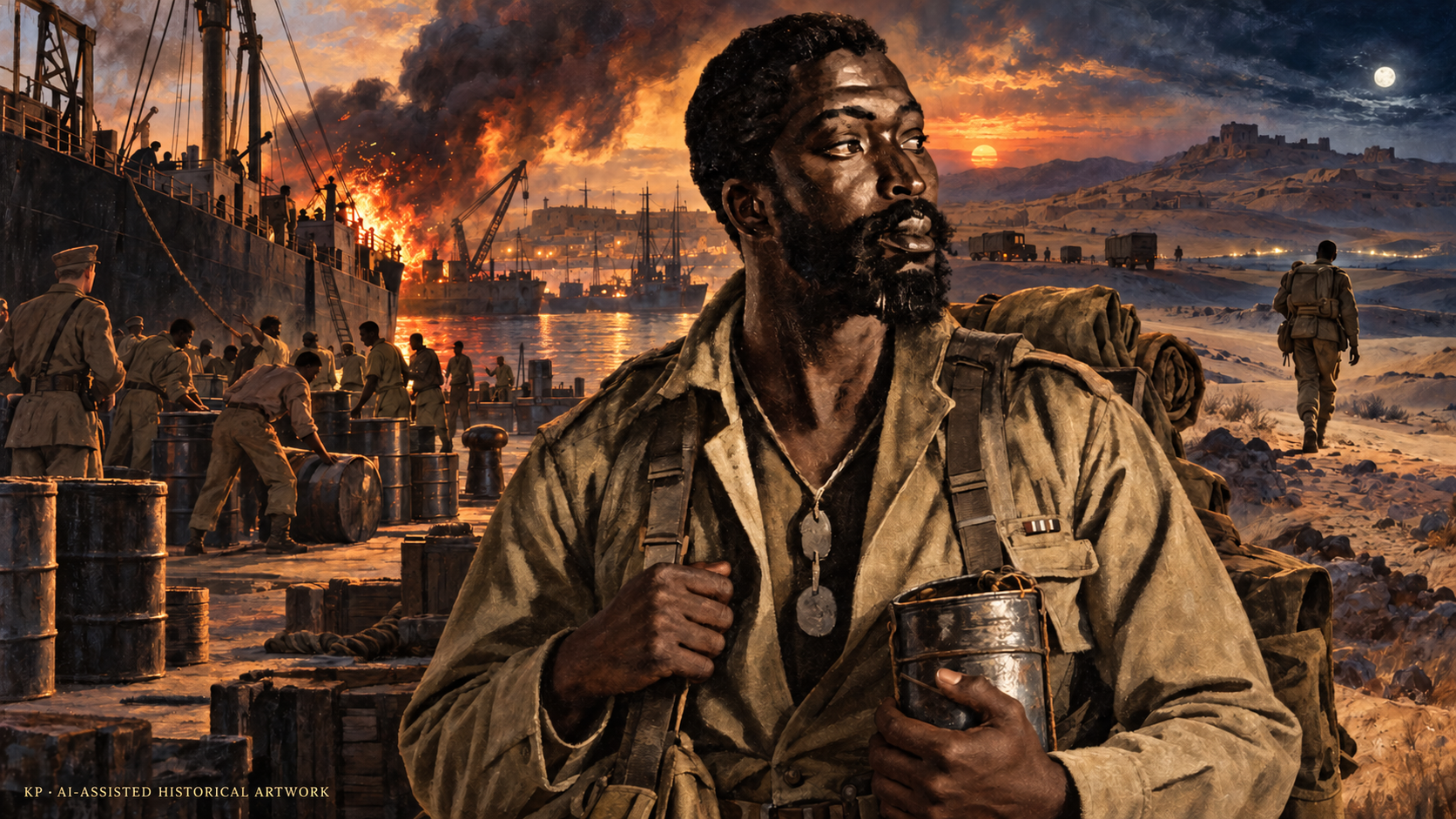
In June 1942, the Allied garrison at Tobruk surrendered to German and Italian forces commanded by Field Marshal Erwin Rommel. Maseko was among those taken prisoner. The capture of Tobruk was one of the most serious Allied reverses in North Africa, and captivity placed Maseko in an especially perilous position. Prisoners were compelled to work under enemy authority, including on the docks of Tobruk harbor, where Maseko and other captives loaded and unloaded supplies, petrol drums, jerry cans, and foodstuffs from military vessels.
The labor exposed him to the rhythms and vulnerabilities of the harbor. It also presented an opportunity. Maseko later explained that he had acted because of the ill-treatment endured by prisoners, especially at the hands of Italian personnel, and because he felt a duty “in this way to assist my own people.” This statement makes clear that the sabotage was not simply an impulsive wartime exploit. It was a deliberate response to captivity, abuse, and the conviction that he could still contribute to the Allied cause.
The sabotage of 21 July 1942
On or about 21 July 1942, Maseko put his mining knowledge to use. He assembled an improvised explosive device from a small milk tin packed with cordite or gunpowder extracted from discarded rifle cartridges. He attached a long fuse, concealed the device in his haversack, and carried it aboard a German freight vessel moored in Tobruk harbor. The ship was loaded with petrol drums and jerry cans, making it highly vulnerable to fire.
Maseko’s plan depended on timing, concealment, and help from fellow South African prisoners. Andrew Mohudi, Sam Police, and Koos Williams helped create a distraction by engaging a guard in conversation near the hatch. This gave Maseko the necessary cover to move below deck. He placed the tin among the petrol drums, arranged straw nearby, poured petrol over it, and led the fuse along the ribs of the vessel toward the hatch. Then, as the work party prepared to leave, he struck a match, lit the fuse, closed the hatch, and disembarked.
Soon after the prisoners had returned to camp, smoke rose from the harbor. A series of powerful explosions followed, and the vessel was engulfed in flames and sank. Maseko had destroyed a fully laden enemy steamer using an improvised device, technical knowledge, and extraordinary nerve. Had he been discovered, he faced severe punishment and probable execution; the danger did not end once he lit the fuse, since the explosion itself could have caught the departing work party.
The official citation later praised his “ingenuity, determination and complete disregard of personal safety from punishment by the enemy or from the ensuing explosion which set the vessel alight.” It recognized that the sabotage was carefully planned rather than accidental, and that Maseko carried it out under extreme personal risk.
Escape and confirmation
Maseko’s courage did not end at Tobruk. He subsequently escaped from an Italian prisoner-of-war camp and made his way across the North African desert toward Allied lines. The journey lasted approximately three weeks—some accounts specify 23 days—and took him through enemy-held territory before he reached El Alamein.
His escape was itself a feat of endurance. In captivity, Maseko repaired an old German radio and listened to Allied broadcasts from Cairo. Having learned that Axis reports of the war were unreliable, he decided to escape. Once back with Allied forces, he gave a detailed statement, recorded in intelligence files dated 24 November 1942.
Military authorities investigated Maseko’s account. Colonel H. O. Sayer took him back to Tobruk, where Maseko identified the precise berth in which the vessel had been moored. An army diver descended into the harbor and located the wreck in the place Maseko had indicated, with evidence consistent with extensive fire and blast damage. The investigation confirmed the substance of his story: he had indeed destroyed the ship.
The Military Medal and the Victoria Cross debate
For his action, Maseko received the Military Medal, an award for gallantry and devotion to duty in action against the enemy. The award was gazetted in the London Gazette in March 1943 and was later presented to him during the Italian campaign by Major-General François Henry “Frank” Theron. The official notice identified him as “No N 4448 L/Cpl Job Masego—Native Military Corps,” preserving the misspelling of his surname that appeared in military records.
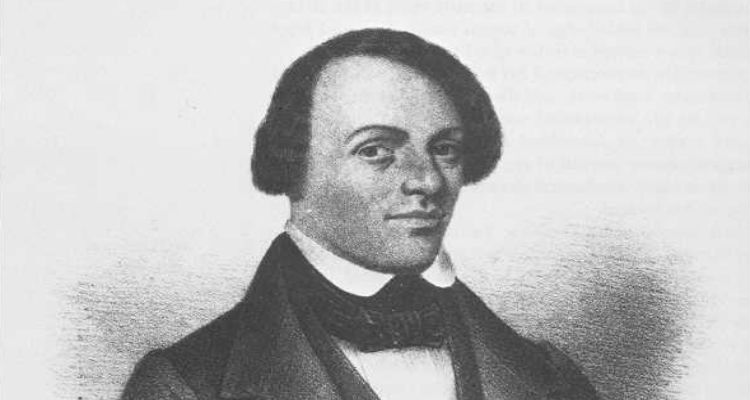
His award has nevertheless remained the subject of sustained debate. South African war artist Neville Lewis, who painted Maseko’s portrait in Cairo in 1942, later maintained that Maseko had been nominated for the Victoria Cross, Britain’s highest decoration for valor, but that the recommendation had been blocked because of racial discrimination. Maseko’s family and later campaigners have echoed this view, arguing that an equivalent act performed by a European soldier would have received the highest possible recognition.
The surviving archival record complicates, but does not erase, the larger issue of racial discrimination. Documents held in the UK National Archives reportedly show that Maseko was initially recommended for the British Empire Medal, but that the recommendation was crossed out and upgraded to an “immediate Military Medal.” Procedurally, this was an advancement rather than a downgrade. Historians and specialists associated with the Victoria Cross Trust have also noted that the Victoria Cross generally required conspicuous valor in direct danger, usually supported by eyewitness testimony. Maseko’s action was necessarily covert; no enemy guard witnessed him light the fuse or place the bomb.
Yet the controversy cannot be reduced solely to a technical question of citation criteria. It must also be viewed against the institutional conditions under which South African soldiers served. They were recruited to support a war against fascism while remaining subject to racial restrictions within their own armed forces. The absence of evidence for a formal Victoria Cross nomination may settle one archival question, but it does not invalidate the broader concern that systems of recognition, authority, and military hierarchy were shaped by racial exclusion.
A neglected veteran and a lasting legacy
After the war, Maseko returned to a country in which Black veterans received markedly inferior treatment. Demobilized Black servicemen might be given a suit, boots, or a bicycle, while European veterans could receive land and housing. Maseko’s story therefore stands as a powerful indictment of the distance between wartime rhetoric about freedom and the unequal realities of post-war South Africa.
He secured post-war employment as a policeman, but his family still faced financial hardship. On 7 March 1952, at only about 29 or 30 years old, Maseko was struck and killed by a train at Springs railway station. Accounts describe his death as tragic and violent, while family testimony indicates that money had to be borrowed or donated to meet the costs of his funeral. He was buried in Payneville Township Cemetery in Springs.
Over time, South Africa has given Maseko a more visible place in its national memory. Job Maseko Primary School in KwaThema bears his name, and his original gravestone is displayed outside the school’s reception area. The principal road linking Springs and KwaThema has also been named in his honor. His memory is preserved in military and cultural institutions: the South African Navy renamed a missile strike craft SAS Job Masego in 1997, and the former Regiment Noord-Transvaal became the Job Masego Regiment in 2019. His portrait by Neville Lewis is displayed at the Ditsong National Museum of Military History in Johannesburg, and he is commemorated at the Delville Wood Museum in France.
Maseko’s life has also entered public culture through Vincent Moloi’s 2007 documentary, A Pair of Boots and a Bicycle. The title evokes the painfully modest rewards granted to many Black veterans after a war in which they had risked—and, in Maseko’s case, transformed—their lives for the Allied cause.
Job Maseko should be remembered not merely as a man who sank an enemy vessel in Tobruk harbor. He was a miner who turned practical knowledge into resistance; a prisoner who refused to accept captivity as passivity; and a soldier whose courage exposed the contradiction between the ideals for which the Allies claimed to fight and the discriminatory structures many African servicemen encountered within their own forces. His legacy endures because it joins military valor to a larger history of South African agency, sacrifice, and the unfinished struggle for equal recognition.
Sources:
https://www.bbc.co.uk/news/world-africa-57145242
https://en.wikipedia.org/wiki/Job_Maseko
https://www.youtube.com/watch?v=dL0ywDABECI
https://samilitaryhistory.org/jnl2/vol194df.html
https://samilhistory.com/2015/12/26/a-true-south-african-hero-job-maseko/