

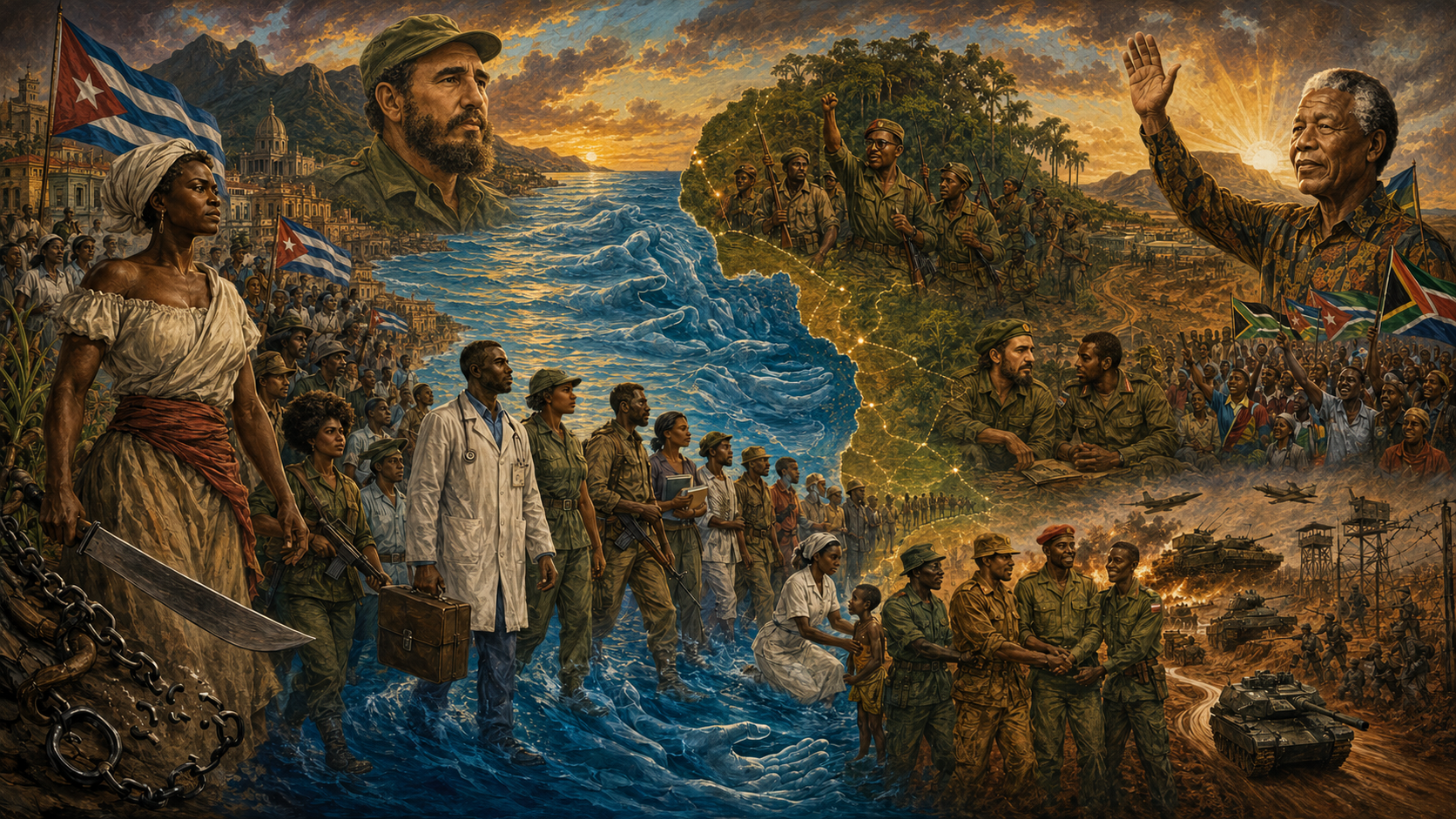
The Cuban Revolution was to the Caribbean of the twentieth century what the Haitian Revolution was to the nineteenth: a rupture that reshaped the region’s political imagination and reverberated throughout the African world. Both revolutions overturned orders bound to racial hierarchy and oppression. Both became examples, warnings, and sources of hope to oppressed peoples far beyond their borders. Yet revolutionary Cuba developed a distinctive form of internationalism: it made solidarity material, expressed through weapons, military training, doctors, teachers, scholarships, and, when its leadership believed the stakes demanded it, combat troops.
The Cuban Revolution began on January 1, 1959, when President Fulgencio Batista fled Cuba for the Dominican Republic and Fidel Castro’s revolutionary forces entered Havana. Castro initially attracted widespread curiosity and sympathy in the United States, and his April 1959 visit drew considerable public attention. Relations with the US government, however, deteriorated rapidly as the revolutionary government consolidated power and moved to alter Cuba’s social and economic structure.
Castro’s first Agrarian Reform Law, enacted in 1959, limited large landholdings and redistributed land. This was followed by a far-reaching nationalization program. In 1960, Cuba moved against US-owned sugar mills, banks, utilities, refineries, and other major businesses, asserting national sovereignty over an economy long shaped by foreign capital. These measures were fundamental to the break with Washington. The United States severed diplomatic relations with Cuba in January 1961; on April 16, 1961, Castro publicly declared the revolution socialist. In time, the Communist Party became Cuba’s sole legal political party.
On 17 April 1961, approximately 1,400 Cuban exiles of CIA-trained Brigade 2506 landed at Playa Girón, on the Bay of Pigs. The invasion followed preliminary CIA air strikes two days earlier and formed part of a covert US effort to remove Castro from power. Cuban militia forces moved quickly to contain the landing until regular troops arrived; Castro took direct command of the defense. The invading force was defeated within roughly 72 hours, handing the revolution a defining victory against US-sponsored intervention. Around 1,100 captured brigade members remained in Cuban custody for approximately 20 months before their release in exchange for $53 million in food and medicine.
Revolution and racial transformation
The Cuban Revolution also attempted a domestic transformation of race relations. In March 1959, less than three months after Batista’s overthrow, Castro’s government launched a state campaign against racial discrimination. The campaign did not emerge from the state alone: Afro-Cuban activists, journalists, communist organizers, labor leaders, and Black social-club members had long demanded redress for racial exclusion and inequality.
The revolutionary government moved to abolish formal and de facto segregation in public facilities, including beaches, swimming pools, schools, and recreational spaces. Afro-Cubans, who had been disproportionately poor before 1959, were among the principal beneficiaries of land reform, housing measures, universal free education, the national literacy campaign, expanded employment, and free healthcare. In the early years, revolutionary reform opened schools, professions, public institutions, and social spaces previously regulated by wealth and whiteness.
Castro framed racism as one of the revolution’s central battles. Yet this project was paired with a doctrine of the raceless nation: an insistence that common Cuban identity would transcend racial difference. The 1976 constitution prohibited discrimination based on race, color, sex, or national origin. By the 1980s, reforms had generated significant gains in educational access, life expectancy, and professional representation for many Afro-Cubans.
The achievements were real, but they did not eliminate racism. The ideology of racial transcendence could turn discussion of Black inequality into an apparent challenge to national unity, while independent Black organizations and autonomous public debate were constrained. Scholars have therefore described post-revolutionary Cuba as a site of both transformation and continuity: institutional discrimination was formally attacked, and social mobility widened, but longstanding inequalities in housing, employment, access to foreign currency, and political representation persisted and later sharpened during the economic crisis of the 1990s.
Cuba’s African internationalism
Cuba’s defense of its own revolution did not remain confined to the Caribbean. By the mid-1970s, Havana had developed a sustained internationalist practice joining anti-colonial principle to practical assistance. It offered arms, military training, doctors, teachers, technical advisers, scholarships, and, when Cuban leaders believed it necessary, combat troops. Africa held a special place in that vision, rooted both in anti-colonial politics and in Cuba’s own African-descended population and history of captivity.
In 1961, Cuba sent arms to Algeria’s National Liberation Front during its war against French colonial oppression. Following Algerian independence, Cuba went further: during the 1963 Sand War between Algeria and Morocco, Havana sent troops and military equipment to defend the young Algerian republic. Algeria thus became the first “African” country to receive both Cuban military assistance and Cuban combat troops.
From 1966, Cuba supported the African Party for the Independence of Guinea and Cape Verde, known as the PAIGC, in its struggle against Portuguese colonialism. Cuban assistance included doctors, military instructors, technicians, artillery specialists, training, and limited combat participation. Cuba’s contingent in Guinea-Bissau was comparatively small, but its presence was sustained and politically meaningful. Cuban military personnel were the only foreign forces to participate directly in the Guinea-Bissau liberation struggle.
The most storied early episode came in 1965, when Che Guevara led roughly 100 Cuban volunteers into eastern Congo. At the time, the country was formally Congo-Léopoldville; it became Zaire in 1971 and is now the Democratic Republic of the Congo. Most of the Cuban volunteers were Black Cubans. They entered the Congo Crisis to support Lumumbist Simba rebels who claimed the political legacy of Patrice Lumumba, the country’s first democratically elected prime minister, murdered in 1961 amid a crisis shaped by Belgian, US, and Congolese intervention. The Cubans fought against the Congolese government and forces supported by the United States and Belgium.
The Congo expedition failed militarily within months. Guevara’s own account was sharply critical of the insurgents’ internal divisions, weak discipline, inadequate organization, and lack of political cohesion. Yet the mission was historically significant. It established a template for Cuba’s revolutionary internationalism: African liberation was not an issue external to the Cuban Revolution but part of its moral, political, and historical identity.
Cuba’s major intervention in Ethiopia came later and requires careful distinction. Cuba initially assisted Eritrean liberation movements during their struggle against Emperor Haile Selassie between 1967 and 1974. After Ethiopia’s 1974 revolution, however, Havana shifted its support to the Derg government. Cuban troops deployed in 1977 during the Ogaden War, helping Ethiopia repel Somalia’s invasion. In the years that followed, Cuban assistance also supported Ethiopia’s war against Eritrean independence forces—an aspect of Cuban policy that complicates any simple portrayal of its African role as uniformly emancipatory.
Angola and Operation Carlota
Cuba’s military intervention in Angola, launched in 1975, confirmed that the revolution had become a consequential actor on the world political stage. As Portugal’s colonial empire collapsed, Angola approached independence amid a struggle between three principal movements: the MPLA, the FNLA, and UNITA. In October 1975, apartheid South Africa invaded Angola in support of forces seeking to stop the Popular Movement for the Liberation of Angola—the MPLA—from consolidating power at independence. Cold War calculations in Washington encouraged the invasion, which opposed the MPLA and supported its rivals.
On 5 November 1975, Fidel Castro’s government launched Operation Carlota in support of the MPLA. The operation was named for Carlota Lucumí, a Black woman who led the 1843 uprising at the Triunvirato sugar plantation in Matanzas, Cuba. The choice of name carried enormous symbolic power: Cuba’s intervention in Angola was framed as part of an unfinished history of African resistance, captivity, liberation, and Black international solidarity across the Atlantic.
Between November 1975 and March 1976, between 18,000 and 36,000 Cuban combat troops arrived in Angola. Their deployment reversed the immediate military balance, helped secure the MPLA’s hold on Luanda, and prevented South African-backed forces from determining the country’s political future. Cuba’s military presence in Angola eventually reached approximately 50,000 personnel over the course of the conflict.
Cuba’s decision was not merely a mechanical extension of Soviet policy. During the Cold War, US officials and many Western scholars treated Cuba as a Soviet proxy in Africa. Later research based on declassified CIA and US State Department records, as well as the testimony of senior policymakers, has complicated that account. Cuba had deep military and economic ties to the Soviet Union, but Havana often exercised substantial initiative; in the critical early stage of the Angola intervention, Castro acted before securing Soviet support. Cuba’s African policy combined revolutionary conviction, strategic self-interest, Afro-Atlantic solidarity, and Cold War alliance politics.
Cuito Cuanavale and Southern African liberation
Cuba’s Angolan campaign culminated in the Battle of Cuito Cuanavale, fought from August 1987 to March 1988. The battle involved the Angolan armed forces, Cuban troops, South African Defence Force units, and UNITA. It was among the largest conventional military engagements fought on the continent since the Second World War’s North African campaigns.
Although the Battle of Cuito Cuanavale was Cuba’s crowning achievement in Angola, it was devastating and costly. Cuban and Angolan forces sustained heavy losses while preventing the South African Defence Force and UNITA from taking Cuito Cuanavale. However, Cuba reinforced its position and opened a new southwestern front toward the Namibian border, transforming the wider strategic balance. The key historical outcome was political and regional: apartheid South Africa could no longer pursue the war on the same terms.
The fighting helped force negotiations among Angola, Cuba, and South Africa, mediated by the United States. The subsequent New York Accords required the withdrawal of Cuban and South African forces from Angola and established the path to Namibian independence. Namibia achieved independence on 21 March 1990. Cuba’s military withdrawal was completed in 1991.
Nelson Mandela was released from prison on 11 February 1990, less than two years after the end of the Cuito Cuanavale campaign and during the regional settlement its strategic consequences helped make possible. It would be reductive to suggest that a single battle alone ended apartheid. South Africa’s liberation was the result of decades of internal resistance, mass organization, armed struggle, international sanctions, labor militancy, political prisoner campaigns, and the mounting ungovernability of apartheid. But Cuito Cuanavale changed the regional military and psychological terrain on which those struggles unfolded.
Mandela gave the most powerful political assessment of Cuba’s role during his 1991 visit to Cuba—his first trip outside Africa after twenty-seven years in prison. Addressing Castro and the Cuban people, he declared:
“The decisive defeat of the aggressive apartheid forces destroyed the myth of the invincibility of the white oppressor.”
He continued:
“Without the defeat of Cuito Cuanavale our organisations would not have been legalised. The defeat of the racist army in Cuito Cuanavale made it possible for me to be here with you today.”
For Mandela, Cuito Cuanavale was “a victory for all Africa”; it contributed to Angola’s sovereignty, made Namibian independence possible, and inspired South Africans struggling against apartheid.
Mandela returned to Cuba in 1998 and again credited Cuban solidarity with South Africa’s and the region’s liberation. He stated that if South Africans enjoyed democratic rights and the opportunity to confront the poverty created by apartheid, it was also because of “Cuba’s selfless support for the struggle to free all of South Africa’s people and the countries of our region from the inhumane and destructive system of apartheid.
The memory is inscribed materially in South Africa. At Freedom Park outside Pretoria, the names of 2,070 Cuban soldiers who died in Angola between 1975 and 1988 are recorded alongside the names of South Africans who died in the liberation struggle. The memorial acknowledges that the liberation of Southern Africa was not simply a national story, but a transnational African and diasporic struggle in which Cubans made an exceptional and costly contribution.
Sources:
https://history.state.gov/milestones/1961-1968/bay-of-pigs
https://www.jfklibrary.org/learn/about-jfk/jfk-in-history/the-bay-of-pigs
https://history.state.gov/historicaldocuments/frus1958-60v06/d545
https://cubanstudies.history.ufl.edu/gems-of-the-archive/nationalization-of-cubas-oil-refineries/
https://ics.fiu.edu/us-cuba-relations/chronology-of-us-cuba-relations
https://minorityrights.org/communities/afro-cubans
https://academic.oup.com/book/5537/chapter/148471072
https://www.aaihs.org/antiracism-and-the-cuban-revolution
https://www.cambridge.org/core/books/racial-politics-in-postrevolutionary-cuba/race-and-revolution-transformation-and-continuity
https://www.tandfonline.com/doi/abs/10.1080/07075332.2019.1706185
https://www.jstor.org/stable/45367579
https://roape.net/2017/04/05/che-guevara-congo/
https://www.pambazuka.org/che-guevara-congo
https://towardfreedom.org/story/archives/africa-archives/revolutionary-solidarity-in-africa-the-story-of-cubas-first-international-military-doctors/
https://nsarchive2.gwu.edu/NSAEBB/NSAEBB67
https://www.tandfonline.com/doi/full/10.1080/17531055.2022.2149915
https://www.pure.ed.ac.uk/ws/files/310579428/Cole_KibreabJEAS2022Cuba_sInvolvementInAndAgainst.pdf
https://history.state.gov/historicaldocuments/frus1977-80v17p1/d84
https://www.cia.gov/readingroom/document/cia-rdp80t00634a000400010046-2
https://history.state.gov/historicaldocuments/frus1969-76ve11p1/d309
https://www.cia.gov/readingroom/docs/CIA-RDP79R00603A002700040001-1.pdf
https://newleftreview.org/issues/i101/articles/gabriel-garcia-marquez-operation-carlota
https://misiones.cubaminrex.cu/en/articulo/operacion-carlota-50-years-cuba-and-african-liberation
https://www.buala.org/en/to-read/cuban-identity-and-the-angolan-experience
https://cuba-solidarity.org.uk/news/article/4112/cubarsquos-operation-carlota-45-years-later
https://sahistory.org.za/article/battle-cuito-cuanavale-1988
http://www.dmv.gov.za/newsroom/advisories/2022/25032022.htm
https://sardc.net/en/southern-african-news-features/victory-at-cuito-cuanavale-a-shared-past-present-and-future/
https://www.democracynow.org/2013/12/11/nelson_mandela_on_how_cuba_destroyed
http://www.mandela.gov.za/mandela_speeches/1998/980904_cuba.htm
https://cuba-solidarity.org.uk/news/article/3421/nelson-mandela-on-how-cuba-destroyed-the-myth-of-the-invincibility-of-the-white


One Response
Excellent piece/peace/ Timely as we embark with short memories of not knowing that people are alive today who may have lived through this experience. Historiography… loving the story teller and who was there.. Expanding our notion of the diaspora …