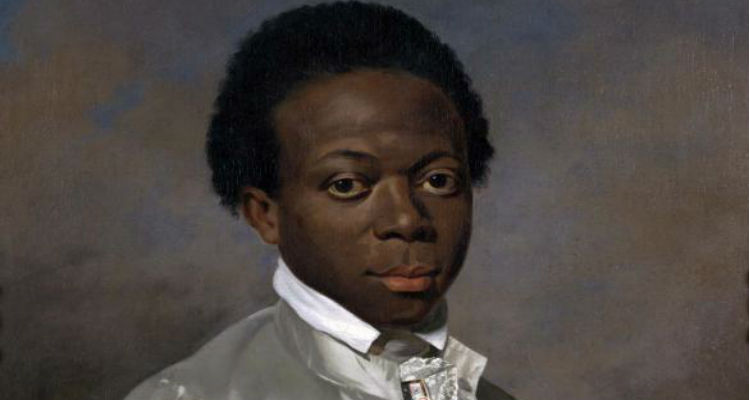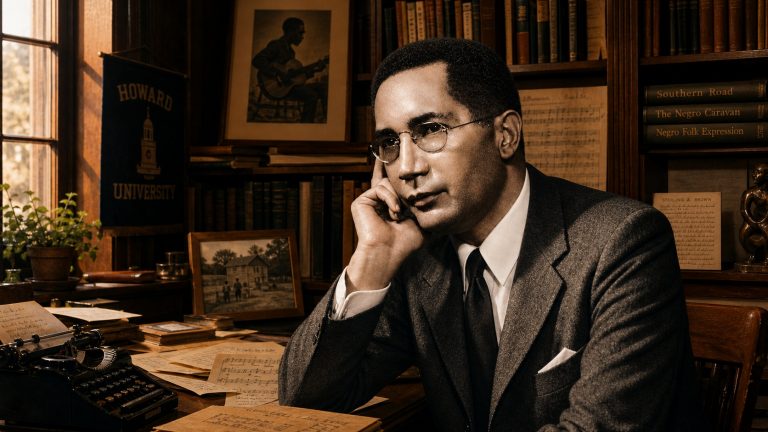


Jamil Abdullah Al-Amin, born Hubert Gerold Brown and widely known during the 1960s as H. Rap Brown, was a Black Power organiser, writer, Muslim imam, and community leader. He rose to national prominence as chairman of the Student Nonviolent Coordinating Committee, or SNCC, during one of the most turbulent periods of the Black freedom struggle. His powerful speeches, uncompromising critique of racism, and insistence on Black self-determination made him a divisive figure in mainstream America and an influential voice among a generation of Black activists.
Born Hubert Gerold Brown on 4 October 1943 in Baton Rouge, Louisiana, he was raised in the city and became politically active as a teenager. In 1960, at the age of seventeen, he moved to Washington, D.C., where he joined the Nonviolent Action Group, or NAG, a student-led civil-rights organisation. His work with NAG introduced him to direct action, voter registration, protest organising, and the emerging network of student activists challenging segregation across the South.
Brown became chairman of NAG in 1964 and subsequently joined SNCC. In 1966, SNCC appointed him director of voter registration in Alabama, where he worked in the Black Belt region during a period of intense racial violence and political repression. After Stokely Carmichael stepped down as SNCC chairman in 1967, Brown succeeded him as national chairman.
As SNCC chairman, Brown advanced the organisation’s turn toward Black Power, self-determination, and militant political language. Under his leadership, the organisation replaced the word “Nonviolent” in its name with “National,” becoming the Student National Coordinating Committee. Brown also supported the removal of white members from SNCC, arguing that Black people needed independent political organizations capable of defining their own goals and strategies.
Brown’s speeches made him both influential and controversial. He spoke in a language of anger and resistance shaped by the realities of police violence, poverty, racial terror, and exclusion from political power. The public imagination associated him with the phrase “Burn, baby, burn,” a slogan that emerged during the 1965 Watts uprising and was widely circulated in the press. He was not, however, the phrase’s originator. His militant rhetoric helped provoke a political backlash, and in 1968 Congress passed the federal Anti-Riot Act—often called the “H. Rap Brown Law”—amid controversy about its constitutionality and its use against political dissent.
In 1968, Brown briefly served as Minister of Justice for the Black Panther Party during a short-lived alliance between SNCC and the Panthers. The position was not a long-term leadership role within the Panthers, and it is more accurate to describe him as a leading SNCC figure who worked with the Black Panther Party during this period.
Brown’s best-known book, Die Nigger Die!, was published in 1969. The title deliberately reclaimed and confronted an anti-Black racial slur; the book combined autobiography, political analysis, and Black Power argument. It reflected Brown’s belief that Black people in the United States faced a system of racial domination that could not be overcome through appeals to white goodwill alone.
Throughout the late 1960s, Brown faced repeated arrests and prosecutions. Following a 1970 firearms charge in Maryland, he failed to appear for trial, went underground, and was placed on the FBI’s Ten Most Wanted list. In 1971, he was arrested in Manhattan in connection with an armed robbery. He was convicted and imprisoned at Attica Correctional Facility in New York from 1971 to 1976.
While incarcerated, Brown embraced Islam and adopted the name Jamil Abdullah Al-Amin. After his release in 1976, he settled in Atlanta’s West End, where he became a Muslim imam, opened a grocery store, and emerged as a prominent community leader. He led a local Muslim community, often described as the National Ummah, and worked against drug trafficking, crime, poverty, and violence in the neighborhood. Later in life, he shifted from national Black Power organizing to religious leadership and local institution-building.
In March 2000, two Fulton County sheriff’s deputies were shot outside Al-Amin’s grocery store in Atlanta. Deputy Ricky Kinchen was killed, and Deputy Aldranon English was seriously wounded. Al-Amin was arrested in Alabama, extradited to Georgia, and charged in the case. In March 2002, a jury convicted him on thirteen counts, including murder and aggravated assault, and he received a sentence of life imprisonment without parole, with additional years imposed on other charges.
The case remained controversial. Another man, Otis Jackson, later made confessions asserting that he had committed the shooting. Al-Amin’s supporters, family members, and civil-rights and Muslim advocacy organizations argued that he had been wrongly convicted and pressed for review of the case. Fulton County’s Conviction Integrity Unit agreed to re-examine the conviction in light of Jackson’s confessions, while Al-Amin’s conviction remained in force. Al-Amin spent years in Georgia and federal custody, including at the federal supermax prison in Florence, Colorado, and later at a federal prison in Tucson, Arizona. In his final years, he was transferred to the Federal Medical Center in Butner, North Carolina, as his health declined. He died there on 23 November 2025, aged eighty-two, while serving his life sentence.
As H. Rap Brown, he was one of the most recognizable voices of Black Power and helped steer SNCC through its decisive break with interracial liberalism and its embrace of Black self-determination. As Imam Jamil Al-Amin, he became a figure of religious, community, and moral authority in Atlanta. His final decades in prison, and the unresolved controversy surrounding his conviction, ensured that debates over his legacy continued long after the era that first made him famous.
Sources:
https://www.archives.gov/research/african-americans/individuals/h-rap-brown
https://snccdigital.org/people/h-rap-brown/
https://www.nytimes.com/2025/11/23/us/h-rap-brown-dead.html
https://www.washingtonpost.com/obituaries/2025/11/25/h-rap-brown-dead-jamil-al-amin
https://www.cair.com/press_releases/breaking-cair-calls-on-bureau-of-prisons-to-treat-imam-jamil-al-amins-urgent-medical-condition-urges-fulton-da-to-expedite
https://www.cair.com/press_releases/muslim-groups-call-on-doj-to-transfer-imam-jamil-al-amin-back-to-georgia-for-fulton-da-review-of-credible-and-consistent-confessions-by-actual-perpetrator/