
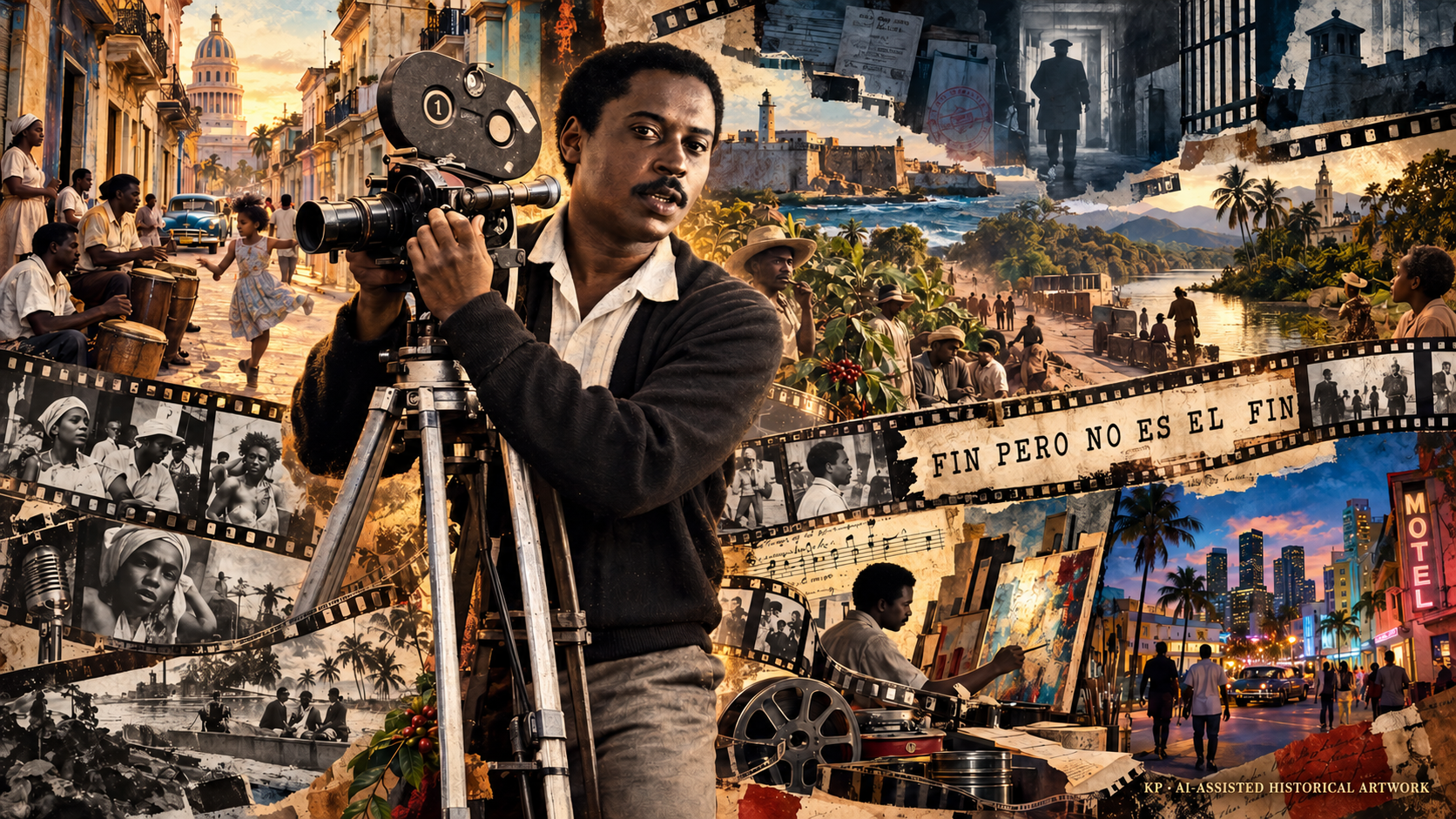
Nicolás Guillén Landrián was one of the most original filmmakers of the Cuban Revolution’s first decades. An Afro-Cuban documentarian, painter, poet, and experimental artist, he created a cinema of rupture: restless, musical, fragmented, and irreverent. His films entered official assignments only to disturb them from within. A documentary about a coffee-growing campaign could become a meditation on racial hierarchy, coercive labor, political spectacle, and the fragility of revolutionary promises. A portrait of a rural community could reveal not a unified people moving happily towards progress, but human beings marked by labor, faith, loneliness, uncertainty, and desire.
For many years, this achievement was pushed to the edges of Cuban cultural memory. His films were censored, withheld from circulation, left inaccessible in archives, and in several cases lost. He was imprisoned, subjected to psychiatric confinement and electroconvulsive treatment, interrogated, placed under house arrest, and finally expelled from the Cuban film institute where he had made his name. In exile in Miami, he painted and lived with limited means, largely absent from the wider history of world cinema. Only after his death did a determined revival—led by filmmakers, critics, restoration teams, and his widow, Gretel Alfonso—begin to recover his work from what one scholar calls the shadows of the official archive.
Today, Guillén Landrián is increasingly recognized as one of its essential artists of Cuban cinema; a filmmaker whose work belongs alongside the great experimental documentarians of the Caribbean, Latin America, Africa, and the wider Black diaspora.
A name, a lineage, a burden
Guillén Landrián was born in Camagüey, central Cuba, on 30 June 1938. His father was a lawyer who represented sugar workers in the region. This connection to laboring people and to the social world of the sugar economy mattered: it placed the young artist near the structures of class, race, land, and exploitation that would later hover beneath the surface of his films.
He was also the nephew of Nicolás Guillén, Cuba’s celebrated poet, whose Afro-Cuban verse and later prominence within the revolutionary cultural establishment made his name nationally resonant. Family and friends knew the younger Guillén Landrián as “Nicolasito.” His surname gave him proximity to intellectual and cultural networks, yet it also cast a long shadow. The uncle’s public stature and his close association with the revolutionary state made the nephew’s nonconformity all the more conspicuous. Eventually, institutional insistence that he use the compound name “Guillén Landrián” on his films marked both a distinction and a distance: he could not simply be Nicolás Guillén.
Before entering cinema, he studied social sciences at the University of Havana, painted, and took part in anti-Batista political activity. His early formation, then, was neither simply artistic nor simply political. It joined a commitment to social transformation with an openness to modernist experiment, literature, painting, music, and the rhythms of ordinary Cuban life. The revolutionary victory of 1959 initially created the cultural environment that let him enter filmmaking. Yet the state that offered that opportunity would eventually attempt to silence him.
ICAIC and a new cinema
In the early 1960s, Guillén Landrián joined the Instituto Cubano del Arte e Industria Cinematográficos, widely known as ICAIC. Founded shortly after the Revolution, ICAIC rapidly became one of the central institutions of Cuban cultural life. It was charged with creating a national cinema that could educate, persuade, document, and help remake society.
Guillén Landrián began in production work and directed early shorts for ICAIC’s Enciclopedia Popular series. These included Patio arenero, Homenaje a Picasso, and Congos reales, all made in 1962. Several early films are now believed to be lost, a devastating reminder that political suppression was accompanied by material neglect. Of the eighteen documentaries he directed before the age of thirty-four, six are thought to have disappeared entirely. Before 2002, only four of his films had been publicly shown in Cuba.
Landrián was one of only three Afro-Cuban filmmakers directing at ICAIC during its first decade. In a period when public discourse increasingly asserted that racism had been overcome by socialist reform, Guillén Landrián’s work made Afro-Cuban life and continuing racial hierarchy visible in ways the official national image could not comfortably absorb.
His early mentors included the Dutch documentarian Joris Ivens and the Danish filmmaker Theodor Christensen. Guillén Landrián later remembered them as crucial to his development, not only because they taught him cinematic technique but because they taught him to approach people with warmth and affection. That ethical orientation remained visible throughout his work. His films were drawn to people normally treated as background scenery in narratives of national development: rural workers, children, elderly residents, Black urban communities, dancers, devout people, people waiting, people watching, people enduring.
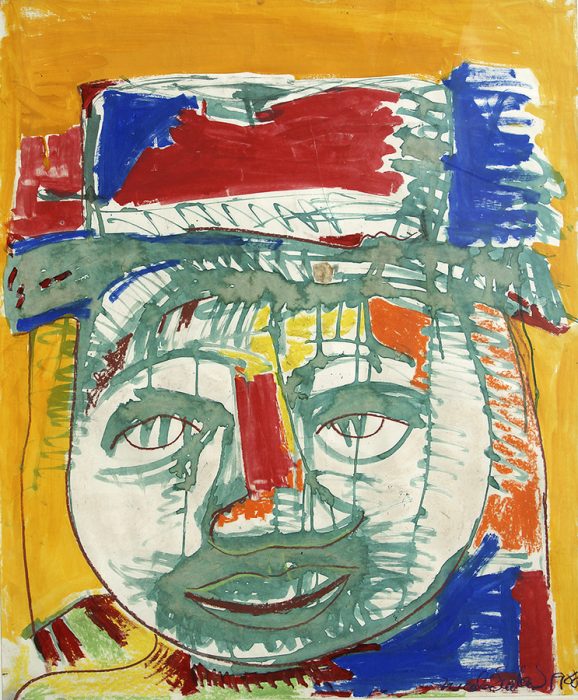
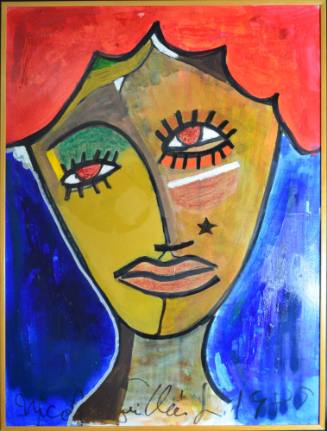
El Borracho, 1988
gouache on paper
42 x 34 3/4 inches
A cinema of interruption
Guillén Landrián’s films refused the clean, linear authority expected of the official documentary. His method combined live footage, still images, archival material, political slogans, written text, voices, abrupt editing, popular music, Afro-Cuban sound, silence, and visual repetition. His montage could be comic, poetic, mournful, agitated, or deeply unsettling. It made viewers work. It did not offer the comfort of a single approved interpretation.
He did not regard this style as separate from politics. In one of his most important statements, he explained that he had no aesthetic conflicts with his films because “all aesthetic conflicts are the result of conceptual conflicts.” He saw himself as an interpreter of reality, not a supplier of uplifting official images. His cinema came from the collision between the complexity he saw and the simplified image of society demanded by institutional power.
The rhythms of Afro-Cuban music and speech shaped his method. Rumba, son, sacred Afro-Cuban musical traditions, syncopation, repetition, and call-and-response structures helped shape the tempo of his editing. His montage was not merely intellectual in the European avant-garde sense; it was also bodily and musical. It moved through interruption, recurrence, improvisation, and counter-rhythm.
He drew from many traditions: documentary realism, cinema verité, Italian neorealism, the French New Wave, Brazilian cinema novo, the Cuban counterculture, and the visual experiments associated with Dziga Vertov. But he did not simply imitate these movements. He adapted their possibilities to a Cuban context in which the documentary image was profoundly entangled with revolutionary state power. His cinema did not stand outside institutional power; it accepted its commissions, and then made its underlying tensions visible.
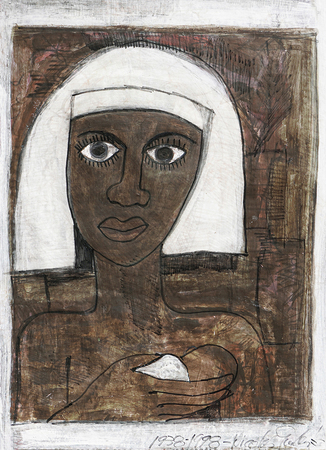
(Madre e Hijo)
Nicolás Guillén
1998
mixed media on canvas
The people in the frame
En un barrio viejo (1963), his portrait of an old Havana neighbourhood, was among the first films to establish his importance. It focused on Afro-Cuban urban life and received recognition at film festivals in Kraków and Tours. Yet he later recalled that he was not allowed to attend the festivals at which his work was honored. The paradox is revealing: the Cuban state could benefit from the international prestige of his artistry while restricting the artist’s own movement and recognition.
In Ociel del Toa (1965), he followed a young man in Cuba’s eastern Baracoa region. The film won a major prize at the Valladolid International Film Festival in 1966, reportedly shared with Ingmar Bergman. The film’s significance lies in its attention to a particular life and landscape rather than in its recitation of development slogans. Rural Cuba appears not as a neutral stage on which national transformation unfolds, but as a human environment bearing the uneven burdens of modernization.
Retornar a Baracoa (1966) continued this interest in eastern Cuba, road construction, and rural transformation. In later critical readings, these Baracoa films have been seen as works in which revolutionary modernization appears as a process of fracture as well as change. Guillén Landrián’s camera observed the promises of development, but it also registered what those promises passed over: unease, displacement, waiting, silence, fatigue, and the weight of change on ordinary people.
His films about Afro-Cuban dancing and neighborhood life, including Los del baile (1965), should also be understood within the climate of the 1960s, when Afro-Cuban religious and popular cultural forms could be treated with suspicion by a state committed to a sober, rationalist version of socialist modernity. By filming dancing, music, religious life, and Black sociality, Guillén Landrián challenged the tendency to locate Afro-Cuban culture at the folkloric edge of the nation rather than at its center.
Coffea Arábiga and race
His greatest film, Coffea Arábiga (1968), began as an ICAIC commission on the Cordón de La Habana, an ambitious state agricultural campaign intended to create a greenbelt of coffee, fruit trees, and other crops around Havana. Officially, the campaign formed part of a wider drive towards agricultural self-sufficiency, discipline, voluntary labour, and revolutionary productivity. In Guillén Landrián’s hands, however, it became something far more troubling.
The twenty-minute film interweaves official material, archival images, slogans, popular songs, handwritten and typed words, agricultural scenes, and fragments of political spectacle. Its best-known gesture is the collision between images of Fidel Castro and the Beatles’ “The Fool on the Hill.” That moment was daring, but it was not the whole of the film. Reducing Coffea Arábiga to a Beatles joke misses its deeper critique.
Scholar Anne Garland Mahler argues that the film identifies the persistence of racial hierarchy within revolutionary agricultural policy and within the nation’s colonial inheritance. This makes the film exceptionally important. In the 1960s, the Cuban state increasingly claimed that revolutionary reform had resolved racial inequality; public scholarship, activism, and art that challenged that claim faced pressure and suppression. Coffea Arábiga therefore spoke into a silence that was not accidental. It raised questions about Black labor, land, modernization, and power at precisely the moment when the state’s official self-image depended on declaring such questions settled.
The film’s force comes from its refusal to make a direct, easily punishable declaration. Guillén Landrián worked by juxtaposition. He inserted discomfort into familiar images. He made the language of progress collide with its social underside. This method has aptly been called a poetics of obliqueness: a political art that did not announce itself through conventional slogans but through irony, rhythm, association, and fracture.
Repression and exclusion
The cost of that freedom was grave. Guillén Landrián’s own testimony, later scholarly research, and restoration-era documentary evidence all indicate a history of surveillance, imprisonment, psychiatric coercion, and professional exclusion. Because the state’s archival record is incomplete and shaped by the very institutions that marginalized him, precise details must sometimes be framed carefully. Yet the broader pattern is clear: Guillén Landrián was targeted as a politically unreliable artist and pushed out of Cuban cultural life.
Before making Coffea Arábiga, he was sent to a forced-labor camp on the Isle of Pines, now known as the Isle of Youth, reportedly for ideological differences with the government. Following a psychological crisis there, he was released and received electroconvulsive treatment at a military hospital in Havana. He was then placed under house arrest. In his own account, he asked either to be allowed to return to filmmaking or to leave the country. He was eventually returned to ICAIC, but reassigned from artistic work to the scientific and technical documentary department. In this constrained setting, he made Coffea Arábiga. The film was censored, and the backlash against it contributed to his definitive expulsion from ICAIC in 1971, during the tightening cultural repression associated with the years often called the quinquenio gris, or “five grey years”—a term many writers consider too mild for the severity of the period.
He also recalled interrogation at Villa Marista, Cuba’s state-security headquarters, and incarceration in facilities including Presidio Modelo and Combinado del Este. The specific sequence, duration, and charges across these encounters require continued archival verification. Nonetheless, his artistic conflict with the state was never confined to the screening room. The attack on his work became an attack on his livelihood, freedom, movement, health, and capacity to remain socially present as an artist.
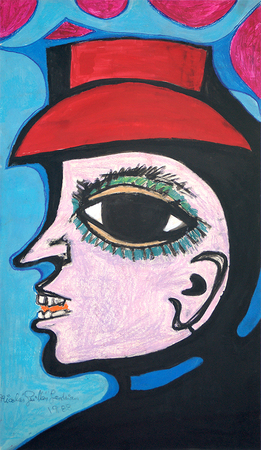
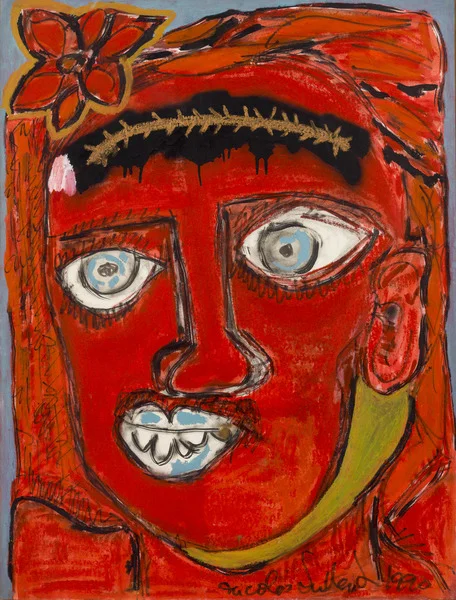
(Hombre con Sombrero Rojo)
Nicolás Guillén
1988
The final films
Guillén Landrián’s later ICAIC work became more overtly radical in form. Desde La Habana ¡1969! Recordar assembled a fractured history of Cuba through political speeches, archival images, music, memory, and questioning. The film rejects the idea that the Revolution resolved Cuban history triumphantly. Instead, it presents the nation’s past and present as a troubled field of mourning, repetition, political myth, and unfinished struggle.
Desde La Habana ¡1969! Recordar begins with images of the atomic destruction of Hiroshima and Nagasaki, locating Cuba’s story within the anxieties of the Cold War and the threat of global catastrophe. It layers national political memory with Beatles music, speeches by Fidel Castro, the remembered dead, and the filmmaker’s own interventions. Its repeated questions—“What?” and “Why?”—work against the certainty of official historical narrative.
In Taller de Línea y 18 (1971), Guillén Landrián turned towards the language of political scrutiny itself. Its recurring question—“Are you prepared to be analyzed by this assembly?”—transformed the collective rhetoric of revolutionary evaluation into an unsettling mechanism of surveillance. The film made the spectator feel watched, assessed, and drawn into the structure of power. It was a remarkable achievement: a documentary that exposed the disciplinary atmosphere surrounding its own production.
His recurring closing phrase, “Fin pero no es el fin”—“The end but not the end”—is central to his philosophy. It suggests that no official resolution is final, no image of national fulfillment complete, and no human story adequately ended by the conclusion of a film. It is also an apt phrase for a life in which institutional suppression could delay recognition but could not fully extinguish the work.
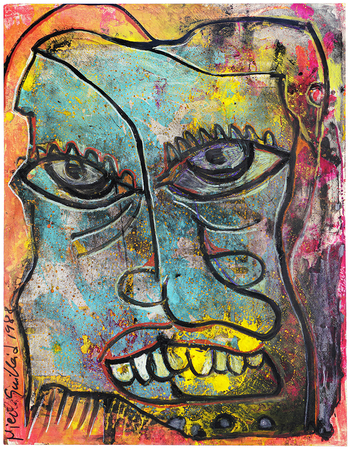
Nicolás Guillén
1988
Exile, painting, and Miami
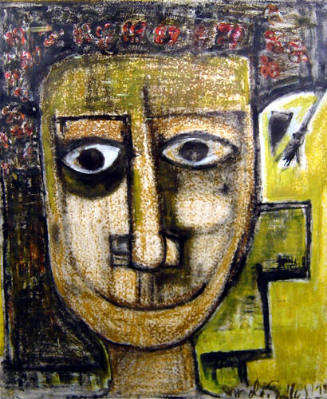
In 1989, Guillén Landrián was permitted to leave Cuba and settled in Miami. Exile did not bring material security or immediate professional restoration. He lived precariously and painted to survive. Yet visual art was neither a consolation prize nor a severance from cinema. Painting had been part of his identity from the beginning, and in Miami it became a renewed way to work through the human face, psychological intensity, social estrangement, and the fragmented self.
His paintings were shown in Miami, including an early exhibition at the Cuban Museum of Arts and Culture. Although he lived with relative obscurity and limited resources, he continued to create. He also returned to moving images once more. In 2001, with Jorge Egusquiza Zorrilla, he co-directed Inside Downtown, a digital video portrait of artists, poets, workers, and marginal lives in downtown Miami.
Inside Downtown is best understood as a continuation of his earlier cinematic commitments. The setting had changed, but the gaze had not. He remained attentive to cultural survival at the margins, precarious urban life, and artists and people living outside the city’s polished public image. The film also brought his familiar concern with the relation between image and sound into the landscape of diaspora.
Guillén Landrián died of pancreatic cancer in Miami on 23 July 2003, aged sixty-five. After his death, Gretel Alfonso returned his remains to Havana, where he was buried in Colón Cemetery. This return carried a powerful irony. Cuban cultural institutions had tried to erase the artist, yet they returned him to the city whose people, streets, rhythms, and contradictions had so profoundly shaped his work.
Resurrection from the archive
Guillén Landrián’s posthumous rediscovery was not spontaneous. People made it possible through the labor of seeking out fragile prints, personal records, letters, testimony, and neglected materials. In 2002 and 2003, ICAIC’s Muestra de Jóvenes Realizadores screened many of his works under the title Premios a la sombra—“Awards in the Shadows.” The title acknowledged both the international recognition his films had received and the deliberate obscurity to which they had been consigned.
The 2003 documentary Café con leche, by Manuel Zayas, helped revive attention to him. It was followed by Nicolás: El fin pero no es el fin (2005), Retornar a La Habana con Guillén Landrián (2013), and, most recently, Ernesto Daranas’s Landrián (2023). Daranas’s film draws on testimony, private journals, poetry, state-security documents, and restored footage. Its premiere in the Venice Classics program marked a major international recognition of an artist whose work had once been isolated and withheld.
The restoration of his films is itself a political act. Censorship does not operate only by banning a work. It can let negatives decay, deny films to audiences, withhold them from students and researchers, exclude them from national film histories, and create the illusion that the artist did not matter. Restoration reverses none of the harm done to Guillén Landrián in his lifetime, but it does challenge the official disappearance of his work.
He is now widely regarded as a foundational figure for younger Cuban filmmakers working in reflective, essayistic, and independent documentary forms. His influence is not direct imitation but permission: permission to break chronology, place music against image, distrust official language, make history unstable, and let the lives of ordinary people resist the narratives imposed on them.
Legacy
Nicolás Guillén Landrián occupies a singular place in Cuban and Caribbean cultural history. He was a Black filmmaker working inside a revolutionary institution that proclaimed equality while limiting the space for sustained public critique of racism. He was an experimental artist in a system that often demanded ideological clarity. He was a revolutionary generation’s child who refused the demand to portray the Revolution as finished, unanimous, and free of contradiction.
His importance lies not only in the injustice he endured. It lies in the art he made before and through that injustice. He transformed documentary film into a living field of tension: between sound and image, Black cultural life and national mythology, official language and social reality, collective memory and personal pain, revolutionary aspiration and bureaucratic violence.
To watch Guillén Landrián’s films now is to encounter a different history of Cuba: not the smooth narrative of fulfilled liberation, but a history of people waiting, working, praying, dancing, mourning, questioning, surviving, and refusing to disappear.
His final phrase remains the most fitting description of his legacy:
Fin, pero no es el fin.
The end, but not the end.
Sources:
https://en.wikipedia.org/wiki/Nicol%C3%A1s_Guill%C3%A9n_Landri%C3%A1n
https://www.mdpi.com/2076-0752/15/6/129
https://www.smjny.com/ex2022-10-22-william-cordova-aia
https://www.uni-bielefeld.de/einrichtungen/cias/forschung/black-americas/resources/Small-Axe-2015-Mahler-55-75-1.pdf
https://repositories.lib.utexas.edu/bitstream/handle/2152/40261/HAHN-DISSERTATION-2016.pdf?sequence=1&isAllowed=y
https://festivaldecineinstar.com/en/notas/guillen-landrian-documents-in-the-shadows-magazine-2024
https://www.torch.ox.ac.uk/event/interrupted-images-remembering-recordando-nicolas-guillen-landrian
https://www.play-doc.com/en/restrospectivas/nicolas-guillen-landrian/
https://opencitylondon.com/events/nicolas-guillen-landrian-a-gaze-restored-programme-2/
https://www.labiennale.org/en/cinema/2023/venice-classics/landri%C3%A1n
https://www.barbican.org.uk/whats-on/series/open-city-documentary-festival-nicolas-guillen-landrian
https://www.research.ed.ac.uk/en/publications/the-restoration-of-inside-downtown-2001-by-nicol%C3%A1s-guill%C3%A9n-landri
https://www.ebsco.com/articles/history/e4d34475-8863-55d1-8369-bdfdb4ae2786/the-restoration-of-inside-downtown-2001-by-nicolas-guillen-landrian-and-jorge-egusquiza-zorrilla-between-painting-and-cinema
https://www.mdpi.com/2076-0752/15/6/129
https://read.dukeupress.edu/small-axe/article/19/1%20(46)/55/33344/Todos-los-negros-y-todos-los-blancos-y-todos
https://emuseum.as.miami.edu/people/4350/nicolas-guillen-landrian/objects
https://secure.cernudaarte.com/artists/nicolas-guillen/