
John Brown Russwurm (1799–1851) was one of the most consequential and debated Black intellectuals of the nineteenth-century Atlantic world. A Jamaican-born scholar, educator, journalist, abolitionist, emigrant, and colonial governor, he crossed boundaries that were geographical as well as political: from the plantation society of Jamaica to schooling in Canada and Maine, from the first Black-owned newspaper in the United States to the emergent settlements of Liberia and Cape Palmas in West Africa.
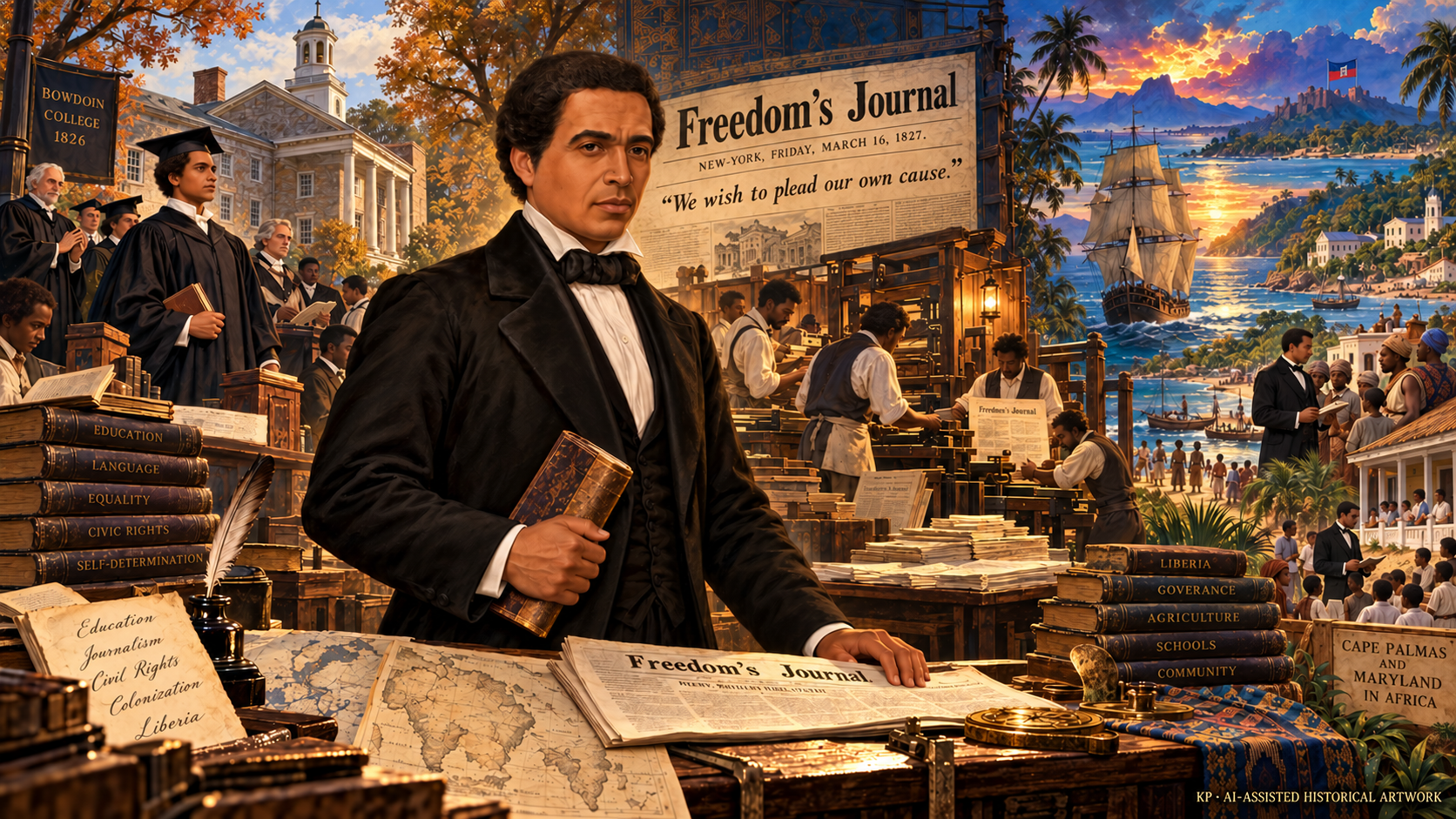
Russwurm’s life was distinguished by an extraordinary succession of historic firsts. In 1826, he became the first Black graduate of Bowdoin College and one of the first African Americans to receive a college degree in the United States. The following year, with Samuel Eli Cornish, he co-founded Freedom’s Journal, the first newspaper in the United States owned, edited, and published by African Americans—a landmark assertion of Black intellectual independence and public voice. After emigrating to West Africa, he became the first Black governor of an African colonization settlement when he was appointed governor of Maryland in Africa at Cape Palmas in 1836. These achievements placed Russwurm at the forefront of Black education, journalism, and political leadership on both sides of the Atlantic. Yet his legacy remains contested because his journey took him from anti-colonization journalism in the United States to public advocacy of emigration to West Africa. To many contemporaries, that decision appeared to renounce Black Americans’ rightful claim to citizenship in the country of their birth. Later scholars have more often understood it as the difficult, pragmatic response of a man who had experienced the tenacity of American racism and sought another path towards collective dignity, education, self-government, and political power.
Origins in Jamaica and Education
John Brown Russwurm was born John Brown on 1 October 1799 in Port Antonio, in Jamaica’s Portland Parish. His father, John R. Russwurm, was a white American merchant and attorney of Virginia descent; his mother was a Black Jamaican woman, described in surviving nineteenth-century accounts as either a free woman of color or captive woman. Her name and life remain largely obscured by the historical record, a silence that reflects the unequal preservation of colonial lives.
Port Antonio was a busy maritime town within a plantation colony structured by captivity, racial hierarchy, and commerce. Jamaica’s colonial population held political and economic power, while a small free population of color occupied an unstable intermediate position and the great majority of African-descended people endured enslavement on sugar and coffee estates. Russwurm’s early life was therefore shaped by the contradictions of colonial society: proximity to his father’s resources and status did not remove the racial barriers that defined his place in the world.
Unlike many European fathers of mixed-race children, John R. Russwurm acknowledged his son and assumed responsibility for his education. In 1807, when the boy was about seven, he was sent to boarding school in Quebec. Shortly before leaving Jamaica, he was baptized in Port Antonio as John Brown. His departure coincided with a period of enormous uncertainty in the British Atlantic: Britain had abolished its transatlantic trafficking in 1807, the Haitian Revolution had transformed the political imagination of captive and free Black people throughout the Caribbean, and colonial authorities feared rebellion.
Russwurm’s years in Lower Canada gave him a rare education and familiarity with French. In 1812, his father moved to Portland, Maine, and the following year married Susan Blanchard, a widow who accepted John into the household. At her encouragement, he took his father’s surname and became John Brown Russwurm.
His father died in 1815, and legal complications diminished Russwurm’s expected inheritance. Two years later, at seventeen, he returned briefly to Jamaica, hoping to find help from his father’s former associates. He found instead that they had died, and he returned to Maine disappointed but not defeated. His stepmother and her second husband, William Hawes, continued to provide a home, while the Maine merchant Calvin Stockbridge became an important guardian and supporter.
Russwurm’s education was never detached from the realities of race. He studied at Hebron Academy in Maine, but the school building burned down before he completed his course. He then taught in Black schools in Philadelphia, New York, and Boston, saving money for further education. In Boston, he encountered a circle of Black intellectuals and activists that included Prince Saunders, the Reverend Thomas Paul, and David Walker. These associations strengthened his interest in Haitian independence, African history, education, and the political future of Black people in the Atlantic world.
Bowdoin and the Defense of Haiti
In September 1824, Russwurm entered Bowdoin College in Brunswick, Maine, as a junior. He was one of very few Black students to gain entry to an American college in this period. His presence provoked hostility among some European students, but he found support from faculty members, notably the chemist and geologist Parker Cleaveland. He was admitted to the Athenaean literary society and is often identified as the first Black member of a college literary fraternity in the United States.
College life remained isolating. Because of racial discrimination, Russwurm lived outside the campus community, lodging with a local carpenter rather than in student housing. He also faced practical humiliations that other classmates did not: on some journeys between North Yarmouth and Brunswick, he was denied passage on stagecoaches because of racial prejudices and had to travel on foot.
On 6 September 1826, Russwurm graduated from Bowdoin College. He was the institution’s first Black graduate and among the first three African Americans known to have earned a college degree in the United States. His classmates and contemporaries included figures who would become prominent in American public and literary life, including Franklin Pierce, Nathaniel Hawthorne, and Henry Wadsworth Longfellow. Russwurm’s achievement was significant not simply because it broke a racial barrier, but because it furnished him with intellectual authority in a nation that systematically denied Black people education, citizenship, and political voice.
At commencement, Russwurm delivered an address titled “The Condition and Prospects of Hayti.” The choice of Haiti was bold. The Haitian Revolution had produced the first independent Black republic in 1804 after captive people destroyed French colonial rule, but the revolution was deeply feared in the United States—especially by captors who held people in captivity. The U.S. government refused to recognize Haiti diplomatically, and American writers frequently represented Black self-government as dangerous or impossible.
Russwurm repudiated those assumptions. He argued that humanity was not divided into fundamentally unequal racial kinds: “Man alone remains the same being, whether placed under the torrid suns of Africa or in the more congenial temperate zone.” Liberty, he insisted, was inherent to human nature, and efforts to suppress it were “as fruitless as would be the attempt to extinguish the fires of Etna.”
The speech defended Haitian independence and insisted that slavery could injure human capacities without extinguishing them. “Once Freedom struck their astonished ears,” he declared of Haitians, “they became new creatures, stepped forth as men, and showed to the world, that though slavery may benumb, it cannot entirely destroy our faculties.” The address was widely praised and reprinted in newspapers beyond Maine. It established the central thread of Russwurm’s political thought: Black freedom required more than moral sympathy from American reformers. It required education, self-reliance, and the capacity for self-government.
Freedom’s Journal and Black Self-Representation
After graduating, Russwurm returned briefly to teaching in Boston. He considered emigration to Haiti and contemplated studying medicine, but neither prospect came to fruition. By the end of 1826, he had moved to New York City, where a major opportunity soon emerged.
On 16 March 1827, Russwurm and the Presbyterian minister Samuel Eli Cornish published the first issue of Freedom’s Journal. It was the first newspaper in the United States owned, edited, and published by African Americans. The paper was established at a moment of intense political importance. New York’s remaining enslaved people were due to be emancipated later that year, but free Black New Yorkers faced racial violence, occupational exclusion, disfranchisement, and continual slander in the American press.
The paper’s opening statement became one of the defining declarations of Black journalism: “We wish to plead our own cause. Too long have others spoken for us.” This was more than an editorial slogan. It announced a challenge to the prevailing practice by which American reformers, politicians, missionaries, and journalists presumed to explain Black life, needs, and aspirations.
Freedom’s Journal offered national and international news, essays, literary material, reports on education, notices of Black businesses and institutions, and commentary on Africa, Haiti, the Maafa, racism, and moral improvement. It cultivated a network of readers and agents across the United States, Canada, England, and Haiti. In Boston, its agents included David Walker, Thomas Paul, and John T. Hilton. The newspaper connected dispersed Black communities and created a forum in which readers could debate questions of strategy and leadership.
Cornish resigned in September 1827 to return to ministerial work, leaving Russwurm as sole editor. Under his leadership, the newspaper expanded its coverage of African history and the question of emigration. At first, Freedom’s Journal had opposed the American Colonization Society, whose program encouraged—or, in the eyes of many Black Americans, threatened—free Black people to leave the United States for settlements in West Africa. The ACS united a shifting coalition: some American supporters opposed the Maafa but also opposed Black equality in the United States; others hoped colonization would remove free Black communities they perceived as a threat to slavery.
For most free Black activists, colonization was unacceptable. They regarded the United States as their country, rejected the premise that they should be expelled from it, and understood that colonization often rested on American racism rather than Black self-determination.
The Colonization Crisis
Russwurm’s eventual support for colonization was one of the defining shocks of his public life. In February 1829, he announced in Freedom’s Journal that his views had “materially altered” and that he had become “a decided supporter of the American Colonization Society.” He did not present the decision as an abandonment of Black uplift; rather, he argued that prejudice in the United States was too entrenched to permit Black citizenship on equal terms.
“We consider it a mere waste of words to talk of ever enjoying citizenship in this country,” he wrote. “It is utterly impossible in the nature of things: all therefore who pant for these, must cast their eyes elsewhere.”
This conclusion emerged from a bleak reading of American democracy. Russwurm had achieved what few Black Americans could achieve: formal education, professional standing, public recognition, and access to influential networks. Yet he continued to encounter exclusion and racial degradation. He came to believe that the United States would not willingly recognize Black people as equal citizens and that a new society in Africa might offer the possibility of Black political authority.
The response was fierce.
Many readers regarded his turn as a betrayal, especially because Freedom’s Journal had been created partly to combat anti-Black propaganda and colonization schemes. Subscribers withdrew their support. In Philadelphia, he was burned in effigy. William Lloyd Garrison denounced him as a “black Benedict Arnold,” and Cornish later criticized him as a man who had sacrificed principle for position.
Such attacks should be understood within the stakes of the moment. The debate was not merely about migration; it concerned who had the right to define Black political belonging. Black opponents of colonization insisted that their struggle must be for freedom and citizenship in the land where they had been born or had lived for generations. Russwurm, increasingly convinced that this struggle would fail, sought a different political horizon.
Freedom’s Journal ceased publication on 28 March 1829. In September, Russwurm departed Baltimore aboard the Susan. He arrived in Monrovia, Liberia, on 12 November after a fifty-eight-day voyage.
Liberia, Cape Palmas, and Colonial Government
In Liberia, Russwurm became Superintendent of Schools, Colonial Secretary, and editor of the Liberia Herald. He revived the newspaper and used it to promote literacy, schooling, civic discipline, and the settlement’s intellectual development. In 1833, he married Sarah McGill, daughter of George McGill, Monrovia’s lieutenant governor. They had five children: George Stockbridge, James Hall, Francis Edward, Angelina, and Samuel Ford.
His years in Monrovia were productive but politically frustrating. Russwurm held important administrative positions, yet the American Colonization Society reserved ultimate authority for European governors. He also faced tension over the limits placed on his editorial independence. By 1835, increasingly disillusioned with paternalistic American control, he resigned.
A new opportunity arose at Cape Palmas, where the Maryland State Colonization Society had established the settlement of Maryland in Africa. In June 1836, its board appointed Russwurm governor. The decision was historic: he became the first Black governor of an African colonization settlement. He would serve for fifteen years, until his death.
Russwurm’s administration concentrated on education, trade, agriculture, public order, and the defence of the colony’s limited autonomy. He expanded the school system from two schools in 1838 to five by 1850 and promoted instruction for both girls and boys. He adopted the Lancastrian or monitorial system, in which more advanced pupils helped teach younger students, a practical response to the shortage of trained teachers.
He also worked to strengthen the settlement’s economy. A local paper currency circulated in small denominations alongside barter. Russwurm acquired trading vessels, the Latrobe and the Doctor, to support commerce in coffee, sugar cane, palm oil, and camwood. He required settlers receiving public assistance to cultivate staple crops, hoping to reduce dependency and prevent food shortages.
Relations with neighboring Glebo communities were central to the colony’s survival. Russwurm learned local languages and pursued direct diplomacy with African leaders. His record included attempts to enforce fair-dealing standards. When a colonist, Charles Snetter, led an unprovoked attack on local Africans in 1838, Russwurm expelled him from the colony despite opposition from settlers.
Yet Russwurm’s governance was not free of contradiction. His settlement existed within a colonization framework that treated African territory and political authority as objects of settler administration. Like many Americo-Liberian leaders of the era, he embraced ideas of “civilization” that privileged Western education, Christianity, English-language culture, and settler respectability. His administration maintained social distinctions between Westernized settlers and indigenous Africans, and its policies could be paternalistic. His career therefore illustrates both the emancipatory aspiration of Black self-government and the uneven power relations that shaped nineteenth-century Liberia.
Legacy and Reassessment
Russwurm returned to Maine in 1848 for medical treatment and renewed contact with Susan Hawes, the stepmother who had helped raise him. He placed two of his sons at North Yarmouth Academy and declined an offer to lead a proposed Black college in Boston. He believed his future lay in Africa. He returned to Cape Palmas and died there on 9 June 1851, aged fifty-one.
For generations, Russwurm was overshadowed by the controversy surrounding colonization. His opponents’ language—traitor, opportunist, “black Benedict Arnold”—proved influential, and abolitionist histories often treated him as a cautionary figure. That judgment, however, cannot encompass the full range of his life.
Russwurm pioneered Black self-representation in print. Freedom’s Journal established a model for the Black press: Black communities speaking in their own voices, circulating their own news, disputing racist misrepresentations, and defining their own political questions. His work at Bowdoin and his defense of Haiti challenged the intellectual foundations of white supremacy. His career in Liberia and Maryland in Africa demonstrated his enduring commitment to education, institutional development, and Black leadership.
His political choices remain difficult because the choices available to him were difficult. He saw the United States deny Black people equal citizenship even in the nominally free North. He chose emigration and African state-building while others rightly continued the fight for American civil rights. Those paths were not identical, and they often clashed, but both grew from a shared refusal to accept racial subordination as permanent.
John Brown Russwurm’s life belongs to the history of Jamaica, the United States, Haiti, Liberia, and the wider African diaspora. He was a searching, ambitious, and sometimes contradictory figure of the Black Atlantic—one who understood that freedom required not only emancipation from captivity, but also voice, education, dignity, political authority, and the power to imagine a future beyond the boundaries imposed by empire and race.
Sources:
Traitor or Pioneer: John Brown Russwurm and the African Colonization Movement by Brian J. Barker (M.A. thesis, University of Massachusetts Boston, 2015). https://scholarworks.umb.edu/cgi/viewcontent.cgi?article=1303&context=masters_theses
A Child of the Atlantic: The Maine Years of John Brown Russwurm by Carl Patrick Burrowes. Maine History 47, no. 2 (July 2013). https://journals.maine.edu/mainehistoryjournal/article/download/4142/4135/4137journals.maine
https://en.wikipedia.org/wiki/John_Brown_Russwurm
https://bowdoin.libguides.com/c.php?g=1460668&p=10862077