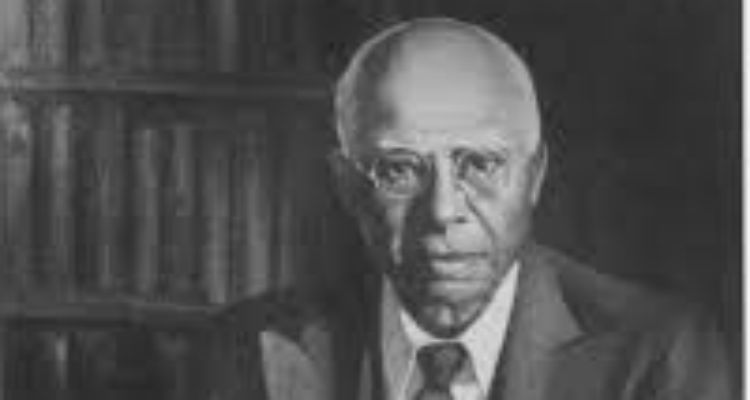

In 2013, a quietly extraordinary discovery emerged from South Carolina. Albert Perry, an African American man, carried a rare Y-chromosome lineage—one so ancient that it pushed the known roots of the living human paternal-line tree back to an initial estimate of nearly 338,000 years.
Perry’s Y chromosome was a genetic outlier, refusing to fit any known branch in the existing human Y-chromosome tree. Researchers designated the lineage A00 and later identified related lineages among the Mbo people of western Cameroon, indicating that Perry’s rare paternal line had deep roots in West-Central Africa.
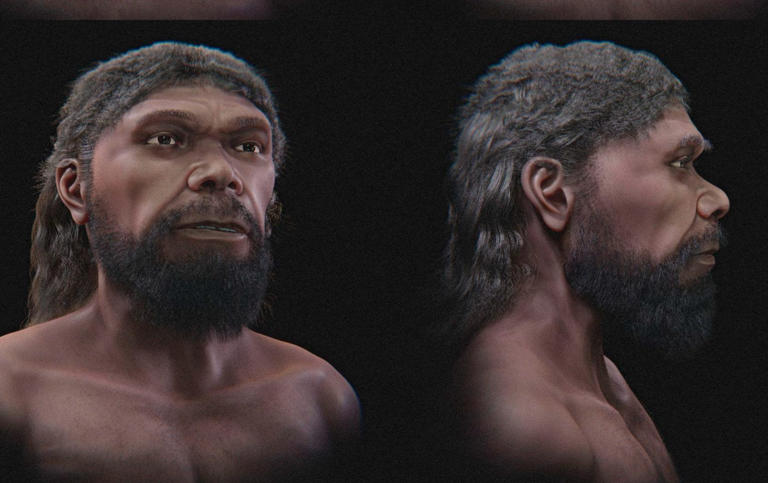
Recently, another fragment of Africa’s distant human past has been given a face—not recovered intact from the earth, but carefully approximated from ancient bone, digital technology, and comparative anatomical knowledge. A newly published digital reconstruction, built from fossil remains recovered at Jebel Irhoud, Morocco, offers a compelling glimpse of how an individual from one of the earliest known Homo sapiens populations may have appeared about 315,000 years ago.
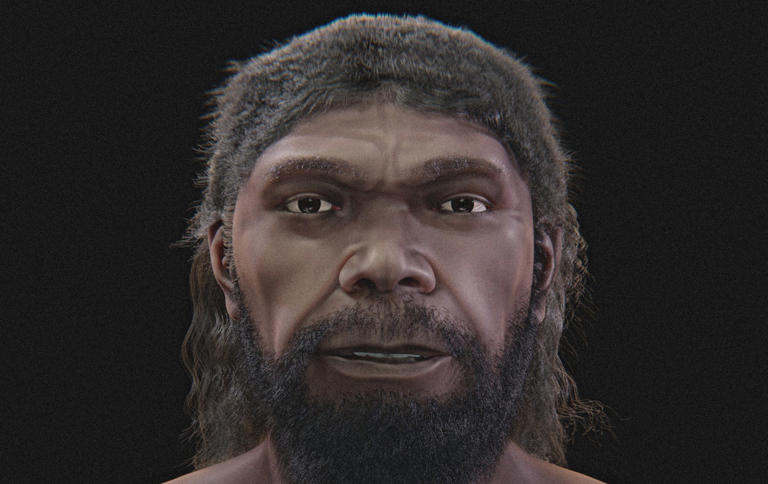
The resulting image is immediately arresting. A broad, resolute face gazes out from an epoch so remote it slips the grasp of ordinary historical imagination: before writing, before cities, before the first seeds of agriculture or the rise of empires, and long before later migrations carried some Homo sapiens populations beyond Africa. It is not the portrait of a literal “father of humanity,” but it has the unsettling force of an ancestral encounter.
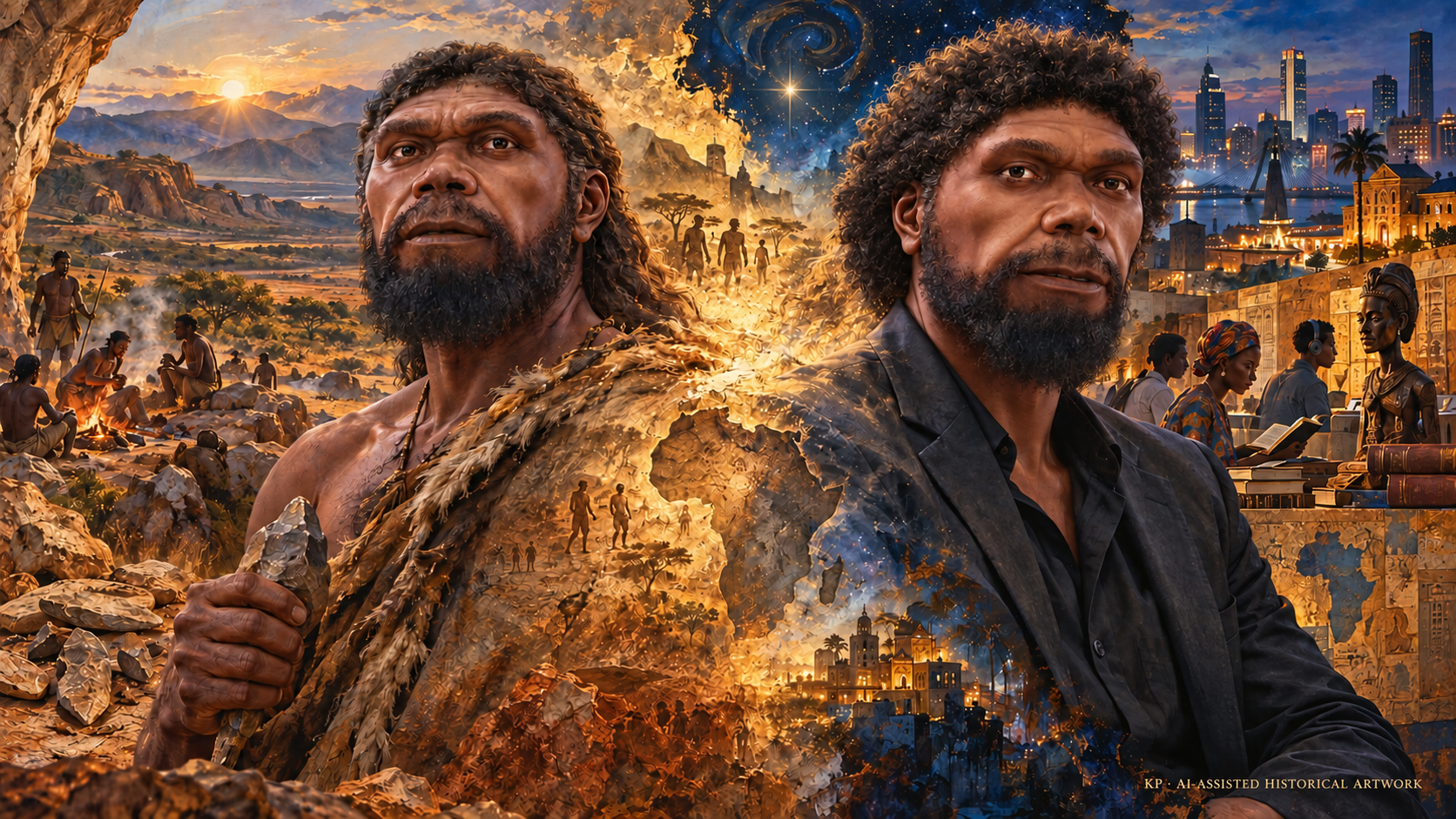
Perry’s genetic legacy and the Jebel Irhoud reconstruction cannot be joined into a single ancestral story. One concerns an exceptionally rare surviving paternal lineage; the other is an anatomical approximation based on a composite of fossil remains. Yet placed alongside one another, they illuminate the immense depth, diversity, and still partly unknown complexity of African human histories.
Jebel Irhoud and the age of our species
Jebel Irhoud is an archaeological site in Morocco, in north-west Africa. Researchers first recovered human fossils and stone tools there in the 1960s. For years, scientists wrestled with the identity of these ancient remains. Some initially assigned them to Neanderthals, or described them as Neanderthal-like, because the crania possessed features unfamiliar from later Homo sapiens skulls.
That interpretation changed dramatically in 2017. A major reassessment of the fossils, together with dating of fire-heated flint artefacts found in association with the remains, placed the Jebel Irhoud material at about 315,000 years old. The studies concluded that the site preserves some of the oldest known fossil evidence attributed to Homo sapiens.
The findings did more than extend our species’ story further into the past. They disrupted a conveniently neat narrative in which modern humans arose about 200,000 years ago in a geographically narrow part of East Africa. Jebel Irhoud instead supported a more complex interpretation: Homo sapiens emerged through a long evolutionary process involving populations across Africa.
Often called the pan-African model of human origins, this perspective recognises that ancient African populations were diverse, sometimes connected, and changing across immense distances and shifting climates. It does not claim that all regions played identical roles, or that the continent contained a single uniform population. Rather, it sees the emergence of Homo sapiens as a deep and intricate African history, shaped by environments, movements, evolving technologies, and changing human bodies.
A modern face, an older braincase
The Jebel Irhoud fossils present a striking evolutionary mosaic. Their faces and jaws are comparatively modern in form, resembling those of later and living Homo sapiens more closely than those of Neanderthals. Yet the braincases tell a different story: they are longer and lower than the rounded, globular cranial vault characteristic of most living people.
The combination suggests that the features associated with our species did not all emerge at once. At Jebel Irhoud, the face already bears crucial Homo sapiens features, while the braincase retains older anatomical patterns. Human evolution was neither a straight line nor a sudden transformation. It proceeded through populations across time, with different traits changing at different rates.
The digital reconstruction gives this evolutionary complexity a form that the public can encounter directly. It evokes a person who was recognisably human, even familiar, while also belonging to a population separated from the present by more than three hundred millennia.
What has been reconstructed?
The Jebel Irhoud fossils do not provide the complete, time-capsuled remains of one ancient person: no unbroken skull, no preserved flesh, hair, or skin. Nor do they mark the beginning of humanity itself. The genus Homo reaches far further into prehistory, and Jebel Irhoud represents early Homo sapiens, not the first humans in the broader evolutionary sense.
Instead, researchers have produced a digital facial approximation from a virtual composite skull. The 2026 study drew principally on the fossil designated Irhoud 1 and incorporated elements from other remains, including Irhoud 11, where anatomy was missing. The result is a composite model constructed from more than one ancient individual associated with the Jebel Irhoud population and deposit.
This means that the face is not a recovered portrait of a single named ancestor. It is a scientifically grounded, necessarily provisional approximation of what an early person from that community may have looked like. Its facial structure is constrained by fossil bone and forensic anatomical modelling; its more lifelike details require interpretation.
The distinction is especially important in the coloured image. Skin pigmentation, hair texture and length, facial hair, eye colour, expression, and other individualising details cannot be read directly from the skull. The hairless, grayscale rendering is therefore closer to the directly modelled anatomical claim, while the coloured face makes the reconstruction emotionally immediate through artistic decisions that should remain transparent to readers.
Africa at the centre
The wider importance of Jebel Irhoud extends beyond the fascination of a reconstructed face. It shows that the deep history of our species is African history. Early Homo sapiens populations lived in Africa in their own time and within their own social worlds—not as a prelude to “real” history elsewhere, but as human communities whose lives mattered in themselves.
At Jebel Irhoud, the long formation of Homo sapiens was already underway more than 300,000 years ago in north-west Africa. Its inhabitants used Middle Stone Age tools and lived in landscapes shaped by climatic change, movement, hunting, social relationships, and adaptation. Their world was not an empty stage awaiting the arrival of civilisation or history. It was already a human world, rich in activity and relationship, even if the material record allows us to recover only fragments of it.
The digital reconstruction invites us to look back into an African past of extraordinary depth and recognise not a primitive other, but an early chapter in the long, unfinished story of Homo sapiens. It may not be the face of “the first man,” nor an exact portrait of one identifiable person. But it is a disciplined approximation of one of the earliest known faces of our species—and an encounter with the African world in which that history was made.
Sources:
https://www.mdpi.com/2571-9408/9/9/369
https://www.msn.com/en-gb/news/other/face-of-earliest-human-seen-for-first-time-in-300-000-years/ar-AA2ddrQT?ocid=msedgntp&pc=SCOODB&cvid=6abce83356c94ec5b8dd0b1b2030313a&ei=15
https://www.nature.com/articles/nature22336
https://www.nature.com/articles/nature22335
https://pubmed.ncbi.nlm.nih.gov/28593953
https://cris.unibo.it/retrieve/handle/11585/610328/840846/Hublin_et_al_2017_New%20fossils%20from%20Jebel%20_postprint.pdf
https://pmc.ncbi.nlm.nih.gov/articles/PMC3591855
https://www.nature.com/articles/ejhg2013303
https://theconversation.com/albert-and-adam-rewrite-the-story-of-human-origins-15835