
Around 1830–31, the grave of a young southern African man was violated. French taxidermists then transformed his body into a commercial specimen, which was displayed in Europe for generations—most infamously at the Museu Darder in Banyoles, Catalonia, from 1916 until the late 1990s. After a sustained campaign led by the Haitian-born physician Alphonse Arcelin, the display was removed. Part of the man’s remains was transferred to Botswana in 2000 and buried in Gaborone on 5 October.
The available evidence strongly points to a Tswana/BaTlhaping origin in what is now South Africa, rather than the later attribution that situated him among Indigenous communities of the Kalahari and Botswana. A 2025 documentary proposed that he was Molawa VIII, a BaTlhaping leader associated with Litakou, now Dithakong. Although this identification is important and plausible, it rests on converging documentary, genealogical, and age evidence rather than a published genetic or forensic match. It should therefore be treated as a compelling hypothesis, not an established fact.
The return did not fully address the loss. Botswana reportedly received the skull and a limited selection of bones rather than the body as generations had known it in Banyoles. In Spain, they separated the skin, reconstructed materials, internal frame, clothing, weapons, and other associated objects before the transfer. A 2004 report confirmed that the preserved skin remained at Madrid’s National Museum of Anthropology rather than being returned for burial. This episode reveals two successive forms of objectification: first, the transformation of a person into a racial specimen; second, the claimed authority of museums and governments to decide which parts counted as human remains, which as institutional property, and what Africa was permitted to receive.
From person to specimen
Jules and Édouard Verreaux belonged to Maison Verreaux, a Parisian family enterprise that collected, prepared, sold, and exchanged natural-history specimens. The business operated within a nineteenth-century transnational network linking expeditions, frontiers produced through European expansion and dispossession, commercial dealers, world exhibitions, zoological gardens, and European museums. Maison Verreaux supplied major institutions, while collectors transformed animals—and at times human bodies—into portable objects that underwrote European claims to scientific possession.
According to accounts associated with Jules Verreaux, the brothers encountered the burial of a southern African man, returned under cover of darkness, violated the grave, and removed his body. Employing animal taxidermy techniques, they discarded or replaced much of the internal anatomy, arranged preserved skin over a support frame, and left selected bones inside. Newspapers later celebrated the result as a triumph of taxidermic technique, while failing to record the man’s name, family, consent, or community.
Assertions that the deceased was a “chief” or “warrior” warrant caution. Such descriptions increased the exhibit’s spectacle and market appeal, drawing upon European conventions that reduced African men to generic martial stereotypes. The spear, shield, ornaments, loincloth, and dramatic pose do not reliably establish his occupation or status; together they create a manufactured visual narrative. Even if some objects came from southern Africa, the completed tableau reflected the taxidermists’ construction of an African “type,” not the man’s own identity.
The earliest European accounts referred to the figure as le Betjouana or il Betjouana. “Betjouana” or “Bechuana” was a European rendering of Batswana, the plural of Motswana, and generally referred to Tswana-speaking peoples living north of the Cape frontier. This matters because it predates the later Kalahari attribution and is closer in time to the original seizure of the man’s body.
Neil Parsons’s research placed the likely origin near the Orange–Vaal confluence, where BaTlhaping communities lived and where Cape travellers and collectors crossed into the southern African interior. He suggested Kgatlane, near the meeting of the rivers, as one possible settlement, while acknowledging that the individual’s identity remained unknown. The later Litakou/Dithakong hypothesis shifts the proposed locality farther north, yet remains within a BaTlhaping and Tswana context. The newer claim therefore revises the geographical detail without altering the broader conclusion concerning the man’s likely people.
The Catalan veterinarian and naturalist Francesc Darder likely acquired the figure through the Verreaux commercial network or its successors around 1880. The specimen featured in Darder’s natural-history display at Barcelona’s 1888 Universal Exposition and entered the municipal museum at Banyoles when Darder’s collection became its foundation in 1916.
In Banyoles, they displayed him upright in a glass case among zoological, anatomical, and anthropological exhibits. His presentation combined human taxonomy with the visual language of a hunting trophy: artificially darkened skin, glass eyes, weaponry, sparse clothing, a static “primitive” pose, and no meaningful biography. The widely used label reduced an unknown individual to skin color alone, while the museum context encouraged visitors to see him as a representative racial specimen rather than as a person whose burial had been violated.
Reports indicate that his skin was artificially darkened, often described as blackened with shoe polish or a similar substance. Whatever the precise material or frequency of application, the process was interpretive as well as cosmetic: it heightened the racial meaning imposed upon his appearance so that the body could perform an invented, immediately legible identity. This artificial darkening likely contributed to the eventual replacement of the earlier, more geographically specific “Bechuana” classification with a racially generic label.
The exhibit emerged from the practices of racial typology, comparative anatomy, evolutionary hierarchy, and European collecting under conditions of dispossession and unequal force. During the nineteenth and early twentieth centuries, museums repeatedly placed African and Indigenous communities subjected to European occupation and extraction alongside animals, skull collections, anatomical casts, preserved organs, and ethnographic objects. The arrangement itself carried an argument: European institutions claimed the authority to observe, classify, possess, and interpret, while African and Indigenous people were reduced to objects of observation.
The issue was not merely the language attached to an otherwise neutral object. The “object” existed because grave robbery, dismemberment, preservation, sale, racial classification, and display had been joined into one process. Museums extended the original violation by converting possession into authority. Institutional custody became a claimed right to rename, alter, exhibit, interpret, divide, and retain a person’s remains.
Bruce Bennett’s comparison with other displays of the dead highlights a crucial distinction. Some archaeological exhibitions attempt—however imperfectly—to connect visitors with a recognizable individual from the past. The Banyoles display instead created separation, presenting an African person as an exotic “Other.” The ethical problem was not simply the visibility of a dead body. It was the transformation of a racial person into a symbol for an entire category of supposedly primitive humanity.
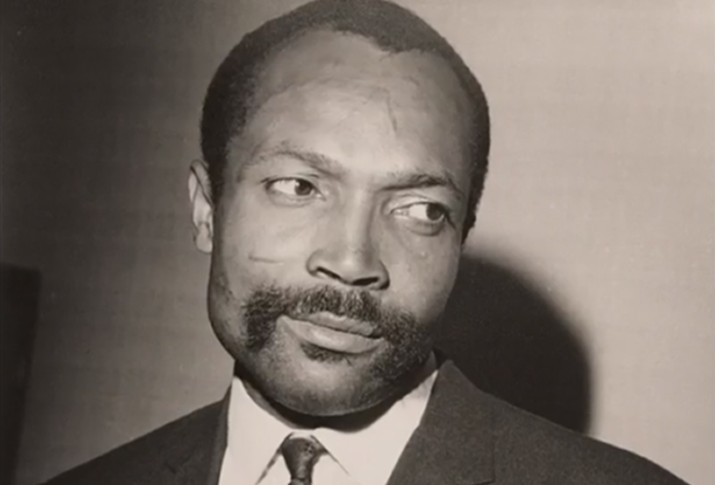
In October 1991, Alphonse Arcelin, a Haitian-born physician and local politician in Catalonia, wrote to the mayor of Banyoles to demand the exhibit’s removal. As Barcelona prepared for the 1992 Olympic Games and Banyoles was set to host rowing events, Arcelin recognised that international attention could create powerful leverage. He argued that displaying a grave-robbed African as an exotic specimen violated human dignity and demeaned Black people in Spain and beyond.
Arcelin’s intervention was pivotal because he reframed the debate. Museum officials focused on legal possession, rarity, scientific value, and local affection; Arcelin asked whether a person could ethically be treated as property. By shifting the question from possession to dignity, he turned an apparently local museum dispute into an international confrontation with racial hierarchy, the memory of European violence, and the treatment of human remains.
The campaign mobilized African diplomats, the Organization of African Unity, UNESCO-linked advocates, anti-racist activists, and international media. The 1992 Olympics amplified the controversy, but public attention alone did not bring immediate resolution. The body remained in museum custody until the late 1990s, showing that visibility alone could not overcome entrenched local attachment and institutional resistance.
Defenders frequently denied racist intent, describing the figure as municipal heritage, a scientific specimen, a childhood memory, or a cherished local symbol. The official Darder Museum history maintains that the popular label was used without derogatory intention and emphasizes that the international controversy accused the museum and townspeople of racism.
Intent, however, cannot resolve the matter. A community may feel attachment to an object whose creation depended upon violence. Claims of local belonging reversed the moral question: instead of considering what Banyoles owed the man and his descendants, defenders asked what right outsiders had to deprive Banyoles of “its” possession. Emotional attachment did not neutralize objectification; it exposed how thoroughly the person had been absorbed into municipal property and folklore.
The museum’s defense also relied on claims of equivalence: if museums display mummies, skeletons, fetuses, or other human remains, why should this case be different? The answer lies in provenance, consent, racialization, manner of display, cultural context, and the persistence of harm. Not all displays of human remains share the same history. Formal consistency can perpetuate injustice when it overlooks the specific circumstances under which bodies were acquired and exhibited.
During the controversy, the figure was frequently assigned to an Indigenous Kalahari identity. The official Darder Museum account continues to repeat that attribution while acknowledging earlier labels. In contrast, University of Botswana research associated with Neil Parsons argues that the early Betjouana designation and the geographical evidence point to a Tswana man, most likely BaTlhaping.
This disagreement shows how museum classifications can outlive their evidential foundation. Once the Kalahari attribution entered circulation, it was repeated in press reports, diplomatic decisions, and public memory. It then influenced the country selected for burial, demonstrating that archival labels do not merely describe a person; they can shape the political and geographical fate of the dead.
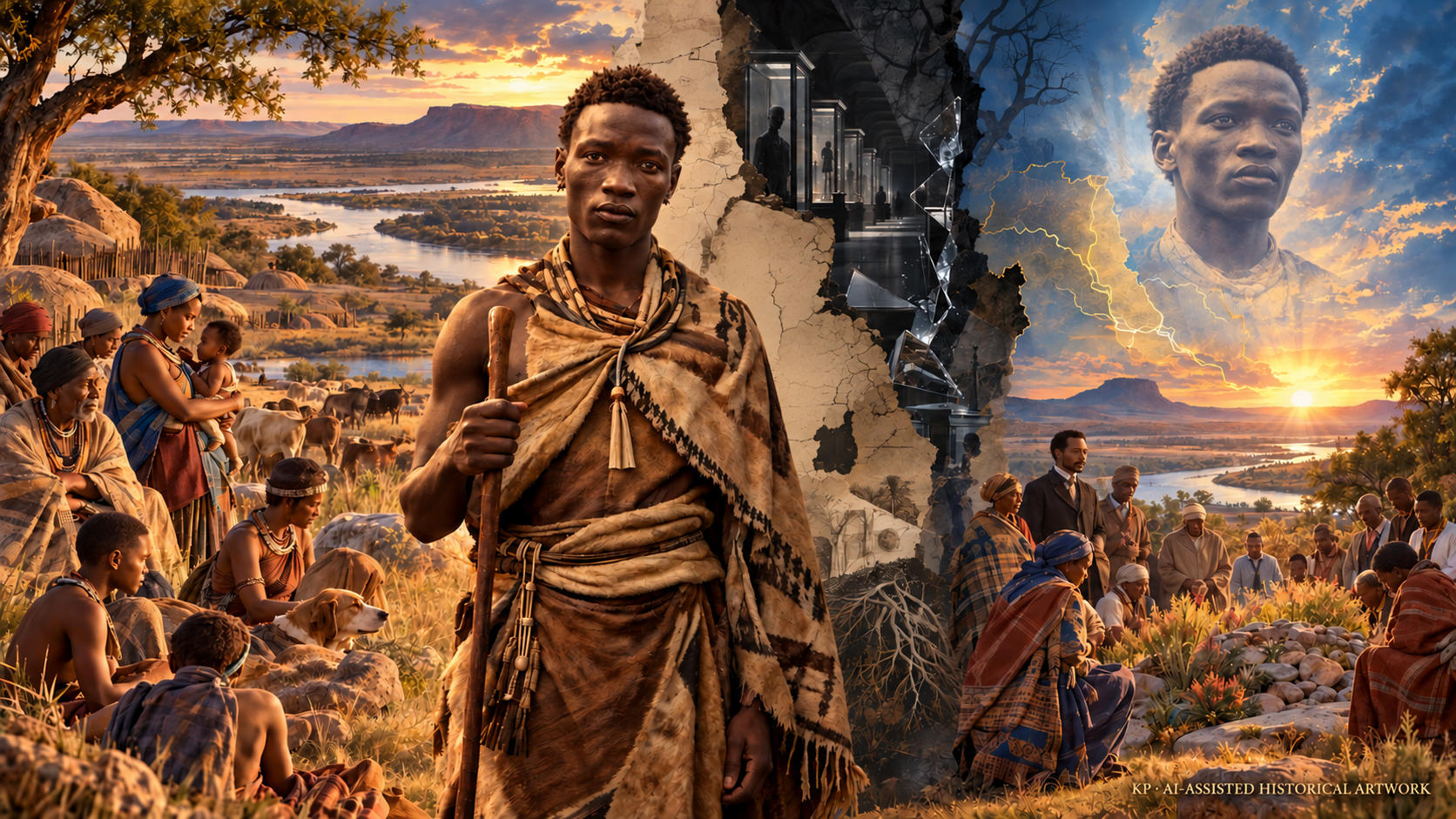
The 2025 documentary El negre té nom, directed by Fèlix Colomer, advanced a significant claim: that the man was Molawa VIII, a BaTlhaping leader from Litakou, now known as Dithakong in South Africa. The filmmakers reportedly developed this identification through an 1831 geographical reference, an estimate that he died at approximately twenty-seven, community genealogies, a proposed birth range of 1800–05, and the absence of Molawa’s grave among his descendants.
This represents an important shift because it returns the inquiry to African place, kinship, and memory rather than European racial typology. It is also consistent with the earlier conclusion that the man was Tswana/BaTlhaping and likely came from what is now South Africa. Descendant testimony and locally maintained genealogies deserve serious evidentiary weight, particularly where European records preserved the body but not the name.
Although public accounts report that the filmmakers were “99%” certain, no peer-reviewed evidentiary study, DNA analysis, or unique contemporaneous description has yet been made available that excludes all other young BaTlhaping men who might have died in the relevant place and period. Until the supporting documents and method can be independently assessed, the most accurate formulation is that recent research plausibly, but not definitively, identifies him as Molawa VIII.
After years of advocacy, Spain and Botswana negotiated the transfer through diplomatic channels. The remains arrived in Gaborone on 4 October 2000 and were buried the next day in Tsholofelo Park. The grave inscription calls him a “Son of Africa,” recording that he died around 1830, was transported to Europe after death, and returned to African soil in October 2000.
Botswana’s acceptance of the remains was Pan-African and symbolic rather than grounded in verified national provenance. Research already indicated that the original burial site was likely in what is now South Africa. Botswana nevertheless acted as the receiving state through an OAU-supported process, offering a public burial when no conclusively identified family had been recognized.
The burial restored something essential: recognition of the man’s humanity and entitlement to funerary respect. Large crowds, national ceremony, and the rhetoric of return repudiated the museum’s reduction of him to a specimen. Yet no state ritual could restore his original funeral, reunite all body parts, or guarantee burial among his own kin.
Before shipment, they took the mounted figure to Madrid and dismantled it. Botswana received the skull and a limited selection of bones rather than the body as it had been publicly remembered in Banyoles. Associated items—including weapons, ornaments, clothing, glass eyes, stuffing, and the internal frame—were separated, and Botswana did not bury preserved skin or surface tissue.
Sources differ or remain incomplete about the fate of each component. Some accounts confirm that the degraded skin remained in Spain; others emphasize the removal of reconstructed tissue and mounting materials, while museum descriptions often list only the bones prepared for transfer. Accessible institutional records have not transparently resolved the current location and legal status of all biological material, associated objects, and archival documentation.
A complete provenance account requires a detailed inventory of every component: original bone, skin, hair, or other tissue; reconstruction materials; internal framework; weapons; clothing; jewelry; photographs; scans; and administrative records. Without such an audit, the term “repatriated” can obscure a division in which European institutions retain parts, objects, records, and interpretive authority, while Africa receives only material that those institutions decide to classify as returnable.
Botswana interred the remains with Christian rites in a public park. Contemporary critics questioned why traditional ritual specialists and possible source communities were not more fully involved, whether a park was an appropriate resting place, and whether the monument risked making the man into a spectacle again. Alinah Segobye’s analysis places these questions within local understandings of kinship, ancestors, the proper reintegration of a person who died far from home, and the treatment of Basarwa communities subjected to exclusion and state violence.
These criticisms reveal that return is not merely a governmental transaction. It is a cultural process requiring serious provenance research, consultation with descendants and source communities, considered decisions about ritual, full transparency regarding all retained materials, and long-term care for the burial site.
The man’s posthumous history passed through a series of imposed identities: “Bechuana,” taxidermic marvel, generic Black man, the imposed Kalahari attribution, municipal mascot, diplomatic problem, Pan-African ancestor, and now possibly Molawa VIII. Each reflected the priorities of the institution or movement that named him. The sequence shows how the dead can be repeatedly enlisted in others’ projects, including projects that profess to restore dignity.
His exhibition endured not because twentieth-century Europeans lacked ethical language with which to object, but because racial hierarchy had been normalized through public display. Visitors learned that an African body could appear beside zoological specimens, that anonymity was unremarkable, and that municipal possession outweighed the violation of burial. The normalization of this spectacular cruelty helps explain the display’s longevity.
This history has often been placed alongside that of Sarah Baartman, whose living body was exhibited in Europe and whose brain, skeleton, and genitalia remained in the Musée de l’Homme until her return to South Africa in 2002. Both cases concern southern African people transformed into racial evidence and retained by European institutions. Both became major tests of whether scientific custody could override human dignity and demands for return.
The differences are equally significant. Baartman’s name, biographical details, coerced living exhibition, and Khoekhoe identity were recoverable. The Banyoles man entered the European record almost entirely as a stolen corpse and commercial specimen. His anonymity made it easier for institutions to alter his attributed ethnicity and burial destination, and harder for a clearly recognized descendant community to assert authority over the return process.
Contemporary museum ethics reject the assumptions that governed Banyoles. The 2026 ICOM Code affirms that museums must uphold the inherent dignity of human remains, work directly with descendants or source communities where possible, and consider restricted use or return when remains retain cultural or spiritual significance. Crucially, it presents restitution as a collaborative process rather than a unilateral decision by a holding institution.
The United Nations Declaration on the Rights of Indigenous Peoples affirms the right of Indigenous Peoples to seek the return of human remains and calls for fair, transparent, and effective mechanisms developed with the affected peoples. Though adopted after the Banyoles return and not a universal legal remedy, it expresses precisely what the 2000 process lacked: direct participation by the relevant source community and procedural transparency.
Current guidance on human remains stresses that display should serve a compelling interpretive purpose, provide adequate contextual information, ensure respectful presentation, and give visitors warning or meaningful choice. In Banyoles, contextual explanation could not undo the exhibit’s dehumanizing logic, because dehumanization was its organizing principle.
The gravest wrong was not merely the public display of a corpse. It was that this man’s death and memory were taken from him, his kin, and his community. European collectors violated his burial, reconstructed his body, erased his name, intensified the racial meanings imposed upon his appearance, repeatedly reassigned his identity, sold him, exhibited him, asserted possession over him, and ultimately decided which fragments Africa was permitted to receive.
The 2000 burial was a genuine victory achieved through persistent anti-racist advocacy, most notably Arcelin’s efforts, and it ended the public exhibition of the man’s remains. Yet it was not full repair.
The 2025 identification of the man as Molawa VIII could profoundly alter the ethical landscape. If independently substantiated, this is no longer only the grave of an unnamed “Son of Africa” in Gaborone, but the displaced resting place of a named BaTlhaping man from Dithakong, whose descendants must be central to every future decision. Restoring his name would be only the beginning. Repair would require a full public accounting of the bodily material and associated objects retained in Spain, the return of all returnable material, and the restoration of authority over commemoration, image, documentation, and any future reburial to the community from which European collecting severed him.
Sources:
https://ubrisa.ub.bw/bitstream/handle/10311/507/Parsons_PBJAS_2002.pdf?sequence=1
https://pdfproc.lib.msu.edu/?file=/DMC/African%20Journals/pdfs/PULA/pula016001/pula016001004.pdf
https://elpais.com/diario/2004/04/25/sociedad/1082844002_850215.html
https://elpais.com/diario/2004/04/25/catalunya/1082855239_850215.html
https://www.rtve.es/play/noticias/20250613/molawa-viii-nom-negre-banyoles/16624346.shtml
https://www.rtve.es/radio/20250613/molawa-viii-nom-negre-banyoles/16624346.shtml
https://www.museusdebanyoles.cat/darder/Les-Colleccions/Colleccions/La-polemica-de-lhome-boixima-dissecat