

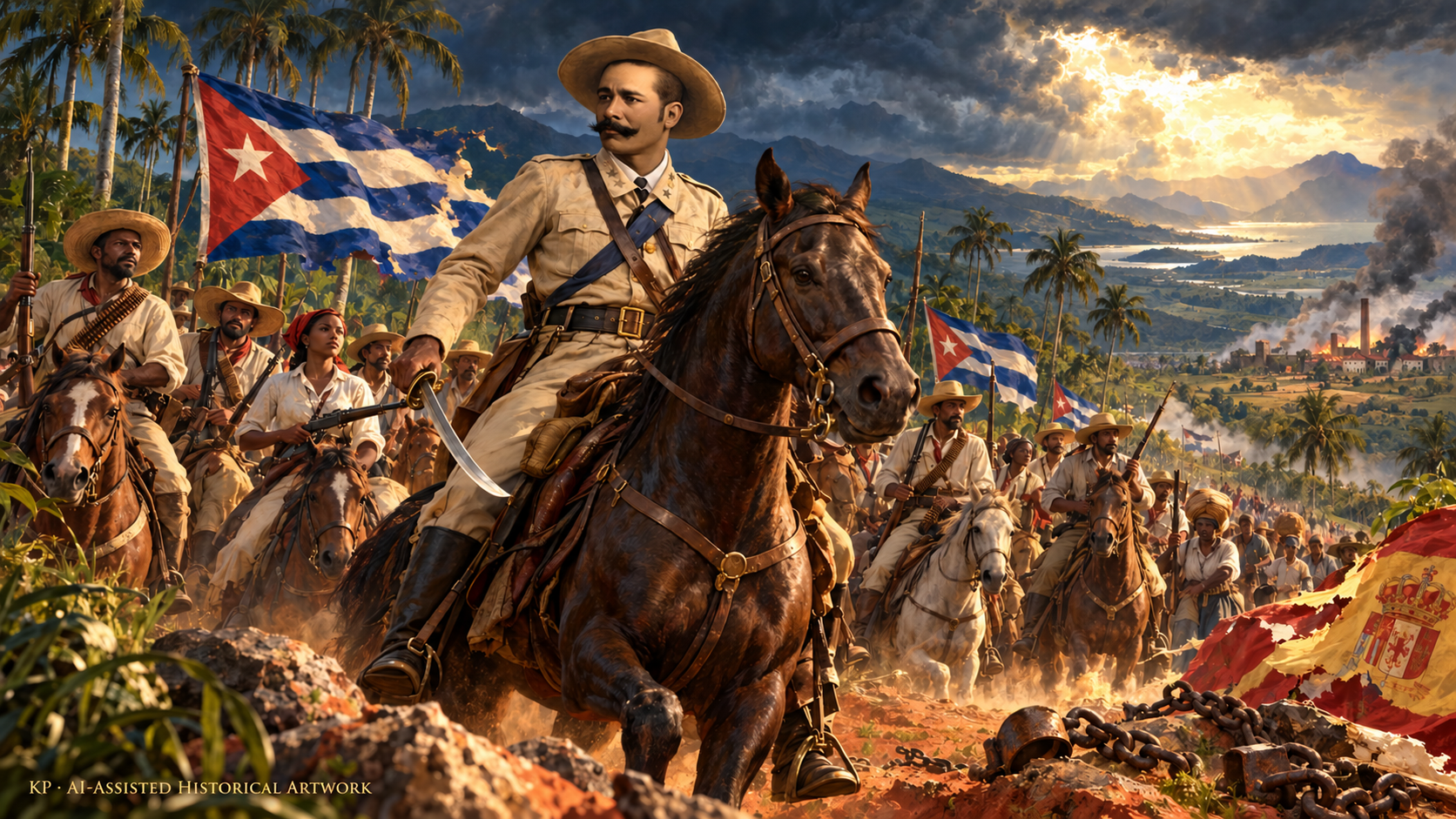
“There can be but one result for the Cubans. That is victory…”
Lieutenant General José Antonio de la Caridad Maceo y Grajales was one of the foremost commanders in Cuba’s nineteenth-century wars for independence from Spain. Known as el Titán de Bronce—the “Bronze Titan”—he rose from the ranks to become second-in-command of the Cuban Liberation Army. His name remains inseparable from the struggle against Spanish colonial rule, slavery, racial hierarchy, and the economic order that sustained them.
Maceo’s courage in battle was widely celebrated, but his importance was never merely military. He was also a principled advocate of Cuban independence and racial equality. At a time when colonial authorities and some Cuban elites sought to exploit anti-Black prejudice to divide the independence movement, Maceo insisted that Cuba’s future could not be built upon racial exclusion. His position is captured in the phrase attributed to him: “No whites nor blacks, but only Cubans.”
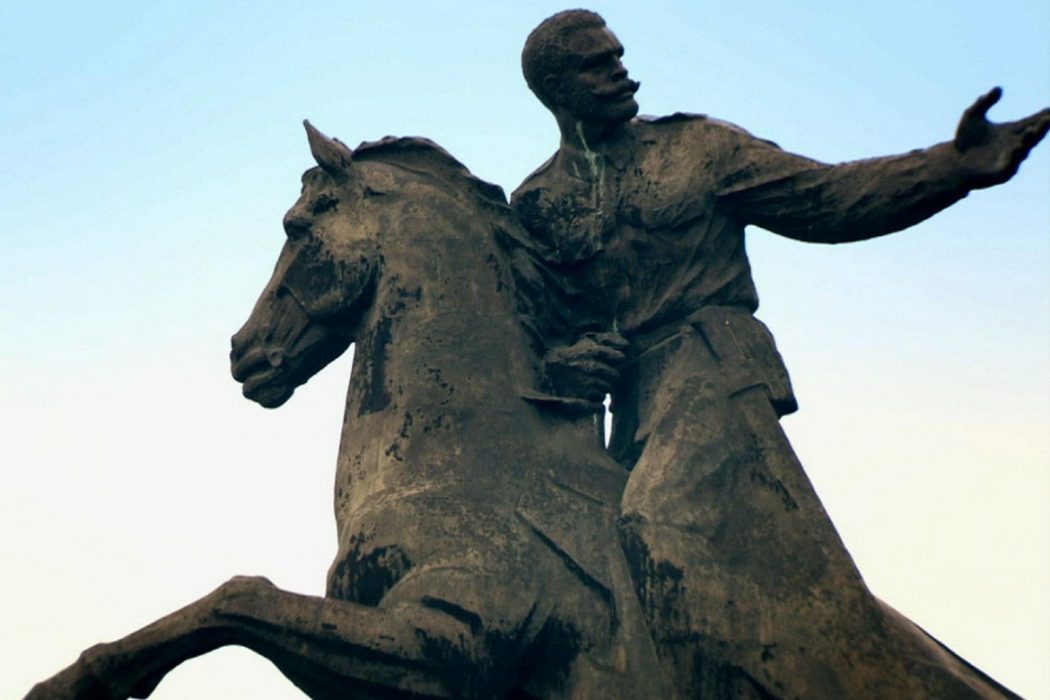
“I know of no man of military standing in the whole of America…that can excel the exploits of Antonio Maceo in the field of battle, as a soldier, during the past hundred years.” ~Arthur A. Schomburg
“General Maceo, the greatest [Black] soldier and general of modern times.” ~ George Edwin Taylor, in his speech accepting nomination as Presidential candidate of the National Labor Party in 1904.
“To Maceo fear was a myth. He was absolutely devoid of the sense we call fear. Every nerve, every sense, so tingled and vibrated with keen foresight, certainty of victory and love for his country that he never gave the slightest heed to personal danger… I loved him best when the lion was dormant and he grew reminiscent. He was one of those immortal characters who cause one to forget for the time that he is but a man. His was a soul of strong magnetism and great character – poetical like all of his race – and ever surrounded by that strength of refinement which denotes genius.” ~J-Syme-Hastings
Early life and family
Antonio Maceo was born on 14 June 1845 at Majaguabo, near San Luis, in the Santiago de Cuba region of eastern Cuba. He was the son of Marcos Maceo, a Venezuelan-born man of African descent, and Mariana Grajales Cuello, a free Afro-Cuban woman remembered as one of the great matriarchal figures of Cuban independence.
The Maceos lived in Oriente, a region whose economy and social structure differed in important ways from western Cuba. Large sugar estates and plantation slavery were especially concentrated in the west, while eastern Cuba included many smaller farms and independent cultivators. Such regional differences shaped the social base of the independence movement, which drew heavily from rural people, people of African descent, free workers, formerly enslaved people, and small landholders.
Mariana Grajales is rightly remembered for her family’s extraordinary sacrifices. Many of her sons entered the revolutionary struggle; several died in the long fight against Spanish oppression. The Maceo family’s commitment to independence was therefore neither symbolic nor rhetorical. It involved exile, the loss of property, bereavement, and decades of armed resistance.
The Ten Years’ War
Cuba’s first major war for independence began on 10 October 1868, when Carlos Manuel de Céspedes issued the Grito de Yara. Céspedes freed the people he held in captivity and called on Cubans to rise against Spanish colonial oppression. The conflict became known as the Ten Years’ War and lasted from 1868 to 1878.
Maceo joined the insurgency as an ordinary soldier. He advanced rapidly, earning his rank through endurance, tactical skill, and effectiveness in guerrilla warfare. Within five years, he had become a general. He fought alongside major figures in the independence movement, including Máximo Gómez, with whom he later shared responsibility for the most ambitious campaign of the final war for independence.
The Cuban insurgents—often called mambises—faced a far larger and better-equipped Spanish army. They relied on mobility, local knowledge, cavalry raids, sabotage, and the destruction of infrastructure that supplied the colonial war machine. The struggle was inseparable from the question of slavery. For many Black and mixed-race Cubans, independence offered the possibility not only of political liberation from Spain but also of a more equal social order.
Maceo’s military leadership and his anti-racist politics made him immensely popular among poorer Cubans and people of African descent. They also made him a target. The Spanish repeatedly attempted to depict Black Cuban leaders as advocates of a racial war or of a separate Black republic. These stories were intended to frighten white Cubans and fracture the revolutionary coalition. Maceo rejected such divisive propaganda, even as he confronted racism within the insurgent movement itself. In an 1876 letter, he protested racist insinuations directed against him and affirmed that being “a person of color” did not make him worth less than any other man.
The Protest of Baraguá
The defining moment of Maceo’s political life came at the end of the Ten Years’ War. On 10 February 1878, many Cuban leaders accepted the Pact of Zanjón, an agreement that ended the conflict without securing either Cuban independence or the immediate abolition of the Maafa.
Maceo refused to accept those terms. On 15 March 1878, at Mangos de Baraguá in eastern Cuba, he met with the Spanish commander General Arsenio Martínez Campos and rejected the pact. The meeting became known as the Protest of Baraguá. It has since occupied a central place in Cuban historical memory because it represented a refusal to treat reform, partial concessions, or colonial promises as a substitute for freedom.misiones.cubaminrex+1
Maceo’s position was not empty defiance. He and his supporters knew that the Cuban insurgency had been gravely weakened. Yet Baraguá declared that the struggle’s fundamental aims—independence and emancipation—had not been achieved. Maceo resumed resistance, though the remaining forces could not sustain the war for long. Eventually, he was compelled to leave Cuba.
The Protest of Baraguá transformed Maceo into a national symbol. It also ensured that the Pact of Zanjón would be remembered not as a final settlement, but as an unfinished chapter in Cuba’s struggle for self-determination.
Exile and political growth
After 1878, Maceo lived in exile and traveled through Jamaica, Haiti, Honduras, Costa Rica, the United States, and other parts of the Americas. He raised funds, built support for Cuban independence, and remained connected to networks of Caribbean and Latin American anti-colonial activism.
He visited New York in late 1878, where he attracted considerable attention from reporters and from Black political and civic communities. His reputation traveled widely, especially among African Americans who recognized in his career a powerful example of Black leadership in an anti-colonial struggle. Philip S. Foner’s study of the American response to Maceo documents the admiration he inspired beyond Cuba.
Maceo’s years outside Cuba were formative. Although he had received limited formal schooling as a child, he read widely, developed his political thought, and emerged from exile with a more fully articulated commitment to social justice, national sovereignty, and opposition to foreign domination. His life demonstrates that political education is not confined to formal institutions; it may also be shaped by war, migration, study, debate, and international solidarity.
In 1879, the short-lived Guerra Chiquita, or “Little War,” renewed armed resistance to Spain. Maceo could not return to Cuba to take part directly, and the uprising was defeated by 1880. Yet the cause of independence did not disappear. It remained alive in exile communities, among veterans, and in the political imagination of a generation determined to resume the struggle under better conditions.
The War of Independence
The final Cuban War of Independence began on 24 February 1895. Maceo returned to Cuba in April of that year, joining the new revolutionary campaign alongside Máximo Gómez and José Martí. He quickly resumed a leading role in the Liberation Army.
The Ten Years’ War’s principal strategic lesson was clear: a rebellion confined to the east could not defeat Spanish colonial structures. The western provinces contained much of Cuba’s wealth, including the sugar estates and commercial infrastructure vital to the colonial economy. The revolutionary army therefore needed to carry the war across the island.
In October 1895, Maceo launched the invasion of western Cuba. It was one of the war’s most audacious operations. His forces crossed from Oriente into the western provinces, fought repeated engagements, and took the conflict into Havana Province and Pinar del Río. The campaign demonstrated that Spain could not confine the rebellion to the east or protect the island’s most valuable economic regions.
Maceo’s western campaign intensified the pressure on Spain and contributed to the appointment of General Valeriano Weyler, whose brutal counterinsurgency policies became infamous. Weyler sought to isolate the rebels from the rural population through forced reconcentration. His campaign brought widespread suffering to Cuban civilians, but it did not destroy the independence movement.
Death at San Pedro
On 7 December 1896, Antonio Maceo was killed in action near San Pedro, close to Punta Brava in Havana Province, while attempting to link up with Máximo Gómez’s forces. He was 51 years old. Panchito Gómez Toro, the son of Máximo Gómez and one of Maceo’s close companions, also died in the encounter.
Maceo’s death was a severe blow to the Cuban cause. Spain celebrated prematurely, believing that the loss of the “Bronze Titan” would break the spirit of the insurgency. Yet the war continued. Cuban forces persisted, and Spanish colonial rule would soon collapse amid the combined pressures of the Cuban war and United States intervention in 1898.
The United States entered the conflict after the explosion of the USS Maine in Havana harbor in February 1898. Spain’s defeat ended more than four centuries of Spanish colonial oppression in Cuba, but it did not bring the full sovereignty Maceo and so many others had fought for. The United States occupied Cuba after the war and retained decisive influence over the island’s affairs for decades.
Maceo’s legacy
Antonio Maceo remains one of Cuba’s great national figures: a military commander, abolitionist, anti-colonial fighter, and Black Cuban leader whose life challenged both Spanish imperial oppression and the racial prejudices that colonialism fostered.
His legacy cannot be reduced to battlefield heroism alone. Maceo represented the conviction that political independence had to be joined to human dignity. He understood that a free Cuba could not be founded upon captivity, racial inequality, or submission to foreign power.
The annual commemoration of his death on 7 December honors not only the man but also the wider generation of Cubans who gave their lives for liberation. Maceo’s brother, Major General José Maceo, was also killed in the war, dying in battle at Loma del Gato on 5 July 1896.
More than a century after his death, Antonio Maceo endures as a symbol of courage, principle, and uncompromising commitment to freedom.
Sources:
Antonio Maceo by Margaret J. Adam (1941). Negro History Bulletin, 4(4), 83-82. JSTOR.
Antonio Maceo: Heroes, History and Historiography by Patricia Weiss Fagen, Latin American Research Review
A Tribute to Antonio Maceo by Phillip S. Foner
https://www.cambridge.org/core/journals/latin-american-research-review/article/antonio-maceo-heroes-history-and-historiography/E97F68156476D861436D50D1086BC27B
https://www.jstor.org/stable/2716545
https://1898exhibition.si.edu/node/55
https://www.britannica.com/biography/Antonio-Maceo


One Response
As the great great nephew of General Antonio Maceo, I truly appreciate your time and dedication to share this history.
Dr. Maceo Daniel Wattley