
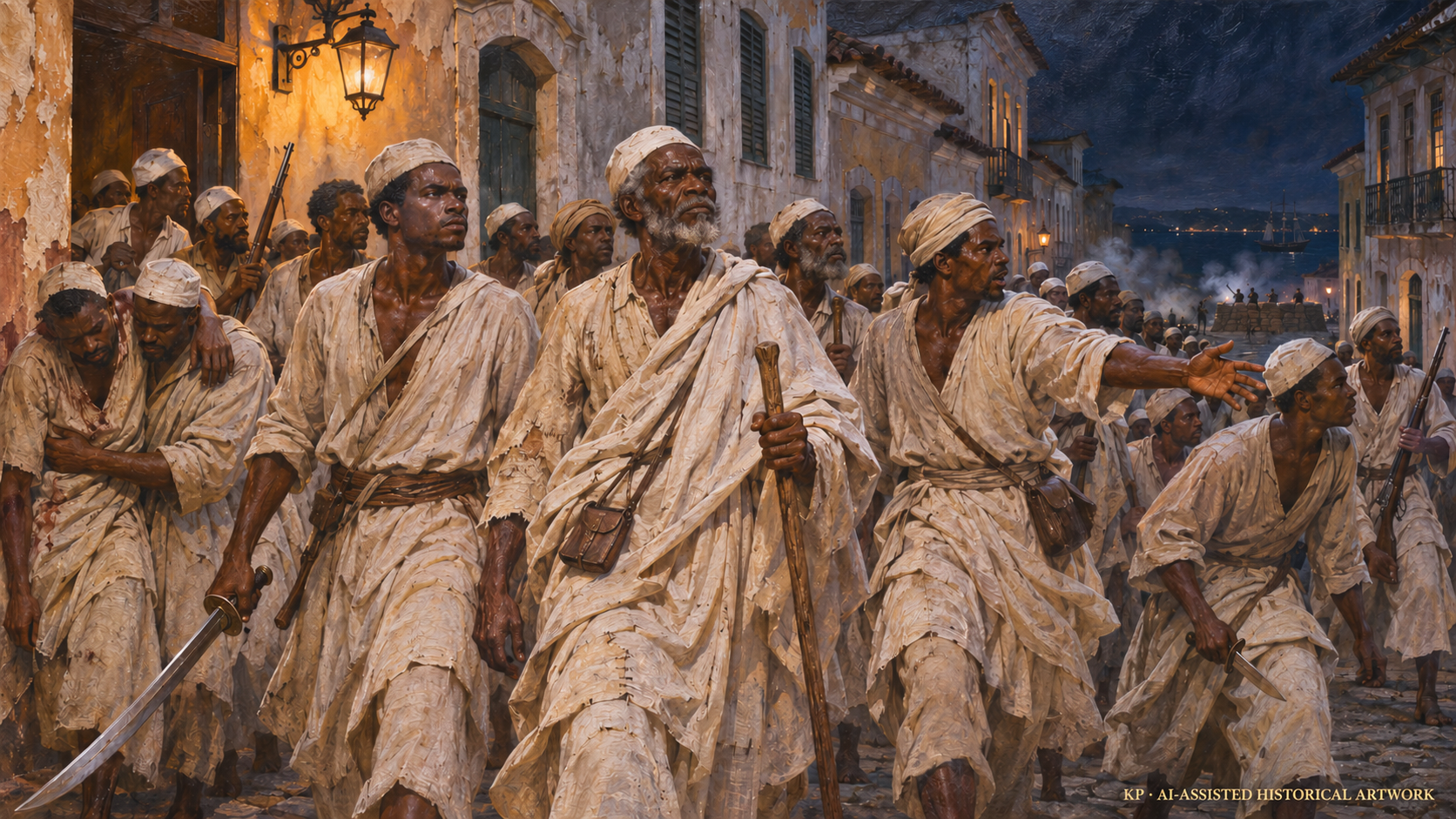
In the early hours of January 25, 1835, hundreds of African men entered the streets of Salvador, the capital of Brazil’s Bahia province, in an organized uprising against captivity and the political order that sustained it. Many wore long, light-colored garments over their trousers. Some carried folded Qur’anic passages in protective pouches. Armed largely with swords, knives, spears, and a limited number of firearms, they confronted soldiers, attacked government positions, and attempted to free a revered Muslim teacher from the municipal jail. For several hours, their movement carried a struggle nurtured in workplaces, rented rooms, and prayer gatherings into the heart of the city.
The movement became known as the Malê Rising, taking its name from ìmàle, a Yoruba word for Muslim. Its principal organizers were African Muslims, especially Yoruba-speaking people known in Bahia as Nagôs. Other Africans, including people who followed Orisha traditions, also joined the fighting. An estimated 600 men participated. More than seventy participants and approximately seven to ten opponents died before the principal fighting ended. Arrests, corporal punishment, imprisonment, executions, and expulsions followed.
The Rising was a military defeat, but its significance cannot be measured by the hours it lasted. It revealed the strength of African intellectual life in Brazil, the political possibilities of urban labor networks, and the solidarity that could connect people across differences of occupation and legal status. Its organizers had preserved and renewed institutions through which they taught, worshipped, pooled resources, and pursued freedom. In January 1835, those institutions helped sustain an armed challenge to the system that held so many of their members captive.
An African City Across the Atlantic
Salvador was a city profoundly shaped by African labor, knowledge, and cultural life. According to historian João José Reis, it had approximately 65,500 inhabitants in 1835, around 40 percent of whom were captive. Africans and people of African descent, both captive and free, together constituted approximately 78 percent of the population. African-born people formed a substantial majority of the captive population.
The city’s economy connected the Atlantic waterfront to the agricultural districts surrounding the Bay of All Saints. This surrounding region, the Recôncavo, produced sugar, tobacco, manioc, and other commodities. Tobacco linked Bahia directly to African commercial networks, where it was exchanged for captives. Manioc flour helped provision the ships that transported them across the Atlantic. The countryside and the city were therefore joined not only through agricultural exports but through the trafficking of people whose work sustained both.
Within Salvador, Africans worked as masons, tailors, blacksmiths, shoemakers, domestic workers, fishermen, boatmen, vendors, and porters. They transported barrels, water, merchandise, food, letters, and passengers. Their knowledge of the streets was practical and intimate: they knew the gradients between the upper and lower city, the locations of fountains and markets, the routes to the waterfront, and the positions of government buildings and military posts.
This urban environment created opportunities that differed from those available on rural estates. Many workers moved through the city to obtain employment, deliver goods, or sell their services. Such movement did not make captivity benign. It did, however, create spaces in which people could exchange information, maintain friendships, attend lessons, and organize beyond the immediate supervision of their captors.
The African Histories Carried to Bahia
The people who organized the Rising had histories that began long before their arrival in Brazil. Warfare, political fragmentation, religious conflict, and commercial trafficking in West Africa shaped the formation of Bahia’s African communities. Hausa-speaking people had been prominent in earlier arrivals and resistance movements. By the 1830s, Yoruba-speaking arrivals had become especially important within Salvador’s African population.
The disintegration of Oyo and fighting across Yoruba-speaking territories generated large numbers of prisoners of war and displaced people. Conflicts involving Ilorin connected local political struggles with Hausa, Fulani, and Yoruba Muslim networks. Captives passed through coastal ports including Ouidah, Porto-Novo, Badagry, and Lagos before being transported to Bahia.
These conflicts did not divide neatly into Muslims on one side and non-Muslims on the other. People with different religious affiliations could become captives, and Muslim identity did not guarantee protection from capture or sale. Among those transported were people with experience in skilled trades, military service, commerce, and Islamic learning.
The designation Nagô gathered together people whose African identities were more particular. They might identify with Oyo, Egba, Ijebu, Ijesha, or other communities. During the investigations after the Rising, some gave these more precise affiliations rather than accepting Nagô as a complete description. One man explained the distinction succinctly: although they were all Nagôs, each had his own homeland.
Shared language and experience in Bahia could nevertheless create new connections across differences that had mattered in Africa. The solidarity mobilized in 1835 was neither an unchanged inheritance nor an identity invented from nothing. It emerged through the interaction of remembered homelands, common experiences in Brazil, religious relationships, and the practical demands of survival.
A Longer History of Resistance
The Malê Rising developed within decades of organized resistance in Bahia. Earlier plots for freedom and uprisings connected urban workers, agricultural communities, and independent settlements beyond plantation control. Hausa participants were especially prominent in several early nineteenth-century movements.
A plan discovered in 1807, armed action around Nazaré das Farinhas in 1809, and the Itapoã Rising of 1814 demonstrated the persistence of collective opposition. Further movements followed in the Recôncavo. In 1826, the Quilombo do Urubu became the setting for armed resistance in which Zeferina, remembered for fighting with a bow and arrows, played a prominent part. Another urban uprising occurred in Salvador in 1830.
These episodes did not form a single uninterrupted organization. Their participants, circumstances, and objectives varied. Together, however, they showed that captivity was repeatedly contested through planning, flight, armed confrontation, and the creation of independent communities.
The events of 1835 should therefore not be presented as a sudden awakening among people previously resigned to their circumstances. They belonged to an established history of political action, while drawing particular strength from Islamic teaching and Salvador’s urban networks.
Workplaces as Networks of Solidarity
One foundation of the Rising lay in how they organized work.
Many African men in Salvador earned money through carrying, hauling, and other services. Captive workers commonly had to surrender a fixed daily or weekly sum to their captors. They could sometimes keep earnings above that amount. Under favorable circumstances, years of saving made it possible to purchase formal release. African women also worked extensively in street commerce, selling food and other goods.
Porters and other workers gathered at stations known as cantos. Often organized around shared African origins or language, these groups operated under a captain who helped arrange services. They provided more than access to employment. They also sustained friendships, mutual assistance, communication, and collective discussion. Reis identifies them as essential to the mobilization of Africans in 1835.
Free and captive Africans frequently worked alongside one another and sometimes lived in the same buildings. Their legal circumstances differed, but their relationships could cross that divide. A free shopkeeper could provide a meeting place; a captive porter could carry news; a teacher could connect people whose daily work otherwise kept them apart. The Rising’s importance lies partly in the decision of particular free Africans to risk their livelihoods and security alongside people who remained captive.
Islamic Learning and the Creation of Community
Islam gave the movement a powerful institutional and spiritual foundation.
Muslim teachers held lessons and prayer gatherings in rented rooms, shops, and other adapted spaces. Students practiced recitation, memorized Qur’anic passages, and learned to write in Arabic. Some had received instruction in Africa; others continued or deepened their learning in Bahia. These activities preserved relationships with African intellectual traditions while adapting them to the conditions of Brazilian captivity.
The surviving testimony offers glimpses of this educational world. One Hausa man, Albino, described students writing lessons on wooden boards, repeating them, and then washing the writing away. The water could be consumed as a way to receive blessings associated with the sacred words. Such practices joined memory, writing and devotion.
Teachers were respected not only for what they knew but for how they embodied that knowledge. An interpretation drawing on historian Rudolph Ware’s work understands these learned figures as “walking Qur’ans”: people whose conduct and teaching made sacred knowledge present within the community. This helps explain why imprisoning or removing a teacher could become a collective crisis rather than an injury affecting one individual alone.
The schools were not merely concealed military organizations. Their purposes included worship, education, charity, consolation, and maintaining religious life. Their contribution to the Rising emerged from the trust and responsibility cultivated through those activities. Institutions built to sustain a community also provided relationships through which its members could organize resistance.
The Teachers and Organizers
Pacífico Licutan: The Teacher Known as Bilal
One of the most respected figures was Pacífico Licutan, an elderly Nagô tobacco worker and Muslim teacher also known as Bilal. His students had attempted to purchase his release, but their offers were refused. He was subsequently imprisoned because his captor’s debts had placed him among the assets liable to seizure and auction. He was not initially jailed for taking part in an uprising.
His detention exposed the gulf between the meaning he held for his community and the status assigned to him by law. To his students, he was a teacher and bearer of knowledge. To creditors, he could be treated as an asset available for disposal.
Freeing him became one of the Rising’s central objectives. The attack on the municipal jail was therefore both a tactical operation and an attempt to restore a teacher to the community that depended on him.
Ahuna
Ahuna, a Nagô Muslim, was recognized in testimony as a leading figure in Bahia’s Muslim community. His removal to Santo Amaro before the Rising intensified concern among his followers. Accounts of the planning associate the movement with a desire to reunite with him.
His importance did not depend on his presence in the streets during the fighting. The respect attached to him, and the relationships formed around his teaching, were themselves part of the movement’s strength.
Manoel Calafate and Aprígio
Manoel Calafate, an older free Nagô craftsman and teacher, was addressed by followers as Pai Manoel—Father Manoel. The rooms associated with him and Aprígio, another free Nagô, became an important center for religious study and preparation. Aprígio also made Muslim clothing, including long garments and prayer caps.
It was at the rented meeting place associated with Calafate that the police confrontation forced the Rising to begin before its planned hour. Calafate took part in the fighting and appears to have died during the night’s confrontations.wikipedia+1
Luís Sanim
Luís Sanim, identified by Reis as a Nupe man, was a tobacco worker and religious teacher associated with a community fund. Contributions supported practical and religious needs, including clothing and the purchase of release from captivity. Accounts differ over the precise allocation of the money, but agree on its collective purpose.resistencia+2
The fund illustrates how community-building could proceed through small contributions under severe financial constraints. People whose labor enriched others nevertheless reserved resources for mutual assistance and the recovery of personal independence.
Dandará
Elesbão do Carmo, known within the African community as Dandará, was a free Hausa tobacco merchant. His shop served as a place of prayer and instruction. Testimony described lessons held twice daily and devotional activity involving prayer beads and repeated invocations.
Other teachers, including Dassalú, Gustard, and Nicobé, sustained learning in the Vitória district. Taken together, these figures reveal a network rather than a movement dependent on one solitary commander. Its strength rested in overlapping relationships among teachers, students, workers, traders, and neighbors.
Ramadan and the Choice of January 25
The organizers planned to act on Sunday, January 25, 1835, during Ramadan.
The timing brought religious meaning and practical opportunity together. Ramadan intensified prayer, gathering, fasting, and collective reflection. Historical accounts also link the Rising to Laylat al-Qadr, the Night of Power, which commemorates the revelation of the Qur’an. Exact calendar claims vary in later retellings, but the movement’s connection to the closing part of Ramadan is well established.
January 25 also coincided with celebrations of Nossa Senhora da Guia, Our Lady of Guidance, within the Bonfim religious calendar. These festivities drew people away from central Salvador. The organizers expected the occasion to create openings for assembly and action. Sunday routines also offered movement opportunities that might be less conspicuous on another day.
The plan was to begin in the early morning. Its success depended on coordination: people needed to assemble, obtain weapons, reach important targets, and connect with others before the city’s armed forces could respond effectively. Advance warning destroyed much of that advantage.
The Warning That Changed the Night
On the evening of January 24, information about the planned Rising reached the provincial government through a chain of personal contacts.
Sabina da Cruz, a free Nagô woman, went looking for her husband, Vitório Sule, and found him among men preparing for the movement. She passed information to Guilhermina, another free African woman. Guilhermina informed her neighbor André Pinto da Silveira, whose associates carried the warning to government representatives.
The provincial president, Francisco de Souza Martins, ordered defensive preparations. The palace guard was reinforced, military posts were alerted, patrols increased, and boats assigned to watch the bay. The organizers’ intended moment of surprise was slipping away.
The warning also reveals divisions within African life in Salvador. Shared origin did not ensure agreement about an armed uprising. Family relationships, religious commitments, personal security, and expectations of retaliation could pull people in different directions.
The Outbreak on Guadalupe Street
At approximately one o’clock in the morning, a patrol approached the house where Calafate and other participants were gathered. The rented rooms stood beneath the residence of Domingos Marinho de Sá on Guadalupe Street, in the area associated with Ladeira da Praça. When the patrol attempted to enter, approximately sixty armed Africans emerged and fought their way into the street.
The Rising had begun several hours before the intended time.
The opening confrontation caused injuries and deaths. Vitório Sule was among those killed. Groups then moved through the city, some engaging armed opponents while others called on Africans to join them. The movement was no longer unfolding according to its preferred sequence; recruitment and combat now occurred simultaneously.
Many potential participants had not yet assembled. Others faced increased surveillance or could not leave their residences. The exposure of the plan therefore affected not only the opening encounter but the size, timing, and coordination of the forces available throughout the night.
The Attempt to Free Licutan
One principal group climbed toward Palace Square and attacked the municipal jail.
Licutan was held in the building’s lower level. Reaching him required overcoming guards in a square overlooked by another armed position: the government palace. The fighters came under fire from both locations and could not breach the prison.
The failed rescue was a major setback. It left a revered teacher in custody and denied the participants an early objective around which the movement had gathered. It also demonstrated the advantage held by defenders occupying fortified buildings with firearms.
The fighters withdrew and continued through Salvador, seeking reinforcements and weapons. The night became a series of encounters across the city’s steep streets rather than the coordinated seizure of key positions envisioned by the organizers.
Fighting Across Salvador
Participants moved through areas around the theater, Vitória, Campo Grande, Mercês, São Bento, and the central city. They attacked military and police positions and attempted to obtain arms. Africans from Vitória joined those already fighting.
The city’s geography offered both opportunity and danger. Familiarity with streets and neighborhoods helped the fighters move and recruit. Yet troops occupying strongpoints could fire into routes the participants needed to use. Reis describes the Africans passing Fort São Pedro under heavy fire; this should not be confused with a successful assault on the fortress.
The principal documented targets were governmental, military, and custodial positions. The movement was not simply an episode of indiscriminate destruction. Its actions reflected identifiable purposes: releasing prisoners, acquiring weapons, gathering participants, and breaking the forces that defended captivity.
Those purposes became increasingly difficult to achieve as the fighting continued. The participants possessed determination, local knowledge, and organization, but only a limited supply of firearms. Their opponents had prepared positions and access to cavalry as well as infantry.
The fighters eventually moved toward the lower city, seeking a route toward Cabrito, where they expected to meet people from surrounding agricultural estates. Connecting urban and rural participants remained an important possibility even after the initial plan had been disrupted.
Água de Meninos
At Água de Meninos, the route out of the city brought the fighters into confrontation with cavalry.
Around three o’clock in the morning, a group reached the military post and attempted to get past it. Gunfire and mounted attacks disrupted their movement. Further participants arrived, but renewed fighting could not overcome the defenders.
This was the decisive encounter. The Africans’ limited firearms and predominantly hand-held weapons left them at a severe disadvantage against gunfire and cavalry charges. Some fled toward the surrounding terrain; others entered the water and drowned while attempting to escape.
By the end of the principal fighting, more than seventy participants had died. Estimates of losses among their opponents vary, generally falling between seven and ten. The commonly cited participation figure of approximately 600 refers to the movement as a whole, not to a single body of men fighting together at every location.
The Rising had lasted only a few hours. Exposure forced it to begin early, while military inequality prevented participants from regaining the initiative.
The Sacred Papers
Among the most remarkable surviving traces of the Rising are Arabic manuscripts and protective objects seized during the investigations.
Some participants carried Qur’anic passages and prayers folded into small leather or cloth pouches. These objects, often called patuás in Brazil, belonged to traditions of protection and devotion that had crossed the Atlantic. They were worn around the neck or carried close to the body. Muslim teachers prepared such materials, and their use extended beyond the Muslim community.
The papers were not simply military instructions written in a language unfamiliar to the police. Many contained prayers, Qur’anic selections, exercises, and devotional texts. One folio associated with a fallen participant began with Surah Ya-Sin and included passages from Al-Baqarah. Another contained material understood as a wird, a collection used in repeated personal devotion. These texts reveal people who entered the fighting carrying their intellectual and spiritual lives with them. The written word could provide reassurance, connection, protection, and an expression of collective hope.
After the Rising, the same materials became grounds for suspicion. Police and magistrates treated possession of Arabic papers as evidence of involvement, exposing people who had not fought to arrest and punishment. Reis explicitly warns that not all African Muslims participated, even though the investigation often treated signs of Muslim identity as signs of guilt.
The confiscated papers therefore have a double history. They were instruments of learning and devotion before becoming exhibits in criminal proceedings. Their survival now permits a partial recovery of the community life that the prosecutions sought to dismantle.
Punishment and the Four Executions
The repression extended far beyond those captured during the fighting.
Searches, interrogations, arrests, and prosecutions reached across African neighborhoods and social networks. Defendants received imprisonment, compulsory labor, corporal punishment, death sentences, and expulsion. Some free Africans were expelled despite the absence of definitive evidence against them.
Sixteen defendants initially received death sentences, according to Reis. Twelve subsequently obtained commutations. Four were executed on May 14, 1835, at Campo da Pólvora:
- Jorge da Cruz Barbosa, whose Yoruba name was Ajahi, a free worker who carried lime.
- Pedro, a Nagô sedan-chair carrier held captive by an English merchant.
- Gonçalo, a Nagô man.
- Joaquim, also a Nagô man.
The four were shot by a firing squad. They had been sentenced to hanging, but officials could not obtain an executioner willing to carry it out. The reason for every refusal is not established; the difficulty itself is recorded in Bahia’s judicial account.
These four executions should be distinguished from the much larger number killed during the fighting and from deaths caused by punishment or detention. Corporal punishment was itself potentially fatal. Sentences ranged from hundreds of lashes to as many as 1,200, administered across multiple days. Reis identifies Narciso, a Nagô man, as at least one person known to have died from this punishment.
Licutan’s Sentence and Uncertain Fate
Licutan remained in prison while his followers fought to release him.
An account preserved through testimony describes him weeping as captured students were brought into custody. The failure of the Rising confronted him not only as a political defeat but as the suffering of people whose religious education and communal lives had been entrusted to him.
Although he had not fought in the streets, he received a sentence of 1,200 lashes, to be administered in installments of fifty. His standing as a teacher made him vulnerable to prosecution as a formative influence on the movement.
His eventual fate is not securely established. Some later interpretations infer that such punishment caused his death.
Expulsion and the Return Across the Atlantic
Deportation became another way to break African networks in Bahia.
Hundreds of Africans were expelled in the aftermath, although published totals vary according to the period and categories counted. Some had been convicted; others were removed on suspicion. Still others chose to leave under conditions of intimidation and insecurity. Departure described as voluntary could take place within a severely constrained field of choices.
These movements formed part of a wider history of return from Brazil to West Africa. Deportees and other returnees contributed to communities along the Bight of Benin and elsewhere on the coast. They carried Portuguese-language experience, family connections, religious practices, and skills in building, tailoring, commerce, and other occupations.
The communities often described as Aguda, and the Tabom community in Ghana, should not be reduced to descendants of the 1835 participants. Their histories include different generations of migrants and returnees, with varied religious identities and reasons for departure. The Malê aftermath contributed to this transatlantic world without accounting for all of it.
Expulsion severed relationships in Bahia, but it could also generate new connections across the ocean. The Atlantic that had carried people into captivity became, under profoundly unequal circumstances, a route through which survivors remade their lives.
Fear Across Brazil
News of the Rising spread beyond Bahia. Newspapers reported it, oppressors discussed its implications, and surveillance of African communities intensified in other provinces, especially Rio de Janeiro.
The Haitian Revolution sharpened captors’ and the government’s fears. Salvador demonstrated that African workers could sustain institutions, coordinate across the city, and turn religious and occupational networks into an armed challenge. The concern was not simply that individuals might escape. It was that people could act collectively as political opponents.
The Rising also entered a longer debate over Atlantic trafficking. Historians have argued that fear of African resistance contributed to the public-security arguments used against continued trafficking, alongside British pressure, diplomatic conflict, and other political considerations. The effective suppression pursued after the 1850 legislation cannot be attributed to the Malês alone, nor did it follow immediately from their defeat: trafficking continued on a large scale during the intervening years.
The connection remains important. It places African resistance within the explanation of political change rather than presenting reform exclusively as the initiative of governments and overseas campaigners.
The Rising was not the final major uprising in Brazil. Manuel Congo and Mariana Crioula’s movement in 1838 provides a clear subsequent example. The repression of 1835 damaged particular networks; it did not end collective opposition to captivity.
African Voices in the Records
The surviving investigations constitute an unusually rich, though deeply mediated, record of African life in nineteenth-century Brazil.
The Public Archive of the State of Bahia preserves judicial testimony and surviving Arabic documents. Through them, historians have recovered information about names, African origins, occupations, religious education, households, friendships, and the movement of people through Salvador.
Some individuals described learning Arabic as children in Africa. Others explained the prayers they wrote or the protective objects they wore. These statements challenge any account in which the Atlantic crossing erased intellectual identity. People remembered lessons, recognized teachers, reproduced texts, and continued forms of learning under new conditions.
The records must nevertheless be read with care. Defendants and witnesses spoke under threat of punishment. Statements passed through interrogation, interpretation, and Portuguese transcription.
The archive does not provide unfiltered access to the participants’ thoughts. It does preserve encounters in which African people asserted identities and described practices that their oppressors often misunderstood.
Memory, Restitution, and the Right to Burial
The Rising remains part of Bahia’s cultural and political life.
The Afro-Bahian musical organization Malê Debalê carries its name into contemporary public culture. Through music, dance, and Carnival performance, the group connects historical resistance with struggles against racism, political exclusion, and violence against Black communities. Remembrance takes place not only through books and commemorative dates but through collective artistic practice.
Another form of remembrance concerns human remains removed from Bahia and taken to the United States.
A skull held at Harvard has been associated in historical documentation with a participant in the Rising, although that identification remains uncertain. Muslim community representatives, historians, and Brazilian institutions have sought its return and a dignified burial. The campaign adopted the name Arakunrin, a Yoruba term meaning “brother.”
Reporting published on November 7, 2026, announced that Harvard would return the remains, with a handover scheduled at the Federal University of Bahia for November 11. Researchers continued to distinguish the documented removal of a person’s remains from Bahia from the still-unproven identification of that person as a Malê fighter. However, a person’s body was removed, transported, and incorporated into a scientific collection within a history of racialized objectification. Restitution concerns the restoration of dignity and care even where an individual name has not yet been recovered.
A Struggle Larger Than the Night
The Malê Rising did not secure the liberation its participants sought. Its organizers were killed, punished, dispersed, or expelled. The attempt to free Licutan failed, and the military imbalance at Água de Meninos brought the principal fighting to a devastating end.
Yet the Rising revealed a society already being made within the constraints of captivity: teachers instructing students, workers maintaining associations, neighbors providing meeting places, and community members pooling scarce earnings for clothing, assistance, and release. Armed resistance emerged from those practices of collective life.
The surviving prayers and testimony preserve the participants as more than defendants in a failed uprising. They appear as people with knowledge, obligations, disagreements, memories, and plans. Their movement was neither an inexplicable eruption nor an undirected act of despair. It was a political undertaking built through relationships that had survived capture, displacement, and the Atlantic crossing.
For a few hours in January 1835, those relationships carried an organized struggle into Salvador’s streets. The fighting ended before the morning they had intended to seize. The history of what they had built—and what they tried to make possible—extends far beyond that night.
Sources:
Slavery in Brazil by Herbert Klein and Francisco Vidal Luna
Freedom by a Thread: The History of Quilombos in Brazil edited by João José Reis and Flávio dos Santos Gomes.
https://cdn2.hubspot.net/hubfs/4713562/Website-Paper-PDFs/Du%27as-of-The-Enslaved_-The-Male-Slave-Revolt-in-Bahia%2C-Brazil.pdf
https://watermark02.silverchair.com/36fogleman.pdf?
https://warwick.ac.uk/fac/arts/history/students/modules/hi2f1/programme/seminar4/reis_slave_resistance_bahia_1807-35.pdf
https://www.academia.edu/16131322/Islamic_Transnationalism_and_Anti_Slavery_Movements_The_Mal%C3%AA_Rebellion_as_Debated_by_Brazil_s_Press_1835_1838
https://festival.si.edu/blog/male-rebellion-african-muslim-brazilian-uprising
https://en.wikipedia.org/wiki/Mal%C3%AA_revolt
https://www.theguardian.com/world/2025/mar/05/brazil-harvard-african-rebels-skull-190-years
https://www.youtube.com/watch?v=FD3rdri2LiQ