
William Henry Johnson emerged from his participation in the First World War as one of the most extraordinary soldiers of his generation. Serving in the 369th Infantry Regiment, the famed Harlem Hellfighters, he became internationally known for an act of astonishing courage in the Argonne Forest, where he fought off a German raiding party while badly wounded and saved his fellow soldier from capture. His heroism would earn him the wartime nickname “Black Death” and make him famous abroad, but it did not bring him immediate justice at home. His story reveals not only battlefield valor but also the bitter contradictions of a nation willing to celebrate African-American sacrifice in war while denying veterans full recognition in peace.
Johnson was born William Henry Johnson in Winston-Salem, North Carolina, around July 15, 1892. As a teenager he moved north to Albany, New York, where he worked a range of laboring jobs before becoming a redcap porter at Union Station. He was slight of build, standing about five feet four inches tall and weighing roughly 130 pounds, but his small stature bore no relation to the force of character he would later display. In June 1917, only weeks after the United States entered the war, he enlisted in Company C of the 15th New York Infantry Regiment, the unit that would later become the 369th Infantry Regiment.
Johnson entered military service in a segregated army that doubted the fitness of Black soldiers for combat. The 369th, like other African American units, encountered racism from white soldiers and commanders and was often denied the dignity routinely extended to white regiments.Eventually attached to the French Army because many white American soldiers refused to fight alongside Black troops, the regiment wore French helmets, used French rifles, and found in France a measure of military respect denied to them by their own country. Under French command, the Harlem Hellfighters proved themselves one of the most formidable fighting units of the war, spending 191 days at the front and earning widespread admiration.
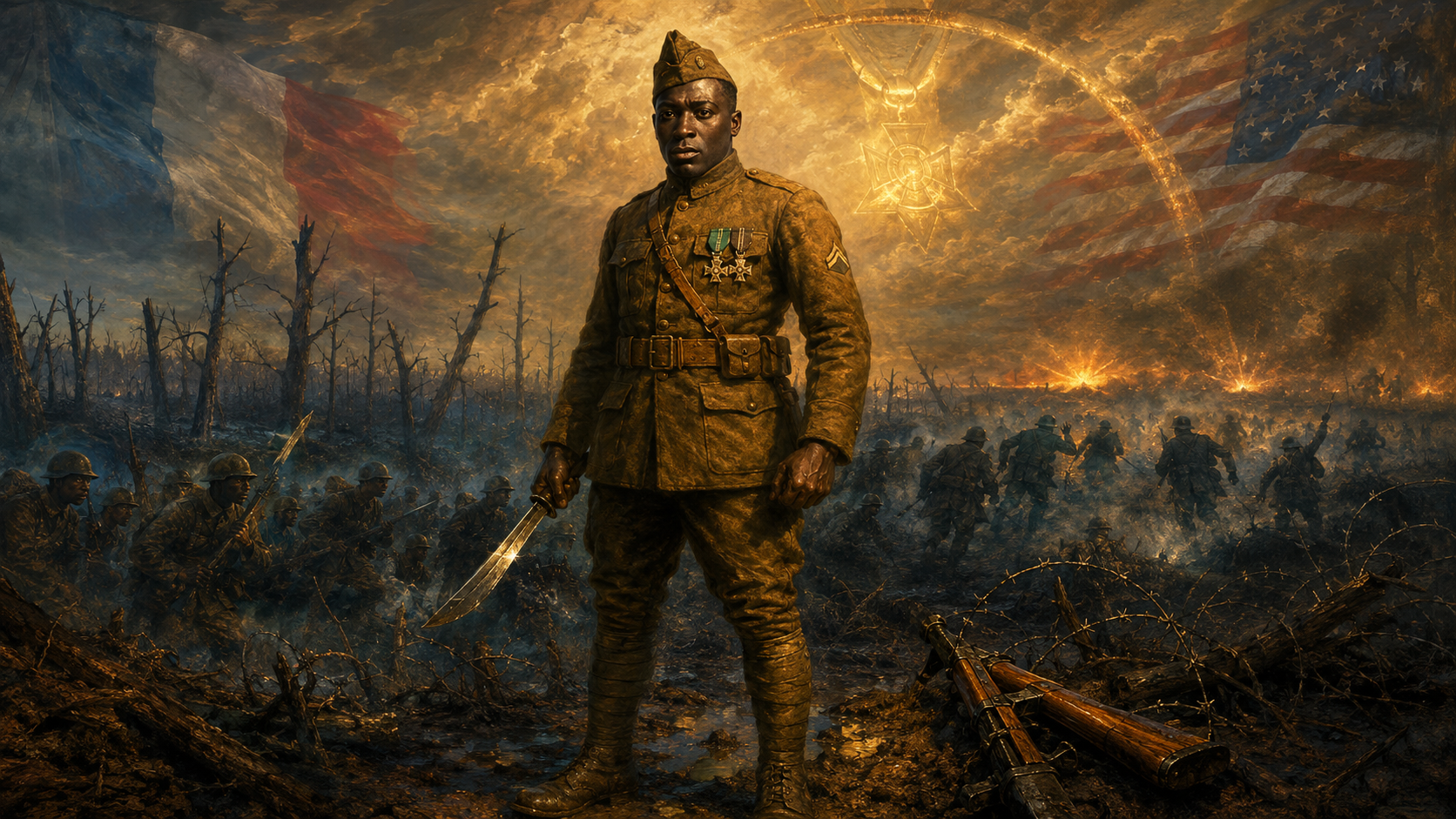
Johnson’s defining moment came during the night of May 14–15, 1918, while he was on sentry duty with Private Needham Roberts in the Argonne Forest.A German raiding party, estimated in some accounts at about twenty-four men, attacked their position with the apparent aim of killing or capturing American soldiers. Roberts was badly wounded, and Johnson himself suffered multiple gunshot wounds and other injuries as the attack intensified. Even so, he kept fighting. He fired his rifle until it jammed, then used it as a club until it splintered, and when left with only a bolo knife, he launched himself at the attackers in close combat.
What followed entered military legend. Johnson slashed and stabbed his way through the raiding party, killing at least four Germans and wounding many more, with estimates ranging from ten to twenty. Though wounded twenty-one times, he prevented the enemy from breaking through the line and stopped them from carrying Roberts away as a prisoner. When reinforcements arrived, Johnson collapsed from his injuries, but the scale of what he had done was already clear by daylight. His own description of the struggle remained characteristically understated: “There wasn’t anything so fine about it. Just fought for my life. A rabbit would have done that.”
The French immediately recognized the magnitude of Johnson’s courage. He and Needham Roberts became the first American privates to receive the Croix de Guerre, and Johnson’s award carried the coveted Gold Palm for exceptional bravery. His feat won admiration across France, and he quickly became one of the most celebrated Black soldiers of the war. The American press also elevated him into public view, and Theodore Roosevelt reportedly named him one of the five bravest Americans to serve in the conflict. In wartime imagery and newspaper accounts, Johnson came to symbolize both the battlefield prowess of the Harlem Hellfighters and the broader capacity of Black Americans whose patriotism had long been doubted.
Yet military glory did not protect him from the racial realities of postwar America. Johnson returned home to acclaim, marched in the 369th’s triumphal parade in 1919, and briefly participated in a speaking tour sponsored to promote racial harmony. That opportunity ended when he spoke candidly about the abuse Black soldiers had suffered and about the refusal of many white troops to serve beside them. After breaking from the approved script, he was sidelined and denied further support. The same country that had used his image as a war hero proved unwilling to hear the full truth of his experience.
His postwar years were marked by pain, instability, and neglect. Because his discharge papers failed to record the twenty-one wounds he suffered in combat, he was denied the disability support that might have given him some security. The injuries made it difficult or impossible for him to sustain regular employment, and the resulting financial hardship contributed to the collapse of his family life. He struggled with ill health, poverty, and personal loss, and by the late 1920s he was seriously ill. Johnson died in 1929, still young, penniless, and for many years insufficiently honored by the nation he had served so bravely.
Even in death, misunderstanding surrounded him. For decades, it was widely believed that he had been buried in a pauper’s grave, a fate that seemed to symbolize the abandonment of Black veterans in American public memory Later research revealed that he had in fact been buried with full military honors at Arlington National Cemetery, correcting one of the most painful misconceptions attached to his story. That rediscovery helped renew the campaign to secure proper recognition for his service.
The honors that should have come swiftly arrived only after decades of advocacy. Johnson was posthumously awarded the Purple Heart in 1996 and the Distinguished Service Cross in 2003. In 2015, nearly a century after his great act of valor, he finally received the Medal of Honor. By then, his life had become emblematic of a broader historical truth: Black soldiers were often asked to prove their loyalty repeatedly, even when their bravery far exceeded the demands placed upon them.
Johnson’s legacy today is inseparable from that of the Harlem Hellfighters, the all-Black regiment that fought with distinction despite segregation, hostility, and institutional prejudice. But his own story remains singular. He was a working-class Black man who, in a moment of terrible danger, fought with unmatched ferocity to defend another soldier and hold the line. His life after that night exposed the cruelty of a society that could praise Black heroism while withholding justice from Black heroes.
To write about Henry Johnson is therefore to write about both courage and betrayal. His battlefield actions belong among the most dramatic and consequential acts of hand-to-hand combat in the American experience of the First World War. His postwar suffering reveals the costs imposed on Black veterans by racism, bureaucracy, and selective remembrance. The long struggle to recognize him fully does not diminish his heroism; rather, it sharpens the meaning of it. Henry Johnson stands as a figure of unyielding bravery whose life compels remembrance not only because of what he did in war, but because of what his nation failed to do for him afterward.
Sources:
https://www.smithsonianmag.com/history/remembering-henry-johnson-the-soldier-called-black-death-117386701/
https://aaregistry.org/story/henry-lincoln-johnson-born/
ttps://www.cbsnews.com/news/wwi-medal-of-honor-henry-johnson-family-not-related
https://en.wikipedia.org/wiki/Henry_Johnson_(World_War_I_soldier)
https://www.warhistoryonline.com/instant-articles/sergeant-henry-johnson.html