

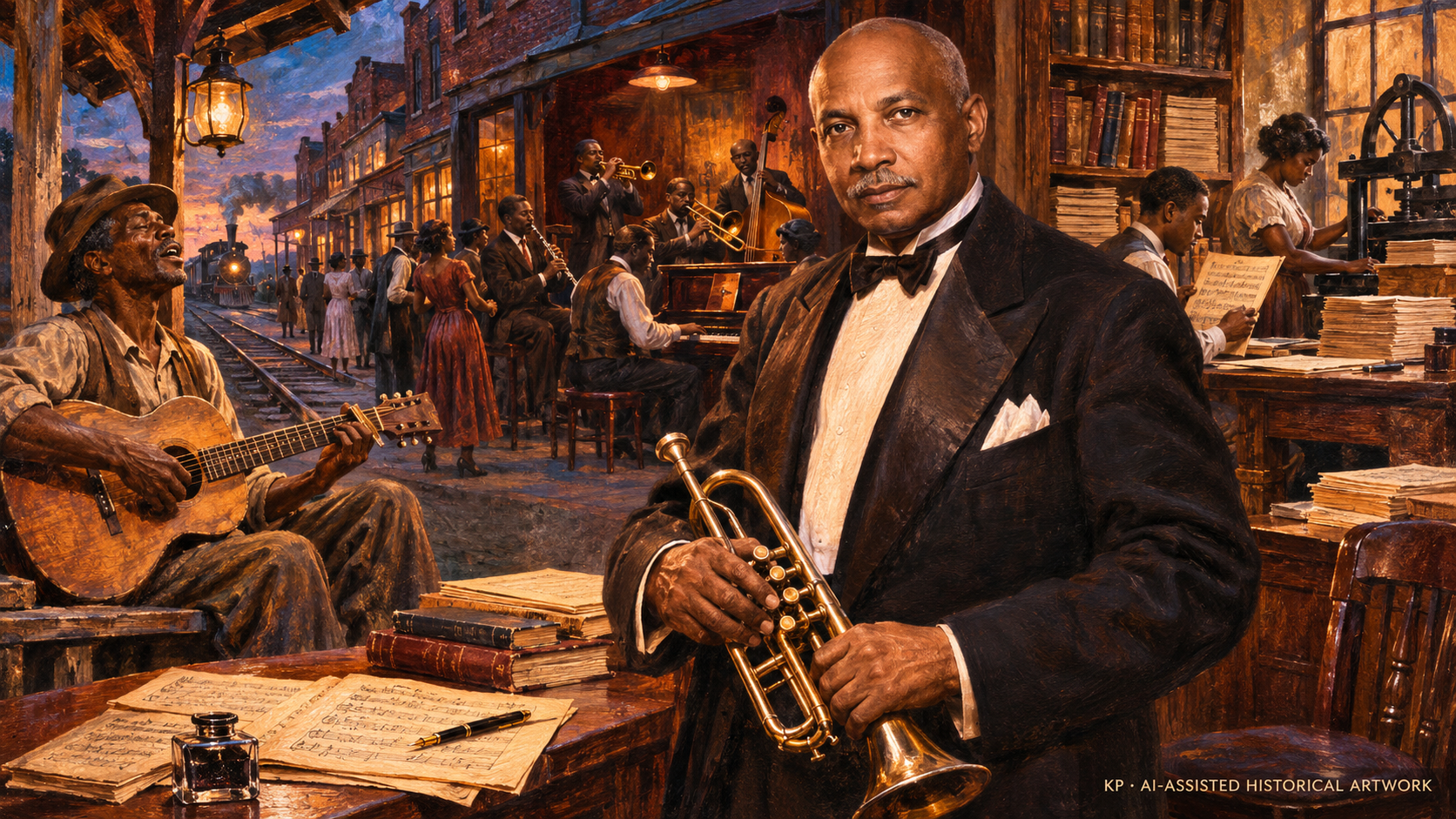
William Christopher Handy was an African American composer, bandleader, music publisher, and author whose work helped carry the blues from community performances into an international musical repertoire. Through compositions including “Memphis Blues,” “St. Louis Blues,” and “Beale Street Blues,” he brought together the expressive language of Black Southern music, the rhythmic energy of ragtime, and the possibilities of orchestral arrangement.
Although known as the “Father of the Blues,” Handy did not invent the music. The blues already belonged to a living tradition sustained by Black singers, instrumentalists, and communities. His particular achievement was recognizing its possibilities as a composer, arranging it for professional ensembles, and building a publishing business through which it could reach wider audiences. His career was therefore not only a story of musical innovation, but also one of Black enterprise and cultural preservation.
A Musical Childhood in Alabama
Handy was born in Florence, Alabama, on November 16, 1873, into a family shaped by both religious life and the experience of bondage before emancipation. His father, Charles, was a Methodist minister, as his grandfather had been. The church provided an early musical environment, but his growing interest in secular performance put him at odds with family expectations.
Music nevertheless surrounded him. His uncle Whit Walker played the fiddle, and the sounds of church services, local musicians, and community gatherings helped awaken his musical curiosity. As a young man, Handy learned several instruments, including the organ, piano, guitar, and cornet. The cornet became particularly important to his professional development as a band musician and leader.
His path into music was neither immediate nor secure. In the early 1890s, he left Florence and traveled in search of opportunities, taking different jobs and performing with musical groups. A difficult period in St. Louis left him without money or reliable work—an experience that later became part of the emotional background to his most celebrated composition.
Learning the Business of Performance
In 1896, Handy joined Mahara’s Minstrels as a cornet player. He subsequently took on responsibilities as an arranger and bandleader, gaining experience in organizing musicians, preparing music, and responding to different audiences. Touring also exposed him to a broad range of musical styles, including Afro-Cuban rhythms encountered during visits to Cuba.
Minstrel entertainment operated within a commercial culture built around racist caricature. For Black professional musicians, it could nevertheless provide employment, travel, and access to audiences within an industry that sharply restricted their opportunities. Handy’s experience in that circuit helped develop the practical skills he would later use to lead his own ensembles and manage a publishing business.
In 1900, he left the company to teach music at the Agricultural and Mechanical College in Huntsville, now Alabama A&M University. He remained there until 1902, then returned to professional performance. Teaching offered a more conventional career, but the possibilities of touring, arranging, and bandleading kept drawing him back.
Listening to the Mississippi Delta
In 1903, Handy moved to Clarksdale, Mississippi, to direct the band associated with the Knights of Pythias, a Black fraternal organization. His work took him to dances and other engagements throughout the region, where he encountered music that differed from the formally arranged repertoire of his own ensemble. One encounter became central to his account of his musical development. While waiting for a train at Tutwiler, around 1903, he heard a Black guitarist sliding a knife along the strings and singing a repeated line:
“Goin’ where the Southern cross’ the Dog.”
The words referred to a railway crossing, but the performance’s lasting importance for Handy lay in the relationship between voice and instrument. The guitar seemed to answer the singer, extending the line’s feeling through its sliding tones. Recalling the encounter in his autobiography, he described the music as unlike anything he had previously heard.
Another lesson came at a dance in Cleveland, Mississippi. During a break in his orchestra’s performance, a local string band played for the crowd and received an enthusiastic response, including a substantial collection of coins. Their success challenged Handy’s assumptions about what audiences valued. Music outside the conventions of his formally trained ensemble possessed an expressive force—and a commercial appeal—that he could no longer overlook.
These experiences did not mark the beginning of the blues itself. They marked a change in Handy’s understanding of music already being created and sustained around him. He began incorporating elements of that tradition into his band’s repertoire and, eventually, his published compositions.
Memphis and a New Musical Direction
Handy moved to Memphis in 1905, entering a city with a vigorous Black musical culture centered in and around Beale Street. He established himself as a bandleader while developing his ambitions as a composer. The city’s theaters, dance halls, clubs, and community events offered opportunities to test arrangements before audiences and bring together different musical influences.
His breakthrough came with “Memphis Blues,” published in 1912. Combining ragtime characteristics with blues elements, it helped introduce his work to a much larger public and became an important early commercial success for blues-based composition.
The song also taught him a difficult lesson about ownership. Having paid to publish it himself and facing financial pressure, Handy sold the rights for a modest sum. Its subsequent success benefited others more than it benefited its composer. The experience strengthened his determination to control the publication of his own work.
In 1913, he established a publishing partnership with Harry H. Pace, a businessman and lyricist. Pace & Handy Music Company gave the two men a way to bring Black-authored music to market through a Black-owned enterprise, rather than relying entirely on publishers who might dismiss their work or buy it cheaply.
“St. Louis Blues”
Published in 1914, “St. Louis Blues” became Handy’s best-known composition and one of the most enduring works in American popular music. Its achievement lay partly in the way it joined different musical languages: blues passages, ragtime-inflected movement, and a contrasting tango section. Rather than simply transcribing a performance he had heard, Handy created a carefully structured composition from the musical worlds through which he had traveled.
The song’s emotional center was a woman’s grief over an absent lover. Yet its musical possibilities extended far beyond a single interpretation. Singers and instrumentalists could emphasize its sorrow, rhythmic vitality, dramatic contrasts, or opportunities for improvisation. It became a shared point of reference across blues, jazz, and popular performance.
Bessie Smith’s 1925 recording, with Louis Armstrong accompanying her on cornet, became one of its most celebrated interpretations. Their performance demonstrated how much expressive depth could emerge when Handy’s published composition met the distinctive phrasing and musical imagination of great performers.
The song’s international success secured Handy’s reputation and provided a continuing source of royalties. It also demonstrated the reach of music rooted in Black experience when its creators could gain access to publication and distribution.
A Composer and a Publisher
Handy followed his early successes with works including “Yellow Dog Blues,” “Joe Turner Blues,” “Beale Street Blues,” and “Loveless Love.” His compositions helped make blues-based music a lasting presence in the commercial repertoire, while offering material that successive generations of musicians would reinterpret.
His importance was not that he reduced the blues to a single formula. Rather, he helped establish ways to present its melodic inflections, repeated phrases, and harmonic patterns in written arrangements. Those arrangements could circulate as sheet music and be performed by musicians far removed from the communities where the music developed.
By the late 1910s, Handy and his publishing business had relocated to New York, the principal center of American music publishing. His partnership with Pace subsequently ended, and Pace went on to establish Black Swan Records. Handy continued publishing through the enterprise that became Handy Brothers Music Company.
The business side of his career mattered deeply. His experience with “Memphis Blues” had shown how easily a composer could lose the financial benefit of a successful work. Publishing offered greater control over copyright, distribution, and income, making ownership an essential part of his musical achievement.
Preserving a Musical Inheritance
As his reputation grew, Handy increasingly turned toward documenting the traditions and musicians whose work had shaped American culture. In 1926, he published Blues: An Anthology, bringing together music and historical commentary at a time when the blues was still frequently dismissed as unworthy of serious attention.
His later publications included W. C. Handy’s Collection of Negro Spirituals and Negro Authors and Composers of the United States, both published in 1938. These works extended his concern beyond his own compositions to preserving and recognizing a much broader Black musical inheritance.
In 1941, he published his autobiography, Father of the Blues. The book traced his development from an Alabama childhood through the uncertainties of touring to his success as a composer and publisher. It also preserved influential accounts of the musicians and performances he encountered in the Mississippi Delta. Further publications included Unsung Americans Sung in 1944 and A Treasury of the Blues in 1949.
Through these books, Handy became a historical witness as well as a musician. His writing helped establish Black musical creativity as a subject deserving documentation, study, and public recognition.
Recognition and Final Years
During his later life, Handy received public honors that reflected the scale of his influence. Memphis named Handy Park on Beale Street in his honor in 1931. The recognition carried a particular contradiction: a city that celebrated his music continued to enforce racial segregation.
Handy died in New York City on March 28, 1958, at age 84. He was buried in Woodlawn Cemetery in the Bronx. That same year, the film St. Louis Blues, starring Nat King Cole as Handy, brought a heavily fictionalized version of his life to the screen.
In 1960, Memphis erected a statue in his honor in Handy Park. A United States postage stamp followed in 1969, further confirming his place in the country’s public musical memory.
A Legacy Beyond the “Father of the Blues”
Handy’s familiar title can obscure as much as it reveals. The blues had no single creator, and the unnamed guitarist at Tutwiler belonged to a much larger world of Black musical invention. Handy’s achievement was to listen closely, recognize the power of that music, and use his skills as an arranger, composer, and businessman to help it travel.
He also understood that cultural recognition alone was insufficient. Musicians needed professional respect, and composers needed a share in the income their work generated. His career connected artistic expression with ownership, institution building, and the preservation of history.
The music he published became a meeting place for generations of performers. Its endurance rests not only on the strength of his compositions, but also on the living traditions he drew upon—and on the musicians who continued to make those compositions their own.
Sources:
https://memphismusichalloffame.com/inductee/wchandy/
https://tennesseeencyclopedia.net/entries/william-christopher-handy/
https://www.nps.gov/locations/lowermsdeltaregion/wc-handy.htm
https://msbluestrail.org/blues-trail-markers/w-c-handy
https://www.britannica.com/biography/W-C-Handy
https://teva.contentdm.oclc.org/digital/collection/p15138coll18/id/745/