
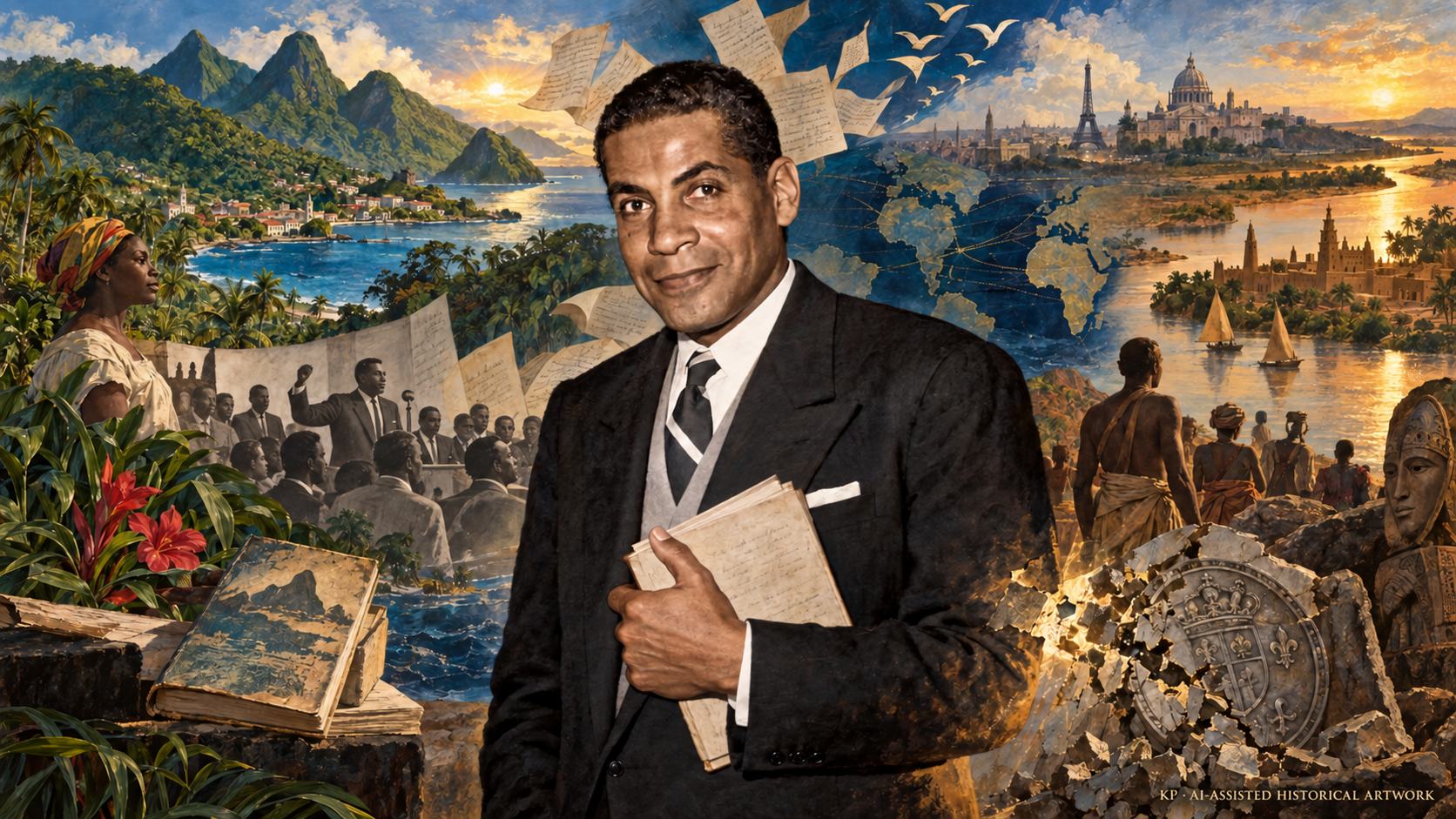
Paul Niger was a Guadeloupean poet, novelist, colonial administrator, and anticolonial organizer whose brief but impactful life bridged three significant geographies: Guadeloupe, France, and West Africa. A compelling figure in twentieth-century Caribbean intellectual and political history, Niger played a key role alongside Édouard Glissant, although he is less widely remembered today. Their close friendship and collaboration—most notably in resisting French assimilation and founding the Front des Antillais et Guyanais pour l’Autonomie—placed Niger at the heart of Glissant’s early political development. While Niger did not directly shape Glissant’s later philosophy, he fostered a climate of debate, activism, and historical urgency in which Glissant’s ideas about Caribbean history, colonial oppression, and relation were tested against lived political realities. Tragically, Niger’s life was cut short at age 46 in the crash of Air France Flight 117.
Niger was born Thomas Gaston Albert Béville in Basse-Terre, Guadeloupe, in December 1915, He was the son of Raoul Béville, among the early Black lawyers of Guadeloupe, and Edmée Michel, a European Creole woman. His early life was marked by education, ambition, and severe personal loss, including the deaths of close family members while he was still young. Those experiences of social ascent and grief later deepened his sense that history was not an abstraction but a lived wound shaping Black Caribbean consciousness.
He studied first in Guadeloupe and later in France, where he attended elite institutions and trained at the École nationale de la France d’Outre-mer, the school that prepared colonial administrators for service in French coloniality. He also studied law to an advanced level, gaining the formal education that let him enter the structures of the colonial state. Yet this path would become one of the central contradictions of his life: Béville entered the colonial administration even as his writing and politics moved steadily toward anti-colonial critique.
In 1939, Béville served during the Battle of France and encountered directly the racial inequities embedded in the French colonial order, including the treatment of Black troops asked to fight in the name of a republic that did not regard them as fully equal. Like other Black intellectuals of his generation, he came to understand that the language of universal citizenship often concealed structures of exclusion and contempt. War did not merely disillusion him; it forced him to rethink what it meant to be Black, Caribbean, and French all at once.
That rethinking took decisive form in Africa. In the 1940s and 1950s, Béville served in several parts of West Africa, including Dahomey, Sudan, Côte d’Ivoire, and Senegal. Africa became the place where Paul Niger, the writer, truly emerged. He adopted the name Paul Niger to protect the freedom of his anticolonial voice, writing his earliest poems under that name between 1944 and 1946, as his career in the colonial administration began. The name “Niger” was also a deliberate declaration of African and Black identification: it evokes the Niger River and signals his profound engagement with Africa, Black ancestry, and Négritude. The divide between Albert Béville, colonial administrator, and Paul Niger, poet and novelist, therefore marked a deeper intellectual struggle over loyalty, race, and responsibility. He saw in Africa an ancestral claim, yet he also recognized that, as an Antillean colonial administrator, he arrived carrying the tools, habits, and authority of French colonial oppression.
This tension gave his writing unusual force. His poetry does not treat Africa as a static source of racial purity or uncomplicated redemption. Instead, he wrote of African landscapes, labor, suffering, beauty, ceremony, and historical endurance while also confronting the poverty, oppression, and institutional violence produced by colonial predation. His first major book, Initiation, published in 1954, gathered poems largely written in the years immediately following his arrival in Africa. The collection is often placed within Négritude, and rightly so, but it is a Négritude tempered by scrutiny: one that moves from ancestral recognition to political lucidity.
In Initiation, Niger used poetry to explore what it meant for a Black Antillean to recover an African inheritance without denying the scars of displacement, mediation, and historical fracture. His poems joined the emotional charge of Black rediscovery to a relentless attention to material conditions—forced labor, administrative rule, compromised elites, and the burden of carrying Europe’s institutions into African life. That doubleness made his work particularly significant for later Caribbean thought. He showed that Black historical recovery could not rest on myth alone; it had to answer to economics, politics, and the contradictions of lived experience.
His literary and political life deepened through his association with Présence Africaine, the great postwar journal and publishing house founded by Alioune Diop. Niger belonged to the intellectual network around its founding and published work in its pages, placing him within the central currents of Black Francophone exchange in the years after the war. He also participated in the Congresses of Black Writers and Artists in Paris in 1956 and Rome in 1959, gatherings that brought together major figures of African and diasporic thought. In that world of pan-African debate, Niger consolidated his standing as both a poet of Négritude and an anti-colonial thinker attentive to the Caribbean’s specific political condition.
Although his reputation today rests chiefly on his poems and politics, Niger also wrote fiction. His first novel, Les Puissants, appeared in 1959, and his second, Les Grenouilles du Mont Kimbo, was published posthumously in 1964. Both novels are linked to his African experience, and both show him trying to transform administrative observation into literary form. Critics have generally regarded Les Grenouilles du Mont Kimbo as the stronger of the two, partly because it gives fuller room to the imaginative and rhythmic energies already present in his poetry.
By the late 1950s, Niger’s attention had turned more directly toward the Caribbean and the constitutional future of the French overseas departments. His experience in the Ministry of Overseas France and in Africa had convinced him that departmental assimilation, celebrated by many as the path to equality, was in practice a more refined continuation of colonial oppression. He saw clearly that legal inclusion in the French Republic had not ended economic dependency, political subordination, or cultural alienation in Guadeloupe, Martinique, and Guyane. Rather, assimilation taught people to read the values, institutions, and language of the oppressor as the only acceptable horizon of advancement.
This analysis placed him among the most penetrating anti-assimilation thinkers of the French Caribbean.
In 1959, he met Édouard Glissant at the Second Congress of Black Writers and Artists in Rome, and the two men quickly recognized a shared political urgency. With others, including Marcel Manville, they helped organize the Front des Antillais et Guyanais pour l’Autonomie, which called for immediate autonomy for Guadeloupe, Martinique, and Guyane, together with a new political and economic relationship among them. Niger became one of the organization’s principal strategists and most forceful minds. In this phase of his life, he was not simply a poet with political sympathies, but a major organizer trying to translate Caribbean historical consciousness into constitutional action.
His most important political text, “L’Assimilation, forme suprême du colonialisme,” appeared in Esprit in April 1962. It remains one of the clearest Caribbean critiques of assimilation as an ideology and structure of power. Niger argued that assimilation was not the opposite of colonialism but one of its highest and most effective forms, because it preserved domination while disguising it as equality, civilisation, and universalism. He traced its effects through education, administration, law, and the formation of local elites, showing how colonial subjects were trained to seek advancement through identification with the values of the metropole. In doing so, he anticipated later analyses of colonial mimicry, dependency, and internalised domination.
Here lies one of the most important ways in which Niger mattered to Glissant. Glissant’s later work would move beyond programmatic politics toward a poetics of relation, opacity, and historical depth, but Niger helped define the anti-assimilation horizon from which that work initially departed. He pressed the question of how Caribbean peoples might recover historical agency after displacement, captivity, colonialism, and administrative incorporation into France. He also insisted that identity could not be reduced to the categories supplied by the colonial state. If Glissant would later develop a more expansive and philosophically supple language for relation and creolization, Niger helped articulate the urgency of thinking history and identity outside the false closure of assimilation.
Niger’s life was cut tragically short at the very moment when his literary and political trajectories were converging most powerfully.
On 22 June 1962, while returning to Guadeloupe, he died in the crash of Air France Flight 117 near Deshaies. Also among the dead were Justin Catayée, the Guyanese deputy and autonomist leader, and Roger Tropos, a Martinican and an autonomist student organizer. The disaster killed all 113 people on board and quickly entered Caribbean political memory as a moment of profound collective loss.
Because several anti-colonial figures died together and the official investigation remained obscure for years, suspicions of sabotage persisted, though later historical inquiry found no proof of assassination and instead identified a chain of aviation and oversight failures.
His death at forty-six helps explain why he is not better known today.
Niger left behind a body of work substantial enough to reveal his importance, but too small and incomplete to secure the kind of lasting public presence achieved by figures such as Aimé Césaire or Glissant. His relative obscurity has been compounded by the scarcity of English translation. Only a small number of his poems have appeared in English; the most useful source is Norman R. Shapiro’s Négritude: Black Poetry from Africa and the Caribbean (1970), an anthology of French-language Black poetry in translation. His major books and political writings remain largely unavailable to English-language readers.
Niger also falls awkwardly between literary categories: too African for some Caribbean readers, too Caribbean for some African literary histories, too political for purely literary remembrance, and too literary for conventional political history. Yet this very in-betweenness is part of what makes him so important. Paul Niger was one of those rare Caribbean figures whose life traced, in concentrated form, the long movement from Black internationalism to anti-colonial autonomy, from Négritude to constitutional struggle, from poetic witness to political action.
He should therefore be remembered not simply as a forgotten contemporary of more famous men, but as a major thinker in his own right. He understood early that history had to be wrested from colonial narration, that identity could not be secured by assimilation, and that solidarity had to be political as well as emotional. He helped build the intellectual world in which Glissant’s later reflections on history and relation would take form, even if the two men finally traveled in different registers. To read Paul Niger now is to recover a Caribbean voice of unusual intensity: one grounded in Africa yet answerable to the Antilles, shaped by empire yet committed to its undoing, and alive to the difficult task of turning historical fracture into collective political consciousness.
Sources:
https://imec-archives.com/archives/fonds/451NGR
https://oxfordaasc.com/display/10.1093/acref/9780195301731.001.0001/acref-9780195301731-e-42715
https://ile-en-ile.org/niger
https://outremermemory.com/albert-beville-alias-paul-niger/
https://www.sudoc.fr/168407574
https://univ-senegal.scholarvox.com/catalog/book/88814616?locale=en
https://search.worldcat.org/title/Albert-Beville-alias-Paul-Niger-:-une-negritude-geometrique-Guadeloupe-France-Afrique/oclc/831
https://www.vie-publique.fr/files/rapport/pdf/164000717.pdf
https://www.assemblee-nationale.fr/sycomore/fiche.asp?num_dept=1518
https://www.guadeloupe.franceantilles.fr/regions/basse-terre-et-sa-region/paul-niger-au-parcours-dauteur-631105.php