
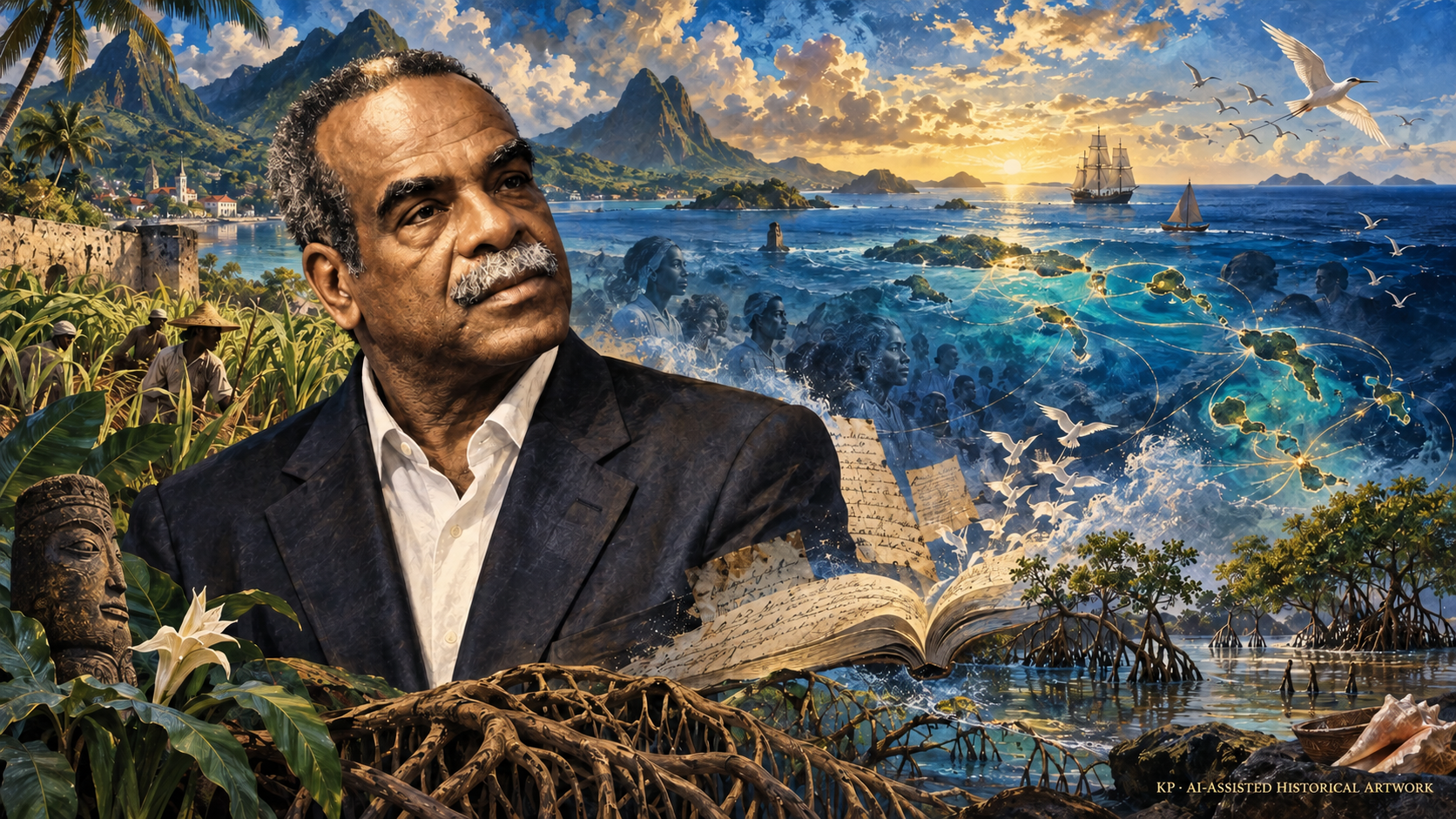
Édouard Glissant was one of the great Caribbean writers and thinkers of the twentieth century: a Martinican poet, novelist, playwright, essayist, philosopher, editor, teacher, and anti-colonial activist whose work altered how readers understand identity, history, cultural exchange, and the world. Born into a Caribbean society shaped by coloniality and the afterlife of the Maafa, plantation labor, linguistic hierarchy, and political dependency, he developed a language that addresses fracture without mistaking it for emptiness. His writing made room for the silenced, the displaced, the mixed, the partially knowable, and the untranslatable.
Across more than half a century, Glissant produced poetry, fiction, drama, criticism, and philosophical essays. Yet his thought extends beyond any one genre. He is particularly associated with concepts such as Relation, creolization, Antillanité, the right to opacity, the Tout-Monde (or All-World), and mondialité. These terms emerged from the material history of Martinique and the Caribbean: from oppression and captivity; from the Atlantic crossing and plantation system; from the suppression of Creole languages; and from the difficult creation of cultural life among peoples violently separated from ancestral lands, names, lineages, and archives.
For Glissant, the Caribbean was not marginal to world history. It was one of the places through which the modern world had been made—and through which it might be reimagined.
A Martinican Childhood
Édouard Glissant was born on 21 September 1928 in Sainte-Marie, on Martinique’s northern Atlantic coast. His early life unfolded in a landscape marked by sugar, the plantation, and the profound social divisions inherited from the Maafa. His father worked as a manager or overseer on a sugar-cane plantation, an occupation that brought the young Glissant close to workers laboring on land formerly organized through coerced African labor.
During school holidays, he accompanied his father to the cane fields and listened to stories told by laborers. These encounters with oral narration would remain important to him. They offered an education distinct from the official curriculum: one grounded in voice, performance, memory, local knowledge, and the lived experience of people whose histories had seldom been preserved on their own terms in formal archives.
Language was central to this early education. At school in Le Lamentin, Glissant and his fellow pupils were forbidden to speak Creole. French was the language of the classroom, state, and intellectual legitimacy; Creole was treated as inferior or improper. The prohibition revealed the cultural violence of colonial oppression, which did not simply govern territory but ordered speech itself, teaching children to experience their own vernacular inheritance as a deficiency.
Glissant never accepted that hierarchy. Although he wrote principally in French, his prose and poetry carried the rhythms, cadences, discontinuities, and imaginative landscapes of the Antilles. His work would later challenge the assumption that a language must be purified, standardized, or made transparent to possess intellectual or aesthetic value.
He won a scholarship to the Lycée Victor Schœlcher in Fort-de-France, one of Martinique’s leading schools. There he encountered two figures who would stand beside him in the history of Caribbean thought: Aimé Césaire, the poet and co-founder of the Négritude movement, was among his teachers; Frantz Fanon was a fellow student. Glissant admired Césaire deeply and, while still a teenager, helped campaign for Césaire’s 1945 election as mayor of Fort-de-France and deputy to the French National Assembly. His experiences in youth political organizing later helped to inform La Lézarde, his first novel.
The lycée’s intellectual atmosphere exposed him to surrealism, anti-colonial politics, literature, and new visions of Black liberation. He joined Franc Jeu, a youth literary and political group concerned with colonial emancipation. But even as Césaire’s influence remained decisive, Glissant would eventually develop a distinct intellectual path. Where Négritude asserted the historical and cultural value of Blackness against colonial racism, Glissant increasingly sought a language for Caribbean societies formed not by a single recoverable origin but by forced encounters, crossings, plural inheritances, and unfinished processes of becoming.
Paris, Literature, and Anti-Colonial Politics
In 1946, aged eighteen, Glissant left Martinique for Paris. He studied philosophy and history at the Sorbonne and ethnography at the Musée de l’Homme. Paris gave him access to avant-garde literary and intellectual circles, but it also sharpened his awareness of the distance between the metropolitan center and the Caribbean world he came from.
He began publishing during the 1950s, contributing to literary and intellectual journals including Présence Africaine, an influential forum for Black, African, Caribbean, and diasporic thought. His first collection of poetry, Un Champ d’îles (A Field of Islands), appeared in 1953. It was followed by the essay collection Soleil de la conscience in 1956 and the epic poem Les Indes in the same year.
These early works already showed the concerns that would animate his career: the sea and the island; colonial oppression and historical loss; exile and return; the tension between singular origins and multiple beginnings; and the possibility of poetry as a mode of knowledge. His writing refused the colonial assumption that Caribbean life could be understood only through French categories or from a metropolitan point of view.
In 1958, Glissant published La Lézarde, later translated into English as The Ripening. The novel won the Prix Renaudot, one of France’s major literary prizes, making him the first writer from the French Caribbean to receive the award. Set in a fictionalized Martinican landscape, it follows young people drawn into political action against colonial oppression. The book established Glissant as an important new voice in Francophone literature, but its achievement was not simply recognition by a French institution. It showed that the political and imaginative life of Martinique deserved to be at the center of a major novel.
Glissant’s literary life was inseparable from his political commitments. In 1959, he and the Guadeloupean writer Paul Niger co-founded the Front Antillo-Guyanais pour l’Autonomie, an organization calling for greater autonomy and decolonization for the French Caribbean and Guyane. In the politically charged years of the Algerian War, the French state dissolved the group. From 1961 to 1965, Glissant was barred from returning to Martinique and was restricted in his movement in France.
The punishment underscored the limits of French republican universalism when confronted by self-determination. For Glissant, political freedom could not mean merely being absorbed into an allegedly universal national culture. It required the capacity to name one’s own history, value one’s own languages and landscapes, and enter the world without surrendering difference.
Return, Institution Building, and Caribbean History
When the travel restrictions were lifted, Glissant returned to Martinique in 1965. His return marked the start of another important phase: creating institutions that would support Caribbean research, intellectual life, and cultural self-understanding.
In 1967, he founded the Institut Martiniquais d’Études, and in 1971 he launched Acoma, a social-sciences review. These projects reflected his belief that Martinique needed spaces to examine its history and present beyond the inherited assumptions of colonial scholarship. They were also acts of cultural infrastructure: attempts to cultivate an intellectual public rooted in the Caribbean while remaining in conversation with the wider world.
His fiction of this period deepened his engagement with Caribbean historical memory. Le Quatrième Siècle (1964), translated as The Fourth Century, traces the intertwined histories of Africans and their descendants in Martinique across generations. Malemort (1975) explores the psychic and social wounds of colonial society in a formally demanding prose. His play Monsieur Toussaint (1961) returned to the Haitian revolutionary Toussaint Louverture, not as a simplified monument of heroic nationalism, but as a figure through whom to consider revolution, imprisonment, colonial oppression, and the unfinished meanings of liberation.
Glissant did not treat history as a stable sequence of dates and official records. For the descendants of people who were captured, he argued, the past often survived in fragments: in oral memory, landscape, ritual, rhythm, family stories, bodily knowledge, and linguistic traces. The archive of the Maafa world had frequently recorded price, ownership, punishment, and shipment while refusing the interior life and social worlds of those it held captive. Caribbean culture therefore had to work with what Glissant called traces rather than with an unbroken, fully documented genealogy. In Glissant’s work, poetry, fiction, and critical thought became means of approaching what official history had obscured without falsely claiming to restore every lost voice in its entirety.
Relation, Opacity, and the All-World
Glissant’s most influential theoretical work emerged fully in Le Discours antillais (1981), translated as Caribbean Discourse, and Poétique de la Relation (1990), translated as Poetics of Relation. In these and later books, he developed an alternative to the fixed, hierarchical, and universalizing forms of thought that had accompanied colonialism.
At the heart of this alternative was Relation. Glissant opposed what he described as a “root identity”: an identity imagined as singular, pure, exclusive, and grounded in one authorized origin. Such an identity, he argued, could become destructive when it claimed the right to exclude, absorb, or dominate others. Instead, he proposed relation identity—an identity made through encounter, movement, exchange, conflict, memory, and contact with others.
This did not mean that people should abandon their histories or accept an empty cosmopolitanism. Glissant’s relation was not a harmonious melting pot. It acknowledged inequalities, historical violence, and the persistence of particular places and peoples. But it also refused the idea that relation must end in sameness. The Caribbean, shaped by Indigenous dispossession, African displacement, European colonialism, Asian indentureship, migration, and linguistic multiplicity, provided him with a powerful example of cultures made in and through contact.
He called this process creolization. Unlike a simple notion of mixture, creolization described an ongoing, unpredictable creation. When cultures meet under particular historical conditions, they do not merely combine into a known result; they generate something unforeseeable. Creolization was therefore a concept of transformation, not a decorative celebration of diversity.
Glissant’s defense of the “right to opacity” is among his most enduring contributions. Colonial oppression had long demanded that peoples make themselves intelligible to European systems of classification: racial, administrative, linguistic, anthropological, and economic. To comprehend another person often meant, in practice, grasping and containing them.
Against this, Glissant argued that people and cultures have the right to be different without first becoming fully transparent to dominant forms of understanding. Opacity did not mean isolation, secrecy, or refusal of communication. It meant relation without reduction: the possibility of living with, respecting, and defending difference without demanding that it be translated into one’s own terms.
This principle is particularly relevant to the study of colonial and displaced lives. It cautions against transforming people into objects of scholarly mastery or imagining that archival recovery can make every aspect of a life available for modern consumption. One may pursue historical truth rigorously while recognizing that another person’s full humanity will always exceed the documents through which they appear.
Glissant later expanded his thought through the concepts of the Tout-Monde—the All-World—and mondialité. The All-World was not a smooth, borderless global order. It was the vast, changing field of relation in which cultures, peoples, languages, histories, ecologies, and imaginations encounter one another. Mondialité, sometimes rendered as worldliness or worldmentality, was his answer to the homogenizing force of economic globalization. Where globalization often standardized culture and concentrated power, mondialité asked people to inhabit a world of interdependence without sacrificing irreducible difference.
A Worldly Caribbean Legacy
Glissant’s work eventually carried him far beyond Martinique. From 1980 to 1988, he served as editor-in-chief of The UNESCO Courier, overseeing a multilingual international publication. He later taught in the United States, including at Louisiana State University and, from 1995, as Distinguished Professor of French Literature at the Graduate Center of the City University of New York.
In 1993, he co-founded the International Parliament of Writers with the Nigerian writer Wole Soyinka, an organization committed to defending persecuted writers and intellectuals. In 2006, he established the Institut du Tout-Monde in Paris, furthering research and dialogue around creolization, Relation, and the cultural realities of the contemporary world.
His reputation continued to grow across disciplines. Scholars of literature, history, philosophy, geography, law, ecology, architecture, art, and film have found in his work a vocabulary for thinking beyond national enclosure and imperial universals. Artists and curators have drawn on his ideas of opacity, errantry, archipelagic connection, and what he termed pensée du tremblement—trembling thinking. This mode of thought resisted rigid systems and remained open to movement, uncertainty, intuition, and the complex reality of a changing world.
Édouard Glissant died in Paris on 3 February 2011, aged eighty-two.
Yet his work remains alive because it speaks to unfinished questions: how to honor particular histories without turning them into prisons; how to recognize connection without erasing unequal power; how to remember catastrophe without allowing catastrophe to define the totality of a people; and how to meet others without demanding their complete transparency.
His enduring achievement was to make the Caribbean archipelago a source of world thought. From Martinique’s cane fields, Creole speech, colonial schools, contested political life, and oceanic horizons, he fashioned a philosophy of relation that remains both demanding and generous. It asks for historical truth, but rejects possession; it values identity, but refuses purity; and it imagines a world in which difference may be encountered not as a problem to solve, but as a condition of shared life.
Sources:
https://en.wikipedia.org/wiki/%C3%89douard_Glissant
https://www.ebsco.com/research-starters/literature-and-writing/edouard-glissant/
https://www.documenta14.de/en/south/34_edouard_glissant_s_worldmentality_an_introduction_to_one_world_in_relation
https://writersmosaic.org.uk/close-up/edouard-glissants-poetics-of-relation/
https://criticallegalthinking.com/2023/11/21/edouard-glissant-the-right-to-opacity/
https://politicaltheology.com/the-sacred-in-edouard-glissant/
https://globalsocialtheory.org/thinkers/edouard-glissant-2/
https://www.moussemagazine.it/magazine/edouard-glissant-asad-raza-2025/