
“Let us all pass on the knowledge,
planting trees in the shade of which
we ourselves may never sit”
Margaret Busby CBE, Hon. FRSL, also known as Nana Akua Ackon, is celebrated as Britain’s first Black female book publisher and its youngest publisher when she co-founded Allison & Busby in 1967. As a publisher, editor, writer, broadcaster, and cultural activist, she has transformed not only which books reach readers but also whose voices are recognized as literature. Her pioneering achievements, impressive as they are, capture only part of her legacy. Over six decades, she has championed overlooked writers, revived essential works, challenged publishing industry norms, and brought generations of women of African descent into a wide-ranging literary conversation.
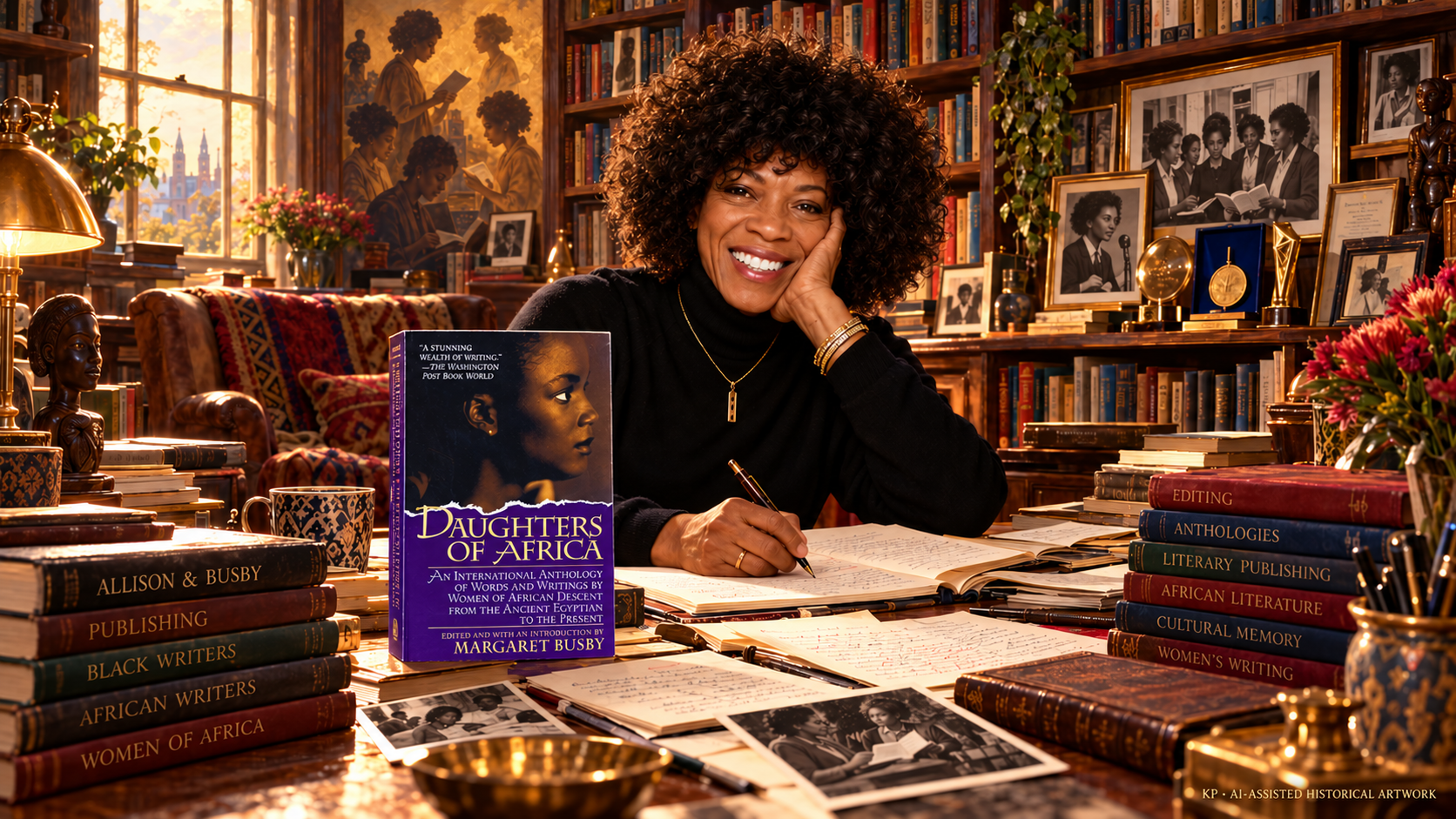
Her landmark anthologies, Daughters of Africa and New Daughters of Africa, illuminated a tradition literary institutions too often overlooked or fragmented. These works revealed that Black women’s writing is not a recent development or limited to a few celebrated authors; rather, it is international, historically rich, and abundant.
Busby’s achievements are rooted in a broad sense of cultural responsibility. For her, publishing means recognizing excellence, preserving memory, and creating opportunities for others. Her impact extends beyond the printed page into education, theatre, broadcasting, mentorship, and the defense of freedom of expression. Her career stands as a lasting example of what is possible when literary conviction meets practical courage.
A Family Across the Atlantic
Margaret Yvonne Busby was born in Accra on 11 October 1944, when Ghana was known as the Gold Coast. She was the youngest of three children. Her family’s legacy connected West Africa, the Caribbean, and Britain through medicine, education, law, and Pan-African thought.
Her father, Dr. George Alfred Busby, was born in Barbados and raised in Trinidad. At Queen’s Royal College, he studied alongside C. L. R. James, forging a friendship that would later influence Margaret’s publishing career. An Island Scholarship enabled him to study medicine in Edinburgh and Dublin. After practicing as a doctor in Walthamstow, East London, he moved to the Gold Coast in 1929 and established a clinic in Suhum, where he served rural communities for decades.
Her mother, Sarah Helena Christian, was born in Sekondi and trained as a nurse in England during the 1920s. After returning to the Gold Coast, she became the nursing sister at Achimota School. Her income also supported the education of extended family members.
Busby’s maternal grandfather, George James Christian, added another dimension to this Atlantic heritage. Born in Dominica, he traveled to London to study law and attended the first Pan-African Conference in 1900. He settled in the Gold Coast in 1902, and his Sekondi home, Dominica House, became a gathering place for Caribbean people living in West Africa.
Thus, Busby inherited a family tradition where intellectual life and public service crossed national boundaries. In her upbringing, Africa and the Caribbean were interconnected, forming parts of a shared history.
In Suhum, she assisted in her father’s dispensary and explored his medical books. From an early age, words fascinated her. At four, she learned to spell “necessary,” “fascinating,” and “picturesque”—three words she would later describe as metaphors for living. Her childhood also unfolded amid the political gatherings and conversations that preceded Ghana’s independence.
Education, Separation and Literary Discovery
In 1950, at the age of five, Busby traveled to Britain with her older siblings, Eileen and George, to pursue their education. Their parents made significant sacrifices to support their schooling, while racial prejudice made it difficult to find a school willing to admit them.
After a brief period at a school in the Lake District, Margaret and her sister attended Charters Towers School in Bexhill-on-Sea, Sussex. The school’s international student body exposed her to a wide range of languages and cultures. She later joked that she could “count in Farsi, swear in Mandarin, and sing in Spanish.”
Being far from home deeply influenced her childhood. Because returning to Ghana for every school holiday was unaffordable, she spent breaks with relatives or in others’ homes. One especially meaningful connection was with writer Verily Anderson, who ran a holiday home in Sussex. Helping type Anderson’s manuscripts gave Busby an early insight into the practical labor of producing a finished book.
Exceptionally precocious, she sat her O-levels at fourteen and left school at fifteen. Back in Ghana, she completed two sets of A-levels by sixteen, then spent a year at Lady Margaret House in Cambridge before entering university. At seventeen, she began studying English at Bedford College, University of London, where she edited the literary magazine, published poetry, and contributed to The New African, graduating at twenty.
Despite her academic achievements, her formal education was marked by a notable absence: no Black writer was ever assigned to her, either at school or during her English degree. She sought out that missing literature on her own, searching second-hand bookshops on Charing Cross Road for imported volumes.
Against this backdrop, seeing South African writer and editor Noni Jabavu on the cover of a British literary magazine in 1961 had a profound impact. Here was an African woman in a position of literary authority—a powerful image of possibility that Busby’s curriculum had never offered.
Allison & Busby: Publishing Without Permission
The idea for Allison & Busby was born at a London party in May 1965. At the time, Busby was in her final year at university when she met Clive Allison, then an Oxford undergraduate and president of the Oxford University Poetry Society. Their shared passion for poetry and books soon turned into a plan to start their own publishing company.
Neither had substantial capital or business experience, but both had a vision for what publishing could become. At a time when poetry was often published in expensive hardbacks, they aimed to produce affordable paperbacks for young readers. More importantly, they wanted to champion books they believed in—especially those other publishers ignored.
Busby gained brief experience at Cresset Press, while she and Allison developed their venture around day jobs, working evenings and weekends from a friend’s Soho flat. When Allison & Busby launched in 1967, its first publications were three paperback poetry collections. Lacking an established distribution network, they sold books directly from the back of a van.
“What we lacked in experience, we compensated for in ideals,” Busby later reflected. Those ideals became the foundation for an ambitious and international publishing list.
Busby’s role exposed her to persistent racism and sexism. While applying for a publishing job, she overheard a receptionist announce that a Black girl downstairs claimed to have an interview. Even after founding her own company, visitors often assumed she was there to make tea rather than editorial decisions.
She countered these assumptions through her work. As editorial director for two decades, Busby helped build a list of more than 300 authors, including Buchi Emecheta, Nuruddin Farah, Rosa Guy, C. L. R. James, Michael Moorcock, and Jill Murphy. The diversity of authors reflected Busby’s commitment to Black writers within a wide-ranging literary vision, rather than a narrowly defined category.
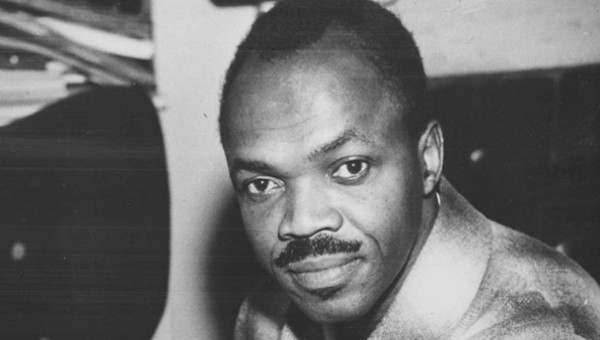
One of Allison & Busby’s early defining successes was Sam Greenlee’s The Spook Who Sat by the Door. Rejected by dozens of publishers, this politically provocative novel found a home at Allison & Busby and became an international bestseller. Busby recognized the book’s power where others saw only reasons to reject it.
The Editor as Midwife
Busby’s editorial practice paired meticulous attention to detail with the conviction that the author—not the editor—should remain at the heart of the book. She likened editing to midwifery: assisting something into existence without claiming ownership of its life.
Her relationship with Buchi Emecheta exemplified this philosophy. For nearly a decade, Busby worked closely with the Nigerian novelist, occasionally retyping entire manuscripts to include revisions. Both were young African women in London, navigating a literary landscape that offered little recognition of their experiences.
Allison & Busby published Emecheta’s Second Class Citizen in 1974. Through Busby’s dedication, stories of migration, motherhood, Nigerian society, and women’s struggles reached an international readership. Their relationship extended beyond editorial collaboration: Busby contributed an introduction to Emerging Perspectives on Buchi Emecheta and included Emecheta in Daughters of Africa.
Her partnership with C. L. R. James similarly blended editorial conviction with enduring personal commitment. Through her father, James was already woven into her family’s world. As a publisher, Busby helped restore access to his writings that had become scarce in Britain, publishing selected works and Nkrumah and the Ghana Revolution.
Busby’s engagement with James extended into other media. She co-edited C. L. R. James’s 80th Birthday Lectures with Darcus Howe and co-founded Penumbra Productions, which produced a series of films based on James’s lectures for Channel 4. Later, she adapted his writings for radio. This relationship highlights a recurring theme in her career: preserving a writer’s legacy means continually finding new ways for their work to reach an audience.
Daughters of Africa: Revealing a Literary Inheritance
Published in 1992, Daughters of Africa was a monumental achievement: over a thousand pages uniting the work of more than 200 women of African descent.
The anthology arose partly from Busby’s frustration with the widespread assumption that only a handful of significant Black women writers existed—often identified solely by prominent African American names. Collections claiming to represent African or Caribbean literature often reinforced this distortion by including few, if any, women.
In December 1975, she wrote to Wole Soyinka about the limited representation of women in his anthology Poems of Black Africa. His response promised improvement. Busby’s intervention reflected a conviction that would guide her own anthology: omissions were not evidence of women’s silence.
The project took formal shape at Pandora Press with editor Candida Lacey. An anthology of British women’s writing inspired the idea of a collection dedicated to women of African descent. Busby embraced the global challenge, drawing extensively from her own library.
The resulting volume spanned centuries, continents, and literary forms. It brought together poetry, fiction, autobiography, and other expressions within a sweeping historical frame, reaching from ancient Egypt to the contemporary world. Its scope challenged expectations, including women linked to countries as diverse as Russia, Turkey, and Germany.
The anthology’s significance was more than numerical. By gathering these voices, Busby made visible the connections between generations, between Africa and its diasporas, and among traditions too often seen in isolation. Readers could appreciate individual brilliance while also experiencing a sense of collective inheritance.
Daughters of Africa challenged the criteria by which literary importance had been assigned. It revealed that limitations arose not from Black women’s creative output, but from the institutions and critical habits that had judged it.
New Daughters, New Possibilities
Twenty-seven years later, Busby revisited the project with New Daughters of Africa, published in 2019. Featuring more than 200 contributors—including Chimamanda Ngozi Adichie and Zadie Smith—the companion volume extended the conversation to new generations and a continually evolving literary world.
Together, the two anthologies brought together the writing of over 400 women. The second collection affirmed that the tradition celebrated in the first was still growing, diversifying, and renewing itself.
The project also transformed literary solidarity into educational opportunity. Contributors waived their fees or royalties to support the Margaret Busby New Daughters of Africa Award, established with SOAS, University of London, to fund postgraduate study—including tuition and accommodation—for an African woman.
The inaugural recipient, Kenyan writer Idza Luhumyo, later won the 2022 Caine Prize for African Writing. The award gave practical expression to Busby’s vision of legacy: a book could honor past achievements while helping to create the conditions for future ones.
Writing, Performance and Cultural Memory
After leaving Allison & Busby in 1987, Busby served as editorial director at Earthscan Publications until 1990. The international roster featured influential writers such as Frantz Fanon, Han Suyin, Albert Memmi, and Carolina Maria de Jesus.
Busby’s subsequent freelance career encompassed editing, criticism, journalism, and broadcasting. Through reviews, essays, and obituaries for publications such as The Guardian, The Observer, and The Independent, she documented writers, artists, and activists whose lives illuminated broader cultural histories.
Radio offered another avenue for bringing literature to audiences. Busby abridged or dramatised works by authors such as Jean Rhys, Sam Selvon, Wole Soyinka, and Walter Mosley. Her BBC Radio adaptation of James’s Minty Alley earned a Race in the Media Award in 1999.
Her theatrical writing brought African and diasporic history to the stage. Notable works include Sankofa, Yaa Asantewaa – Warrior Queen, and An African Cargo, the latter dramatizing the Zong massacre. These projects reflect her enduring interest in who is remembered, how history is passed on, and whose perspective shapes its narrative.
Music, especially jazz, has also played a vital role in her life. Busby was married to musician and educator Lionel Grigson, with whom she co-wrote “Shadows and Echoes,” recorded by Norma Winstone. Friendships and encounters with artists such as Nina Simone, Stevie Wonder, Miriam Makeba, and Hugh Masekela contributed to a cultural life where literature and music were in constant dialogue.
Changing Institutions, Preserving Lives
Busby has long insisted that publishing cannot become truly representative through occasional gestures alone. In the 1980s, she co-founded Greater Access to Publishing, campaigning for increased Black participation across the industry. As patron of Independent Black Publishers, she supported presses forging their own paths to print.
Her focus has always been structural: who makes decisions, who is employed, who owns platforms, and who defines the terms of recognition. Busby rejects the notion that writers of color should conform to narrow expectations about race, trauma, or cultural difference. She insists their imaginative freedom must be as broad as anyone else’s.
“I am central to my own world—as you are to yours,” she has said, rejecting the idea that anyone naturally belongs at the margins.
In 2020, Busby chaired the Booker Prize judging panel. In April 2023, she became president of English PEN, succeeding Philippe Sands and bringing her lifelong advocacy for writers to an organization dedicated to defending literature and freedom of expression.
Her commitment to historical visibility also appears more quietly in her research and editing of Wikipedia biographies of overlooked women and Black cultural figures. The medium may differ from a publishing house or anthology, but her purpose remains clear: to prevent important lives from vanishing from the public record.
An Inheritance Carried Forward
Busby’s achievements have received widespread recognition. Her honors include an OBE in 2006, a CBE in 2021, the Royal Society of Literature’s Benson Medal, the inaugural Africa Writes Lifetime Achievement Award, and the London Book Fair Lifetime Achievement Award. She has also received honorary doctorates from universities in Britain and South Africa.
One honor connects her directly to her Ghanaian heritage. In 1999, she was enstooled in Cape Coast as Nana Akua Ackon, becoming a safohen, or captain, of the Bentsir No. 1 Asafo Company in the Fante tradition. This profound homecoming linked her maternal ancestry to the broader Atlantic history embodied by her family.
Her literary work has continued alongside these honors. She edited Firespitter: The Collected Poems of Jayne Cortez, published in 2025. In 2026, Part of the Story: Writings from Half a Century collected her own prose, bringing into focus the writer whose editorial labor has so often illuminated others.
A consistent principle runs through all her work: knowledge gains its greatest value when shared. Busby often invokes the image of planting trees under whose shade one may never sit.
Busby has embodied that principle through affordable poetry books, careful editorial partnerships, the recovery of overlooked texts, expansive anthologies, and opportunities created for younger writers. Her legacy lives on in the literature she helped bring into the world—and in the readers, editors, publishers, and authors who, inspired by her example, discovered that they, too, could help shape it.
Meserette’s note: I was fortunate to meet Margaret Busby, who generously gave me a hardback copy of Daughters of Africa and signed it for me. Her anthology later inspired one of the most-viewed posts on Kentake Page: Five Inspirational Poems for Black Women. This biography celebrates a woman whose work has been a profound source of inspiration to me—and introduces readers to a book I hope they will seek out for themselves.
Sources:
https://www.margaretbusby.com/about
https://en.wikipedia.org/wiki/Margaret_Busby
https://www.youtube.com/watch?v=17WhngG6d3A
https://www.theguardian.com/society/2020/oct/22/margaret-busby-the-uks-first-black-female-publisher-everyone-assumed-i-was-there-to-make-the-tea
https://granta.com/on-meeting-margaret-busby/
https://theconversation.com/margaret-busby-how-a-pioneering-ghanaian-publisher-put-african-womens-writing-on-the-map-227000
https://www.englishpen.org/posts/news/margaret-busby-appointed-president-of-english-pen/
https://observer.co.uk/culture/books/article/making-books-with-margaret-busby
https://commonwealthfoundation.com/granddaughters-of-africa-margaret-busby-2/
https://africainwords.com/2019/06/29/qa-margaret-busby-on-new-daughters-of-africa/