
Henri Christophe (c. 1767–1820) was one of the commanding figures of the Haitian Revolution and the founder of the northern Kingdom of Haiti. Soldier, general, statesman, and monarch, he helped defeat the French colonial regime in Haiti and later ruled as King Henry I.
From Captivity to Revolution
Christophe’s precise origins remain uncertain—a reminder of the archival violence that surrounded captive people in the eighteenth-century Caribbean. He was probably born on 6 October 1767, most likely in Grenada, though Saint Kitts and Saint-Domingue have also been proposed. His mother was in bondage, while his father is generally described as a free Black man named Christophe. As a child, he was brought to Haiti (called Saint-Domingue by the French), the enormously profitable sugar and coffee colony that would become Haiti.
A persistent tradition places the young Christophe among the men and boys from Haiti who joined the Franco-American attempt to retake Savannah, Georgia, from British forces in 1779. He is said to have served as a drummer, orderly or auxiliary with the Chasseurs-Volontaires de Saint-Domingue, a regiment of free Black soldiers. Whether every detail of this episode can be firmly established, it became central to the story later told of him: a Black Caribbean child encountering warfare decades before he would become a principal architect of an anti-colonial revolution.
By the eve of the 1791 uprising, Christophe had his freedom and lived in Cap-Français, now Cap-Haïtien. He worked in several trades—reported variously as a mason, sailor and hotel worker—and spent time at La Couronne, a prominent inn and restaurant in the colonial city. This experience brought him close to Haiti’s commercial and political life. It also placed him in a society structured by racial hierarchy and the vast wealth extracted from African-descended labor.
When the Ayitian people rose in the northern plain in August 1791, Christophe joined the revolutionary struggle. He aligned himself with Toussaint Louverture in 1793 and rose rapidly through the army. By the end of the decade he was an important commander in the north; by 1801 he had become a brigadier general. His advancement reflected military ability, discipline and an aptitude for administration as much as courage in battle.
Defending Saint-Domingue
Christophe’s reputation was decisively forged during Napoleon Bonaparte’s expedition to Saint-Domingue in 1802. The French government sent a large army under General Charles Leclerc, ostensibly to restore French oppression but, as events soon made clear, with the wider restoration of captivity in view. France had already reimposed the Maafa in some of its Caribbean territories. For the formerly enslaved population of Saint-Domingue, the danger was immediate and unmistakable.
As commander at Cap-Français, Christophe led the resistance to the French landing in February 1802. When General Charles Leclerc’s forces approached the port, Leclerc sent him a written ultimatum, threatening to storm the town with fifteen thousand troops unless the Black defenders surrendered by daybreak. Christophe’s reply became legendary: “If you have the means with which you threaten me, I shall offer you all the resistance worthy of a general; and if fate favours your weapons, you will not enter the town of Cap until I reduce it to ashes; and then and there, I shall keep fighting you.” True to that declaration, Christophe ordered the destruction of strategic stores and set the town on fire before withdrawing his forces inland. The French thus entered a devastated Cap rather than receiving the swift victory Leclerc had demanded, while Christophe’s army continued the struggle from the interior.
Like other revolutionary leaders, Christophe briefly surrendered and joined the French forces in April 1802 after assurances that captivity would not be restored. But the arrest and deportation of Toussaint Louverture, followed by mounting evidence of French intentions, exposed the fragility of those assurances. Christophe returned to the war of independence and joined Jean-Jacques Dessalines in the final struggle against the French. Haiti declared its independence on 1 January 1804, becoming the first independent Black republic and the first state born from a successful revolution led by people who had been held in captivity.
Christophe emerged from the revolution as one of the new nation’s most powerful military leaders. Under Dessalines, he served as general-in-chief and exercised particular influence in the north. Independence, however, did not bring peace. Haiti faced diplomatic isolation, the persistent threat of foreign invasion, economic devastation after years of war, and deep disagreements over land, labor and political power.
A Northern State
After Dessalines was assassinated in October 1806, the struggle for power divided Haiti. Christophe initially became provisional head of state, but he soon broke with Alexandre Pétion and his southern allies. In 1807, after military conflict and a constitutional dispute, the country effectively separated into two governments: Pétion’s republic in the south and west, and Christophe’s State of Haiti in the north. Christophe ruled the northern state as president and generalissimo.
The division was political, but it was also economic and social. Pétion’s government moved toward distributing land in smaller holdings, a course welcomed by many former soldiers and cultivators who wanted to escape plantation discipline. Christophe took the opposite direction. He preserved large estates, maintained export agriculture, and imposed a stringent labor regime often described as fermage or corvée. Workers received a share of production and certain provisions, but they were also compelled to remain attached to agricultural labor under military supervision.
This system generated revenue, helped finance the northern state and supported an ambitious program of construction, defense and education. Yet it also reproduced forms of coercion that people who had fought to end the Maafa bitterly resented. Christophe’s regime cannot be understood simply as a restoration of the colonial order: it was an effort to create a sovereign Black state capable of surviving in a hostile Atlantic world. But it relied on labor discipline that narrowed the freedom many Haitians expected independence to bring.
King Henry I
On 28 March 1811, Christophe transformed the northern state into the Kingdom of Haiti. He was crowned King Henry I on 2 June at Cap-Henry. The monarchy was deliberately theatrical and institutional: it asserted that Haiti was not a temporary insurgent polity but a durable, sovereign nation entitled to stand among the world’s powers.
Henry established a hereditary nobility of princes, dukes, counts, barons and knights. He created court offices, orders of chivalry, formal ceremonies and a royal household. European observers often treated these features as evidence of imitation or excess. Yet the royal court also carried a sharper political meaning. It was an assertion of Black dignity, authority and statecraft at a time when Europeans and Americans refused to recognize Haiti’s full equality.
His government sought to build the institutions of an independent state. Christophe promulgated the Code Henry, developed a currency system associated with the later Haitian gourde, encouraged technical and medical education, and supported a public-school system influenced by the Lancastrian model of peer instruction. Through correspondence with British abolitionists, including Thomas Clarkson and William Wilberforce, he pursued teachers, expertise, commercial connections, and international legitimacy.
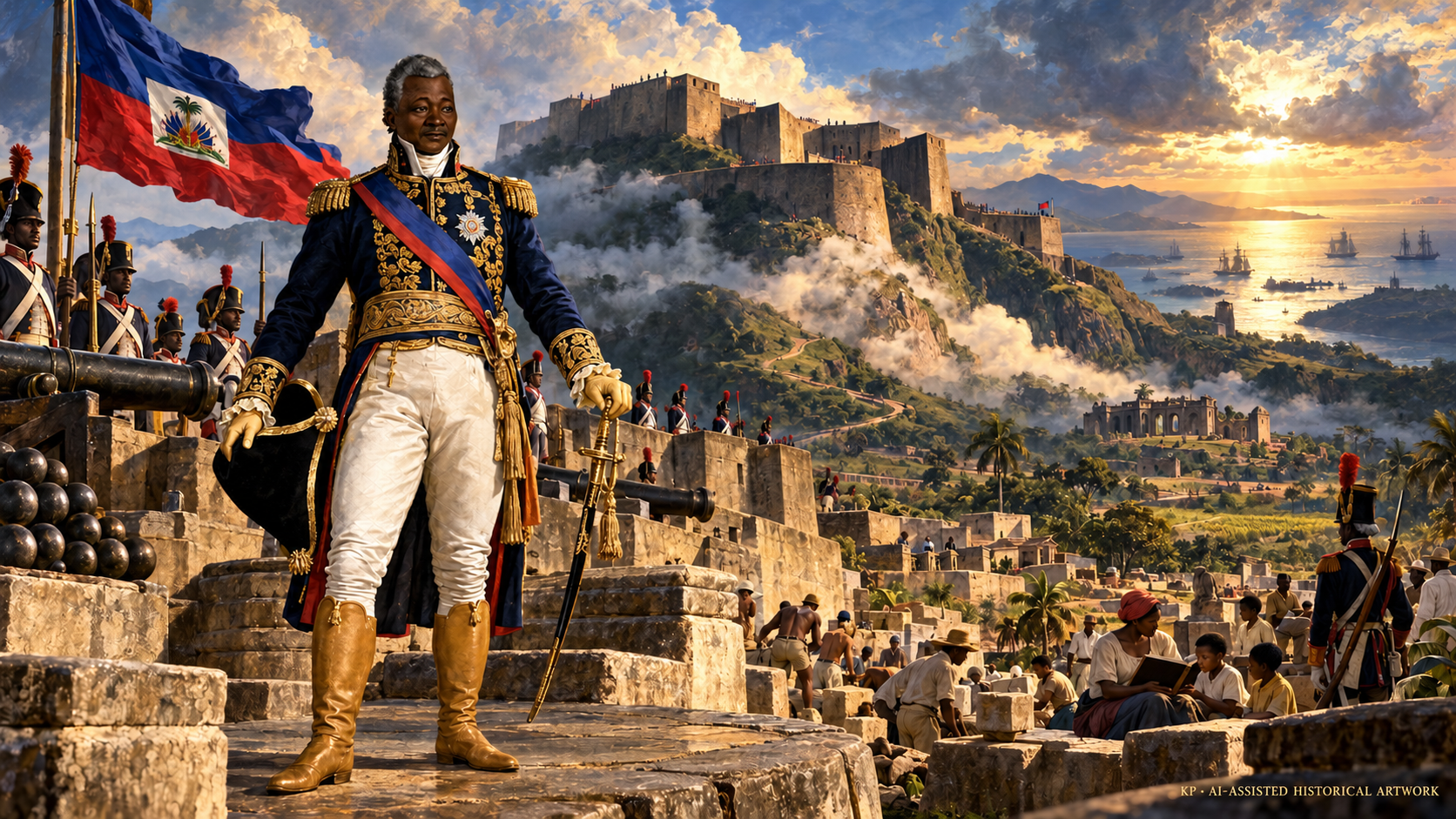
The most enduring monuments of his reign are architectural. At Milot, he built the Sans-Souci Palace, an elaborate royal residence whose name—French for “without care”—invoked both European royal grandeur and a distinctly Haitian political landscape. Above it rose the Citadelle Laferrière, one of the great fortresses of the Atlantic world. Positioned high in the mountains, supplied with artillery and designed to shelter soldiers, civilians and the royal household during an invasion, the Citadelle represented Haiti’s determination never to be oppress again.
The scale of these works was extraordinary. Thousands of laborers carried stone, supplies and cannon up steep mountain routes. The Citadelle contained barracks, storerooms, water systems, a hospital, a bakery and other facilities intended to sustain a long siege. It was not merely a palace-fortress or symbol of royal ambition; it was an answer to the still-plausible prospect of a French return.
Death and Historical Legacy
By 1820, the pressures within Christophe’s kingdom had become acute. His labor regime, strict military administration, and centralized authority had fostered growing resentment. In August he suffered a debilitating stroke, and revolts spread among troops and officials. On 8 October 1820, facing the collapse of his authority, Henry Christophe died by suicide at Sans-Souci Palace. His loyal followers carried his body to the Citadelle Laferrière, where they reportedly buried it in quicklime to prevent its desecration.
His death ended the northern kingdom. Within days, his son and heir, Jacques-Victor Henry, was killed by rebel forces. Jean-Pierre Boyer, Pétion’s successor in the south, moved north and reunited Haiti under a single republic.
Christophe remains one of the most debated figures in Haitian and Caribbean history. He was authoritarian, and the agricultural system he enforced subjected rural workers to coercive restrictions after a revolution fought against captivity. At the same time, he was a formidable revolutionary commander and an audacious builder of institutions, schools, fortifications, and monuments. His monarchy was not simply an imitation of Europe; it responded to an international order that treated Black sovereignty as intolerable. For Christophe, Haitian independence required more than a declaration: it required defenses, institutions, wealth, discipline, and an unyielding confidence that a Black nation could govern itself.
Sources:
https://scholarworks.uno.edu/cgi/viewcontent.cgi?article=2714&context=td
https://www.marxists.org/history/haiti/1811/king-henri.htm
https://en.wikipedia.org/wiki/Henri_Christophe
https://news.yale.edu/2025/04/07/recalling-life-henry-christophe-haitis-first-and-last-king
https://www.youtube.com/watch?v=p8G9_N00J9M
https://www.encyclopedia.com/humanities/encyclopedias-almanacs-transcripts-and-maps/christophe-henri-1767-1820