
On November 18, 1803, the revolutionary army of Saint-Domingue confronted French forces at Vertières, near the northern port of Cap-Français, now Cap-Haïtien. Led by Jean-Jacques Dessalines, the fighters of the Armée indigène attacked the fortified approaches to the city and broke the defensive position on which the French military presence in the north depended. This victory marked the pivotal moment of the Haitian Revolution, culminating in the assertion of Haitian sovereignty. Six weeks later, Haiti proclaimed its independence.
Vertières was more than the closing engagement of a campaign. It symbolized the collective determination of people who fought to liberate themselves from hereditary captivity, forced plantation labor, and a colonial regime built on racial violence. For the soldiers advancing toward the French guns, defeat meant the erasure of hard-won freedoms reclaimed through generations of resistance. Their objective was to ensure that French oppression could never be reimposed.
The battle’s most celebrated figure is François Capois, remembered as Capois-la-Mort, whose persistence under artillery fire became an enduring symbol of Haitian courage. Yet the victory was collective: it belonged to the commanders who coordinated the offensive, the artillery crews who transformed seized ground into positions of resistance, and the thousands of freedom fighters who continued advancing as their formations suffered devastating losses.
The Road to Vertières
By late 1803, the struggle in Saint-Domingue had entered its final campaign against the expedition sent by Napoleon Bonaparte. The French intervention had begun in 1802 under General Charles Leclerc, Napoleon’s brother-in-law. Its purpose was to dismantle the autonomous government associated with Toussaint Louverture and return the territory to direct French control.
French promises to respect freedom became increasingly inseparable from developments elsewhere in the Caribbean. The violent restoration of human bondage in Guadeloupe exposed the danger facing Saint-Domingue. Louverture’s arrest and deportation in 1802 further demonstrated the insecurity of any accommodation with the expedition. Revolutionary commanders renewed their resistance as the prospect of a return to plantation captivity became unmistakable.
After Leclerc died of yellow fever in November 1802, command passed to Donatien de Rochambeau. His campaign relied on extreme violence against Black soldiers and civilians, including mass drownings and the use of dogs brought from Cuba against the resistance. These practices made the French military presence a threat not only to political autonomy but also to the survival of entire communities.
The expedition nevertheless continued to weaken. Yellow fever devastated its ranks, while revolutionary forces contested roads, settlements, and access to provisions. When war between Britain and France resumed in May 1803, British warships added a maritime blockade to the pressure exerted on land. By the closing months of the year, Rochambeau’s remaining positions were increasingly isolated.
Dessalines brought the revolutionary campaign toward Cap-Français, the principal French stronghold in the north. The struggle had become a contest over whether the expedition could retain a defensible foothold or would have to leave.
An Army United by the Necessity of Freedom
The name Armée indigène expressed the revolutionary army’s identification with the land it was fighting to free from French possession. Its soldiers were not an outside force attempting to seize an unfamiliar territory. They were fighting for the country in which their futures, families, and hard-won freedoms were rooted.
Dessalines’s task was to turn that shared purpose into coordinated military action. The campaign required more than determination. It demanded concentrated troops, cooperation among experienced commanders, and attacks that prevented the French from shifting their strength freely between threatened positions.
At Vertières, several commanders carried essential responsibilities. Augustin Clervaux directed major elements of the assault. Capois led troops into some of the most exposed approaches. Louis Gabart and Jean-Philippe Daut helped carry the attack onto the strategically important Charrier heights. Henry Christophe and Romain operated on the surrounding high ground, increasing the pressure on Cap-Français and restricting French movement.
Their soldiers brought years of experience to the battlefield. The revolution had required them to adapt repeatedly to changing alliances, campaigns, and forms of warfare. At Vertières, that accumulated experience supported a common objective: the departure of the French expedition and the permanent protection of freedom.
The Fortified Approaches to Cap-Français
The French position depended on a network of strongpoints around the Haut-du-Cap plateau. Fortifications at Vertières, Bréda, Champin, and Pierre-Michel protected the approaches to Cap-Français. Their artillery covered routes along which an attacking army would have to advance.
The terrain intensified the danger. Narrow approaches and exposed slopes placed revolutionary formations within range of cannon and musket fire from elevated positions. A frontal advance could become costly before the attackers reached the defenses.
Dessalines identified the heights at the Charrier plantation as a crucial objective. Possession of that ground would allow his army to threaten the connections between French positions and bring artillery against Vertières from above. The engagement therefore depended on more than taking a single fort. It required breaking the relationship between several defensive positions.
Preparations continued through the night of November 17–18. Revolutionary artillerymen established a battery close to Fort Bréda, bringing their guns into position before the main engagement began. At dawn, the struggle for the approaches to the city opened.
Capois Beneath the Guns
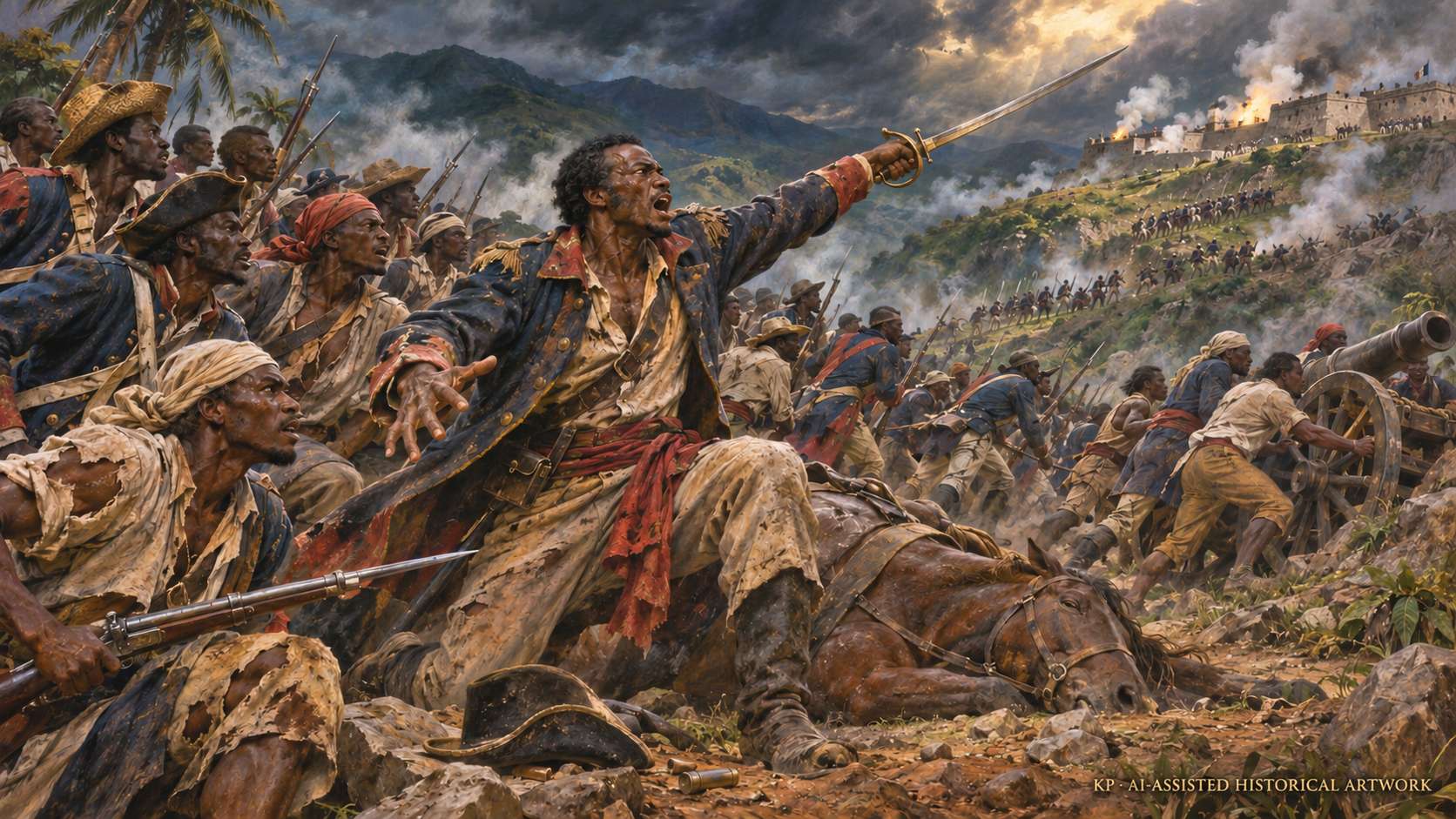
François Capois became the central figure in the battle’s most enduring narrative. Leading his soldiers toward the French positions, he advanced through concentrated cannon and musket fire. Each attempt exposed the revolutionary formations to devastating losses, yet Capois continued urging them forward.
According to the account preserved in the battle’s historical tradition, a cannonball killed his horse and threw him to the ground. Another shot carried away his plumed hat. Capois rose, drew his sword, and continued on foot, calling to his soldiers: “En avant! En avant!”—“Forward! Forward!”
Then the French guns fell silent.
Watching the advance, Rochambeau had called a temporary halt to the firing.
A French officer rode out toward the revolutionary lines to deliver a message honoring the commander whose courage had arrested the French’s attention. In the traditional account, the officer announced: “The Captain-General sends compliments to the general who has just covered himself with such glory!”
The officer saluted Capois and returned to the French position. The extraordinary pause ended, and the fighting resumed.
The episode became inseparable from the memory of Capois-la-Mort: a commander who rose beneath the guns and continued advancing with such determination that the opposing force interrupted the battle to acknowledge him. Yet the meaning of Capois’s courage did not rest on Rochambeau’s recognition. It lay in what his soldiers witnessed. Their commander faced the same fire, fell before their eyes, and rose to lead them again. His persistence gave visible form to their willingness to die for freedom.
The Struggle for Charrier
While Capois’s advance drew intense French fire, Dessalines committed additional troops to the struggle for the heights. Gabart and Daut became central to this phase of the engagement, leading forces toward Charrier.
Clervaux also remained closely engaged. The account describes him fighting with a musket and continuing after grapeshot tore away an epaulette. Such details place the senior commanders within the same dangerous space as the troops whose movements they directed.
The capture of Charrier altered the battle’s tactical balance. Revolutionary soldiers brought cannon onto the heights and used the elevated position against the French defenses. Their fire threatened Vertières directly and challenged the artillery at Champin. Ground that had offered the possibility of French protection became a platform for the revolutionary attack.
This was the essential connection between the battle’s courage and its strategy. The exposed advances occupied the defenders and maintained pressure. The seizure of higher ground then made the French position increasingly difficult to sustain.
Dessalines’s achievement lay in coordinating these efforts. He had to judge where persistence remained necessary, when reserves should enter the struggle, and which captured position could turn costly fighting into a decisive advantage.
Vertières was therefore not simply a succession of heroic charges. It was a coordinated assault in which endurance created an opening and the capture of strategic terrain converted that opening into victory.
Rain, Withdrawal, and Capitulation
Late in the afternoon, heavy rain swept across the battlefield. The downpour disrupted firing and brought a pause to the engagement. It did not reverse the deterioration of the French position. During the night, French troops withdrew from exposed fortifications toward Cap-Français. Rochambeau now faced revolutionary forces pressing toward the city while British warships restricted escape by sea.
An approach for an armistice followed. Dessalines insisted that the outcome must be evacuation, not a temporary suspension that would leave the expedition in possession of its remaining stronghold. On November 19, an agreement granted the French ten days to leave Cap-Français.
The agreement marked the collapse of Rochambeau’s ability to continue the campaign from the city. Yet departure did not mean an unrestricted return to France. The British blockade remained in place, and the French ships and troops subsequently surrendered to British naval forces.
From Battlefield Victory to Independence
Vertières did not create freedom in a single day. Its fighters inherited and extended a struggle carried through years of resistance, organizing, military service, and political transformation. Their victory made it possible to defend that freedom through national independence rather than through promises issued from France.
On January 1, 1804, Dessalines proclaimed independence at Gonaïves.
The new country took the name Haiti, reclaiming an Indigenous name for the land and rejecting its French colonial designation.
The declaration gave political form to what the revolutionary army had secured militarily. An oppressed population defeated an expedition sent to reassert French oppression. Haiti emerged as an independent Black nation whose existence challenged the racial assumptions underpinning colonial societies across the Atlantic.
The military victory did not remove the difficulties of building a country after prolonged devastation. Nor did it guarantee acceptance from states whose prosperity remained bound to plantation exploitation. France withheld recognition until 1825, when it demanded a vast payment as compensation for former colonial proprietors. That demand imposed a new financial burden on the independence won through war.
These later pressures underscore the importance of Vertières without diminishing it. The battle secured the departure of a military expedition; it could not, by itself, end the external hostility that Haitian independence faced.
The People Within the Victory
National remembrance often gathers around a few recognizable figures. Dessalines supplied strategic direction. Capois embodied persistence under fire. Clervaux, Gabart, Daut, Christophe, Romain, and other commanders helped turn a shared objective into coordinated action.
Yet the battle cannot be understood through its generals alone. Artillerymen moved and served the guns. Infantry soldiers crossed exposed ground. Formations continued advancing after suffering devastating casualties. Men whose names seldom appear in surviving narratives performed the work on which every celebrated maneuver depended. Capois’s survival becomes a moment within collective endurance. The capture of Charrier becomes not simply a commander’s achievement but the result of soldiers climbing, fighting, and bringing artillery into position under dangerous conditions. The battlefield’s human cost was catastrophic. Victory required people to continue after seeing others fall beside them.
Meaning of Vertières
November 18 remains a day of national commemoration in Haiti.
Vertières endures as a place of military achievement and as a statement about who could claim freedom, defend a homeland, and establish an independent political future. Capois’s remembered cry—“Forward!”—has survived because it gives the struggle for freedom a human voice. But the battle’s deepest meaning lies in the collective movement behind it: an army advancing through fire, commanders coordinating their efforts, and a people making independence possible through their own action.
At Vertières, the French expedition lost the position from which it hoped to continue its campaign. The revolutionary army secured the decisive military victory that took a nation across the threshold to freedom. Long live Ayiti!
Sources:
https://en.wikipedia.org/wiki/Battle_of_Verti%C3%A8res
https://ijnh.seahistory.org/wp-content/uploads/sites/2/2012/01/Giraud.pdf
https://www.univ-paris8.fr/IMG/pdf/programme-detaille3.pdf
https://www.youtube.com/watch?v=kaht9JMZbKw
https://echoesofbattle.com/blog/battle-of-vertieres
https://marlenedaut.com/blog/this-week-in-haitian-history-november-18-1803-haiti-s-historic-victory
https://tile.loc.gov/storage-services/master/gdc/gdcebookspublic/20/19/66/80/42/2019668042/2019668042.pdf