
“Study History, Erase The Mystery.”
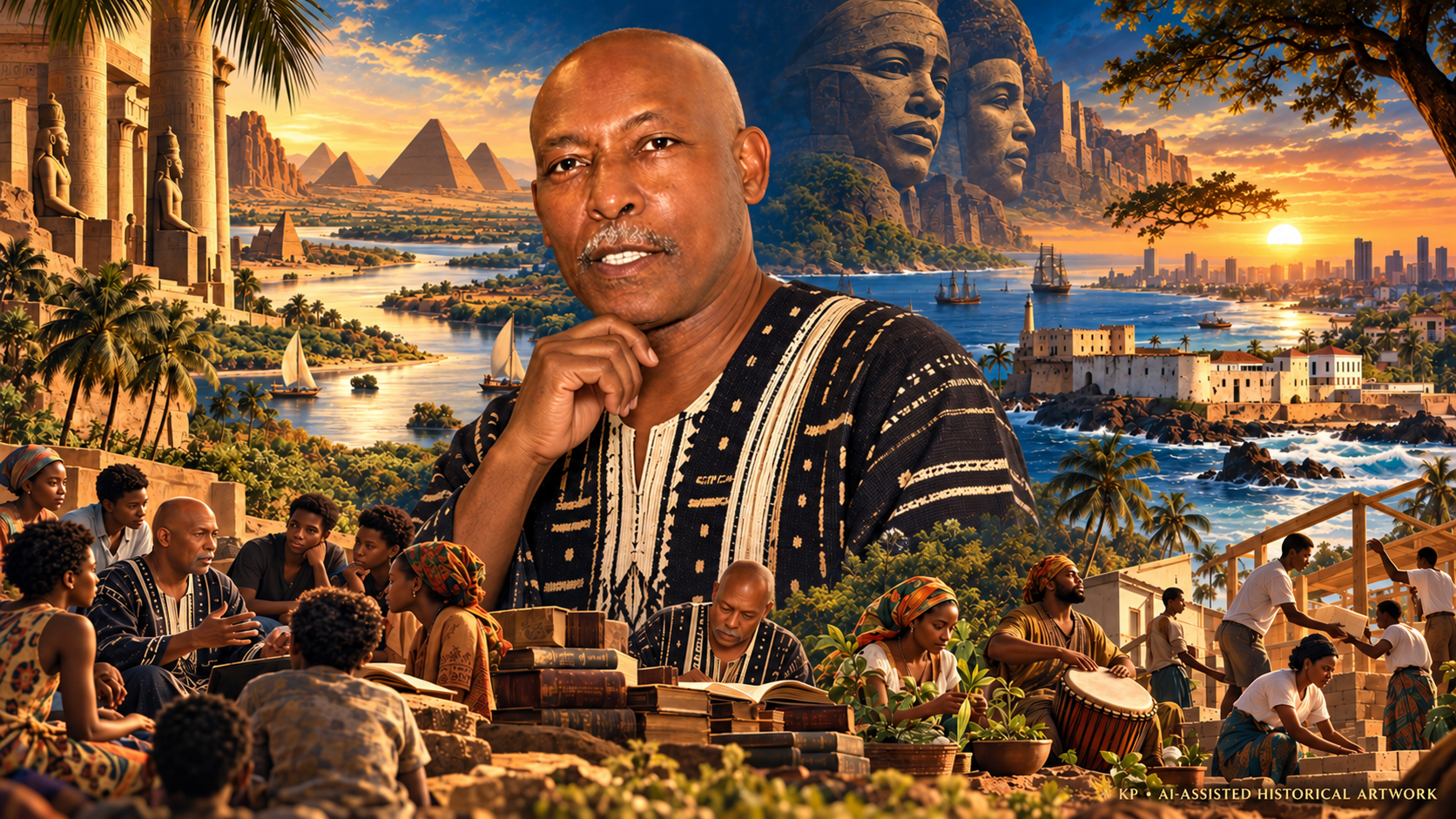
Professor James Small has devoted his life to Pan-Africanism, bringing together historical scholarship, political activism and spiritual teaching. Across classrooms, community organizations and international lecture platforms, he has encouraged African-descended people to understand their histories, recover their cultural inheritance and strengthen their capacity for self-determination.
Small was born on 22 October 1945 and raised on Arcadia Plantation in Georgetown County, South Carolina. He grew up in a rural community shaped by Christianity and African American cultural traditions. He later served in the United States Navy and moved to New York in 1966, where he entered the city’s political and intellectual networks. From his teenage years, Small participated in the civil rights and Black liberation movements through the Student Nonviolent Coordinating Committee, the NAACP, and the Organization of Afro-American Unity, founded by Malcolm X. He also served as a liaison between the OAAU and the Black Panther Party. His connection to Malcolm’s legacy became both organizational and personal: he served as principal bodyguard to Malcolm’s sister, Ella Little-Collins, and as imam of Muslim Mosque Inc., the religious organization Malcolm established after leaving the Nation of Islam.
A graduate of the City College of New York, Small went on to teach in its Africana Studies department and at New York City Technical College. His courses explored Pan-Africanism, Malcolm X, comparative African religions, folklore, and African spiritual traditions across the diaspora. His intellectual development included study and exchange with John Henrik Clarke, Yosef A. A. ben-Jochannan, Leonard Jeffries, Ivan Van Sertima, Asa Hilliard, Wade Nobles, Amos Wilson and Frances Cress Welsing.
Spiritual inquiry is central to his work. A Babalorisha and priest of Oya in the Yoruba/Ifa tradition, Small lectures on African religious systems, including Ifa, Akan spirituality and Vodou/Vodun. His teaching situates these traditions within a wider conversation about African knowledge, cultural continuity and the relationship between spiritual practice and everyday life.
His organizational leadership includes service as president of the Eastern Region of the Association for the Study of Classical African Civilizations and international vice-president of both the OAAU and the World African Diaspora Union. His work also extends to Ghana-based enterprises and educational journeys through Africa, Haiti, and the United States.
Film and television have brought his historical perspective to a wider audience. His work includes historical consulting on Godfather of Harlem, consulting and narration for Cassius X: Becoming Ali, and appearances in documentaries including 1804, HAPI and Out of Darkness. Across these settings, he has pursued a consistent purpose: making African history and cultural knowledge resources for collective understanding and practical action.
Understanding His Ideas
Small’s ideas connect subjects that are often discussed separately. History provides orientation; education shapes identity and judgment; spiritual traditions establish relationships between human life, nature, and communal responsibility. Economics and institution-building determine whether these understandings can sustain people in their daily lives.
A central concern runs through his work: how African people can draw upon their own historical experience and sacred systems while responding to our present conditions. He asks not only what has been lost or misrepresented, but what can be recovered, reinterpreted, and put to use. His discussions of Christianity, the Maafa and the Haitian Revolution examine cultural survival and collective struggle. His reflections on Malcolm X, music and cinema consider how ideas circulate, whose perspectives receive attention and how communities can participate in telling their own stories.
These subjects form an interconnected philosophy rather than a series of unrelated interests. Its practical destination is a community capable of educating its children, supporting its creative life, meeting material needs and preparing future generations to act with knowledge and purpose.
On African History
For Small, African history is a living inheritance. It offers a foundation for self-knowledge and a means of understanding African life beyond narratives that begin with captivity, dispossession or European arrival.
His account begins with Africa’s place in human origins. Drawing on fossil evidence, he presents the continent as humanity’s ancestral homeland, from which populations dispersed across the world. This perspective places Africa at the beginning of the human story rather than at its margins.
He extends this understanding to the intellectual achievements of ancient African societies, particularly those of the Nile Valley. Small situates Kemet, or ancient Egypt, within a wider African world that includes Nubia and the territories of present-day Sudan. In his interpretation, knowledge and culture traveled northward along the Nile, making Egypt an expression of older African developments rather than an isolated civilization.
He emphasizes African contributions to mathematics, writing, architecture, and medicine. Imhotep occupies an important place in his teaching as a figure through whom he challenges accounts that locate the beginnings of medical knowledge in ancient Greece. His larger concern is separating African achievements from the people and societies that produced them.
Small regards that separation as consequential. When African people encounter their ancestors chiefly as victims or as peoples without substantial intellectual traditions, their understanding of their own possibilities narrows. Recovering history therefore involves more than adding overlooked names to an existing narrative. It means reconsidering the framework through which we understand African experience.
In his account, this recovery is not an invitation to reproduce every inherited practice. Historical experience must be examined for its achievements, limitations and continuing relevance. The purpose is to acquire the grounding needed to make independent choices: to know that African people have created institutions, developed knowledge and responded imaginatively to changing circumstances before, and can do so again.
On Miseducation
In Small’s view, education must do more than prepare a person for employment. It should help people understand identity, responsibility, and the relationship between individual achievement and collective life. He uses “miseducation” to describe a process that works against those purposes. It disconnects people from their cultural inheritance, restricts their opportunities, and encourages them to measure themselves through values that may not serve their communities. His phrase “psycho-spiritual terrorism” conveys the depth of the injury he believes this can inflict on self-understanding.
Small examines schooling as a site of cultural estrangement. He contrasts African educational traditions, which he describes as integrating practical skills, communal responsibilities, and cosmological understanding, with European-designed systems that encouraged children to reject their inheritance. The replacement of African names and the punishment of children for speaking their mother tongues exemplify this process. He argues that teaching children to feel ashamed of their language also weakens their connection with the parents and elders who carry its knowledge.
His sparrow-and-robin metaphor illustrates the resulting disorientation. A sparrow cannot learn to live fully as a sparrow by relying exclusively on a robin’s ancestral instruction. Similarly, an education centered entirely on another people’s historical experience can leave African students unfamiliar with their own community’s needs and possibilities. His objection is not to learning about other societies, but to allowing that learning to displace knowledge of oneself.
Small also connects restricted literacy and inadequate technical preparation to economic exclusion. When children are denied sound teaching, their opportunities to enter medicine, science, technology, and public life diminish. He interprets the relationship between educational exclusion, poverty and incarceration as evidence that unequal schooling has consequences far beyond the classroom.
To illustrate the deliberate shaping of educational limits, he cites the late nineteenth-century Lake Mohonk conferences associated with former United States president Rutherford B. Hayes. He presents these gatherings as examples of influential Anglo-Americans determining the scope of Black education rather than allowing Black communities to define their aspirations.
His response begins with families and community institutions. Saturday schools and after-school programs can provide historical grounding and ethical instruction alongside academic preparation. He distinguishes training from education: training supplies a tool; education develops the judgment needed to decide how that tool should be used.
He extends this invitation to adults denied literacy earlier in life. Learning to read carries no shame. His injunction to “study history, erase the mystery” makes education a continuing practice through which people gain orientation, encounter other minds and prepare to shape their circumstances.
On African Sacred Science and Spiritual Traditions
Small uses “African sacred science” to describe an understanding of existence in which human life, the natural environment and the cosmos belong to an interconnected whole. He prefers this term to classifications that reduce African traditions to abstract beliefs or portray them as superstition.
Within his framework, spiritual practice is inseparable from everyday life. Knowledge of plants, medicine, astronomy, philosophy, and human behavior contributes to a shared effort to understand the relationships that sustain existence. Observing celestial movements, identifying planting seasons and learning the therapeutic properties of local vegetation join practical necessity to cosmological understanding.
Small locates a common foundation in the conditions human communities share. People everywhere encounter birth, death, seasonal change, the sun and the moon. Their needs remain similar, but the environments in which they meet those needs differ. A rainforest community and a desert community therefore develop different rituals, languages and symbols. He interprets these differences as local expressions of related principles, rather than evidence that the traditions have nothing in common.
This emphasis on relationship also shapes his understanding of the Divine. Small describes a sacred source expressed throughout creation, placing ethical development within the relationship between knowledge, conduct, and the conditions that support life.
Vodun occupies an important place in this account. He associates it with Fon and Ewe traditions and interprets it as an expression of the Divine within the person and the surrounding world. Against sensationalized portrayals of sinister magic, he presents Vodun as a framework for healing, moral instruction and communal organization. He also identifies botanical and therapeutic continuities in North American practices known as hoodoo and rootwork.
Small gives particular attention to the teaching functions of metaphor, storytelling, music, dance and ritual. These forms communicate complex ideas through experiences communities can share and remember. He reads spiritual figures as expressions of relationships between natural processes and human capacities.
In his interpretation, Shango represents the courage required for spiritual development. Oya expresses change, clearing away stagnation and making room for renewal. Ogun embodies transformation, evoked through fire-shaped iron. These interpretations belong to his teaching framework rather than exhausting the meanings such figures hold for practitioners.
He likewise resists treating Orishas, Lwa, Akan spiritual beings and the Neteru of ancient Kemet as straightforward equivalents of a single Western category of gods. His approach asks what these figures communicate within their particular cultural settings and how they help people understand themselves.
The practical purpose remains central. For Small, sacred knowledge should support ethical growth, healing, and communal responsibility. Its value is not confined to preserving ceremonies or explaining the distant past. It lies also in helping people cultivate relationships that sustain life.
On Ancestral Consciousness
For Small, ancestral consciousness begins with recognizing that living people are continuations of those who came before them. Ancestry is not a distant realm disconnected from ordinary existence. It is a relationship expressed through the body, cultural memory and the responsibilities each generation inherits.
He describes this continuity through the language of DNA, biological memory, and spiritual energy. In his interpretation, children embody a lineage extending across countless generations. His references to inherited ancestral experience express his spiritual philosophy, rather than an established scientific explanation of how particular memories are transmitted.
This understanding shapes his view of time. The future contains hopes and possibilities, while the present remains unfinished. Only the past offers completed experiences whose consequences can be examined. Small therefore treats ancestral history as a source of instruction: a record of choices, achievements and failures through which communities can guide present decisions.
Full consciousness, in this account, means letting that inheritance shape ways of living that sustain people and their surroundings. Remembering ancestors is not simply an emotional attachment to earlier generations. It carries an obligation to learn from them and consider what to pass on.
Small encourages both reflective and communal practices of remembrance. Home altars or shrines, with family photographs, water, candles and incense, can provide a focus for meditation and attention. He understands these practices as opportunities to become receptive to ancestral guidance.
Reading history, listening to oral traditions, making music, drumming, dancing and offering libations also sustain relationships between generations. Ancestral remembrance therefore extends beyond ritual observance. It includes learning how earlier generations lived, what they endured, what they created, and how their decisions shaped the present.
His spiritual interpretation reaches back to the origins of existence. He describes the Divine as the first ancestor, placing human lineage within a sacred relationship with creation. He also presents reincarnation as a return within the family line through which character develops across generations. These teachings belong to his particular account of African spiritual traditions, rather than a doctrine shared identically by all African societies.
The ethical purpose is continuity with discernment: receiving an inheritance thoughtfully, sustaining what nourishes life and leaving future generations a firmer foundation.
On Christianity
Small examines Christianity through the histories of African knowledge, cultural disruption and spiritual survival. He distinguishes between the beliefs communities use to sustain themselves and the institutional uses of religion that encourage compliance with unequal social arrangements. He foregrounds the churches of Egypt, Ethiopia and ancient Sudan, alongside African contributions to early Christian theology. He challenges the presentation of Christianity as an exclusively European inheritance later delivered to African peoples. He argues that such accounts obscure Africa’s participation in the tradition’s development.
Small also distinguishes early Christian communities’ aspirations from Christianity’s later relationship with the Roman state. He interprets early movements as expressions of resistance to Greek and Roman occupation, and Constantine’s involvement in the Council of Nicaea as a decisive intervention in the organization of belief. In his reading, spiritual teachings were reshaped to serve government and social obedience. His wider critique concerns religious instruction that encourages people to distrust their own inherited knowledge. When African traditions are presented as shameful or spiritually deficient, adopting another framework can entail estrangement from family histories, languages and communal values.
Small describes Christianity, Judaism and Islam as “fragments from the periphery” of African sacred science. In his interpretation, they preserve elements of older African cosmologies and teachings that were later reorganized in other cultural settings. Recovering those connections forms part of his effort to restore recognition of African intellectual contributions. Yet he does not portray African-descended Christians as passive recipients of an imposed tradition. In the Americas, he argues, African people reworked Christianity through their own spiritual understandings. The church could become a refuge and a space where ancestral practices endured beneath Christian language.
He interprets rhythm, dance, communal participation, and experiences described as receiving the Holy Ghost as spaces of African spiritual continuity. In this reading, religious adaptation did not necessarily require complete cultural surrender. This tension is central to his account. A tradition used to discipline communities could also become a resource for solidarity and resistance. Small asks not only what Christianity did within African life, but how African people reshaped it to meet their needs.
On the Maafa
Small understands the Maafa as an African catastrophe whose consequences extend beyond the historical trafficking and forced labor of African people. His concern encompasses the disruption of families, the assault on cultural memory and the institutions through which racial exploitation continues. He argues that the arrangements established to extract African labor were reorganized rather than wholly dismantled. In the United States, he points to the Thirteenth Amendment’s punishment exception as a link between earlier forms of bondage and compulsory prison labor. He interprets mass incarceration as part of this continuity, connecting the confinement of Black communities to economic interests that benefit from their restricted freedom.
The psychological dimensions are equally important to his analysis. Renaming people, suppressing languages, and discouraging ancestral practices attacked the foundations of collective identity. Small argues that recovery must therefore involve more than legal recognition or improvements in material circumstances. It requires rebuilding relationships with histories and traditions that people were taught to reject. At the same time, his account foregrounds African ingenuity. People brought together through forced displacement formed relationships across distinct cultural backgrounds, developing shared identities while preserving elements of their particular inheritances. What survived did not always remain unchanged; adaptation itself could sustain continuity.
His criticism of “Amazing Grace” follows from his concern with whose experiences receive remembrance. He questions its prominence in Black worship because its author, John Newton, had participated in the trafficking of African people. Small asks why Newton’s story of redemption should occupy the emotional center of remembrance rather than the lives of African ancestors.
For him, studying the Maafa requires attention to both injury and agency. African people experienced devastating losses, but they also preserved knowledge, created communities and organized for freedom. An account confined to suffering would fail to recognize the capacities through which life continued.
On the Haitian Revolution
The Haitian Revolution occupies a distinctive place in Small’s understanding of African liberation. He regards it as a demonstration of what becomes possible when a people join collective organization to ancestral knowledge and spiritual resolve.
Vodun stands at the center of his interpretation. Rather than treating it as incidental to military and political events, he presents it as a foundation for solidarity, psychological preparation and coordinated action. His reading challenges accounts that privilege European political ideas while giving little attention to the African traditions of the participants. He gives particular importance to Bwa Kayiman, remembered as a formative gathering in the revolutionary struggle. In his account, Dutty Boukman and women spiritual leaders helped articulate a shared commitment to freedom. He interprets the ceremony as a declaration that African people could turn towards their own sources of meaning and resolve.
Women occupy a central place in this reading. Small challenges histories organized almost entirely around male generals, foregrounding Cécile Fatiman and Sanité Bélair, alongside traditions concerning Toya and her relationship with Jean-Jacques Dessalines. He also emphasizes Ezili Dantor, connecting this female Lwa’s associations with protection and motherhood to the revolution’s spiritual foundations.
His discussion of leadership distinguishes Toussaint Louverture’s pursuit of a relationship with France from Dessalines’s commitment to complete separation. Small reads Louverture’s capture and imprisonment as evidence of the dangers of relying on French assurances. Dessalines, alongside leaders such as Henri Christophe, represents the determination to secure a freedom France could no longer revoke.
Small stresses the scale of the struggle against French, British, and Spanish forces. In his interpretation, military skill and ancestral grounding mutually sustained each other, rather than competing explanations for achievement. The difficulties following independence give his account a cautionary dimension. He treats Dessalines’s assassination and subsequent internal divisions as warnings about estrangement from the foundations of collective struggle. He interprets Haiti’s later difficulties partly through the displacement of ancestral principles by European-oriented institutions and values.
His enduring lesson is that independence requires more than a change of government. It also depends on sustaining the relationships, shared commitments and cultural resources through which freedom becomes a collective way of life.
On Malcolm X
Small’s relationship with Malcolm X combines personal inspiration, organizational service and sustained intellectual study. He recalls meeting Malcolm in Harlem while still a teenager and considering leaving school to join the movement. Malcolm urged him to finish school and attend college, presenting learning as essential to Black freedom.
Small credits that encounter with strengthening a connection between scholarship and service that would remain central to his life.
After Malcolm’s assassination, he helped sustain the institutions through which Malcolm’s ideas continued to circulate. He served for eleven years as imam of Muslim Mosque Inc. and spent eleven years as principal bodyguard to Ella Little-Collins, who continued the work of the Organization of Afro-American Unity. He also rebuilt networks and maintained links with the Black Panther Party. These experiences inform his rejection of Malcolm’s portrayal as an “angry Black man”. Small regards that image as a substitution of temperament for thought. In his interpretation, Malcolm exemplifies the transformation made possible through disciplined self-education, historical study, and self-knowledge. He presents Malcolm’s Black nationalism and Pan-Africanism as complementary.
At the community level, nationalism meant taking responsibility for economic resources, political participation, and cultural development. Pan-Africanism connected those responsibilities to the concerns of African-descended people across borders. Small particularly emphasizes the OAAU’s hemispheric outlook, extending beyond the United States to the Caribbean, Central America and South America. He also stresses Malcolm’s commitment to cooperation across religious differences. Unity did not require identical beliefs; it required recognizing shared needs and responsibilities.
Through teaching and public lectures, Small has carried these ideas into new settings. His recollection of Malcolm’s teaching that “the secret to life is to have no fear” captures the example he seeks to preserve: intellectual independence joined to courage and practical commitment.
On the Music Industry
Ownership of a recording does not, in Small’s analysis, guarantee artistic independence. A musician may own master recordings yet remain dependent on another company’s decisions about promotion, circulation, and audience access. Distribution therefore stands at the center of his critique. He cites a study he describes as commissioned by Columbia Records and conducted at Harvard, interpreting its central lesson as the importance of retaining control over how music reaches listeners. He illustrates the issue through an account involving Teddy Riley and Blackstreet. Small describes the group as facing pressure from Interscope Records to move toward rap, or risk having their album remain unreleased. He presents this as an example of commercial gatekeeping shaping creative decisions.
His economic concern is the gap between the wealth Black music generates and the share its creators retain. He invokes Ruth Brown, Sam Cooke, Nat King Cole, and James Brown when discussing struggles over royalties, independent enterprise, and the obstacles artists face in seeking greater control over their careers. The cultural consequences also matter. Music carries stories and communicates ideas about relationships, identity and aspiration. Decisions about which recordings receive investment consequently affect which values circulate most widely. Small contrasts music that nurtures communal belonging with commercial priorities that reward degrading or destructive messages.
He places considerable importance on Black-owned enterprises that can retain income, develop artists, and reach audiences. He sees Jay-Z as an example of pursuing greater commercial independence. For Small, artistic freedom requires more than individual success. It requires the means to finance, distribute, and sustain creative work while allowing its makers to share fairly in the value they generate. Music can then remain a way for communities to tell their stories and imagine their futures, rather than serving chiefly as a source of revenue for others.
On Hollywood and Media
Small approaches cinema and television as informal educators. They build emotional associations, make certain viewpoints seem natural, and shape which experiences audiences recognize as worthy of care. He pays particular attention to portrayals of ancient Kemet in films such as The Mummy and Stargate. He identifies a recurring association between African sacred imagery and danger or destructive supernatural forces. In his view, these portrayals encourage fear of ancestral traditions before viewers can encounter them as sources of knowledge and cultural achievement.
His criticism of Black Hawk Down concerns the unequal treatment of human life and the narrowing of historical context. He objects to a narrative centered on American military experience in which Somali perspectives receive comparatively little attention. He also argues that the film excludes economic interests and broader political circumstances.
For Small, omissions can be as consequential as explicit messages. A story need not directly instruct viewers what to believe if its selection of heroes, threats and background figures has already established the boundaries of sympathy. Repeated across different programs and films, partial accounts can begin to feel complete. He describes this process as psycho-spiritual socialization. Spectacle, drama and music engage audiences emotionally, sometimes leaving little room to examine the assumptions beneath the story. His concern is not pleasure itself, but entertainment that substitutes familiar stereotypes for historical understanding.
His participation in historical consulting and documentary production offers a practical response. Such work provides opportunities to widen the stories available to audiences and bring African-centered perspectives into public discussion. The question is not simply whether African people appear on screen. It is whether they appear as fully realized participants in history, with intellectual traditions, motivations and experiences that receive serious attention.
On Economic Independence and Community Institutions
For Small, spiritual understanding must translate into the practical ability to sustain life. He cautions against pursuing abstract spiritual experiences while neglecting food, clothing, shelter, safety and security. Community institutions should be organized around securing these essentials. His framework joins economics, politics and culture. Economics concerns the organization of resources, the local environment, and collective wealth. Politics provides the systems that manage and distribute resources. Culture establishes the values that guide both, defining whose needs receive attention and what prosperity should mean.
Spiritual practice belongs within this relationship because it helps shape the responsibilities people recognize towards one another. Its everyday significance shows up in how communities educate children, care for neighbors, and provide for the future.
Drawing on Claude Anderson, Small argues that substantial collective income achieves too little when spent through disconnected individual transactions. His alternative is economic aggregation: bringing resources together through community-owned institutions so that money can support shared priorities. The distinction is between earning income individually and developing the capacity to meet needs collectively. Money that continually leaves a neighborhood may support consumption without establishing the financial foundations for local development. In his account, pooled resources can help finance homes, education, property, and businesses.
Credit unions occupy a practical place in this vision. He describes his involvement in initiatives in Harlem and Ghana as examples of people building financial institutions that fit their circumstances. He advocates small-scale lending that enables entrepreneurs to purchase equipment, acquire materials or begin trading. A carpenter who needs tools, a tradesperson seeking premises or a small business requiring modest start-up funds illustrates the relationship he wants to establish between savings and productive activity. The purpose is to connect available resources with needs that conventional lenders may overlook.
Institution-building extends beyond finance. Small encourages community members to participate in healthcare, teaching, emergency services and local administration. Protest can identify injustice and mobilize people, but it cannot replace the ongoing work that keeps a neighborhood functioning. Educational and cultural institutions belong within the same undertaking. Schools develop knowledge and judgment; media enterprises circulate stories and perspectives; financial organizations help sustain the material conditions in which both can flourish.
Individual achievement remains valuable, but Small asks what it leaves behind. Does it create opportunities for others? Does it strengthen the institutions families depend on? Does it help a community meet its needs with greater confidence and continuity? These questions bring his philosophy back to its practical center. Historical understanding and ancestral remembrance acquire their fullest meaning when they inform how people live together. The task is not only to recover knowledge of what African people have accomplished, but to use that knowledge to build conditions in which future generations can thrive.
Meserette’s note: I saw Professor James Small in Ghana in the summer of 2025 and hoped to arrange an interview with him for Kentake Page. It had been years since we last interviewed an African scholar, and I hoped to share his insights with our readers. Although I couldn’t arrange an interview, that intention became the starting point for this article.
Drawing on Professor Small’s lectures and YouTube interviews, I’ve gathered his reflections on a range of subjects. Two AI tools—Gemini Notebook and Perplexity—were invaluable in helping me organize the material thematically. This article synthesizes his recorded discussions. Sadly, it is not a direct interview.
Sources:
https://www.professorjamessmall.com/about
https://amandlanews.com/dont-abandon-your-culture-professor-james-small/
https://www.youtube.com/watch?v=a2YHzWi697c
https://www.youtube.com/watch?v=2JaywpehccE
https://www.youtube.com/watch?v=TEL2kYdFYhM
https://www.youtube.com/watch?v=llwFL-TNee4
https://www.youtube.com/watch?v=PVHUeikXDr4
https://www.youtube.com/watch?v=W6Lfv41TUWs
https://www.youtube.com/watch?v=6YkEPelFOKE