
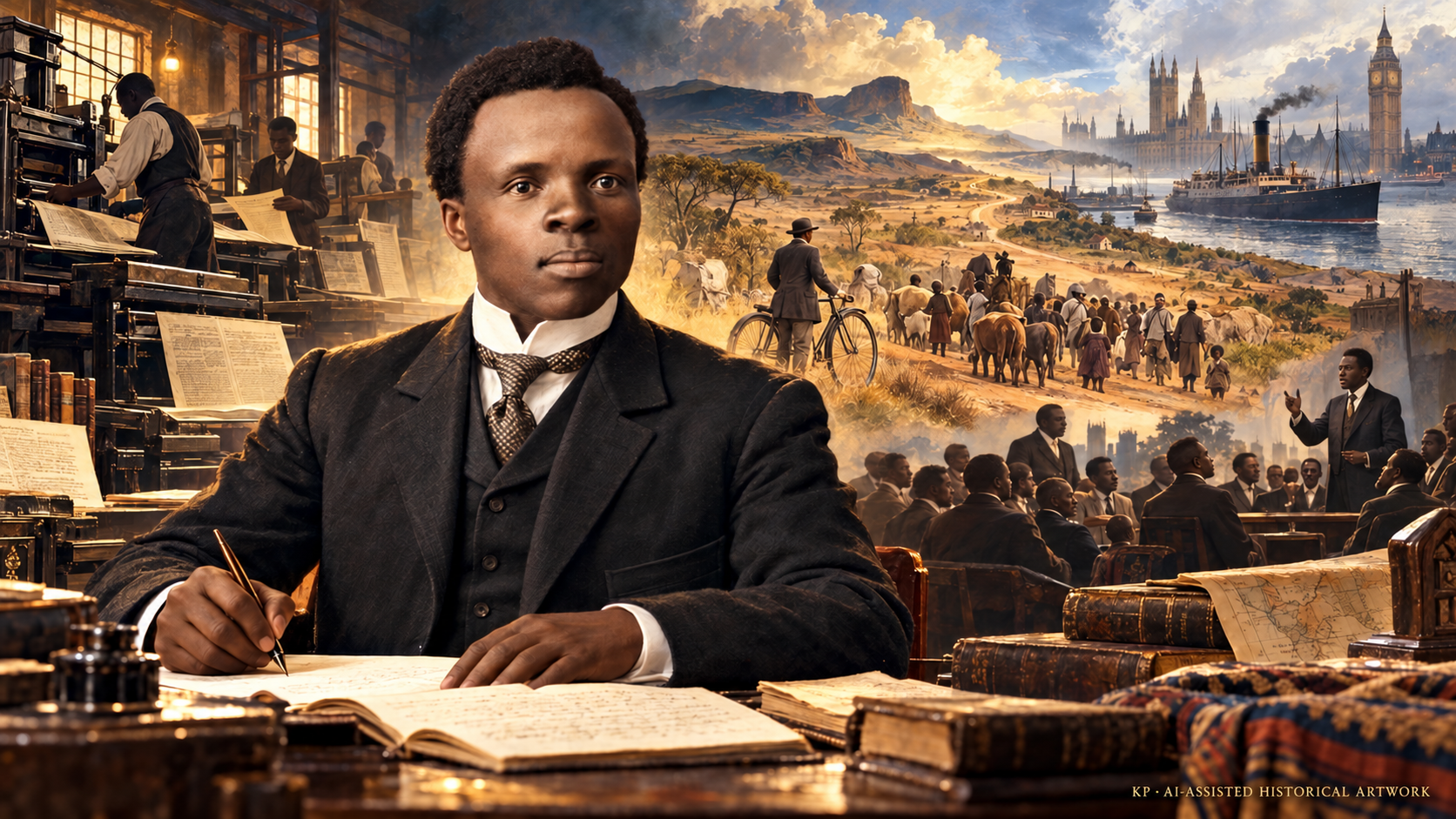
Solomon Tshekisho Plaatje was a South African writer, journalist, translator, and political organizer whose work joined the defense of African rights to the preservation of African language and historical memory. A founding member and first Secretary-General of the South African Native National Congress—later renamed the African National Congress—he helped establish a national platform to challenge racial exclusion. Through his newspapers, international campaigns and books, he documented the consequences of dispossession and insisted on the intellectual and political dignity of African people.
Plaatje’s achievements spanned fields often treated separately. He was a court interpreter who became a wartime diarist, an independent newspaper editor who became an international campaigner, and a Setswana scholar who translated Shakespeare and wrote a pioneering English-language novel. Across these activities ran a consistent purpose: to make African experiences heard, to challenge colonial accounts, and to sustain the languages and traditions through which communities understood their lives.
Childhood, Family and Education
Plaatje was born on 9 October 1876 on the farm Doornfontein, near Boshof in the Orange Free State, into a Barolong family belonging to the wider Tswana community. His parents, Kethanecwe Martha and Kushumane Johannes Plaatje Mogodi, were Christians whose lives were closely connected to mission work. Around 1880, the family moved to Pniel, a Berlin Mission Society station near Barkly West. There, Plaatje received his early education.
His childhood blended his family’s spoken traditions with the mission’s written culture. His grandmother, Ma Magriet, told Barolong legends and folktales, nurturing an interest in storytelling that would later inform his fiction. At Pniel, he developed his reading skills and read mission publications aloud to older community members. The relationship between oral narration and the printed word became a lasting feature of his intellectual life.
Plaatje’s abilities attracted the attention of Wilhelmine Westphal, the missionary’s wife, who provided additional tuition and taught him singing, piano, and violin. He subsequently worked as a pupil-teacher at Pniel between 1892 and 1894. Although his formal schooling was limited, he continued to educate himself through reading, language study and professional experience.
Kimberley, Marriage and the Civil Service
In 1894, Plaatje moved to Kimberley and found work as a postman and telegraph messenger. He studied independently for the Cape civil service examinations and distinguished himself in Dutch and typing. His command of languages became both a professional qualification and the foundation of his later work as a journalist, translator and author.
In 1898, he married Elizabeth Lilith M’belle, an Mfengu woman whose brother, Isaiah Bud M’Belle, was a prominent figure in Kimberley. Their marriage crossed social prejudices surrounding unions between Barolong and Mfengu families. They had six children. Elizabeth’s contribution to the household would become especially important during Plaatje’s prolonged campaigning abroad, when she managed family responsibilities amid recurring financial difficulties.
That same year, Plaatje moved to Mafeking, now Mahikeng, to work as a court interpreter and clerk under Civil Commissioner and Magistrate Charles Bell. His position required him to move between languages, communities and systems of authority. It also placed him at the centre of a town that would soon become internationally known through war.
An African Witness to the Siege of Mafeking
During the South African War of 1899–1902, Mafeking endured a 217-day Boer siege. Plaatje continued his interpreting and administrative work while keeping a diary of life in the besieged town. His duties included interviewing African messengers and gathering information from people who crossed the opposing lines.
His diary recorded the pressures of wartime life alongside court and administrative work. It preserved an African perspective on a conflict whose familiar narratives centered overwhelmingly on British and Boer participants. African people appeared not merely as background figures, but as members of the besieged population and active participants in the communications and labor on which the town depended.
The manuscript remained unpublished during Plaatje’s lifetime. Rediscovered in 1969, it was edited by John L. Comaroff and published in 1973 as The Boer War Diary of Sol T. Plaatje: An African at Mafeking. Later editions appeared under the title Mafeking Diary: A Black Man’s View of a White Man’s War. Its publication restored an important eyewitness account to the historical record and contributed to renewed interest in Plaatje’s life.
Building an Independent African Press
After the war, Plaatje left the civil service for journalism. With the support of Barolong leader Silas Molema, he helped establish Koranta ea Becoana, a Setswana-English newspaper in Mafeking, in the early 1900s. His responsibilities extended beyond writing and editing to the practical work of producing and distributing the paper.
The newspaper provided a platform to defend African interests, discuss public affairs, and develop Setswana as a language of print. Plaatje urged readers to speak, study, and sustain their mother tongue. For him, language preservation was inseparable from political life: a community’s ability to debate its circumstances and transmit its knowledge depended in part on its language’s vitality.
Independent publishing was financially precarious. After Koranta ea Becoana closed, Plaatje returned to Kimberley and established Tsala ea Becoana, later renamed Tsala ea Batho, or “Friend of the People”. Through these newspapers, he addressed land rights, racial discrimination and the political arrangements surrounding the creation of the Union of South Africa in 1910. His journalism challenged the consolidation of white political power and the exclusion of African people from meaningful national representation.
Founding the South African Native National Congress
In January 1912, Plaatje joined other African leaders in Bloemfontein to establish the South African Native National Congress, or SANNC. Leading figures in its formation included John Dube and Pixley ka Isaka Seme. Plaatje became its first Secretary-General. The organization adopted the name African National Congress in 1923.
The SANNC sought to create a common political voice across regional and community divisions. Plaatje brought to this task the experience of an editor, interpreter, and public advocate: he knew how to explain grievances, communicate across constituencies, and present African demands to audiences beyond South Africa.
His political approach emphasized constitutional rights, public argument, petitions and organized representation. Yet the campaign that soon dominated his work exposed the limits of appealing for justice within a political order built around African exclusion.
The Land Act and the Journey to Native Life in South Africa
The Natives Land Act of 1913 became the defining cause of Plaatje’s political life. The legislation imposed racial restrictions on landholding and threatened the livelihoods of African tenants and farmers. Plaatje traveled through rural districts, including parts of the Orange Free State and Transvaal, often by bicycle, to investigate its consequences.
He gathered accounts of evictions, lost livelihoods, and families forced to travel with their possessions and livestock to find somewhere to live. His reporting connected legislative language to its effects on households. Land dispossession emerged not simply as an administrative policy, but as an assault on economic independence, security and belonging.
These investigations formed the basis of Native Life in South Africa, published in London in 1916. Its opening sentence expressed the rupture with characteristic force:
“Awaking on Friday morning, June 20, 1913, the South African Native found himself, not actually a slave, but a pariah in the land of his birth.”
The book combined eyewitness testimony, political analysis, and an appeal to readers’ consciences. Plaatje described how land restrictions undermined African farming and increased dependence on labor for European employers. He made displaced families’ experiences central to his argument, refusing to let official explanations obscure the law’s human consequences.
Taking the Campaign Abroad
In 1914, Plaatje traveled to Britain as part of a SANNC deputation seeking intervention against the Land Act. The British government declined to overturn the legislation. When the outbreak of the First World War disrupted the delegation’s work, Plaatje remained in Britain and continued to write and speak publicly about conditions in South Africa.
He addressed numerous meetings, cultivated support among sympathetic organizations and worked to bring Native Life in South Africa into print. The campaign required persistence under difficult circumstances. Political backing and financial support were unreliable, and he relied on supporters’ assistance while trying to sustain his public work.
Plaatje returned to Britain with another deputation in 1919 and later traveled to Canada and the United States. In North America, he encountered influential African American political and intellectual networks, including those associated with W. E. B. Du Bois and Marcus Garvey. These contacts helped carry South African grievances into a wider international discussion of racial inequality.
His campaigning also produced The Mote and the Beam, a pamphlet published in 1921 that challenged racial double standards in sexual relationships. Selling his publications and delivering lectures helped finance his travels. Although the overseas campaigns did not secure the repeal of the Land Act, they widened the audience for African testimony about South Africa’s racial order.
Setswana, Translation and Cultural Preservation
Plaatje’s linguistic work was central to his understanding of public service. His multilingual abilities supported his employment as an interpreter, but he also used them to develop written resources for Setswana and to bring its expressive qualities to new audiences.
In 1916, he published Sechuana Proverbs, a collection of 732 proverbs accompanied by translations and European equivalents. That year, he also co-authored A Sechuana Reader with the phonetician Daniel Jones. These works brought oral knowledge, language study and print culture into a shared project of documentation and education.
His Shakespeare translations pursued a related ambition. He translated plays including Julius Caesar and The Comedy of Errors into Setswana, drawing on idiom, proverbial expression and the resources of formal speech. Rather than treating Setswana as inadequate to complex literature, he demonstrated its capacity to convey dramatic argument, humor and emotional depth.
The translations also challenged a colonial hierarchy that assumed European languages held greater literary authority. Plaatje’s work placed Setswana in an active relationship with internationally recognized literature while preserving its distinctive expressive resources. His advocacy of mother-tongue education followed the same principle: African languages were instruments of thought and learning, not obstacles to them.
Mhudi: History Through an African Heroine
Plaatje’s historical novel Mhudi: An Epic of South African Native Life a Hundred Years Ago was completed around 1920 but did not appear until 1930, after prolonged publishing difficulties. It became the first full-length novel in English published by a Black South African.
Set amid the conflicts and migrations of the 1830s, Mhudi brought African historical experience into a literary field heavily shaped by colonial narratives. Plaatje drew on oral traditions and historical memory to portray communities living through violence, displacement and changing political relationships.
The novel’s heroine occupies the center of its moral and historical vision. Mhudi is not a passive witness to events determined by men: her courage, judgment and capacity for action shape the narrative. Through her, Plaatje made an African woman a principal agent in the telling of southern African history.
The book extended his journalism and political writing into a different form. Where Native Life in South Africa documented the immediate consequences of dispossession, Mhudi explored an earlier historical world through character, memory and imagination. Both works resisted accounts that marginalized African lives.
Women’s Rights, Music and Community Life
Plaatje’s concern with women’s agency was not confined to fiction. He challenged the exclusion of Charlotte Maxeke from voting at Congress meetings and opposed proposed inheritance arrangements that privileged male heirs. His political commitments therefore included criticism of restrictions within African institutions as well as those imposed by the state.
Music and performance remained part of his life. In London in 1923, he recorded “Nkosi Sikelel’ iAfrika” with Sylvia Colenso accompanying him on piano. The recording is recognized as the earliest known surviving recording of the hymn, which later became part of South Africa’s national anthem.
He also performed in Britain and, after returning to South Africa, traveled as a mobile film exhibitor. Such activities reflected both his cultural interests and the practical need to earn a living. His involvement in fellowship and temperance organizations also linked public advocacy to community education and social welfare.
The Personal Cost of Public Service
Plaatje achieved these things under persistent financial strain. Newspaper publishing left him with accumulated debts, campaigning took him away from paid employment, and overseas journeys separated him from his family for extended periods. Elizabeth carried much of the burden of maintaining the household during these absences.
His career also involved repeated disappointments. Appeals to British authorities failed to overturn the Land Act, and the publication of Mhudi was delayed for roughly a decade. These difficulties make any account of his life as an uninterrupted series of triumphs misleading. His work depended on sustained effort without dependable financial security or immediate political success.
Plaatje died of pneumonia in Johannesburg on 19 June 1932, aged fifty-five. Kimberley’s West End Cemetery buried him. A memorial inscription identified him as a Morolong and a servant of Africa, linking his community identity to the broader public commitments that shaped his life.
Rediscovery and an Enduring Legacy
In the decades after his death, much of Plaatje’s work became difficult to obtain or received limited public attention. From the late 1960s and 1970s, renewed scholarship and republication brought his contributions into clearer view. John Comaroff’s edition of the wartime diary, Tim Couzens and Stephen Gray’s literary work, and Brian Willan’s archival research and biography helped establish the breadth of his achievement.
His former home in Kimberley became the Sol Plaatje Museum and Library. The municipality that encompasses Kimberley and Sol Plaatje University is named after him. In 2004, the Order of Luthuli in Gold was awarded posthumously for his contributions to civil rights and journalism. Literary prizes and other commemorations also recognize his work in language and culture.
Plaatje’s enduring importance lies in how these achievements relate. He treated political rights, access to land, historical representation and the vitality of African languages as connected questions. His writing preserved testimony that exclusionary institutions sought to marginalize, while his translations and fiction expanded the forms through which African experience could be expressed. His life left a record not only of resistance to injustice, but of the intellectual and creative labor required to build a more inclusive public world.
Sources:
https://en.wikipedia.org/wiki/Sol_Plaatje
https://sahistory.org.za/people/solomon-tshekisho-plaatje
https://hipsa.org.za/publication/sol-t-plaatje-a-life-in-letters/
https://www.spu.ac.za/index.php/sol-plaatje/
https://blogs.soas.ac.uk/archives/2014/10/21/black-history-month-2014-papers-of-sol-plaatje/
https://www.anfasa.org.za/sol-plaatje-a-life-of-solomon-tshekisho-plaatje-1876-1932/
https://artubuntu.org/wp-content/uploads/SAAPP-SOL-PLAATJE.pdf
https://www.youtube.com/watch?v=TuLtjW29hFQ
https://www.thejournalist.org.za/pioneers/sol-plaatje-1876-to-1932/
https://sahistory.org.za/sites/default/files/Native%20Life%20in%20South%20Africa_0.pdf
https://thehub-beta.walthamforest.gov.uk/sites/default/files/2024-05/Solomon_Plaatje_Updated_Learning_Resource_2-compressed.pdf